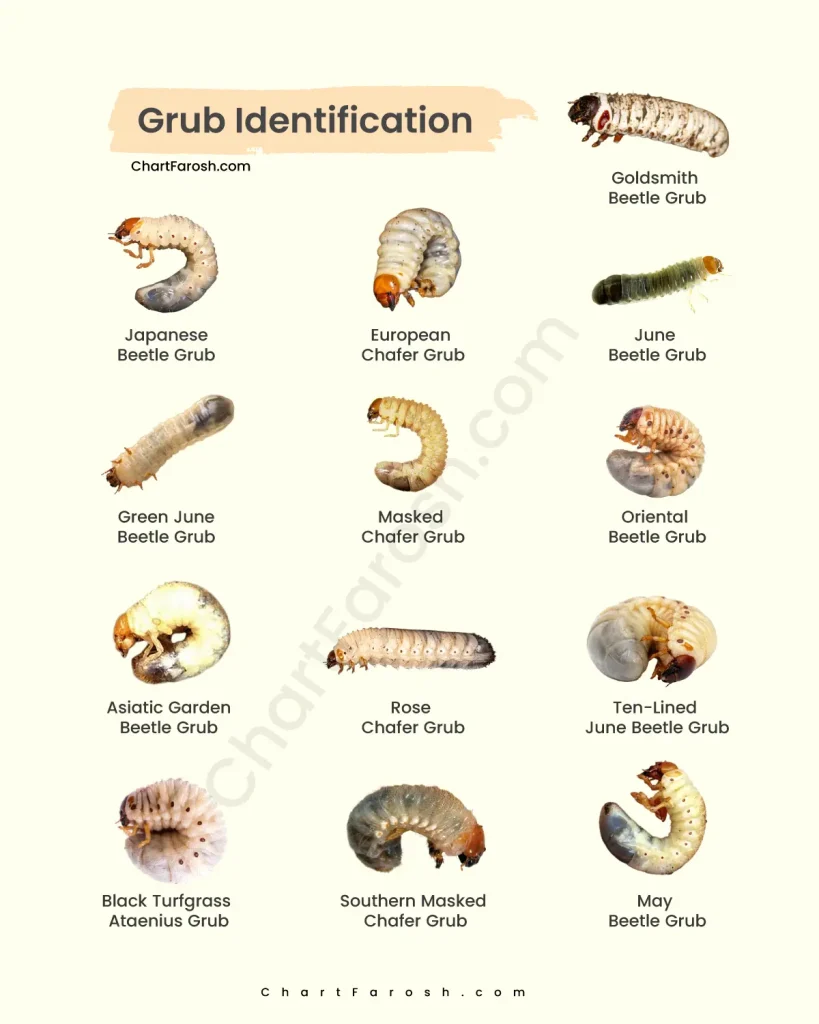
If you've ever peeled back a patch of dead turf and found pale, squirming larvae curled in the soil, you're probably wondering exactly what you're looking at. Knowing what do grubs look like in lawn situations is the first step toward figuring out whether you actually have a problem and what to do about it. The catch is that "grub" isn't one single creature.
It's a catch-all term for the larval stage of several different scarab beetle species, and they don't all look the same.
The most common lawn grubs in the United States range from a tiny ¼ inch to a chunky 1½ inches long, depending on the species and how mature they are. Some are widespread across the entire country, while others are regional. Getting a close look at the right features is what separates a confident identification from a lucky guess.
Image source: Bing (Web (fair-use with source credit))
Quick Answer
White grubs are the larvae of scarab beetles. They have soft, C-shaped bodies that are creamy white to grayish-white with a distinct brown or tan head capsule. Most species have three pairs of true legs near the head.
Body length ranges from ¼ inch to 1½ inches depending on the species. The pattern of hairs on the underside of the last abdominal segment, called the raster pattern, is the most reliable way to identify individual species.
Why You Can't Identify Grubs From a Description Alone
Here's the thing about grub identification. Written descriptions will only get you so far because the differences between species are subtle and physical. You need to see the actual body shape, the head capsule color, the leg structure, and especially the raster pattern on the grub's rear end.
A photo or diagram is worth more than a paragraph of text every single time.
This is also why so many homeowners misidentify what's in their soil. Annual bluegrass weevil larvae look superficially similar to grubs but have no true legs. Sod webworms are caterpillars that live above ground.
Millipedes have dozens of legs and a rounder body. Without a visual reference, it's easy to lump all of these together and either panic over nothing or miss a real problem.
The good news is that once you know exactly which features to check, the process becomes straightforward. We'll walk through each one.
What Grubs Actually Look Like: The Key Visual Features
Every grub species shares a basic body plan, and recognizing that shared structure is your starting point before you narrow down to a specific type.
Body Shape, Color, and Size
All white grubs have a soft, plump, segmented body. The color is typically creamy white to grayish-white, though you may notice a dark line running through the body wall. That's just visible gut contents and it's completely normal.
The body is noticeably thicker in the middle and tapers toward both ends.
Size varies significantly. A mature May/June beetle grub can reach 1½ inches long, while a mature black turfgrass ataenius grub tops out around ¼ inch. Most of the common species you'll encounter fall somewhere between ½ inch and 1 inch at full size.
If you're looking at a tiny larva in early summer, it may only be a few millimeters long and much harder to identify.
The C-Shaped Posture
This is the single most recognizable feature. When you disturb a grub by digging or handling it, it curls into a distinct C shape. Almost all scarab beetle larvae do this.
It's such a consistent trait that if you find a larva in your soil that stays straight or only slightly curved, it's probably not a white grub.
The C-curl is more than just a party trick. It's a reliable first-pass filter. If the creature in your lawn curls into that tight C when you pick it up, you're dealing with a scarab larva.
If it doesn't, you're looking at something else entirely.
Head Capsule and Legs
Flip the grub over or look at it head-on. You'll see a hardened head capsule that's tan, brown, or reddish-brown. This is darker than the rest of the body and it's one of the easiest features to spot without magnification.
Just behind the head, you'll find three pairs of true legs. These are jointed and relatively prominent. Not all lawn-dwelling larvae have them.
Annual bluegrass weevil larvae, for instance, are legless. Billbug larvae are also legless. So the presence of those three leg pairs is another strong indicator that you're looking at a true white grub.
The Raster Pattern (The Real ID Tool)
This is where identification gets specific and where most people need a hand lens or at least a good macro photo. The raster pattern is the arrangement of hairs, spines, and bare spots on the underside of the grub's last abdominal segment. You have to flip the grub over and look at its rear end to see it.
Different species have distinctly different raster patterns. Japanese beetle grubs have a V-shaped pattern of spines. European chafer grubs have a Y-shaped or more irregular pattern.
May/June beetle grubs have two parallel rows of spines. These patterns are consistent within a species, which is why entomologists rely on them for definitive identification.
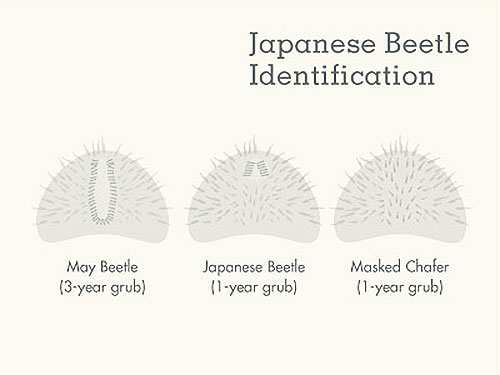
Image source: Bing (Web (fair-use with source credit))
You don't need to become an expert at reading raster patterns overnight. But knowing that this feature exists and that it's the gold standard for species-level ID will save you a lot of confusion. If you're serious about identifying what's in your lawn, a 10x hand lens is a worthwhile investment.
How to Tell the 7 Most Common Lawn Grub Species Apart
Now that you know the basic features to check, let's look at the species you're most likely to encounter. Each one has a slightly different appearance and a different geographic range.
Japanese Beetle Grub
Japanese beetle grubs are one of the most widespread lawn pests in the eastern and midwestern United States. They reach about 1 inch long at maturity. The body is creamy white with a tan to brown head capsule and three pairs of legs near the head.
The raster pattern is V-shaped, formed by two rows of spines that converge toward the rear. This species is particularly damaging because the adults feed on over 300 species of plants while the larvae destroy turf roots below ground.
European Chafer Grub
European chafer grubs are common in the Northeast and Great Lakes regions. They're slightly smaller than Japanese beetle grubs, reaching about ¾ inch long. The body color and head capsule are similar, but the raster pattern is different.
It's more Y-shaped or irregular, with spines scattered in a less organized arrangement. European chafer adults emerge earlier in the season than Japanese beetles, which affects the timing of both egg-laying and larval damage.
May/June Beetle Grub
May/June beetle grubs, from the genus Phyllophaga, are among the largest lawn grubs. They can reach 1½ inches long at full size. They're found across most of the United States.
The body is creamy white with a brown head capsule. The raster pattern features two parallel rows of spines running lengthwise. These grubs have a longer life cycle than other species, sometimes taking two to three years to develop, which means you can find multiple size classes in the same lawn at the same time.
Masked Chafer Grub (Northern and Southern)
Northern and southern masked chafer grubs are very similar in appearance. They reach about ½ to ¾ inch long. The body is creamy white with a tan to brown head capsule.
The raster pattern is similar to the Japanese beetle's but less distinctly V-shaped, with a more random arrangement of spines. These species are common in the Midwest, Northeast, and mid-Atlantic regions. They're often found in lawns that receive full sun and have well-drained soil.
Black Turfgrass Ataenius Grub
This is the smallest of the common lawn grubs, reaching only about ¼ inch long. It's easy to overlook because of its size. The body is creamy white with a tan head capsule.
The raster pattern is difficult to see without significant magnification. This species is particularly problematic on golf course fairways and home lawns in the Northeast, Midwest, and Pacific Northwest. It has a faster life cycle than most other grubs, sometimes producing two generations per year.
Green June Beetle Grub
Green June beetle grubs are unusual among lawn grubs for one key behavior. They crawl on their backs when moving across the soil surface. They're also large, reaching up to 2 inches long.
The body is creamy white, but the head capsule is darker brown. They're most common in the Southeast and mid-Atlantic states, extending into the Midwest. Unlike most grubs that stay below ground, green June beetle larvae often emerge at night and can be found crawling on sidewalks, driveways, and patios.
Asiatic Garden Beetle Grub
Asiatic garden beetle grubs are smaller, reaching about ½ inch long. They're common in the Northeast and mid-Atlantic regions. The body is creamy white with a brown head capsule.
The raster pattern is similar to the Japanese beetle's but less defined. This species has become more prevalent in recent years and is often found in lawns with a history of organic mulch use, as the adults are attracted to lay eggs in mulched areas.

Image source: Bing (Web (fair-use with source credit))
Creatures People Mistake for Grubs (And How to Tell the Difference)
Your lawn is home to all kinds of larvae, and not all of them are grubs. Misidentification leads to wasted time, unnecessary treatments, or missed problems. Here are the most common look-alikes.
Annual Bluegrass Weevil Larva
Annual bluegrass weevil larvae are frequently mistaken for white grubs. They're found in the same soil environment and they're roughly the same size and color. The critical difference is that weevil larvae have no true legs.
They're also more yellowish than creamy white and they tend to feed inside grass stems rather than on roots. If you find a legless, yellowish larva inside a hollowed-out grass stem, it's a weevil, not a grub.
Sod Webworms
Sod webworms are caterpillars, not beetle larvae. They live above ground, feeding on grass blades and thatch, not on roots. They're usually brown or green with dark spots and they have a more typical caterpillar body plan with prolegs in addition to true legs.
If the damage is on the grass blades and you can see the larvae on the surface, you're dealing with webworms, not grubs.
Billbug Larvae
Billbug larvae are legless and yellowish-white, similar in appearance to weevil larvae. They feed inside grass stems and crowns rather than in the soil. The adults are weevils with distinctive snouts.
If you pull on a damaged grass stem and it breaks off easily with a hollow, sawdust-filled interior, billbugs are the likely culprit.
Ground Beetle Larvae
Ground beetle larvae are predators, not pests. They're beneficial insects that feed on other soil-dwelling larvae, including grubs. They have a more elongated, flattened body with prominent mandibles and long legs.
If you find a fast-moving, dark-colored larva with visible jaws, leave it alone. It's doing you a favor.
Millipedes
Millipedes are detritivores that feed on decaying organic matter. They have a rounder, harder body with two pairs of legs per body segment. They're not feeding on your grass roots and they're not a threat to your lawn.
You'll often find them in mulch beds or under decaying leaves. If the creature has way more legs than three pairs, it's not a grub.
How to Inspect Your Lawn for Grubs Step by Step
Knowing what to look for is only half the battle. You also need to know how to look. A proper inspection takes about 15 minutes and requires nothing more than a shovel and a flat blade.
When to Look
The best time to inspect for grubs depends on what you're trying to accomplish. For identification purposes, late July through October is ideal because the grubs are present and large enough to examine. For treatment decisions, August through early September gives you the best window because the grubs are young, small, and most vulnerable to control products.
Spring inspections can be misleading. By spring, many grubs have already pupated and emerged as adult beetles, or they've moved deeper into the soil to pupate. You may find low numbers even in a lawn that had significant damage the previous fall.
The Sod Peel Test
This is the standard inspection method used by turf professionals. Here's how to do it.
- Cut a 1-foot square of turf using a shovel or flat spade. Go about 2 to 3 inches deep.
- Peel the sod back carefully, like opening a flap.
- Examine the soil and root zone for grubs. Look in the top 2 inches of soil and among the roots.
- Count the grubs you find in that square foot.
- Press the sod back into place and water it in. The turf will re-root within a week or two.
- Repeat this process in several areas of the lawn, especially in spots that show browning or thinning.
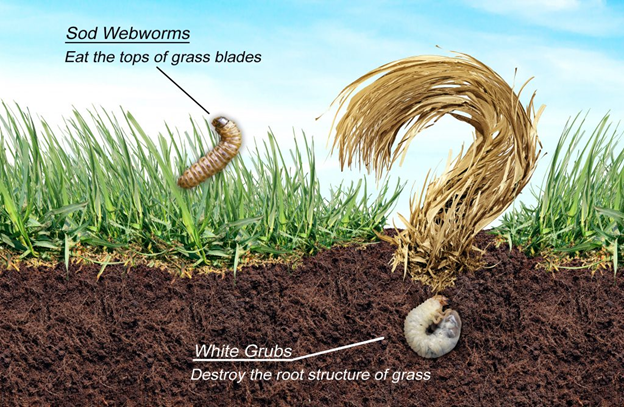
Image source: Bing (Web (fair-use with source credit))
What to Count and Record
Keep a simple tally. Note the number of grubs per square foot, the approximate size of each grub, and the location in the lawn. If you find grubs in multiple spots, calculate an average.
This number is what you'll use to decide whether treatment is necessary.
Also note the species if you can identify it. A lawn with 8 Japanese beetle grubs per square foot is a different situation than one with 8 green June beetle grubs per square foot, because the damage potential and treatment timing differ between species.
Using a Hand Lens for Raster Identification
If you want to confirm the species, pick up a grub and flip it over. Use a 10x hand lens to examine the underside of the last abdominal segment. Compare what you see to a reference chart or diagram.
The raster pattern is small, so good lighting helps. A phone camera with a macro lens attachment can also work if you don't have a hand lens handy.
Don't worry if you can't get a perfect read on the raster pattern the first time. It takes practice. Even experienced turf managers sometimes need to examine several specimens before they're confident in the identification.
What Grub Damage Looks Like vs. Other Lawn Problems
Grub damage has a distinctive appearance, but it's commonly confused with other issues. The key characteristic is that grub-damaged turf lifts easily off the soil like a loose carpet. That's because the roots have been chewed away and nothing is holding the sod down.
The damage typically appears as irregular brown patches that start small and expand over weeks. It's most visible in late summer and early fall when grubs are actively feeding and turf is already under heat and drought stress. The patches may look similar to fungal disease, but with fungal disease, you'll usually see lesions on the grass blades or visible mycelium in the early morning.
With grub damage, the blades often look healthy right up until the patch turns brown.
Dog urine damage can also look similar, but it tends to be more circular and concentrated in areas where pets frequent. Urine spots usually have a dark green ring around the dead center, which grub damage doesn't produce.
Drought stress is the most common misdiagnosis. If your lawn is browning during a dry spell, it's easy to blame grubs. But drought-stressed turf will feel firm and rooted when you tug on it.
Grub-damaged turf will lift right up. That simple tug test is often all you need to tell the difference.
When Grub Numbers Actually Warrant Treatment
Finding a few grubs doesn't automatically mean you need to treat. Most lawns can tolerate a low population without visible damage. The general treatment thresholds are:
- Japanese beetle, European chafer, masked chafer: 5 to 10 grubs per square foot
- May/June beetle: 3 to 5 grubs per square foot (they're larger and cause more damage per individual)
- Black turfgrass ataenius: 20 to 30 grubs per square foot (they're small, so higher numbers are needed to cause visible damage)
- Green June beetle: 2 to 3 grubs per square foot (they're very large and their tunneling causes additional damage beyond root feeding)
These thresholds can vary based on turf type, overall lawn health, and environmental conditions. A well-maintained, deeply rooted lawn in good soil can tolerate higher grub numbers than a stressed lawn with shallow roots. If your lawn is already struggling from compaction, poor soil, or drought, even moderate grub populations can push it over the edge.
Common Mistakes People Make When Identifying Grubs
Even with good intentions, people get grub identification wrong. Here are the most frequent errors.
Treating based on damage alone without confirming grubs are present. Brown patches have many causes. Always dig and verify before applying any product.
Assuming all white larvae are grubs. As we covered, weevils, billbugs, and other insects produce larvae that look similar. Check for legs and head capsule color.
Inspecting at the wrong time of year. Spring inspections often miss grubs that have already pupated. Late summer is the most reliable window.
Ignoring the raster pattern. If you're going to the trouble of identifying grubs, go all the way. The raster pattern is the only way to confidently distinguish between species, and species matters for treatment timing.
Over-treating based on a single sample. Grub populations are often patchy. One square foot might have 15 grubs while another has none. Sample multiple areas before making a decision.
Confusing grub damage with drought stress. The tug test takes five seconds and saves you from unnecessary treatment. If the turf doesn't lift easily, grubs probably aren't the problem.
Quick-Reference Grub Identification Chart
| Species | Size | Head Capsule | Legs | Raster Pattern | Key Behavior |
|---|---|---|---|---|---|
| Japanese beetle | Up to 1 inch | Tan to brown | 3 pairs | V-shaped | Most widespread eastern/midwestern pest |
| European chafer | ¾ inch | Tan to brown | 3 pairs | Y-shaped/irregular | Common in Northeast and Great Lakes |
| May/June beetle | Up to 1½ inches | Brown | 3 pairs | Two parallel rows | Largest common species; 2-3 year life cycle |
| Masked chafer | ½ to ¾ inch | Tan to brown | 3 pairs | Less defined, random | Common in sun-exposed lawns |
| Black turfgrass ataenius | ¼ inch | Tan | 3 pairs | Hard to see | Smallest; two generations per year possible |
| Green June beetle | Up to 2 inches | Dark brown | 3 pairs | Similar to Japanese beetle | Crawls on back; emerges at night |
| Asiatic garden beetle | ½ inch | Brown | 3 pairs | Similar to Japanese beetle | Attracted to mulched areas |
Frequently Asked Questions
How do I know if the white thing in my lawn is a grub?
Check for three key features. A true white grub will have a C-shaped body, a hardened brown or tan head capsule, and three pairs of true legs near the head. If the creature is legless, stays straight, or has many more than six legs, it's not a grub.
What time of year are grubs easiest to identify?
Late July through October is the best window. Grubs are present in the soil, large enough to examine, and haven't yet pupated into adult beetles. Spring inspections are less reliable because many grubs have already moved deeper or transformed.
Can I identify grubs without a magnifying glass?
You can confirm that something is a basic white grub without magnification by checking the C-shape, head capsule color, and leg count. But species-level identification requires seeing the raster pattern, which needs at least a 10x hand lens or a good macro photo.
How many grubs per square foot is considered a problem?
It depends on the species. For most common grubs like Japanese beetle and European chafer, 5 to 10 per square foot is the treatment threshold. For smaller species like black turfgrass ataenius, you might need 20 to 30 per square foot before damage appears.
Do all grubs curl into a C shape?
Virtually all scarab beetle larvae curl into a C shape when disturbed. It's one of the most consistent identifying features. If a soil-dwelling larva in your lawn doesn't curl, it's likely a weevil, billbug, or some other type of insect larva rather than a true white grub.
What Grub Damage Looks Like vs. Other Lawn Problems
Grub damage has a distinctive appearance, but it's commonly confused with other issues. The key characteristic is that grub-damaged turf lifts easily off the soil like a loose carpet. That's because the roots have been chewed away and nothing is holding the sod down.
The damage typically appears as irregular brown patches that start small and expand over weeks. It's most visible in late summer and early fall when grubs are actively feeding and turf is already under heat and drought stress. The patches may look similar to fungal disease, but with fungal disease, you'll usually see lesions on the grass blades or visible mycelium in the early morning.
With grub damage, the blades often look healthy right up until the patch turns brown.
Dog urine damage can also look similar, but it tends to be more circular and concentrated in areas where pets frequent. Urine spots usually have a dark green ring around the dead center, which grub damage doesn't produce.
Drought stress is the most common misdiagnosis. If your lawn is browning during a dry spell, it's easy to blame grubs. But drought-stressed turf will feel firm and rooted when you tug on it.
Grub-damaged turf will lift right up. That simple tug test is often all you need to tell the difference.
When Grub Numbers Actually Warrant Treatment
Finding a few grubs doesn't automatically mean you need to treat. Most lawns can tolerate a low population without visible damage. The general treatment thresholds are:
- Japanese beetle, European chafer, masked chafer: 5 to 10 grubs per square foot
- May/June beetle: 3 to 5 grubs per square foot (they're larger and cause more damage per individual)
- Black turfgrass ataenius: 20 to 30 grubs per square foot (they're small, so higher numbers are needed to cause visible damage)
- Green June beetle: 2 to 3 grubs per square foot (they're very large and their tunneling causes additional damage beyond root feeding)
These thresholds can vary based on turf type, overall lawn health, and environmental conditions. A well-maintained, deeply rooted lawn in good soil can tolerate higher grub numbers than a stressed lawn with shallow roots. If your lawn is already struggling from compaction, poor soil, or drought, even moderate grub populations can push it over the edge.
Common Mistakes People Make When Identifying Grubs
Even with good intentions, people get grub identification wrong. Here are the most frequent errors.
Treating based on damage alone without confirming grubs are present. Brown patches have many causes. Always dig and verify before applying any product.
Assuming all white larvae are grubs. As we covered, weevils, billbugs, and other insects produce larvae that look similar. Check for legs and head capsule color.
Inspecting at the wrong time of year. Spring inspections often miss grubs that have already pupated. Late summer is the most reliable window.
Ignoring the raster pattern. If you're going to the trouble of identifying grubs, go all the way. The raster pattern is the only way to confidently distinguish between species, and species matters for treatment timing.
Over-treating based on a single sample. Grub populations are often patchy. One square foot might have 15 grubs while another has none. Sample multiple areas before making a decision.
Confusing grub damage with drought stress. The tug test takes five seconds and saves you from unnecessary treatment. If the turf doesn't lift easily, grubs probably aren't the problem.
Quick-Reference Grub Identification Chart
| Species | Size | Head Capsule | Legs | Raster Pattern | Key Behavior |
|---|---|---|---|---|---|
| Japanese beetle | Up to 1 inch | Tan to brown | 3 pairs | V-shaped | Most widespread eastern/midwestern pest |
| European chafer | ¾ inch | Tan to brown | 3 pairs | Y-shaped/irregular | Common in Northeast and Great Lakes |
| May/June beetle | Up to 1½ inches | Brown | 3 pairs | Two parallel rows | Largest common species; 2-3 year life cycle |
| Masked chafer | ½ to ¾ inch | Tan to brown | 3 pairs | Less defined, random | Common in sun-exposed lawns |
| Black turfgrass ataenius | ¼ inch | Tan | 3 pairs | Hard to see | Smallest; two generations per year possible |
| Green June beetle | Up to 2 inches | Dark brown | 3 pairs | Similar to Japanese beetle | Crawls on back; emerges at night |
| Asiatic garden beetle | ½ inch | Brown | 3 pairs | Similar to Japanese beetle | Attracted to mulched areas |
Frequently Asked Questions
How do I know if the white thing in my lawn is a grub?
Check for three key features. A true white grub will have a C-shaped body, a hardened brown or tan head capsule, and three pairs of true legs near the head. If the creature is legless, stays straight, or has many more than six legs, it's not a grub.
What time of year are grubs easiest to identify?
Late July through October is the best window. Grubs are present in the soil, large enough to examine, and haven't yet pupated into adult beetles. Spring inspections are less reliable because many grubs have already moved deeper or transformed.
Can I identify grubs without a magnifying glass?
You can confirm that something is a basic white grub without magnification by checking the C-shape, head capsule color, and leg count. But species-level identification requires seeing the raster pattern, which needs at least a 10x hand lens or a good macro photo.
How many grubs per square foot is considered a problem?
It depends on the species. For most common grubs like Japanese beetle and European chafer, 5 to 10 per square foot is the treatment threshold. For smaller species like black turfgrass ataenius, you might need 20 to 30 per square foot before damage appears.
Do all grubs curl into a C shape?
Virtually all scarab beetle larvae curl into a C shape when disturbed. It's one of the most consistent identifying features. If a soil-dwelling larva in your lawn doesn't curl, it's likely a weevil, billbug, or some other type of insect larva rather than a true white grub.