Determining the right amount of grass seed per acre is crucial for a healthy, dense lawn. This guide breaks down the factors influencing your seed needs, from grass type to desired density. Learn how to calculate the exact pounds per acre for your specific project, whether you’re establishing a new lawn or overseeding an existing one, ensuring you get the best results for your green space.
# How Many Pounds per Acre for Grass Seed
A beautiful, green lawn is the envy of any neighborhood. But achieving that lush carpet of grass starts with getting the foundation right – and that means using the correct amount of grass seed. If you’re wondering “how many pounds per acre for grass seed,” you’ve come to the right place. This comprehensive guide will walk you through everything you need to know to determine the perfect seeding rate for your lawn project, ensuring a healthy, vibrant result.
We’ll cover the key factors that influence how much seed you’ll need, provide clear calculation methods, and offer practical tips to help you succeed. Whether you’re starting a new lawn from scratch, filling in bare patches, or giving your existing lawn a boost, understanding your seeding rate is fundamental. Let’s dive in!
## Understanding the Basics: Why Seeding Rate Matters
The amount of grass seed you apply per acre directly impacts the success of your lawn. Too little seed, and you’ll end up with a thin, patchy lawn that’s prone to weeds and erosion. Too much seed, and you’ll waste money, potentially leading to weaker grass that competes too aggressively for resources and can even increase the risk of disease.
The goal is to achieve optimal germination and density for a robust, healthy turf. This means providing enough individual grass plants to form a dense canopy, but not so many that they struggle to thrive.
## Key Factors Influencing Grass Seed Per Acre
Before we get to the numbers, it’s important to understand the variables that affect your grass seed needs.
### 1. Type of Grass Seed
This is arguably the most significant factor. Different grass species have vastly different seed sizes, germination rates, and growth habits.
* **Cool-Season Grasses:** These grasses, like fescues, ryegrasses, and Kentucky bluegrass, are popular in northern climates. They often have smaller seeds and require a higher seeding rate to achieve good density. For example, ryegrass seed, especially annual ryegrass, can have a wide range depending on its intended use.
* **Warm-Season Grasses:** These grasses, like Bermuda grass, zoysia, and centipede grass, thrive in warmer regions. Their seeds are typically larger, and they often spread via rhizomes and stolons, meaning they can establish a good cover with a slightly lower seeding rate when the plant matures.
* **Blends vs. Monocultures:** Most lawn seed you buy is a blend of several grass varieties. These blends are formulated to offer a mix of desirable traits like drought tolerance, wear resistance, and shade tolerance. The specific blend will have its own recommended seeding rate on the packaging.
### 2. New Lawn Establishment vs. Overseeding
Are you starting from scratch or refreshing an existing lawn?
* **New Lawn Establishment:** When you’re creating a lawn on bare soil, you need to ensure maximum germination and coverage from the start. This typically requires a higher seeding rate to overcome initial challenges and create a dense stand of grass.
* **Overseeding:** This is the process of adding new seed to an existing lawn, usually to fill in thin areas or improve the overall turf quality. Since there’s already grass present, you can often use a slightly lower seeding rate. The existing grass provides some cover and competition, and the goal is to supplement, not completely replace. For overseeding, understanding how much grass seed for overseeding is key to avoid over-application.
### 3. Desired Lawn Density and Quality
What kind of lawn are you aiming for?
* **High-Density, Premium Lawn:** If you desire a thick, golf-course-quality lawn, you’ll need to use more seed. This ensures a tight, weed-resistant turf.
* **Functional Lawn:** For areas that are primarily for play or general use, a slightly less dense lawn might be acceptable, allowing for a lower seeding rate.
### 4. Soil Conditions and Climate
The environment where your lawn is growing plays a role.
* **Poor Soil:** If your soil is compacted, has poor drainage, or lacks nutrients, germination rates might be lower. You might consider a slightly higher seeding rate to compensate. Proper soil preparation is vital, and you can learn how to prepare soil for grass seed to improve your chances.
* **Challenging Climate:** Areas with extreme temperatures, high winds, or significant pest pressure might benefit from a slightly higher seeding rate to ensure a resilient turf.
## How to Calculate Grass Seed Per Acre
Now that we understand the influencing factors, let’s get to the calculation. Most recommendations are provided in pounds per acre.
### Step 1: Determine Your Area in Acres
This might seem obvious, but it’s crucial for accurate calculation. If you know the dimensions of your lawn (length and width), you can calculate the total square footage.
* **Square Footage:** Length (feet) x Width (feet) = Total Square Feet
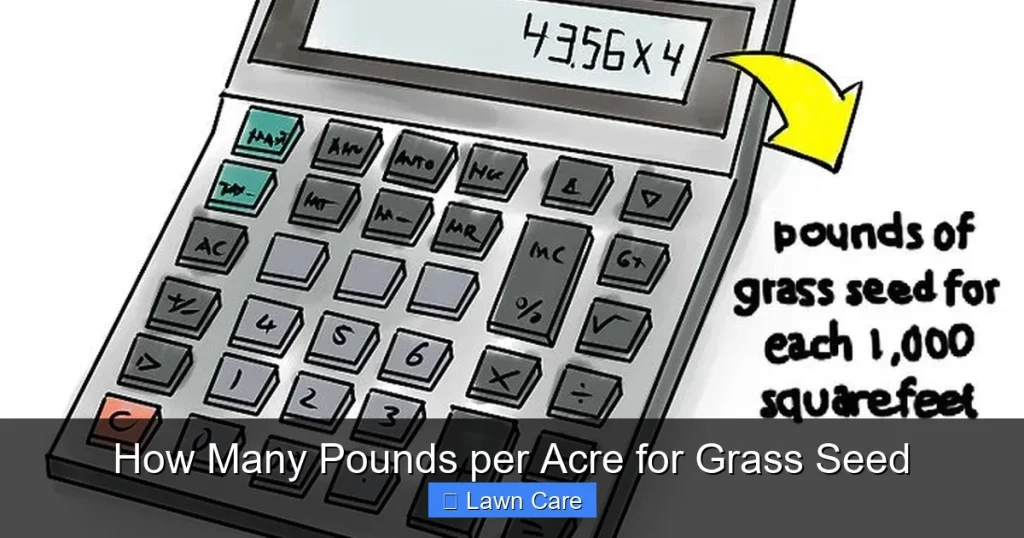
* **Converting to Acres:** There are 43,560 square feet in one acre.
* Total Square Feet / 43,560 = Number of Acres
**Example:** If your lawn is 200 feet long and 100 feet wide:
200 ft x 100 ft = 20,000 sq ft
20,000 sq ft / 43,560 sq ft/acre = approximately 0.46 acres
If you have an irregularly shaped area, you might need to break it down into smaller, measurable sections and add them together, or use online mapping tools.
### Step 2: Consult Your Grass Seed Packaging
This is your most important resource! Every bag of grass seed will have a recommended seeding rate. This rate is usually given in pounds per 1,000 square feet or pounds per acre.
* **Example Recommendations:**
* **New Lawn:** 4-8 pounds per 1,000 sq ft
* **Overseeding:** 2-4 pounds per 1,000 sq ft
**Important Note:** These are general guidelines. Always prioritize the specific recommendations printed on your seed bag.
### Step 3: Calculate Total Seed Needed
Once you know your area in acres and the recommended seeding rate, you can calculate the total amount of seed required.
**Formula:**
(Recommended pounds per acre) x (Your area in acres) = Total pounds of seed needed
**Let’s use an example:**
Suppose you have 1.5 acres to seed for a new lawn, and the seed bag recommends 5 pounds per 1,000 square feet.
* **First, convert the per-acre rate to per-square-foot rate (if needed):**
* There are 43,560 sq ft in an acre.
* (5 lbs / 1,000 sq ft) x 43,560 sq ft/acre = 217.8 lbs per acre.
* **Now, calculate for your specific acreage:**
* 217.8 lbs/acre x 1.5 acres = 326.7 pounds of seed.
**Alternatively, if the recommendation is already in pounds per acre:**
Suppose the bag recommends 100 pounds per acre for a new lawn, and you have 0.75 acres.
* 100 lbs/acre x 0.75 acres = 75 pounds of seed.
This is where knowing how much grass seed for 1 acre you need becomes a stepping stone to larger projects.
## Typical Seeding Rates for Common Grass Types (Pounds per Acre)
While the seed bag is your ultimate guide, here are some general ranges you might encounter. These are for **new lawn establishment**. For overseeding, you would typically use about half these amounts.
### Cool-Season Grasses
* **Kentucky Bluegrass:** 2-4 pounds per 1,000 sq ft, which translates to approximately **85-175 pounds per acre**. This is a finer seed, and good density is crucial.
* **Perennial Ryegrass:** 3-5 pounds per 1,000 sq ft, roughly **130-220 pounds per acre**. It germinates quickly and is often used in blends.
* **Tall Fescue:** 5-8 pounds per 1,000 sq ft, approximately **220-350 pounds per acre**. It has larger seeds and establishes well. If you’re specifically looking at tall fescue, understanding how long for tall fescue grass seed to germinate is also beneficial.
* **Fine Fescues (Creeping Red, Chewings, Hard):** 3-5 pounds per 1,000 sq ft, around **130-220 pounds per acre**. These are excellent for shade and low-maintenance areas.
### Warm-Season Grasses
* **Bermuda Grass:** 1-2 pounds per 1,000 sq ft, approximately **45-90 pounds per acre**. Bermuda is known for its vigorous spread. For specific regions, you might research the best Bermuda grass seed for South Carolina or learn how to plant Bermuda grass seed in Texas.
* **Zoysia Grass:** 0.5-1 pound per 1,000 sq ft, roughly **20-45 pounds per acre**. Zoysia establishes slowly but creates a very dense turf.
* **Centipede Grass:** 4-6 ounces per 1,000 sq ft, about **10-15 pounds per acre**. This is a very low-maintenance grass with a fine texture.
**Remember:** These are general figures. Always check your seed packaging for the most accurate recommendations. If you’re having trouble with germination or growth, consider resources on how long does it take for grass seed to germinate or how long does it take for grass seed to grow.
## Practical Tips for Seeding Success
Beyond just calculating the pounds per acre, several practices will help ensure your seeding project is a success.
### 1. Prepare the Seedbed Properly
This is non-negotiable for good germination.
* **Remove Debris:** Clear away rocks, sticks, and old vegetation.
* **Loosen Soil:** Till or lightly rake the soil to create a fine, crumbly texture. This allows seeds to make good contact with the soil and roots to penetrate easily.
* **Grade the Area:** Ensure proper drainage to prevent waterlogging.
* **Add Topsoil/Compost:** Amending the soil with nutrient-rich organic matter can significantly improve germination and grass health. Refer to guides on how to choose the right soil for new grass seed.
### 2. Choose the Right Time to Seed
The best time to plant grass seed depends on your climate and grass type.
* **Cool-Season Grasses:** Plant in early fall or early spring when temperatures are moderate and there’s ample moisture.
* **Warm-Season Grasses:** Plant in late spring or early summer after the threat of frost has passed and the soil has warmed up.
### 3. Distribute Seed Evenly
Using the correct amount of seed is only half the battle; distributing it evenly is the other.
* **Use a Spreader:** A broadcast spreader (for larger areas) or a drop spreader (for more precise application) is highly recommended. They ensure a uniform distribution, preventing clumping and bare spots.
* **Divide and Conquer:** If you have a large area, divide your seed and your lawn into smaller sections. Fill the spreader with seed for one section and walk the designated area. This prevents over-seeding one spot and under-seeding another.
* **Crosshatch Pattern:** For extra uniformity, spread half the seed going in one direction (e.g., north-south) and the other half going in the perpendicular direction (e.g., east-west).
### 4. Lightly Rake or Roll the Seeded Area
After spreading, you want to ensure good seed-to-soil contact without burying the seeds too deep.
* **Light Raking:** Gently rake the area to lightly cover the seeds with about 1/8 to 1/4 inch of soil.
* **Rolling:** A lawn roller can press the seeds into the soil. Be careful not to compact the soil too much.
### 5. Water Consistently
Water is critical for germination and establishment.
* **Keep Seed Moist:** Water gently and frequently – typically 1-2 times a day – just enough to keep the top layer of soil moist. Avoid heavy watering that can wash seeds away.
* **Deep Watering Later:** Once the grass starts to establish, gradually reduce watering frequency but increase the amount of water each time to encourage deep root growth. Consider guides on how often to water Bermuda grass seed if that’s your chosen type.
### 6. Mow at the Right Time
Don’t mow too early! Wait until the new grass reaches about one-third taller than its ideal mowing height.
* **First Mowing:** Set your mower to a higher setting than usual.
* **Sharp Blade:** Always use a sharp mower blade to avoid tearing the tender new grass.
## Troubleshooting Common Seeding Issues
Sometimes, despite best efforts, you might encounter problems.
### Bare Patches
* **Cause:** Uneven seeding, poor seed-to-soil contact, lack of water, or soil compaction.
* **Solution:** If small, re-seed those areas, ensuring good soil contact and consistent moisture. For larger areas, you might need to prepare the soil again.
### Thin or Weak Grass
* **Cause:** Under-seeding, poor soil fertility, insufficient sunlight, or disease.
* **Solution:** Ensure you used enough seed initially. Test your soil and amend as needed. Check if your grass is getting enough sun – for example, Bermuda grass needs how many hours of sun does Bermuda grass need. If disease is suspected, identify the issue and treat accordingly.
### Weed Invasion
* **Cause:** Bare patches providing space for weeds, or weed seeds present in the soil.
* **Solution:** A dense, healthy lawn is the best defense against weeds. Proper seeding rates and good cultural practices help. Pre-emergent herbicides can be used in some cases, but always follow label instructions carefully.
## Conclusion
Calculating how many pounds of grass seed per acre you need is a vital step towards achieving a beautiful, healthy lawn. By considering the type of grass, whether you’re establishing a new lawn or overseeding, and the specific recommendations on your seed packaging, you can confidently determine the correct amount. Remember to always prepare your soil thoroughly, seed evenly, and provide consistent care. With the right approach, your efforts will pay off in a lush, green paradise. Happy seeding!
- Seed type is a major factor: Different grass species have varying seed sizes and germination rates, influencing the recommended pounds per acre. Cool-season grasses often require more seed than warm-season varieties.
- New lawn vs. overseeding: Establishing a new lawn generally requires a higher seeding rate than overseeding an existing one to ensure adequate coverage and density.
- Desired lawn density matters: A thicker, more luxurious lawn will need more seed than a sparser, functional turf.
- Soil conditions and climate play a role: Poor soil or challenging climates might necessitate a slightly higher seeding rate to compensate for germination challenges.
- Always read the seed bag: Manufacturers provide specific recommendations based on their seed blend, which should be your primary guide.
- Calculating for your area is key: Knowing the exact acreage you’re seeding is essential for accurate calculation and avoiding waste or under-application.