Here's the thing about grub damage. It doesn't announce itself with a neat label. It shows up as brown patches, spongy ground, and turf that seems to give up overnight.
If you've ever walked across your lawn and felt the ground squish or roll under your feet, you've probably wondered what does a lawn with grubs look like and whether that's what you're dealing with.
The tricky part is that grub damage mimics a dozen other lawn problems. Drought, fungal disease, dog urine, compacted soil, even a broken sprinkler head can all produce similar-looking brown patches. The difference comes down to what's happening below the surface.
White grubs, the larval stage of scarab beetles, feed on grass roots, which means the turf loses its anchor and its ability to take up water. Most university extension services note that damage typically becomes visible in late summer through early fall, with a treatment threshold of roughly 5 to 10 grubs per square foot depending on turf type and species.
Quick Answer
A lawn with grubs shows irregular brown patches that don't respond to watering. The turf feels spongy underfoot and pulls up easily like loose carpet. When you peel it back, you'll find white, C-shaped larvae in the top few inches of soil.
Animals like skunks and raccoons may also dig up the lawn searching for the grubs.
Why Grub Damage Is Easy to Misread
The biggest mistake homeowners make is assuming brown grass means the lawn needs more water. So they run the sprinklers longer, which doesn't help because the roots are gone. The grass can't absorb moisture even if you flood it.
Grub damage also spreads differently than most lawn diseases. Fungal issues like brown patch tend to produce circular rings or defined patterns. Grub damage starts as scattered, irregular patches that gradually merge into larger dead zones.
The shape is less uniform, more random, like someone took a sponge and dabbed brown spots across the yard.
Another reason it gets misread is timing. Grub damage peaks in August and September in most cool-season grass regions. That's also when heat and drought stress hit hardest.
The two problems overlap so often that even experienced lawn care professionals dig test holes before committing to a diagnosis.
What Grub Damage Actually Looks Like
Let's walk through the visual signs step by step so you know exactly what to look for.
Above-ground signs:
- Irregular brown or straw-colored patches, usually starting in sunny, well-drained areas of the lawn
- Patches that don't green up after a good rain or a week of watering
- A spongy or soft feeling when you walk across affected areas
- Turf that feels detached from the soil, almost like it's floating
Below-ground signs:
- Grass roots are chewed off or completely missing
- The top layer of soil is loose and crumbly
- White, C-shaped larvae visible in the root zone
- Grubs concentrated in the top 2 to 3 inches of soil
The progression matters too. Early-stage grub damage might look like a few small thin spots that you could easily overlook. By mid to late summer, those spots expand and connect.
In severe cases, entire sections of lawn can die off in a matter of weeks.
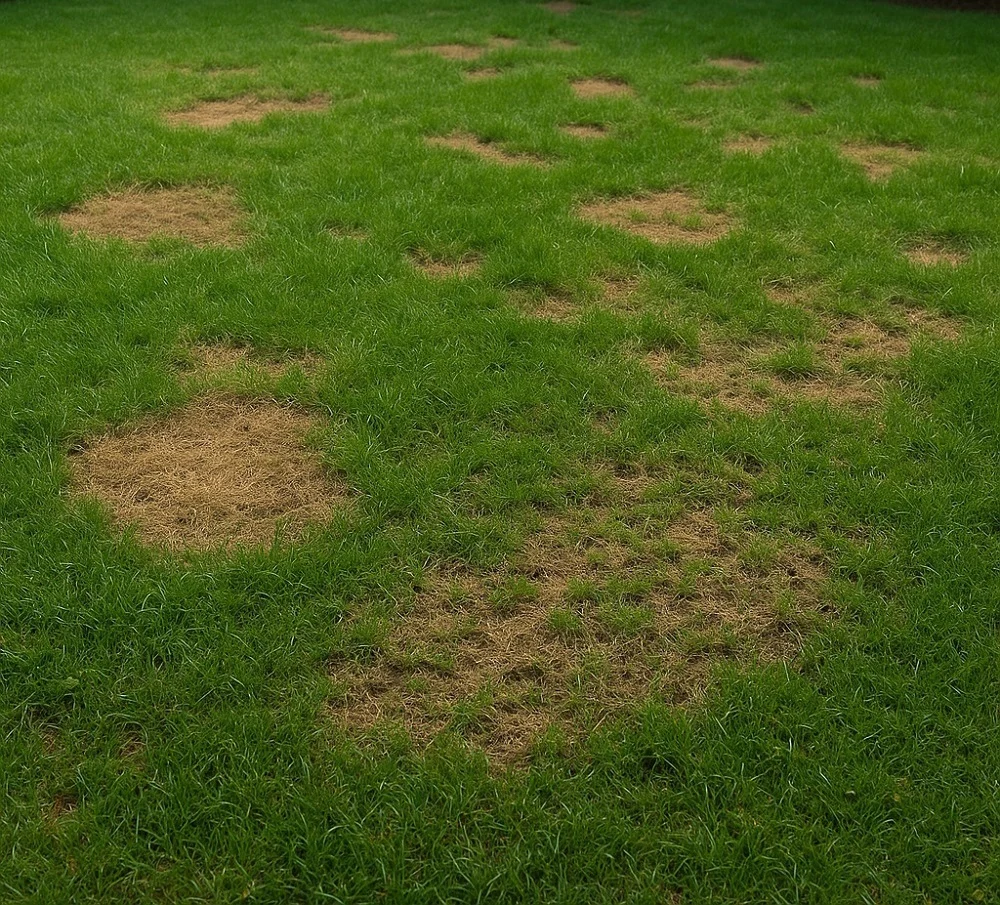
Image source: Bing (Web (fair-use with source credit))
The Tug Test: Fastest Way to Confirm Grubs
Before you start digging or buying products, try this. Grab a handful of the brown grass at the edge of a damaged patch and pull upward firmly. If the turf lifts easily, almost like peeling back a rug, that's a strong indicator of grub feeding.
Healthy grass with intact roots resists. Grub-damaged grass comes up with little to no resistance because the roots have been severed.
This test works best in the morning when the turf is still hydrated. Dry afternoon grass can tear for other reasons, which might give you a false positive. Test a few spots across the lawn, not just one area.
Grubs often cluster, so you might find heavy concentrations in one section and almost none just a few feet away.
If the turf lifts cleanly and you see grubs in the exposed soil, you've got your answer. If the turf holds firm and the roots look healthy, the problem is likely something else.
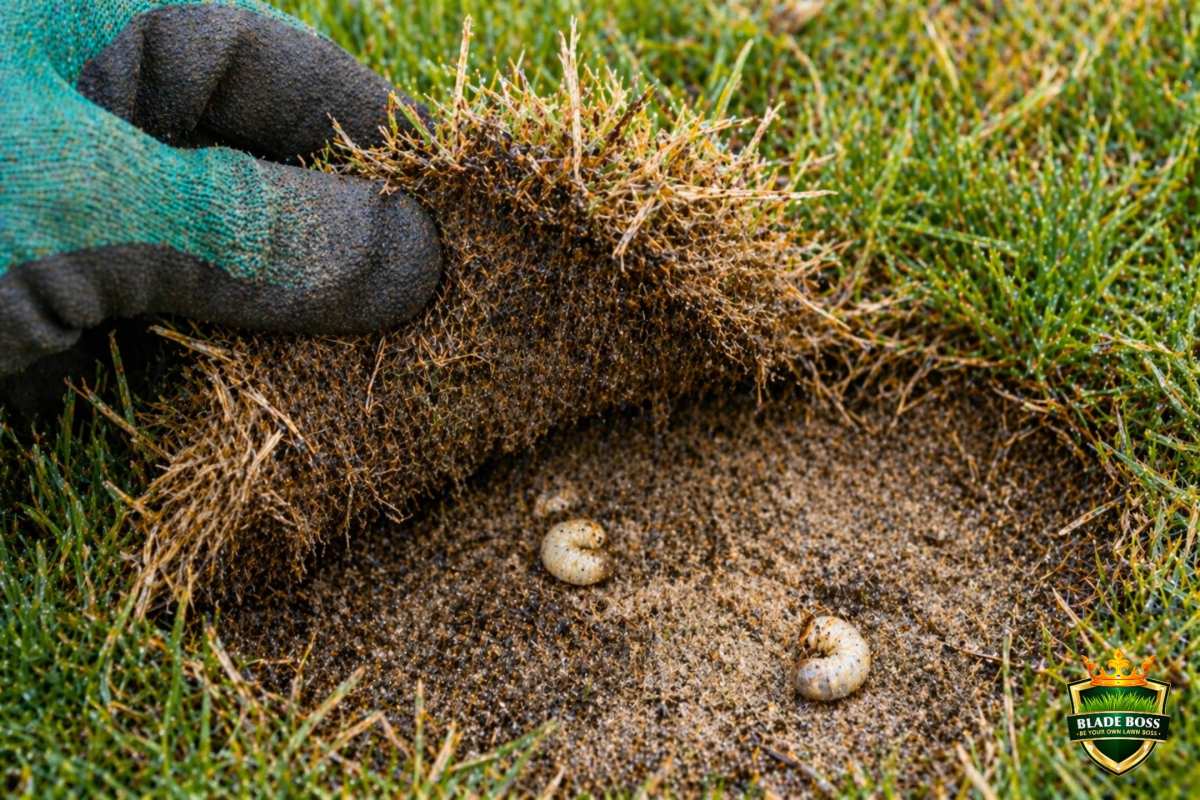
Image source: Bing (Web (fair-use with source credit))
What You'll See When You Cut Into the Turf
The tug test gives you a quick answer, but cutting a sample section gives you certainty. Use a spade or flat shovel to cut a 1-square-foot section of turf at the boundary between healthy and damaged grass. Fold it back like opening a book and examine the soil underneath.
Here's what to count and measure:
| What to Look For | What It Means |
|---|---|
| 0-4 grubs per square foot | Usually not enough to cause visible damage |
| 5-9 grubs per square foot | Threshold range, monitor closely, consider treatment if turf is stressed |
| 10+ grubs per square foot | High likelihood of significant damage, treatment recommended |
| Grubs deeper than 3 inches | Likely late-stage larvae, harder to control with surface applications |
| No grubs found | Problem is probably drought, disease, or something else |
The grubs themselves are white to cream-colored with a distinct brown head and six legs near the front. They curl into a C-shape when disturbed. Size varies by species and age, ranging from about a quarter inch in early summer to over an inch by late summer.
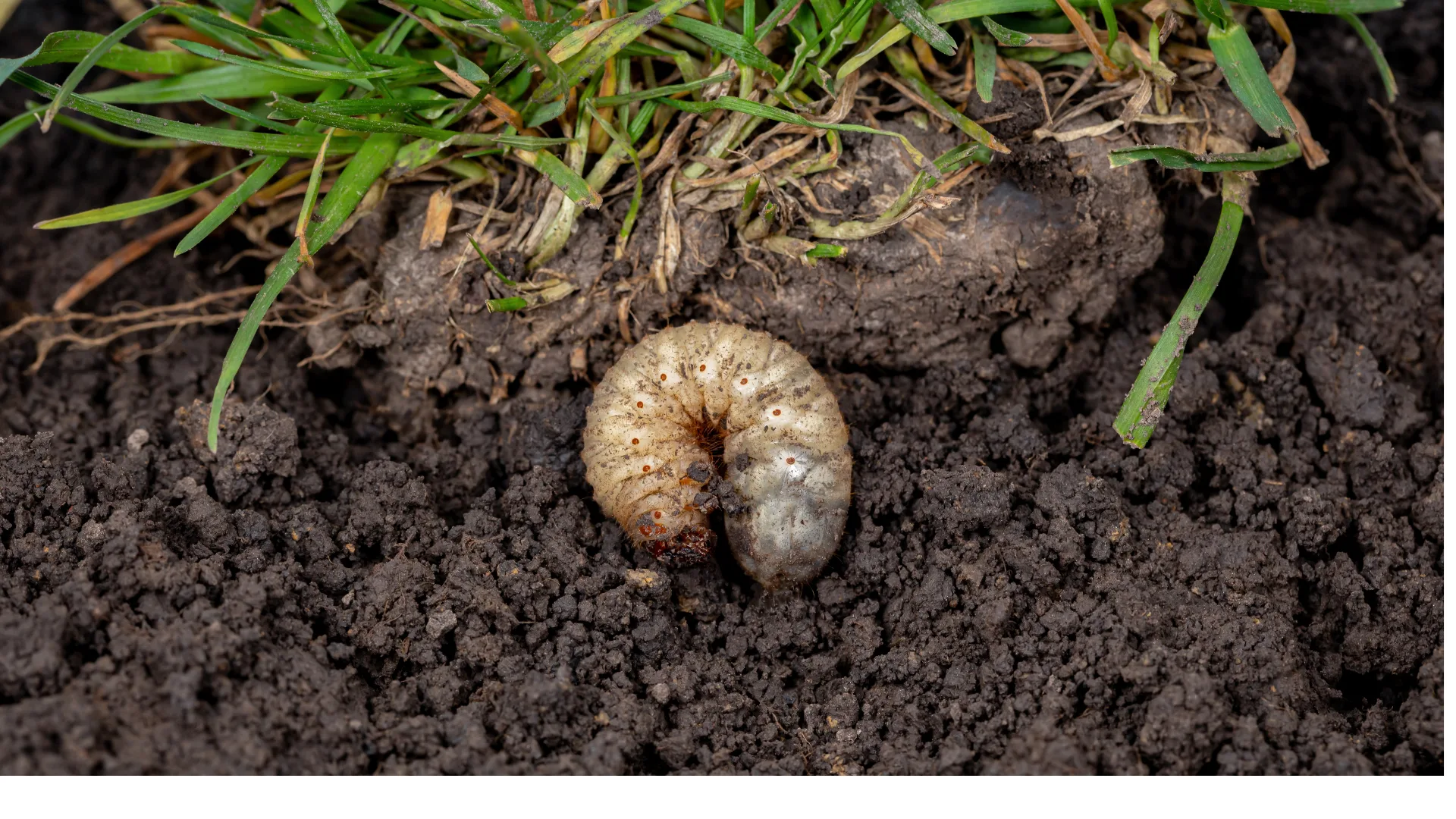
Image source: Bing (Web (fair-use with source credit))
Take samples from multiple spots. Grub populations are rarely uniform across a lawn. One area might have 15 grubs per square foot while another has none.
This patchy distribution is actually another clue that points toward grubs rather than a broad environmental issue like drought.
How Grub Damage Differs from Drought, Disease, and Other Lookalikes
This is where most people get tripped up. Let's break down the key differences so you can rule out the common impostors.
Grub damage vs. drought stress:
Drought-stressed grass typically has intact roots and will recover after adequate watering. Grub-damaged grass won't green up no matter how much you water because the roots are gone. The tug test separates these two quickly.
Grub damage vs. fungal disease:
Fungal diseases like brown patch or dollar spot often produce distinct patterns. Brown patch creates circular areas with a darker "smoke ring" border. Dollar spot makes small, round spots about the size of a silver dollar.
Grub damage is more irregular and doesn't show the defined edges or fungal structures you'd see with disease.
Grub damage vs. dog urine:
Dog urine spots are usually small, round, and surrounded by a ring of dark green grass (from the nitrogen concentration). Grub patches are larger, irregular, and don't have that dark green border.
Grub damage vs. compacted soil:
Compacted areas tend to show thin, struggling grass rather than sudden death. The ground feels hard underfoot, not spongy. Water pools on the surface instead of soaking in.
Grub damage vs. chinch bugs:
Chinch bugs cause damage that looks similar, but they feed above ground on grass stems and crowns. You can often see the tiny black-and-white insects at the base of grass plants in sunny areas. Grubs work entirely below the surface.
If you're still unsure after checking these signs, cut a sample and look for the larvae. Nothing confirms a grub problem faster than seeing the grubs themselves in the root zone.
What the Grubs Themselves Look Like Up Close
Not all grubs are the same species, but most of the common lawn-damaging types share a similar body plan. They're soft-bodied, creamy white, and curl into that distinctive C-shape when at rest or disturbed. The head is usually brown or tan, and you'll see six small legs right behind it.
Here's a quick reference for the species most likely to show up in residential lawns:
| Species | Size | Key Identifying Feature | Common Region |
|---|---|---|---|
| Japanese beetle | Up to 1 inch | V-shaped raster pattern on underside of tail tip | Eastern and midwestern US |
| European chafer | About ½ to ¾ inch | Y-shaped raster pattern | Northeastern US, Great Lakes |
| May/June beetle | Up to 1½ inches | Larger, stiffer body | Widespread across US |
| Black turfgrass ataenius | About ½ inch | Smaller, darker body | Northern US, sports turf |
| Masked chafer | About ¾ inch | Similar to Japanese beetle but hairier raster | Eastern and central US |
The raster pattern is the arrangement of tiny hairs and spines on the underside of the grub's last abdominal segment. You need a hand lens to see it properly, but it's the most reliable way to distinguish between species. For most homeowners, knowing you have grubs is enough to make a treatment decision.
Species-level ID matters more if you're timing preventive applications, since different beetles lay eggs at slightly different times.
Grubs go through several growth stages, called instars. Early-stage instars are small, maybe a quarter inch, and do relatively little damage. By the third instar in late summer, they're large enough to devour significant root mass in a short period.
That's when visible damage accelerates.
Secondary Signs: Animals Tearing Up Your Lawn
Sometimes the animals arrive before the grubs get blamed. Skunks, raccoons, and birds are all grub predators, and they'll dig through turf to get at them. A skunk typically rolls back small sections of sod with its front paws.
Raccoons are messier, tearing up larger patches and sometimes pulling apart the turf piece by piece. Birds leave smaller, scattered holes or peck marks in the ground as they probe for larvae.
This secondary damage can actually be more visible than the grub damage itself. You might wake up to find a section of lawn that looks like it's been rototilled overnight. The confusing part is that by the time animals start digging, the grub damage underneath has usually already been happening for weeks.
Animal activity is a strong clue, but it's not foolproof proof. Other soil insects like earthworms and cutworms can attract some digging too. If animals are tearing up your lawn, cut a sample section and check for grubs in the top 3 inches of soil.
You'll almost certainly find them if vertebrate predators are that interested.
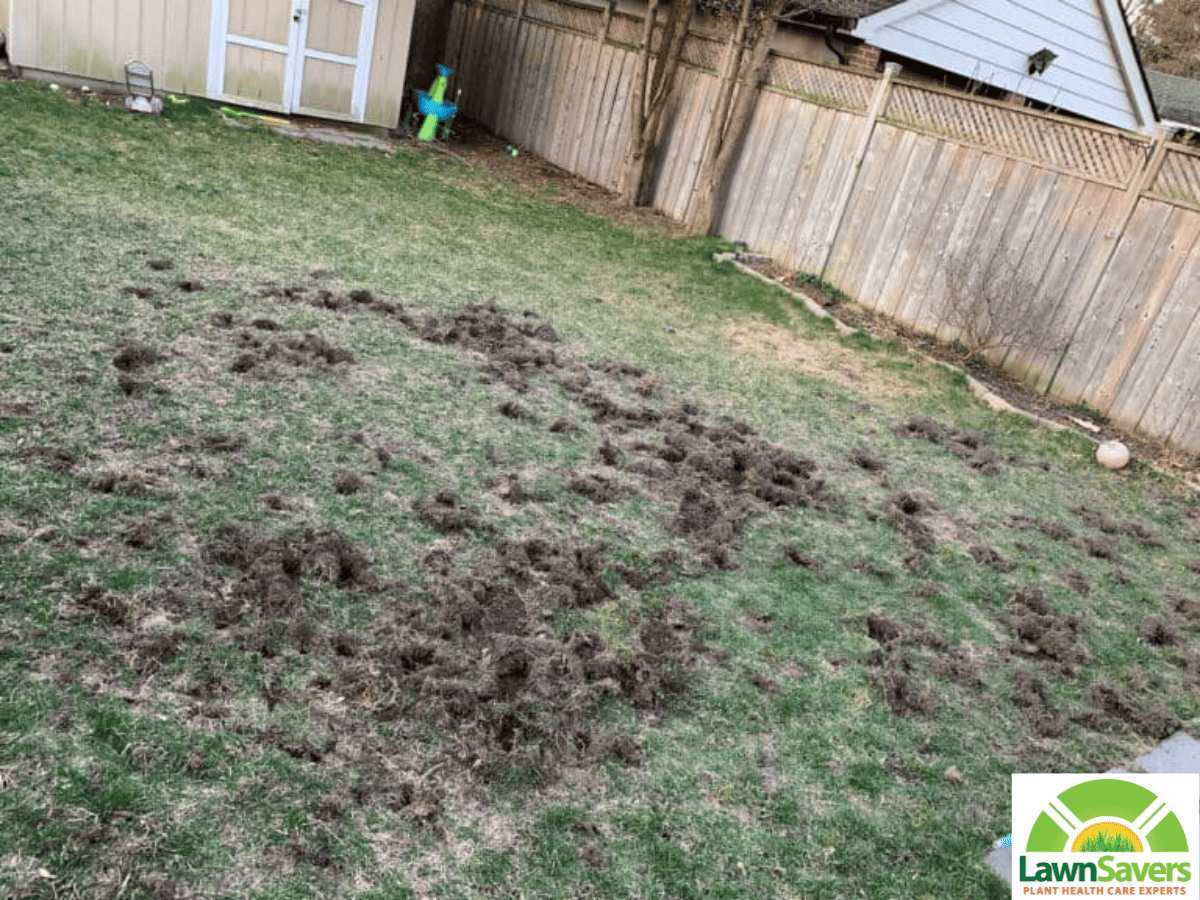
Image source: Bing (Web (fair-use with source credit))
When Grub Damage Is Actually Worth Treating
Finding a few grubs doesn't automatically mean you need to treat. Healthy, well-maintained turf can tolerate moderate grub populations without showing visible damage. The grass grows new roots as fast as the grubs consume them.
Treatment becomes worthwhile when you're seeing the threshold numbers we discussed earlier and the grass is already showing stress. Add in any of these factors and treatment makes even more sense:
- Your lawn has a history of grub problems
- The turf is already weakened by drought, heavy foot traffic, or other stress
- You're growing a turf type that's particularly susceptible, like Kentucky bluegrass
- Animal digging is creating its own cosmetic damage on top of the root loss
Timing matters enormously for treatment success. Curative products work best in late summer when grubs are small and actively feeding near the surface. By fall, the grubs burrow deeper and become harder to reach.
Preventive applications, on the other hand, go down in late spring to early summer before the next generation of eggs hatch.
How to Tell If the Damage Is Already Done
Sometimes the damage is visible but the grubs are no longer worth targeting. If it's late fall or early spring and you're seeing brown patches, the grubs may have already pupated and transformed into adult beetles. Those brown patches are leftover damage from the previous year.
Here's how to tell which scenario you're in:
Active current damage:
- Turf is spongy and lifts easily
- Grubs are visible in the root zone right now
- Patches are still expanding
- Animal activity is ongoing
Old damage from last season:
- Turf feels firmly rooted
- No grubs found in new samples
- Patches have stopped spreading and may show some new green growth at the edges
- Ground is firm, not spongy
If you're looking at old damage, hold off on treatment. Focus instead on renovating those areas with overseeding or fertilization to help the surrounding grass fill in. Plant roots can take weeks to recover, so give the lawn time before deciding it's a lost cause.
Come spring, most grub-damaged areas that still had some root structure will recover on their own with proper care.
Common Mistakes When Diagnosing Grub Damage
Even experienced gardeners get tripped up on a few recurring errors. Here are the ones that waste the most time and money.
Treating without confirming grubs are present. This is the biggest one. People see brown patches and immediately apply grub control without checking the soil. If the real culprit is fungal disease or irrigation failure, that product does nothing and the lawn keeps dying.
Testing only one spot. Grub populations are patchy. A single 1-square-foot sample might miss the problem entirely. Take at least three to five samples from different areas of the lawn, focusing on the transition zones between healthy and damaged turf.
Waiting too long to inspect. Once grubs are visible as large larvae in August and September, they've already been feeding for weeks. Earlier scouting in June and July gives you a heads up before damage becomes visible.
Assuming all brown patches have the same cause. A lawn can have multiple problems at once. The east side might have grub damage while the west side has brown patch fungal disease. Treat each area based on what's actually happening in that section.
Applying preventive products too late. Preventive grub treatments need to be in the soil before eggs hatch. Applications made after the grubs are already large won't give you the protection you expect. Most university extension services recommend a window of late May through early July for preventive products in northern climates, timing the application to local beetle flight activity.
Frequently Asked Questions
How do I know if my dead grass is from grubs or just drought?
The tug test is your fastest answer. Grab the brown grass and pull firmly. If it lifts away from the soil with almost no resistance, the roots have been eaten and grubs are the likely cause.
If the grass holds firm and the roots look intact, drought or disease is more probable. Grub-damaged turf won't recover with watering because the roots are gone.
What time of year does grub damage show up?
Grub damage typically becomes visible from mid-summer through early fall, peaking in August and September for most cool-season grass regions. The grubs have been feeding since the previous summer's egg hatch, but the damage doesn't show until the grass is already stressed by heat and dry conditions. Spring damage is possible too if winter was mild and grubs fed early.
Can a lawn recover from grub damage on its own?
Yes, if the root system isn't completely destroyed. Light to moderate grub feeding often allows the lawn to bounce back with proper watering and fertilization. Severe damage where roots are entirely gone usually requires overseeding or sodding to repair.
Give the lawn a few weeks after grubs are controlled before deciding whether renovation is necessary.
How many grubs per square foot is considered a problem?
Most guidelines cite 5 to 10 grubs per square foot as the treatment threshold for cool-season turf. Warm-season grasses can sometimes tolerate higher numbers. Below 5 per square foot, healthy turf usually outpaces the feeding damage.
The context matters too, a lawn already stressed by drought or heavy traffic will show damage at lower grub counts.
What animals dig for grubs at night?
Skunks and raccoons are the most common nighttime grub predators. Skunks roll back small patches of turf with their front paws. Raccoons tear up larger sections and can do significant cosmetic damage in a single night.
Crows and starlings also feed on grubs but cause smaller, more scattered peck marks rather than rolled-up sod.
Is there a natural way to control grubs without chemicals?
Beneficial nematodes, specifically Heterorhabdacter bacteriophora, are microscopic worms that seek out and kill grubs in the soil. Milky spore disease targets Japanese beetle grubs specifically but takes several years to build up effective populations. Both work best when applied to moist soil in late summer and watered in thoroughly.
They're slower acting than chemical options but avoid pesticide concerns.