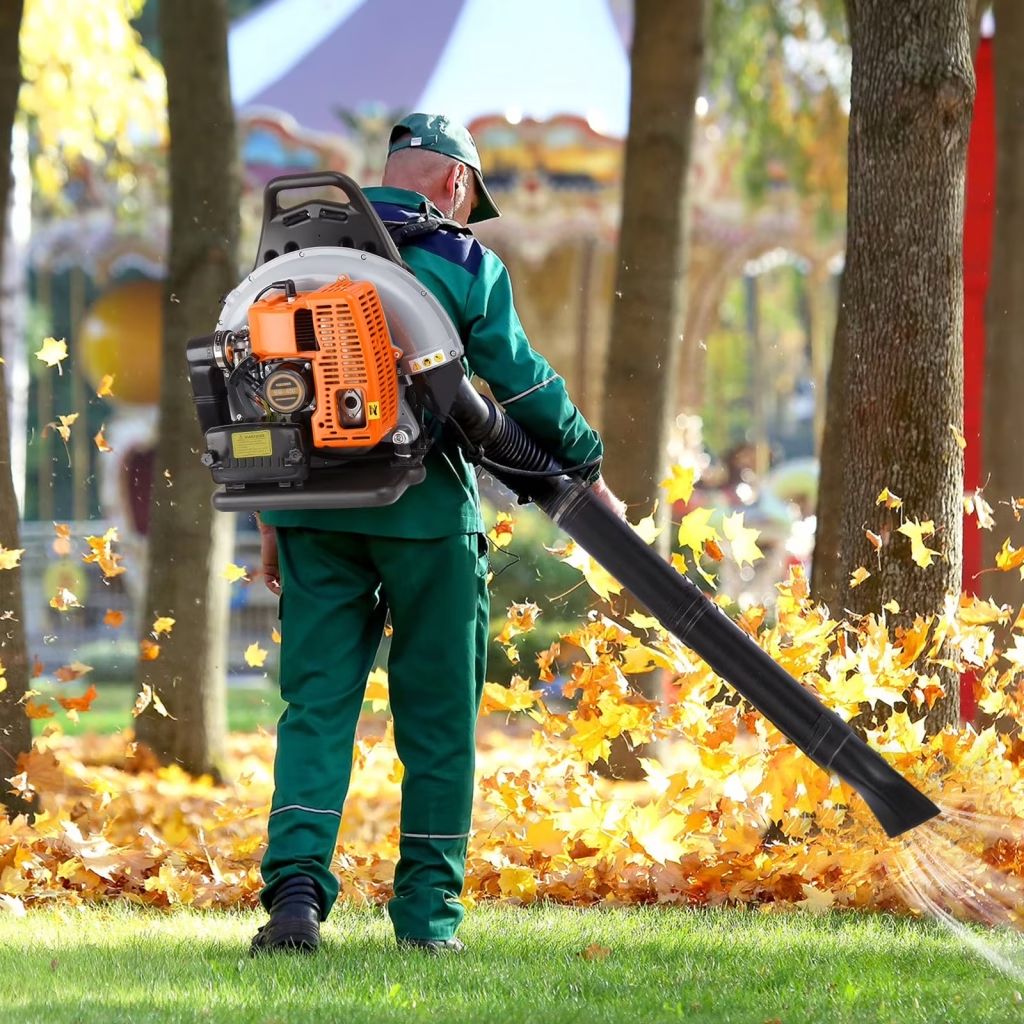
If you’ve ever finished a fall cleanup with a handheld blower and felt like your arm was about to fall off, switching to the best lawn blower for backpack use isn’t an upgrade, it’s a different job entirely. The weight moves off your wrist and onto your hips and shoulders, where your body can carry 20-plus pounds for an hour without screaming at you. That shift changes how long you can work and how much ground you actually cover.
Manufacturer specs tell you a backpack blower pushes 500 to over 900 cubic feet per minute of air, but the real unlock is the hour of steady runtime you get with both hands free. Per ANSI B175.2 testing, these machines move debris at 150 to 250-plus mph, yet the spec sheet alone won’t tell you why the harness fit determines whether you finish the job or quit early. That’s where the engineering behind the straps and the fan really pays off.
Quick Answer
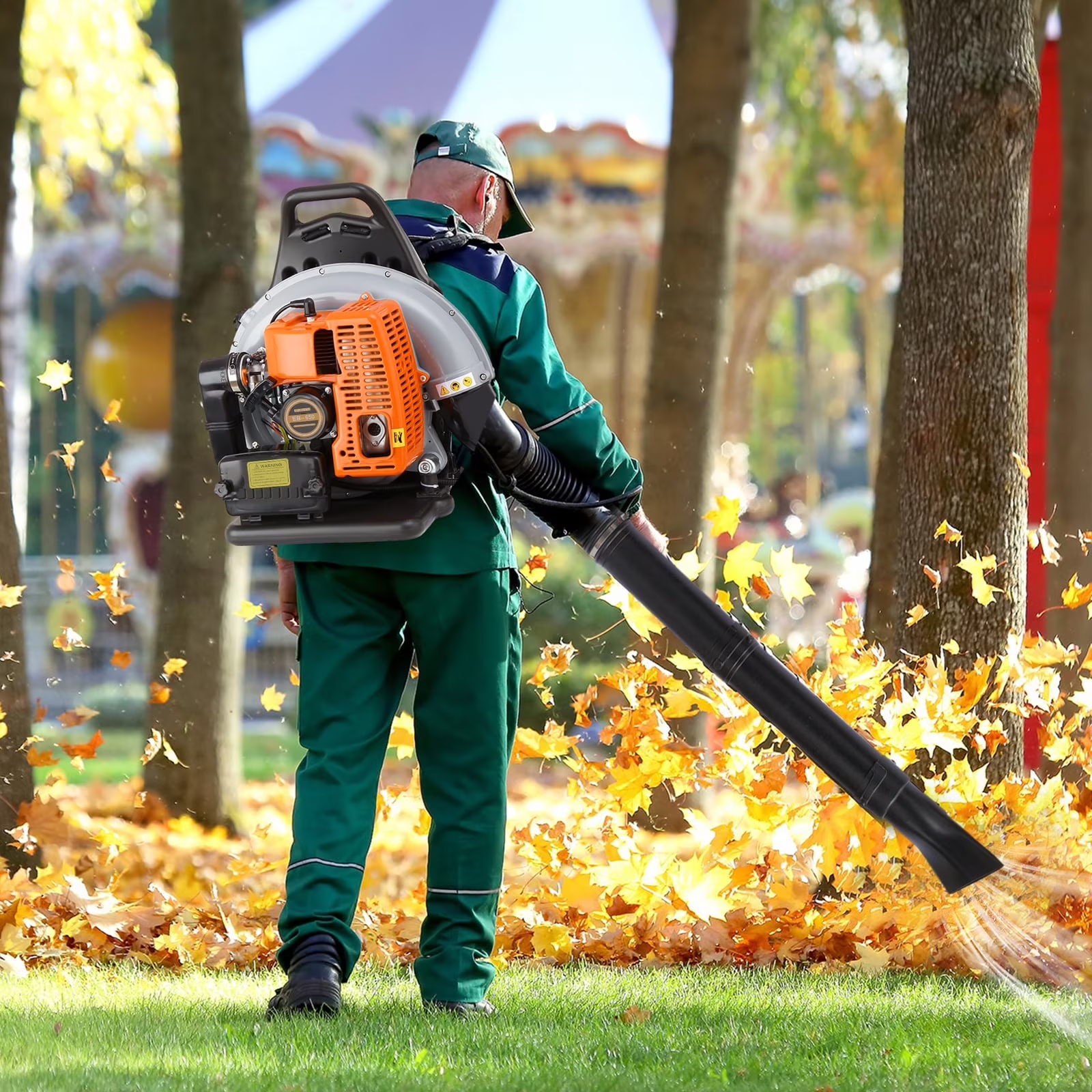
For most homeowners on half an acre or more, the best lawn blower for backpack use is a mid-range gas model from Stihl, Echo, or Husqvarna. Look for 500 to 600 CFM. That hits the sweet spot of clearing power and manageable weight.
Battery backpack blowers from EGO or Makita now rival gas for quiet neighborhoods. Commercial crews need 700-plus CFM units built for all-day abuse.
Why Swapping a Handheld for a Backpack Blower Changes Everything
Handheld blowers ask your forearm and wrist to do the heavy lifting. After 20 minutes, fatigue sets in and you start cutting corners. A backpack blower distributes the load across a padded shoulder harness and a wide waist belt.
Your arms just guide the tube. That’s why pros can run them for hours without stopping.
The other leap is air volume. Handhelds typically max out around 450 CFM. Entry-level backpack blowers start there and climb past 900 CFM.
That extra volume moves wet, matted leaves and heavy grass clippings that a handheld would just scatter. You clear more ground in a single pass.
Battery technology has also closed the gap enough that a cordless backpack blower can handle a suburban yard on a single charge. The ability to skip gas mixing and pull-starts now comes with runtimes approaching 90 minutes on high-capacity packs. That simply wasn’t possible a few years ago.
What Actually Makes a Backpack Blower Worth Your Money
CFM, MPH, and Newtons: Which Number to Trust
CFM, or cubic feet per minute, tells you how much air the blower moves. MPH tells you how fast it comes out. High MPH sounds impressive, but a narrow, fast airstream often falls short on big piles.
What you really want is volume, CFM, to push a wide swath of debris. Some manufacturers now list Newtons, a combined measure that accounts for both. A Newton force above 25 starts to feel genuinely powerful in real use.
Ignore the temptation to chase the highest MPH on the box. A 500-CFM blower with a well-designed tapered nozzle clears more leaves faster than a 400-CFM unit screaming at 230 mph. CFM is the number that does the actual work.
2-Stroke Gas, 4-Stroke Gas, or Battery: The Real Tradeoffs
2-stroke engines still dominate backpack blowers because they pack the most power into the lightest package. They require mixing oil with gasoline, run louder, and produce more emissions. Brands like Stihl, Husqvarna, and Echo have refined 2-stroke tech to be remarkably reliable. 4-stroke backpack blowers are rare but run cleaner and quieter, though they’re heavier and more complex.
Battery backpack blowers have crossed the threshold for serious residential use. Brushless motors in the EGO 56V or Makita 64V systems generate CFM ratings that compete with mid-size gas blowers. The tradeoff: runtime is finite and large batteries cost more than you might expect.
For a property under an acre, battery is now a legit choice. For commercial crews or multi-acre properties, gas still wins on endurance.
Harness Design and Ergonomics: Where the Best Units Pull Ahead
A blower that hurts your back after 30 minutes is useless no matter how much CFM it produces. Good harnesses use wide, ventilated padding at the shoulders, a sternum strap to prevent the pack from shifting, and a load-bearing hip belt that transfers weight off the spine. Stihl’s semi-rigid backplate design and Husqvarna’s ergonomic frame set the benchmark.
Cheaper units skimp on padding and instead of a hip belt you get a simple strap, fine for a few minutes, torture after an hour.
Throttle placement also matters. Tube-mounted throttles put the control right under your thumb while your arm hangs naturally. Hip-mounted throttles can be awkward to reach and force a constant twist.
For long cleanups, a cruise control that holds the throttle at your chosen speed spares your hand entirely.
Gas Backpack Blowers: The Heavy Hitters for Large Properties
Stihl, Husqvarna, and Echo: The Commercial Trio Compared
These three brands own the pro market for good reason. The Stihl BR 600 delivers a balanced 756 CFM at 201 mph while weighing just over 22 pounds, a combo that works for both daily commercial routes and serious homeowners. Its big brother, the BR 800, cranks 912 CFM but adds a few pounds and a higher price tag.
Husqvarna’s 350BT is a lighter, simpler machine at 494 CFM that’s ideal for smaller crews or home use. The 570BTS pushes 768 CFM and includes an X-Torq engine that burns cleaner and uses less fuel. Echo’s PB-580T lands in the middle with 510 CFM and a tube throttle, while the PB-9010T is a beast at 1110 CFM, the most powerful handheld-style backpack blower you can buy right now.
All three brands have strong dealer networks, so parts and service are accessible. That alone is a tiebreaker if you don’t want to ship a broken blower back to a warehouse.
RedMax and Schroder: Where Budget and Pure Power Fit In
RedMax’s EBZ8500 is a high-output machine that rivals the top Stihl and Echo models in raw CFM, often at a slightly lower price. It’s a favorite for large commercial properties where every dollar spent on equipment needs to earn back fast. Schroder’s SR-6400L fills the other end of the spectrum: a bare-bones 64cc backpack blower under $200 that gives you gas power on a shoestring.
You give up refinement, vibration control, and long-term durability, but for a few big cleanups a year it can make sense.
Battery Backpack Blowers: Finally Good Enough to Compete
EGO, Makita, Greenworks, and DeWalt: How the Big Four Stack Up
EGO’s LBX6000 uses a 56V battery to produce 600 CFM and 180 mph in a package that weighs under 17 pounds with the battery. It runs about 45 minutes on a 7.5 Ah pack and recharges quickly. Makita’s EB7660TH delivers 670 CFM from two 18V batteries bridged to 36V, with an impressive runtime that tops an hour using 6.0 Ah packs.
Greenworks’ 80V backpack blower hits 580 CFM and survives a full suburban leaf season on a single battery charge if you run it at moderate speed. DeWalt’s DCBL772 puts out 600 CFM from a 60V FlexVolt battery, making it a smart pick if you already own other DeWalt 60V tools. Each system ties you to a battery platform, so choose based on the gas or battery mower you might already use on the rest of the yard.
Runtime, Charging, and Cold-Weather Performance Reality Check
Maximum CFM numbers in battery blowers come at full throttle, which chews through a battery fast. The 45- to 60-minute runtime you see in marketing is often at half power. In real leaf-clearing duty, you’ll get closer to 20 to 30 minutes of hard use per charge.
That’s enough for a quarter-acre yard with a spare battery ready. For properties that take an hour or more to clear, you’ll need multiple batteries or a gas unit.
Cold weather also saps lithium-ion power. On a chilly November morning, runtime can drop by 10 to 15 percent. Keep spare batteries indoors until you need them and consider a rapid charger that gets you back up and running in under an hour.
Side-by-Side Specs: CFM, Weight, Noise, and Runtime at a Glance
| Model | Power Source | CFM (max) | Weight (lbs) | Noise (dB) | Approx. Runtime |
|---|---|---|---|---|---|
| Stihl BR 600 | Gas (2-stroke) | 756 | 22.5 | 75 | 50 min / tank |
| Husqvarna 350BT | Gas (2-stroke) | 494 | 22.5 | 104 | 45 min / tank |
| Echo PB-9010T | Gas (2-stroke) | 1110 | 26.4 | 79 | 45 min / tank |
| EGO LBX6000 | Battery (56V) | 600 | 16.9 | 64 | 45 min (7.5 Ah) |
| Makita EB7660TH | Battery (36V) | 670 | 21.2 | 61 | 60 min (6.0 Ah) |
| DeWalt DCBL772 | Battery (60V) | 600 | 20.5 | 66 | 40 min (9.0 Ah) |
| RedMax EBZ8500 | Gas (2-stroke) | 908 | 24.5 | 76 | 55 min / tank |
| Schroder SR-6400L | Gas (2-stroke) | 460 | 22.0 | 97 | 40 min / tank |
Weight listed for gas models is dry, without fuel. Noise readings are at the operator’s ear per manufacturer data; local sound ordinances vary. Runtime estimates assume a mix of idle and full-throttle use.
Dig into those numbers and you’ll see why raw CFM isn’t everything. The Stihl BR 600 weighs the same as the 350BT but moves over 250 more CFM, a testament to better fan and engine design. The Echo PB-9010T hits numbers that make it overkill for a typical lawn but perfect for a municipal grounds crew clearing football-field-sized leaf beds.
Battery units cluster around 600 CFM because that’s the efficiency sweet spot for current brushless motor tech. They run dramatically quieter, which matters if you have neighbors within earshot or you’re tired of wearing earplugs. As of 2026, the battery backpack blower category is no longer a compromise; it’s a legitimate alternative that just requires a battery to match the size of your lawn.
If you’re used to a push mower that struggles on slopes, you already know that equipment matched to the terrain saves time. A mower built for hills follows the same logic: the right tool for the specific challenge. A backpack blower is no different, pick one that fits your acreage, not the most impressive specs on a shelf.
Matching the Blower to Your Property Size and Cleanup Load
Pick by acreage and debris type, not by the biggest number on the box. A small yard needs control and quiet operation. A large property needs runtime and airflow that holds up under heavy leaf loads.
| Property size | Best fit | Why it works |
|---|---|---|
| Under 1/4 acre | Battery, 450 to 550 CFM | Light, quiet, enough for quick cleanup |
| 1/4 to 1/2 acre | Battery, 550 to 600 CFM | Good balance of power and runtime |
| 1/2 to 1 acre | Gas or battery, 500 to 650 CFM | Handles deeper piles without stalling |
| 1 to 3 acres | Gas, 700+ CFM | Better endurance and faster clearing |
| Commercial use | Gas, 750+ CFM | Built for daily abuse and easy service |
Wet oak leaves need volume more than speed. Pine needles need a controlled airstream so they do not scatter everywhere. Gravel drives call for lower throttle and a wider nozzle pattern.
If your whole shed runs on one battery platform, match the blower to your cordless walk-behind options so chargers and packs carry over. That saves real money.
Half-Acre Yards and Suburban Lots
A 500 to 600 CFM unit clears a half-acre in about 20 to 35 minutes. Battery models shine here because they start instantly and skip the fumes. If your trees drop heavily, keep a second battery charged and nearby.
Acreage, Farms, and Heavy-Duty Leaf Season
Move to gas once you pass an acre. A 65cc backpack blower with 700 CFM handles wet leaves, long fence lines, and repeated sessions without waiting on a charger. Refueling takes less than two minutes.
For very large properties, look for cruise control and a hip-mounted throttle. Those features reduce hand fatigue when you are clearing for an hour or more.
Professional Crews Running Daily Routes
Buy for service network and parts availability. Stihl, Echo, and Husqvarna dealers usually keep common wear parts in stock. That matters when downtime costs you money.
Crews should also look for commercial warranties, heavy-duty air filtration, and easy access to the spark plug and fuel filter. Small conveniences add up over a full season.
The Harness Fit Nobody Talks About Until Their Shoulders Hurt
A bad harness turns a strong blower into a chore. The pack should sit high on your back, not sag against your lower spine. The hip belt should carry most of the weight, while the shoulder straps mainly stabilize the load.
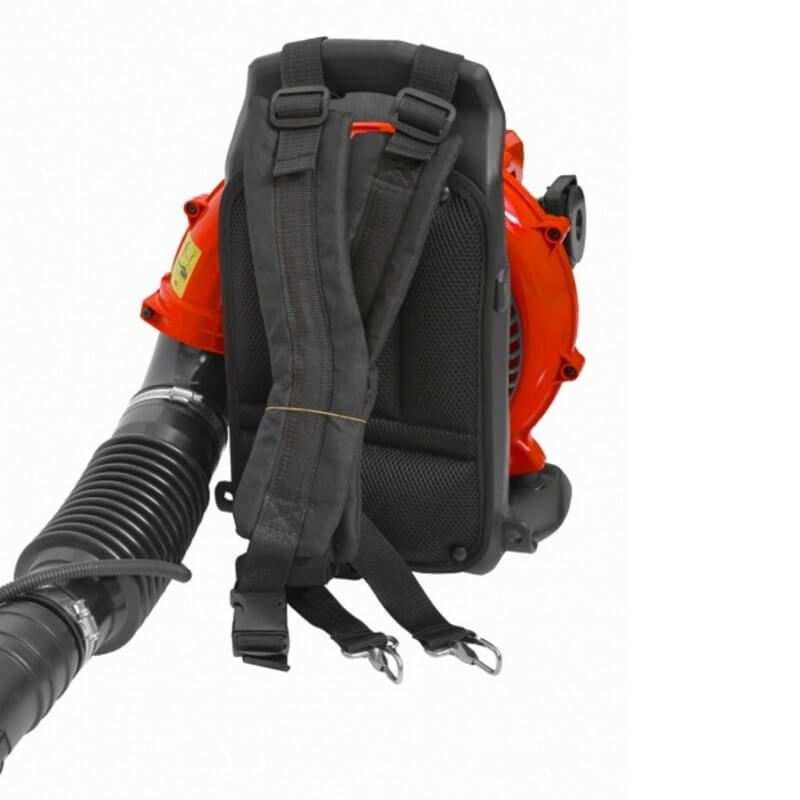
Look for padded shoulder straps, a sternum strap, and a ventilated back panel. If the unit sways when you turn, tighten the hip belt first. Then shorten the shoulder straps slightly.
Anti-vibration mounts matter too. They reduce hand tingling and make long sessions far more comfortable. Cheap frames often transfer engine buzz straight into the straps and your shoulders.
Tube Throttle vs Hip Throttle: Why It Matters After Hour Two
Tube throttle is better for most users. Your thumb controls speed while your wrist stays in a neutral position. That feels natural after the first few minutes and even better after the first hour.
Hip throttles can free up the tube hand, but they often force a twist at the waist. Some users like them, but many find them awkward. Cruise control helps on long open lawns because you can lock the throttle and relax your grip.
Noise, Neighbors, and Local Rules You Can't Ignore
Battery blowers are the safe pick near neighbors. Most run around 60 to 66 dB at the operator’s ear. Gas units often sit near 75 dB or higher, and some older models are louder still.
Check local ordinances before early morning work. Many towns limit outdoor power equipment to certain hours. HOAs can be stricter than city code, so a quiet battery unit may save you a complaint.
For paid crews, hearing protection is not optional. OSHA sets exposure limits for workplace noise. Even if you feel fine after one job, repeated exposure adds up over a season.
Common Mistakes That Turn a Good Blower Into a Bad Experience
Bad Fuel Mix, Wrong Oil, and Storage Rot
Most gas backpack blowers use a 50:1 fuel mix. Use fresh gasoline and a quality 2-stroke oil. Do not use automotive oil in a 2-stroke mix, and do not guess the ratio.
Ethanol-heavy fuel attracts moisture and gums up carburetors. If the blower will sit for 30 days or more, add stabilizer or run the tank dry. Old fuel is the top cause of hard starting.
The same habit helps with routine mower upkeep across your whole shed. Fresh fuel prevents half the spring headaches people blame on the machine.
Chasing High MPH Instead of Usable CFM
High MPH moves fast air through a small area. Usable CFM moves a wide pile. A narrow blast can scatter leaves instead of moving them cleanly.
Match the nozzle to the job. Round nozzles give focused speed for stuck-on debris. Flared nozzles spread air for final cleanup on lawns and drives.
Keep the tube just above the grass, not digging into it. Too low, and you kick up dirt, mulch, and small stones. Too high, and you lose clearing force.
What a Full Season of Ownership Actually Looks Like
Starting, Tuning, and Day-to-Day Operation
Gas models start easier when you follow the same routine every time. Use choke for a cold engine. Open the throttle slightly and pull until it fires, then move the choke to half or off.
If it starts but dies, check fuel age, air filter, and spark plug first. Many no-start issues follow the same patterns covered in small engine troubleshooting. Fix the simple things before you assume the worst.
Maintenance That Keeps It Running Past the Warranty
Clean the air filter after dusty jobs. Inspect tube clamps and straps weekly during leaf season. Replace worn padding before it fails mid-job.
For battery units, keep the contacts clean and store packs at room temperature. Do not leave them in a hot truck or a freezing shed. A little care adds years to the tool.
What You'll Spend and What's Worth Stretching the Budget For
Pay for comfort and service first. Entry gas units start near $200. Strong residential models run $350 to $600.
The Shortlist: Best Pick for Each Kind of User
Best Overall Residential Gas Backpack Blower
Stihl BR 600 is the safe pick.
Best Battery-Powered Backpack Blower for Quiet Neighborhoods
EGO LBX6000 is quiet and light.
Best Commercial-Grade Backpack Blower for Daily Pro Use
Echo PB-9010T brings maximum airflow.
Best Budget Pick That Still Gets the Job Done
Schroder SR-6400L suits occasional cleanup.
When a Walk-Behind or Handheld Makes More Sense
Handhelds fit patios and small drives. Walk-behind blowers fit long pavement.
FAQs From People Who've Never Owned One
Are backpack blowers hard to carry?
No, with a fitted hip belt.
Do battery models have enough power?
Yes, under about an acre.
What fuel do gas models use?
Fresh 50:1 mixed gasoline.
Are they worth it for tiny yards?
Usually not. Handhelds cost less.
The Bottom Line: Pick Based on Your Acres, Not the Spec Sheet
Choose gas for heavy leaves and long runtime. Choose battery for quiet suburban cleanup.