[IMAGE 1]
You've walked out to the lawn and noticed something's off. Maybe it's a brown patch that wasn't there last week. Maybe the ground feels strange underfoot.
You're wondering what does grub damage looks like, and honestly, it's a harder question than you'd think. Plenty of lawn problems wear the same disguise.
Grubs are the larvae of scarab beetles, and they feed on grass roots just below the surface. The real challenge is telling grub damage apart from drought, disease, and other common culprits. Once you know the specific visual signs, you can confirm the problem quickly.
Research from cooperative extension services consistently points to a treatment threshold of about 5 to 10 grubs per square foot for most cool-season grass lawns. Let's walk through exactly what to look for.
Quick Answer
Grub damage looks like irregular brown patches in your lawn. The turf feels spongy underfoot. It peels back easily from the soil.
You'll find C-shaped white grubs in the top few inches of dirt.
Why Grub Damage Is So Easy to Misidentify
Here's the thing most guides don't tell you upfront. Grub damage doesn't follow a neat pattern. It doesn't show up as a perfect circle like a fungal patch.
It doesn't start at the edges and work inward like drought stress often does.
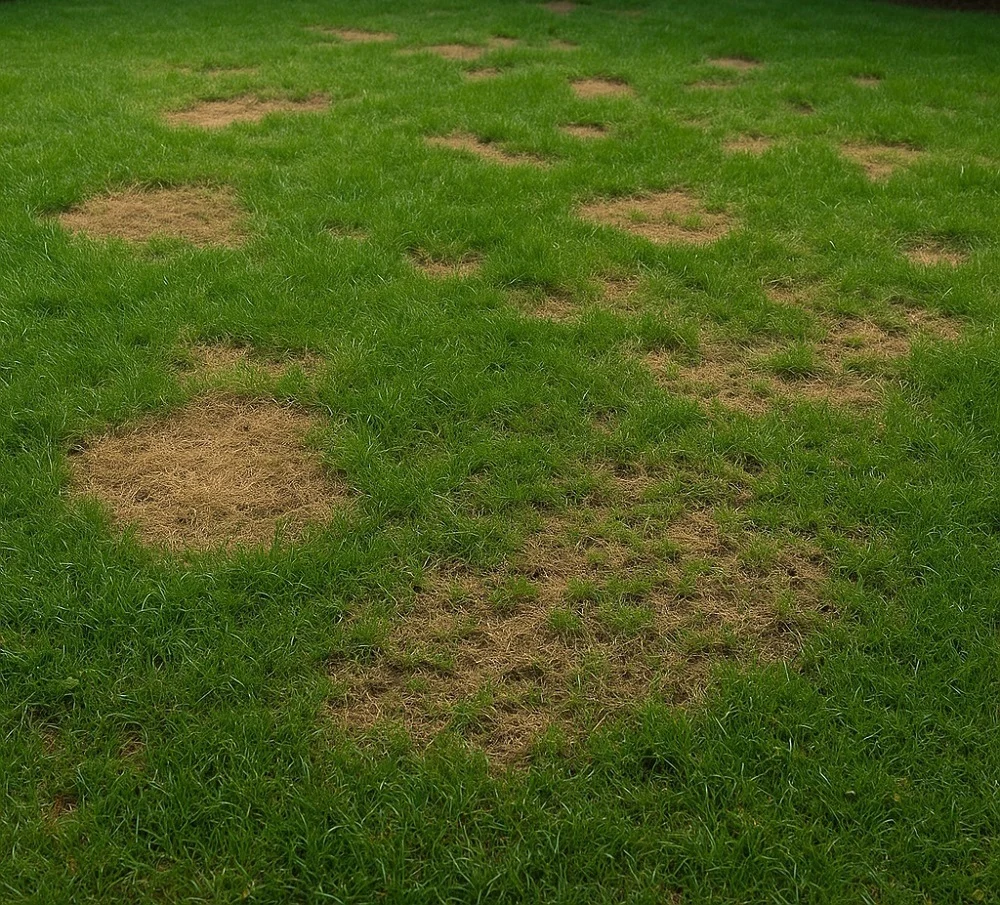
Image source: Bing (Web (fair-use with source credit))
Grub damage is random, scattered, and often appears in patches that connect over time. You might see one spot near the driveway and another near the oak tree with nothing in between. That irregularity is actually your first clue.
The second challenge is timing. Damage typically becomes visible in late summer and early fall in most temperate regions, which is exactly when grass is also stressed from heat and drought. Two problems pile on top of each other, and most homeowners blame the weather.
Our research into turfgrass science literature shows that grub damage is consistently misdiagnosed. Many homeowners treat for drought when the real issue is root-feeding larvae underground. The visual signs are specific if you know what to watch for.
Let's break them down.
The Tell-Tale Signs of Grub Damage (What Your Lawn Is Actually Showing You)
You don't need a magnifying glass or a soil test to spot grub damage from across the yard. There are four primary visual and tactile signs that set it apart from other lawn problems. Each one tells you something different, and together they paint a clear picture.
Irregular Brown Patches, Not Uniform Circles
Grub damage rarely forms a neat, round dead spot. Look for patches with uneven edges. The dead areas often look torn or ragged, not symmetrical.
Fungal diseases like brown patch (caused by Rhizoctonia solani) tend to produce more circular lesions, sometimes with a darker "smoke ring" border in the early morning. Grub patches lack that defined edge. They look more like someone took a bite out of the lawn in random places.
The patches may start small, roughly dinner-plate size. Left unchecked, they expand and merge over weeks. By the time damage is severe enough to notice from a distance, grubs have been feeding for weeks.
Spongy, Soft Turf Underfoot
Walk across the damaged area. Does it feel different under your feet?
Grub-damaged turf loses its anchor because the root system has been chewed away. The ground feels soft, almost sponge-like. Some people describe it as walking on a wet sponge, even when the soil underneath is dry.
Drought-stressed grass, by contrast, may turn brown but usually stays firm underfoot. The roots are still intact, just dormant or sparsely hydrated. If your lawn squishes when you step on it, that softness is a strong indicator of root damage underground, and grubs are a leading cause.
Turf That Peels Back Like Carpet
This is the single most reliable surface-level sign of grub damage. When the roots are severed, the sod is basically loose.
Grab a handful of the brown grass at the edge of a damaged patch. Pull gently. If it lifts away from the soil with almost no resistance, like peeling back a rug, you've got a grub problem.
turf peeling back from grub damage
Image source: Bing (Web (fair-use with source credit))
Healthy grass holds firm because the root system grips the soil. Even drought-stressed turf takes some effort to lift. Grub-killed turf rolls right up, revealing the dirt and usually a few grubs in the process.
Animal Digging, The Secondary Red Flag You Shouldn't Ignore
If you notice skunks, raccoons, or birds tearing up your lawn, take it seriously. These animals feed on grubs and are excellent detectors of an infestation.
Raccoons peel back sections of sod with their front paws, often at night. Skunks create small cone-shaped holes as they nose into the turf. Birds pecking repeatedly at a specific area can also signal grubs below.
The damage animals cause is usually patchier and more chaotic than the grub damage itself. They're essentially doing the "peel back" test for you, just more aggressively. If animals are targeting your lawn, check those disturbed areas first.
Grub Damage vs. Everything Else: Getting the Diagnosis Right
This is where most homeowners go wrong. They see brown grass and immediately assume grubs, drought, or disease. Each of these problems requires a different response, so nailing the diagnosis matters.
grub damage vs drought stress comparison
Image source: Bing (Web (fair-use with source credit))
Grub Damage vs. Drought Stress
Drought stress typically starts on slopes, near sidewalks, and in areas with poor soil. The grass turns a uniform straw-brown and feels dry but firm. Water it deeply, and drought-stressed grass greens back up within a week or so.
Grub damage doesn't respond to watering. Those brown patches stay brown no matter how much you irrigate because the roots are gone. If you've been watering consistently and certain areas still won't recover, grubs are a likely culprit.
Grub Damage vs. Fungal Turf Disease
Fungal diseases like brown patch, dollar spot, and Pythium blight create more defined patterns. Brown patch often shows a dark border around the lesion in early morning when the grass is wet. Dollar spot produces smaller, silver-dollar-sized spots.
Grub damage is larger, more irregular, and lacks those diagnostic borders. Also, fungal diseases often respond to fungicide applications. Grub damage never does, which can be another clue if you've already tried that route.
Grub Damage vs. Dog Urine Spots
Dog urine burns tend to be small, roughly 4 to 8 inches across, with a dark green ring around the dead center. The pattern is usually scattered and relates to where your dog relieves itself.
Grub patches are much larger and lack that green halo. If you have a dog, it's easy to confuse the two. The key difference is size and the surrounding tint.
Grub Damage vs. Billbug Damage
Billbug larvae look similar to grubs but are legless and white with a darker body. They feed inside the grass stem rather than on the roots, which produces a different damage pattern.
Billbug damage often shows individual blades that break off at the crown and pull out easily. You can sometimes see a sawdust-like frass inside the hollow stem. Grub damage, on the other hand, affects the entire root zone and produces that signature spongy, loose turf.
The 5-Minute Confirmation Test: Cut, Lift, Count
Visual signs get you close, but confirming a grub infestation takes one simple test. No special tools needed. A flat spade or a sturdy knife will do the job.
Here's how to check:
Locate a damaged area. Choose a spot at the edge where green grass meets brown. Cut three sides of a 1-foot square flap, going about 2 to 3 inches deep.
Peel the sod back like a trap door. Examine the soil and root zone. Count every grub you see.
Repeat at 2 to 3 spots across the lawn.
white grub identification in soil
Image source: iNaturalist / Irene
White grubs are C-shaped with a cream-white body, a reddish-brown head, and six small legs near the head. They range from about ¼ inch (newly hatched) to over 1 inch (late instar, close to pupation). If you find them in the top 1 to 3 inches of soil at the root level, you've confirmed the problem.
Don't be alarmed if you find one or two. A small number isn't harmful. Turfgrass tolerates low grub densities without visible damage.
The treatment threshold is what matters, and we'll cover that next.
Grub Counts That Actually Matter, When to Treat and When to Hold Off
Finding every grub per square foot can get you thinking you need to respond. Not every population requires treatment, and overtreating wastes money and introduces unnecessary product into the soil.
Here's a practical threshold table based on widely cited turfgrass research:
Grubs per square foot: 0, 4
Damage risk: Low
Recommended action: Monitor; no treatment needed for most lawns.
Grubs per square foot: 5, 9
Damage risk: Moderate
Recommended action: Treat if lawn is stressed, high-value, or has a history of grub problems.
Grubs per square foot: 10 or more
Damage risk: High
Recommended action: Treat. Expect visible damage if action is delayed.
Grubs per square foot: 15 or more
Damage risk: Severe
Recommended action: Treat immediately. Animal activity often follows at this level.
A few notes on this. Newly seeded lawns and turf under heat stress have lower tolerance. In those situations, even 5 grubs per square foot can cause visible decline.
Well-established Kentucky bluegrass or tall fescue lawns can handle a bit more, especially if properly watered and fertilized.
Also, grubs go through growth stages. Early-stage larvae (¼ inch, pale) are the easiest to kill with either curative or preventive products. Late-stage grubs approaching pupation in early fall are tougher to control and may require a specific curative insecticide labeled for that use.
What the Grubs Themselves Tell You (Species, Size, and Timing)
Not all grubs are identical, and the species in your lawn affects when damage appears and how quickly it progresses. The most common white grub species in residential lawns across the United States include Japanese beetles (Popillia japonica), European chafers (Amphimallon majale), and masked chafers (Cyclocephala spp.).
Japanese beetle grubs tend to cause damage earliest in late summer. European chafers are common in the Northeast and Midwest and can produce particularly severe damage in September through October. Masked chafers are prevalent across much of the eastern half of the country and follow a similar schedule.
June beetle (Phyllophaga species) grubs have a longer life cycle, sometimes taking two to three years to mature. Damage from June beetles can be less sudden but more persistent over multiple seasons.
The species matters less for diagnosis and more for timing your treatment. If you're applying a preventive product, you need to know when adult beetles are laying eggs in your area. That window typically runs from late June through July, depending on latitude and local climate.
State cooperative extension services provide excellent regional timing charts. As of 2026, many have updated these to reflect shifting beetle flight patterns over the past decade.
Size matters because grub age determines treatment effectiveness. Small, early-stage grubs (under ½ inch) respond well to all common control products. Larger grubs that are close to pupating may need the stronger curative options available.
How Location and Grass Type Change What Damage Looks Like
Grub damage doesn't look identical across every yard. Your grass type, local climate, and soil conditions all influence how the damage appears and when it becomes obvious.
Cool-season grasses like tall fescue, Kentucky bluegrass, and perennial ryegrass dominate the northern half of the United States. Damage typically shows up in August and September, when heat and drought already stress the turf. Grub feeding on already weakened roots accelerates the damage.
Dead patches appear fairly suddenly during this period.
Warm-season grasses like Bermudagrass, zoysiagrass, and St. Augustinegrass grow across the South and transition zone. Grub damage in these lawns often appears in the following spring rather than the previous fall.
The grubs do their feeding in autumn, but the grass masks the damage while dormant in winter. You notice the dead patches when the lawn fails to green up properly in April or May.
Soil type plays a role too. Sandy soils drain quickly and dry out faster. Grass in these areas shows damage sooner because there's less moisture reserve.
Heavy clay soils hold more water, which can delay visible symptoms even when grub feeding is active.
Drought during the summer amplifies everything. A lawn with adequate rainfall might tolerate 8 to 10 grubs per square foot without visible damage. That same lawn under drought stress might show browning at just 3 to 5 grubs per square foot.
Mistakes That Cost Homeowners Time and Money
Most grub treatment failures come down to one of a few common errors. Knowing them ahead of you can save you a full season of frustration.
Missing the treatment window is probably the biggest one. Homeowners often notice damage in September, buy a product, and apply it only to find it's too late. Curative products work best on small, young grubs, not the large, late-stage ones visible during peak damage.
That's why preventive applications in early summer are so effective. They target grubs when they're most vulnerable.
Skipping the confirmation test is another costly mistake. Not every brown patch is caused by grubs. Treat lawns with fungal disease using a grub control product, and you've spent money on the wrong solution while the real problem spreads.
Always inspect the soil before buying anything.
Watering patterns can mask early damage and lead to wasted water. If a lawn stays green in some areas but browns out elsewhere, check the brown areas specifically. More water won't fix grub damage and can actually encourage fungal disease on the healthy grass.
Over-applying product beyond label rates won't kill more grubs. It increases risk to non-target organisms and can contaminate runoff. Follow the labeled rate.
It's there for a reason.
Ignoring the animal activity connection is another missed signal. If skunks are digging nightly, that's essentially a free grub detection service. Check those disturbed areas first to confirm the infestation before treating the whole yard.
What to Do Once You've Confirmed Grub Damage
You've cut the sod, counted the grubs, and confirmed the numbers are above the threshold. Now what?
First, decide between curative and preventive treatment. If you're catching the problem in late summer or early fall and grubs are already present, a curative insecticide is appropriate for immediate reduction. Products containing carbaryl or trichlorfon are commonly labeled for this use and work relatively fast, often within a few days.
If you're planning ahead, preventive products containing imidacloprid, chlorantraniliprole, or clothianidin are applied before beetles lay eggs. That means a window from roughly May through mid-July, depending on your region. These products target newly hatched grubs and provide a longer period of protection.
For those looking at biological control, beneficial nematodes (Heterorhabditis bacteriophora) and milky spore disease (Paenibacillus popilliae) are options, though they require specific soil conditions to work well. Nematodes need moist soil and warm temperatures. Milky spore is most effective against Japanese beetle grubs specifically and can take several years to build up in the soil.
After treatment, focus on lawn recovery. Reseeding damaged areas in early fall (for cool-season grasses) or late spring (for warm-season grasses) gives you the best chance of filling in dead patches. Grub-killed sod leaves behind loose soil.
Rake the dead material away, loosen the top inch of soil, seed, and keep the area consistently moist until germination.
New grass doesn't need heavy foot traffic while it's establishing. And keeping up with proper mowing height, fertilization, and irrigation will help the lawn outgrow minor damage over time.
Frequently Asked Questions
How can I tell the difference between grub damage and fungus?
Grub-damaged turf peels back easily because roots are severed. You'll find C-shaped white grubs in the top 2 to 3 inches of soil. Fungal disease patches often have defined borders, sometimes with a dark ring in damp morning conditions, and the grass stays anchored to the soil.
What month does grub damage usually appear?
In most temperate regions, visible grub damage peaks between August and October. That's when grubs are largest and feeding most aggressively, and when heat and drought compound the stress on the lawn.
Do I need to treat if I find just a few grubs?
No. Healthy, well-maintained turf can tolerate low grub populations without visible damage. Treatment thresholds for most cool-season lawns start around 5 grubs per square foot.
Can grub-damaged lawn recover on its own?
Sometimes, if grub numbers are low and the grass has enough root mass to regenerate. But once turf turns fully brown and detaches from the soil, that area usually needs reseeding even after the grub population is controlled.
How long does a curative grub treatment take to work?
Most curative insecticides reduce grub populations within a few days to a week of application. You'll know it's working when animal digging activity stops and no new damage appears.
Should I reseed before or after treating for grubs?
Seed after treatment. Applying insecticide first eliminates the food source for new grubs before you put down expensive seed and water. Reseeding too early often just feeds the next wave of larvae.
The Bottom Line
Grub damage has a consistent set of visual clues if you know how to read them. Irregular brown patches, spongy turf underfoot, sod that lifts easily, and animal digging all point toward white grubs feeding underground. The only way to confirm is to cut back the turf and count what's in the soil.
Once you've confirmed the infestation and the grub count exceeds the threshold for your grass type, choose the right product and timing. Early treatment is cheaper and more effective than trying to rescue lawn that's already gone brown.
The good news is that grubs are one of the more straightforward lawn pests to manage. Once you understand the visual signs and the treatment window, protecting your turf becomes a matter of paying attention and acting at the right time. And that's well within any homeowner's reach.
The Bottom Line
Grub damage has a consistent set of visual clues if you know how to read them. Irregular brown patches, spongy turf underfoot, sod that lifts easily, and animal digging all point toward white grubs feeding underground. The only way to confirm is to cut back the turf and count what's in the soil.
Once you've confirmed the infestation and the grub count exceeds the threshold for your grass type, choose the right product and timing. Early treatment is cheaper and more effective than trying to rescue lawn that's already gone brown.
The good news is that grubs are one of the more straightforward lawn pests to manage. Once you understand the visual signs and the treatment window, protecting your turf becomes a matter of paying attention and acting at the right time. And that's well within any homeowner's reach.
Frequently Asked Questions
How can I tell the difference between grub damage and fungus?
Grub-damaged turf peels back easily because roots are severed. You'll find C-shaped white grubs in the top 2 to 3 inches of soil. Fungal disease patches often have defined borders, sometimes with a dark ring in damp morning conditions, and the grass stays anchored to the soil.
What month does grub damage usually appear?
In most temperate regions, visible grub damage peaks between August and October. That's when grubs are largest and feeding most aggressively, and when heat and drought compound the stress on the lawn.
Do I need to treat if I find just a few grubs?
No. Healthy, well-maintained turf can tolerate low grub populations without visible damage. Treatment thresholds for most cool-season lawns start around 5 grubs per square foot.
Can grub-damaged lawn recover on its own?
Sometimes, if grub numbers are low and the grass has enough root mass to regenerate. But once turf turns fully brown and detaches from the soil, that area usually needs reseeding even after the grub population is controlled.
How long does a curative grub treatment take to work?
Most curative insecticides reduce grub populations within a few days to a week of application. You'll know it's working when animal digging activity stops and no new damage appears.
Should I reseed before or after treating for grubs?
Seed after treatment. Applying insecticide first eliminates the food source for new grubs before you put down expensive seed and water. Reseeding too early often just feeds the next wave of larvae.