Here’s the thing about figuring out when to kill grubs in lawn: the right answer changes depending on what’s actually happening under your grass right now. Treat too early and the product wears off before the grubs even show up. Treat too late and they're already large, deep, and feeding hard, so most products barely touch them.
Get the timing right and you kill them before they destroy your lawn, often with less product than you'd expect.
The answer isn't a single date on a calendar. It depends on the grub species in your region, what life stage they're in, your soil temperature, and whether you're trying to prevent next year's problem or stop this year's damage. Our research into extension service recommendations shows that most lawn grub failures come down to timing errors, rarely product weakness.

Image source: Wikimedia Commons / Сарапулов (CC BY)
The Quick Answer: When to Treat Based on What You're Dealing With
If you want to prevent grubs next year, apply a preventive product containing chlorantraniliprole from mid-June through late July.
If grubs are already damaging your lawn right now, use a curative product with trichlorfon from August through September while they're small and actively feeding.
Don't waste money on spring grub treatments, rarely work against fully grown larvae.
Why Grub Timing Is the Make-or-Break Factor
Here's something that catches most homeowners off guard: the insecticide you use matters far less than when you put it down. You can buy the best grub product on the shelf, but apply it two months off and you'll see zero results. That's because grubs are only vulnerable during a narrow window of their life cycle.
Young grubs are tiny, close to the surface, and feeding aggressively on grassroots. That's when they're easiest to kill. Large, mature grubs bury deeper, slow their feeding, and develop a tougher cuticle that resists most products.
The window between those two stages is short, usually just a few weeks.
Another timing trap is treating spring damage that happened the previous fall. By the time you see brown patches in April, the grubs have already done their worst and are pupating. Spring treatments are largely wasted on them at that stage, and preventive product won't take effect until the new batch of eggs hatches months later.
The hard truth is that grub control is reactive in curative situations and proactive in preventive ones. If you've already got damage, you're on the clock. If you're planning ahead, you've got a comfortable window of several weeks to act.
How to Confirm You Actually Have a Grub Problem
Before you grab any product, you need to be certain grubs are your real problem. Brown lawns come from drought, fungal disease, dog urine, over-fertilization, and compaction. Treating for grubs when the issue is something else doesn't just waste money, it puts unnecessary insecticide into your yard.
The simplest and most reliable method is the threshold sample test. Here's how it works:
- Pick three or four spots showing damage or along the border between healthy and stressed grass.
- Cut a square of sod about 1 foot by 1 foot and 2 to 3 inches deep on three sides.
- Peel it back like a flap and count the grubs you see in the root zone and top layer of soil.
- Press the sod firmly back into place and water it; it will re-root within a week or two.
The generally accepted damage threshold for most cool-season lawns is between 5 and 10 grubs per square foot. If you find fewer than that, the grass will usually outgrow the damage and treatment isn't necessary. Some researchers suggest as few as 3 to 5 per square foot for highly maintained or irrigated turf because the grass is under other stresses.
Hanging back and rolling out fresh sod is going to be simpler than spraying anything.
You should also watch for secondary wildlife damage. Skunks, raccoons, and birds tearing up your lawn overnight are often chasing grubs. The damage they cause can be more destructive than the grubs themselves.
If you're seeing that kind of nighttime activity, treat it as a strong signal that your grub count is above threshold even before you dig.
Understanding the Grub Life Cycle (And Why It Dictates Everything)
Grub timing only makes sense when you understand the life cycle of the beetles that produce them. Most of the common lawn grubs in the United States come from scarab beetles: Japanese beetles, European chafers, masked chafers, June beetles, and black turfgrass ataenius. They all follow a roughly annual cycle with slight variation by region.
Here's the timing pattern that matters:
- Adult beetles emerge, mate, and lay eggs from roughly May through July depending on species and climate. Japanese beetles tend to peak in early to mid-summer; European chafers in early summer in northern areas.
- Eggs hatch into small larvae within about 2 to 4 weeks after being laid. Egg hatch commonly begins once sustained soil temperatures reach about 60°F (15.5°C). This is the seed of the preventive window.
- Small larvae feed aggressively near the surface from mid-July through September. This is the target for most preventive products applied in early to mid-summer that remain active in the root zone.
- Larger larvae continue feeding into October, then burrow deeper into the soil as temperatures drop to overwinter below the frost line.
- Overwintered larvae return to the root zone in spring for a brief feeding period before pupating. This is when you see early spring damage, but the grubs are large and nearly impossible to control chemically at this point.
- New adults emerge from late spring into early summer and the cycle starts again.
The species mix explains why blanket calendar recommendations can fail. If European chafers dominate your yard, your egg hatch window might be three to four weeks earlier than a neighbor dealing with Japanese beetles. Local extension services track adult beetle emergence across states and often publish degree-day models that predict local egg hatch more precisely than any national timeline.
One important note: grub species don't all respond to the same control methods. Milky spore (Paenibacillus popilliae, a naturally occurring bacterium) is effective specifically against Japanese beetle grubs and doesn't impact European chafer or other species. Beneficial nematodes using Heterorhabditis bacteriophora have broader activity against several grub species.
That species-target alignment matters when you choose between chemical and biological controls.
The Grub Control Timing Table
This overview shows why half of these windows are the right call and the rest are mostly wasted effort.
| Timing | Insecticide type | Grub stage | Expected effectiveness |
|---|---|---|---|
| Mid-June through late July | Preventive (chlorantraniliprole) | Targets newly hatched grubs in 2–4 weeks | High: grubs not yet arrived, product waiting in root zone |
| August through September | Curative (trichlorfon, carbaryl) | Small to medium actively feeding grubs | High: grubs vulnerable, feeding close to surface |
| October through early November | Curative | Large grubs beginning to burrow deep | Moderate: partial control possible but they're moving away |
| April through May | Any type | Mature overwintered larvae, soon to pupate | Low: grubs are large, deep, and product-resistant |
Preventive Treatment: The Mid-Summer Window That Most People Miss
Preventive grub control works by keeping a low dose of insecticide in the root zone just before or during egg hatch. The grub larvae ingest it within hours of hatching and stop feeding almost immediately. They die before you'd ever notice damage.
The most widely recommended preventive product is chlorantraniliprole, sold under the brand name GrubEx and generic equivalents. It belongs to a different chemical class than older systemic insecticides and has a favorable safety profile for mammals, birds, and pollinators. As of 2026, it remains the primary active ingredient recommended by university extension programs for preventive grub control.
Application timing for preventive product typically runs from mid-June through late July, but here's what varies by location or year. The goal is to have the product placed and watered in before a flush of egg hatch. In most of the northern half of the country and southern Canada, that means sometime during July.
A few extension programs suggest a slightly earlier window further south if adults are emerging in May instead of late June. If you use the rough soil temperature sign that warming into the 60°F (15.5°C) range pushes egg development, you've got a natural cue.
One application typically provides enough residual activity to cover the whole egg hatch and early feeding period. There's no benefit to splitting the dose or applying it twice, which just increases cost and chemical load.
When Preventive Makes Sense
- Your lawn had grub damage in previous years.
- Adult beetles were visible on your property in late spring or early summer.
- You've seen skunk or raccoon digging activity.
- Your neighbor has a known grub problem.
- You're growing a high-value cool-season lawn and want zero risk.
Image source: Wikimedia Commons / Сарапулов (CC BY)
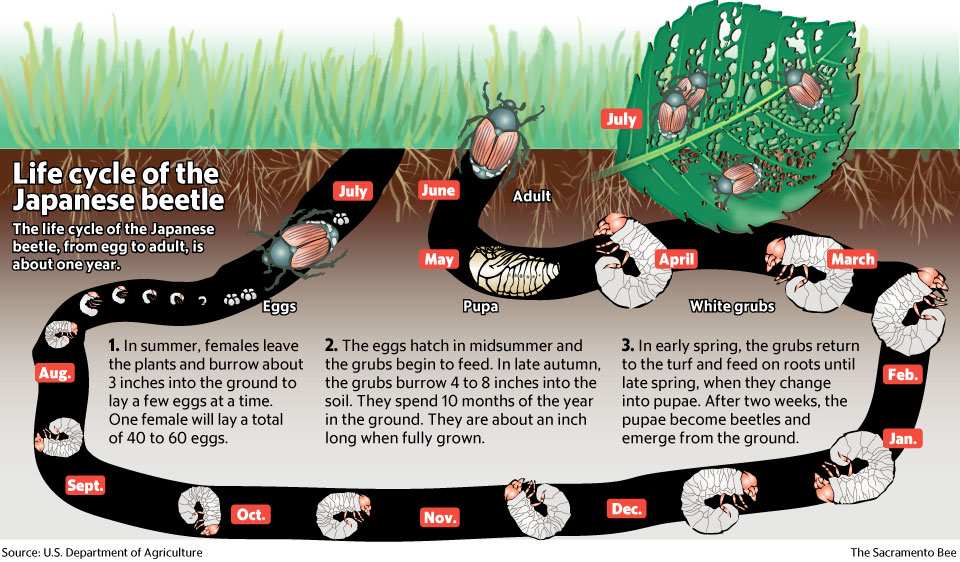
Image source: Bing (Web (fair-use with source credit))
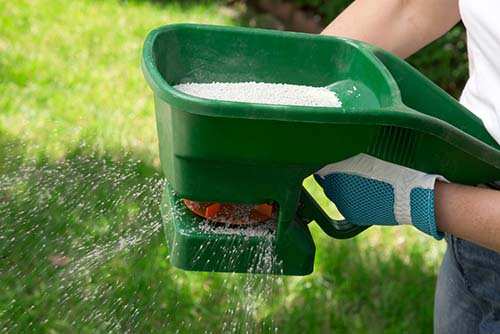
Image source: Bing (Web (fair-use with source credit))
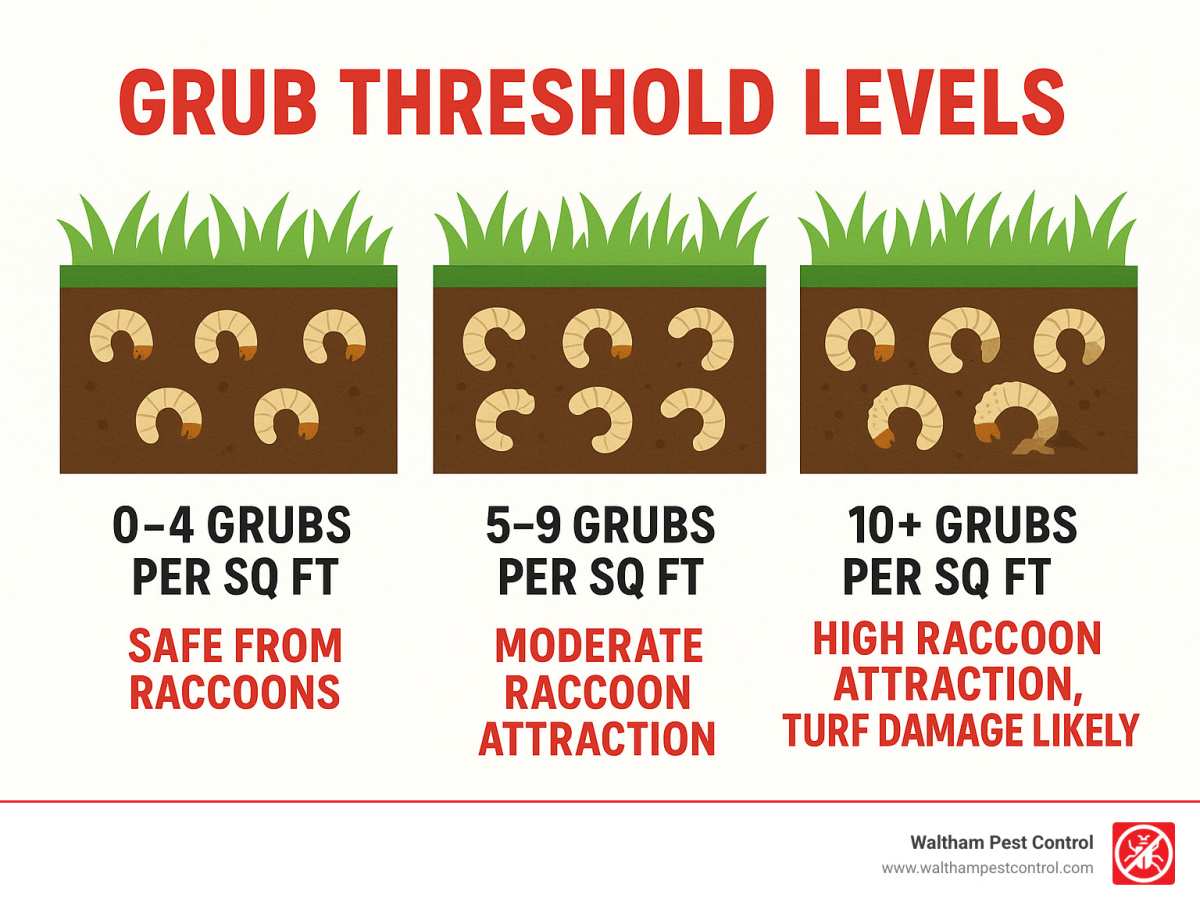
Image source: Bing (Web (fair-use with source credit))
Curative Treatment: When You're Already Seeing Damage
If your lawn is already showing brown patches that peel back like loose carpet, you're past the preventive window. You need a curative product that kills existing grubs quickly before they continue feeding through early fall.
The two active ingredients with reliable curative performance against grubs are trichlorfon (Dylox) and carbaryl (Sevin). Trichlorfon acts faster and is generally preferred when grubs are large and actively feeding. It kills on contact and through ingestion, typically within 24 to 72 hours.
Carbaryl works but tends to be more effective against smaller, younger larvae.
The curative window runs from roughly August through September in most regions. By October, grubs are beginning to move deeper in the soil, and product penetration into that deeper zone becomes inconsistent. You can still get partial control in October if your fall is warm, but don't expect complete elimination.
Curative treatments have a notably shorter residual than preventive products. They're designed to knock back the current population, not to sit in the soil waiting for next year's eggs. That means if you had severe damage this year, you should plan on applying preventive product the following summer to protect against reinfestation.
One practical note from extension research: curative products work best when the soil is moist before application. If you're in a dry spell, water the lawn a day before you treat. Moisture brings grubs closer to the surface and improves product contact.
Spring Treatment — Why It Usually Doesn't Work
Here's a frustrating scenario we see year after year. A homeowner notices dead patches in April, digs up some large grubs, and rushes to the store to buy insecticide. They apply it carefully, then wonder why the lawn still looks terrible in May.
The problem is that spring grubs are approaching the end of their larval stage. They're large, feeding less aggressively, and preparing to pupate. Most insecticides available to homeowners are significantly less effective against third-instar (large) grubs compared to young larvae.
You'll get partial kill, but rarely a clean result.
There's another timing issue. The grubs causing spring damage fed last fall, so they've already done most of their destruction. Killing them in spring doesn't bring back the dead grass.
It only prevents a secondary round of pupation into the adult beetles that lay the next batch of eggs. That can be worthwhile as part of a longer-term strategy, but it won't fix the lawn in front of you.
If you're seeing spring damage, the better move is to focus on reseeding or sodding the affected areas. Save your chemical application for the preventive window next summer, or shift to a curative treatment in late summer if you're seeing a recurring cycle.
Spring treatment can make sense in one specific situation: if you're using trichlorfon strategically to reduce the adult beetle population the following summer. It won't rescue your current lawn. It can lower next year's egg count by cutting off the pupation cycle.
That's a planning move rather than a rescue move.
Choosing Between Chemical and Biological Controls
Your choice here depends on three things: what species you're targeting, how comfortable you are with chemical applications, and whether results need to be fast or can develop over time.
Chemical Insecticides
Chlorantraniliprole for prevention and trichlorfon for cure represent the standard chemical recommendation from most university turf programs. Other products containing imidacloprid were the primary recommendation for many years, but several states have restricted neonicotinoid use in part because of concerns about pollinator exposure and persistence in water systems. Some regions have limited overspray onto blooming weeds.
Always check your state's current regulations.
Carbaryl remains a viable curative option but has higher toxicity to bees and some beneficial insects. It should never be applied to flowering weeds in the lawn, including white clover. If you're managing an organic-property-edge garden, consider whether drift onto blooming plants is a realistic risk.
Biological Options
Milky spore (Paenibacillus popilliae) is a bacterium that infects Japanese beetle grubs specifically. Once established in the soil, it can persist for years. However, aggregate reviews and university field data indicate that it takes one to three years to build an effective soil population, and it has no impact on European chafer, masked chafer, or other species.
If Japanese beetles are your dominant pest in a long-term homemaking setting, milky spore can be part of a slow-burning strategy, but it won't help if you've got multiple species.
Beneficial nematodes using Heterorhabditis bacteriophora are microscopic worms that actively seek out and enter grubs, releasing bacteria that kill the host from within. They're a curative biological option that works against several grub species, not just Japanese beetles. Success requires moist soil, soil temperatures above about 55°F (13°C), and proper handling.
Live nematodes are perishable and need refrigeration. They should be applied in the evening to prevent UV light from destroying them on contact. Our review of university trial data suggests nematode performance is more variable than chemical controls, but it's a solid option when chemical use isn't practical.
Trichlorfon-based chemical insecticides are best when you need fast knockdown of established grubs in late summer or early fall. Biological nematode treatments suit organic-minded homeowners who can manage the application requirements and accept more variable results.
How to Apply Grub Products So They Actually Work
Application failure is the most common reason grub treatments underperform, and it's usually fixable. The product label specifies rate, spreader setting, and watering requirements. Skipping any of those three steps dramatically reduces your results.
Use a broadcast or drop spreader calibrated to the product rate. Hand-broadcast granules by hand and you'll almost certainly get uneven coverage with streaks of damage and untreated patches. Most manufacturers publish recommended spreader settings for common models.
If yours isn't listed, start by setting the spreader to a mid-range opening, apply a measured amount over a small test area, and adjust.
Water the lawn after application. This is the step people skip most often, and it matters. Granular grub products need about a quarter-inch to half-inch of irrigation to wash the active ingredient off the granules and down into the root zone where grubs are feeding.
Without that watering-in step, the granules sit on the surface and degrade in sunlight.
Timing your irrigation matters too. If rain is expected within 24 hours of application, you can let nature handle the watering. If rain is forecast for more than 48 hours out, irrigate after application and don't gamble on the forecast.
Avoid mowing within a day or two of granular application. Mowing right after spreading can whip newly applied granules off the lawn with the clippings. Conversely, if the lawn is excessively tall, mow first so the granules reach the soil surface instead of getting trapped in the thatch layer.
The Damage Threshold: When You Can Skip Treatment Entirely
Here's a piece of advice that saves money and puts less chemistry into your yard: most lawns can tolerate some grub feeding without any treatment. Not every grub sighting requires a product. The damage threshold exists because healthy turf with adequate moisture and a strong root system can outcompete low-level grub pressure.
The generally accepted threshold is around 5 to 10 grubs per square foot for most cool-season grasses, but context matters:
| Situation | Threshold | Why |
|---|---|---|
| Irrigated, high-maintenance Kentucky bluegrass lawn | 3 to 5 per sq ft | Grass is already stressed by frequent mowing, fertilizer, and foot traffic |
| Unirrigated, low-maintenance tall fescue or fine fescue mix | 10 to 15 per sq ft | Deep-rooted grass tolerates more feeding before showing damage |
| Warm-season lawn (Bermuda, zoysia) during active growth | 8 to 12 per sq ft | Vigorous summer growth outpaces feeding if moisture is adequate |
| Drought-stressed lawn of any type | Reduce threshold by half | Drought limits the grass's ability to regenerate damaged roots |
If your sampling comes up below the relevant threshold, skip the treatment and focus on regrowing the damaged areas. Core aeration, a fall fertilizer application, and consistent watering will almost always get you a full recovery.
One realistic concern: your neighbor's infestation can migrate. If they're not managing grubs and beetle pressure is heavy in your area, the threshold logic assumes standard local pressure. When everyone around you has a problem, your risk of reinfestation rises even if your lawn currently tests negative.
Regional Timing Differences You Need to Know
Grub species and climate shift the calendar depending on where you live. A July-first recommendation from a national Extension publication is going to fit the Great Lakes region better than the mid-Atlantic.
Northeastern and Great Lakes homeowners deal most often with European chafers and Japanese beetles, so adult flights happen from mid-June through July, with egg hatching in mid-to-late July. Mid-Atlantic homeowners who see mostly Japanese beetles can often wait until early July for preventive application because egg peak follows shortly after. Much of the Southeast deals with masked chafers and tropical sod webworms and the whole timetable runs earlier, often from May into early June.
Your local cooperative extension service is the most reliable source of region-calibrated timing. Many publish weekly pest alerts based on adult trapping data during the flight season. If you're looking for a rough guide until that local data arrives, the rule of thumb for broad preventive control across most of the northern belt is mid-June through late July, applied before or during the early flush of egg development.
The Most Common Grub Treatment Mistakes
Treating too late is the single most common error, followed closely by not watering in granules. Another widespread mistake is treating every brown spot as a grub problem, when drought or disease may actually be to blame. Confirming grub presence with square-foot sampling prevents wasted application and unnecessary cost.
Spring treatments are nearly always too late for rescue and counter-productive relative to summer preventive timing, but homeowners still chase knockout then. Skipping calibration on a spreader leads to streaky coverage and grubs surviving in untreated zones. Finally, applying preventive product when no grubs exist in your lawn's history is a waste, because it will not address other common causes of thinning such as compaction or shade.
When to Call in a Professional
One clear case is heavy secondary damage. If skunks or raccoons are tearing up entire sections nightly, a licensed applicator can apply fast-acting curative material and reinforce prevention faster than most homeowners. When multiple species overlap and timing is confusing, a landscape professional familiar with local pest cycles can coordinate an integrated plan so you're not guessing.
Large lawns also benefit: treatment over multiple acres is labor-intensive and requires accurate spreader setup. If you've repeated full curative circuits two seasons running and still lose grass, there may be compounding disease or drainage issues beyond grub control.
Final Decision Guide: Your Step-by-Step Action Plan
Start by confirming the problem. Cut back a few square-foot sections of damaged turf now. Count the grubs.
If you're under 5 per square foot on an unirrigated lawn, skip treatment and focus on recovery. If you're above threshold, size them up. Small, young grubs in late summer respond well to curative insecticide applied immediately.
Large grubs right now still respond to curative products, but only trichlorfon-based options will give reliable large-larva knock-down. If you're seeing grubs but no damage yet, and it's late summer, apply a curative product for immediate knockdown through September. If it's winter or early spring with no active damage, wait, mark your calendar, and plan a preventive treatment in early summer.
Your decision path comes down to one question: when are there enough grubs now to justify fast action, or should you plan for the next generation?
Frequently Asked Questions
How late in the year can I treat grubs?
Trichlorfon remains effective through October as long as grubs haven't burrowed deep. By mid-to-late fall, soil temperature drops below their feeding activity zone and treatment timing is over.
Can I apply grub killer and grass seed at the same time?
Yes, grub products labeled for preventive or curative control won't harm new grass seed. Just water the product in first before seeding, or seed separately after the recommended interval.
Does rain wash away grub treatment before it works?
Heavy rain immediately after application can move granules off-target. Light to moderate rain actually helps push the active ingredient into the root zone. If torrential rain hits within a few hours, a light watering-in helps correct any distribution loss.
Will grub damage recover on its own?
If it's a low-level problem and you provide adequate water and a fall fertilizer application, most cool-season lawns can regenerate fully. Severely thinned areas may need reseeding.
How long does preventive grub control last?
A single application of chlorantraniliprole typically provides enough residual activity to cover the entire egg hatch and early feeding period. One application per year is the standard recommendation.