Figuring out how to know if your lawn has grubs is less about spotting one magic sign and more about walking through a short diagnosis. Brown patches, spongy turf, and animals digging at night can all point to grubs, but plenty of other problems look almost identical. The difference between treating correctly and wasting time and money comes down to confirming what is actually living under your sod.
You do not need a soil science degree for this. A flat-bladed shovel, a few minutes on a warm evening, and a simple count will tell you whether grubs are the real problem. As of 2026, university extension services across the country still recommend the same basic field test.
Count what you find, compare it to the damage threshold, and you will know exactly where you stand.

Image source: Bing (Web (fair-use with source credit))
Quick Answer
Look for irregular brown patches that feel spongy underfoot. Peel back a square foot of turf and count any C-shaped white larvae. If you find more than 5 to 10 grubs per square foot, most cool-season grasses are at risk.
Perform this check in late summer or early fall when grubs are small and feeding near the surface. Confirm before treating. Wrong identification wastes money and delays fixing the real problem.
What Grub Damage Actually Looks Like (And What Gets Mistaken for It)
Grub damage rarely shows up as a neat, uniform circle. Instead, you will see irregular brown patches that seem to grow and merge over a few weeks. The affected turf often feels soft or spongy when you walk across it, almost like walking on a damp sponge.
The signature giveaway is the tug test. Grab a handful of the brown grass and pull. If it lifts up easily like a loose carpet, the roots have been severed below the surface.
Grass with intact roots will resist and stay anchored. Damaged turf rolls back because the grubs have chewed through the root zone that holds everything together.
Animal activity is another strong clue. Skunks, raccoons, and armadillos tear up sections of lawn overnight to feed on grubs. Birds picking at the surface during the day can signal grubs too.
If you see plucked-up sod or small cone-shaped holes appearing suddenly, something is eating the larvae below.
The Quick Test: How to Confirm Grubs Are in Your Lawn Right Now
Visual signs get you suspicious. Confirmation requires flipping some sod. The simplest field method is cutting a one-square-foot section about 2 to 3 inches deep with a spade.
Peel it back and examine the root zone and top layer of soil.
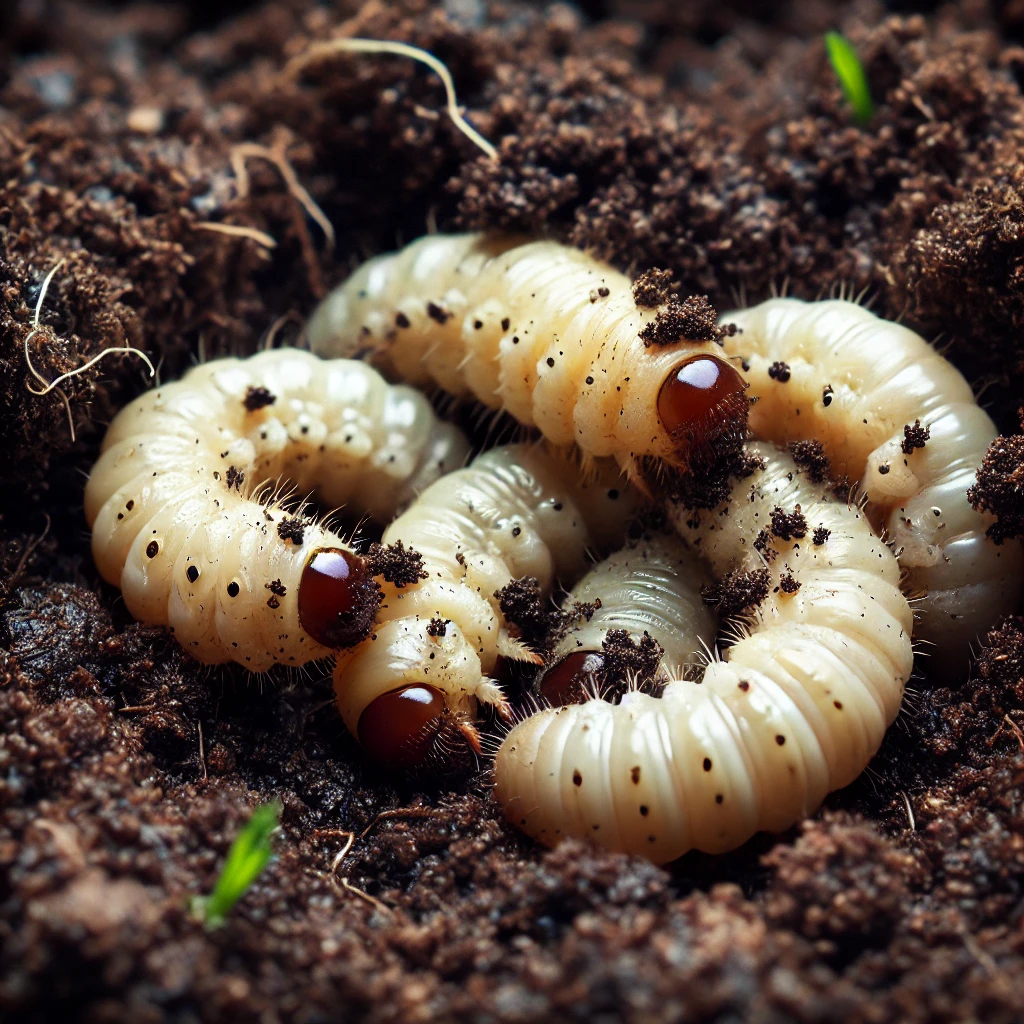
Image source: Bing (Web (fair-use with source credit))
White grubs are the larval stage of scarab beetles, and every species shares the same basic look. They are C-shaped with a cream-colored body, a distinct brown head capsule, and three pairs of legs right behind the head. Size varies by species and age, but most are roughly 1/4 inch to 1 inch long during the late-summer window when you are most likely to check.
Here is how to run the test properly:
- Pick multiple spots. Check three to four different areas of the lawn. Grubs rarely distribute themselves evenly, so one clean square does not guarantee the whole yard is clear.
- Cut a 1-foot square. Slice three sides of a square about 3 inches deep. Flip the flap back like a hinge.
- Count what is visible. Grubs will be in the soil just below the thatch layer. Count every one you see in that single square.
- Check nearby. Repeat in at least one or two more spots, especially in areas that look worst.
One important detail: grubs move deeper into the soil when conditions get hot and dry. If you are checking during a mid-summer drought, you may need to dig 4 to 6 inches down. In a normal late-summer pattern with some rainfall, most grubs stay in the top 2 to 3 inches where the roots are.
The Dime Test vs. the Spade Test: Which One to Use and When
Two practical methods work for most homeowners. The spade test gives you a direct count. The soap flush, sometimes called the dime test, brings grubs to the surface so you can spot them without digging.
The spade test is the gold standard. You cut a defined area, flip it, and count. It is fast, it does not require any supplies beyond a shovel, and it gives you a number you can compare directly to the damage threshold.
Use this method when you want a definitive answer.
The soap flush test works well when you want to check a larger area without tearing up the turf. Mix 1 to 2 ounces of liquid dish soap into a gallon of water. Mark off a one-square-foot section and pour the solution over it.
Wait 5 to 10 minutes. Grubs and other insects will wriggle to the surface where you can see and count them.

Image source: Bing (Web (fair-use with source credit))
Each method has trade-offs:
| Method | Best For | Limitation |
|---|---|---|
| Spade test | Definitive count, small areas | Disturbs turf, requires physical effort |
| Soap flush | Larger areas, no digging | Less precise, works poorly in dry or compacted soil |
If your soil is bone dry and hard-packed, the soap solution will not penetrate well. Water the test area lightly the evening before. In most cases, the spade test is the more reliable starting point.
Use the soap flush as a follow-up if you want to sample more ground without flipping sod every few feet.
How Many Grubs Is Too Many? Understanding the Damage Threshold
Finding a few grubs does not automatically mean you have a problem. Healthy lawns with deep roots can tolerate a low population without visible damage. The question is not whether grubs are present, but whether their numbers exceed what your grass can handle.
University extension programs generally cite these thresholds for cool-season grasses like tall fescue, Kentucky bluegrass, and perennial ryegrass:
- 1 to 4 grubs per square foot: Usually no treatment needed. Monitor the area.
- 5 to 9 grubs per square foot: Borderline. Treat if the lawn is stressed, thin, or newly established.
- 10 or more grubs per square foot: Active damage is likely. Treatment is recommended.
Warm-season grasses like Bermuda and zoysia have deeper root systems and can often tolerate slightly higher numbers. Newly sodded or seeded lawns are far more vulnerable because the root system has not fully developed. A count of 5 grubs in a three-month-old lawn is a bigger threat than 10 grubs in a mature, thick stand of turf.
The species matters too. Japanese beetle grubs tend to cause more visible damage at lower counts because they feed aggressively in late summer. European chafer grubs can be present in higher numbers before symptoms show, then cause sudden collapse in early fall.
Knowing which species you are dealing with helps you interpret the count correctly.
Grub Species That Matter and Why Timing Changes Everything
Not all grubs are the same, and the species in your yard affects when they feed, how deep they go, and which treatments will work. The most common lawn-damaging species in the United States include Japanese beetle, European chafer, May/June beetle, black turfgrass ataenius, and masked chafer.
All of these follow roughly the same annual cycle. Adult beetles lay eggs in midsummer. Those eggs hatch into small grubs that feed on roots from late July through October.
As soil temperatures drop in fall, the grubs burrow deeper to overwinter. They return to the root zone briefly in spring, then pupate and emerge as adult beetles by early summer.
The critical window for curative treatment is late July through September, when grubs are small, actively feeding, and still near the surface. Once grubs grow larger in mid to late fall, they are harder to kill with most products. By the time you see damage in October or November, the window for effective curative treatment is closing fast.
Preventive products work on a completely different timeline. These are applied in May through early July, before the eggs hatch. They create a zone of protection in the soil that kills young grubs shortly after they emerge.
If you are using a preventive approach, you are treating for next year's problem, not this year's.
Here is a quick species reference:
| Species | Region | Peak Damage Window | Notes |
|---|---|---|---|
| Japanese beetle | Midwest, Northeast, Mid-Atlantic | August to October | Most widely recognized; adults damage ornamental plants too |
| European chafer | Northeast, Great Lakes | September to November | Can survive colder winters; damage appears later |
| May/June beetle | Midwest, Plains states | August to October | Larger grubs; longer life cycle in some regions |
| Black turfgrass ataenius | Northeast, Mid-Atlantic | June to August, again in fall | Two generations per year in some areas |
| Masked chafer | Ohio Valley, Midwest, Southeast | August to October | Similar to European chafer but smaller |
If you are unsure which species you have, your local cooperative extension office can often identify grubs from a photo or a physical sample. That identification helps you time treatment correctly and choose the right product.
Ruling Out the Usual Suspects: Drought, Fungus, Dog Urine, and Other Lookalikes
Grub damage gets blamed for a lot of lawn problems it did not cause. Before you commit to treatment, it is worth ruling out the conditions that mimic grub damage almost perfectly.
Drought stress is the most common misdiagnosis. Grass that is not getting enough water turns brown in irregular patches, and the turf can feel loose if the soil has pulled away from the roots. The difference is that drought-stressed grass does not roll up like carpet when you pull it.
The roots are still there, they are just dehydrated. Water the area deeply and see if it greens up within a week. If it does, grubs were never the issue.
Fungal diseases like brown patch and dollar spot also create irregular dead areas. Brown patch shows up as roughly circular patches with a darker "smoke ring" edge in humid conditions. Dollar spot produces smaller, silver-dollar-sized spots.
Neither causes the spongy, lifted turf feel that grubs do. If you see visible fungal growth, webbing, or distinct pattern rings on individual grass blades, you are likely dealing with a pathogen, not a pest.
Dog urine damage creates small, concentrated dead spots with a dark green ring around the outer edge. The center is brown and dead, but the surrounding grass gets a nitrogen boost from the urine. These spots are much smaller and more uniform than grub patches, and they do not spread or merge over time.
Sod webworms and chinch bugs are actual insects that cause similar-looking damage. Sod webworms leave behind small, uniform dead patches and you may see tiny moths flying low over the lawn at dusk. Chinch bugs cause damage in hot, dry areas, usually in full sun, and they tend to start at the edges of the lawn near pavement.
Neither produces the C-shaped larvae you find with a spade test.
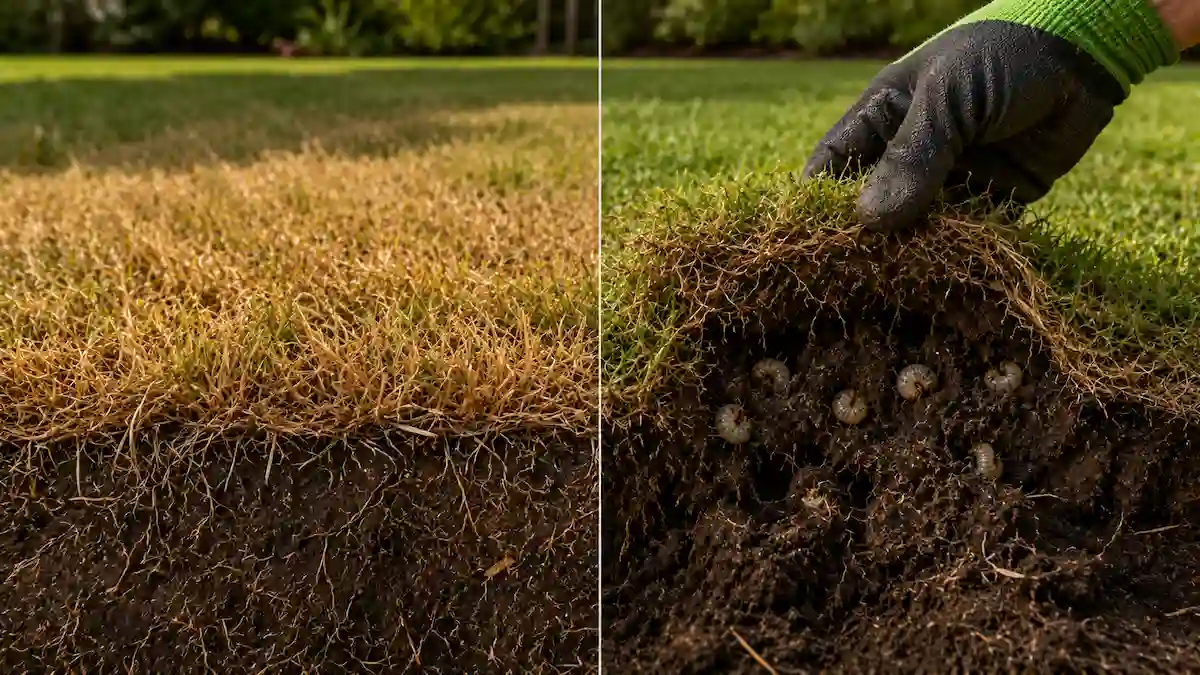
Image source: Bing (Web (fair-use with source credit))
The fastest way to rule out lookalikes is to combine the tug test with the spade test. If the turf pulls up easily and you find grubs in the root zone, you have your answer. If the turf holds firm and the soil is dry 2 inches down, water first and reassess before spending money on insecticide.
What to Do If You Confirm Grubs: Curative vs. Preventive Treatment
Once you have confirmed grubs above the damage threshold, you have two paths. The right one depends entirely on the time of year and the size of the grubs you found.
Curative treatment targets grubs that are already present and actively feeding. This is the approach you use in late summer through early fall when you have already found grubs during your inspection. The goal is to kill them quickly before they cause more root damage.
The most widely recommended curative active ingredient is trichlorfon, sold under the brand name Dylox. It works fast, typically killing grubs within one to three days, and it is effective against larger, later-stage grubs that preventive products cannot touch. The downside is that trichlorfon breaks down quickly in soil, so timing matters.
Apply it when grubs are still small enough to be vulnerable, ideally in August or early September.
Carbaryl, the active ingredient in Sevin, also works as a curative option. It is slower than trichlorfon but still effective against small to medium-sized grubs. Both products are applied as granules or sprays and need to be watered in according to the label.
Preventive treatment is a completely different strategy. You apply it in late spring to early summer, before adult beetles lay their eggs. The product sits in the soil and kills young grubs shortly after they hatch, before they can do any real damage.
Chlorantraniliprole, sold as Acelepryn, is one of the most effective preventive options. It has a favorable environmental profile compared to older chemistry and provides season-long control from a single application. Imidacloprid, the active ingredient in Merit and several generic products, has been the standard preventive choice for years.
It works well but has faced increasing regulatory restrictions in some states due to concerns about pollinator exposure.
Here is the key decision point: if you are reading this in August and you just found grubs, preventive products will not help you. They are designed to kill tiny, newly hatched larvae, not the half-inch grubs already chewing through your roots. Use a curative product now and plan a preventive application for late spring next year.
Natural and Biological Options: Nematodes, Milky Spore, and Chemical-Free Approaches
If you prefer to avoid synthetic insecticides, biological controls can work. They require more precise timing and realistic expectations, but they are effective when applied correctly.
Beneficial nematodes are microscopic roundworms that seek out and kill grubs in the soil. The species Heterorhabditis bacteriophora is the one most commonly used for grub control. You mix them with water and apply them to the lawn using a hose-end sprayer or watering can.
They need moist soil to move and survive, so water the lawn before and after application. Apply them in the evening because UV light kills them quickly. Soil temperatures need to be above 60°F for them to be active.
Nematodes work best against small grubs. If you are applying them in late August or September when grubs are still young, you can see meaningful reduction. They are less effective against large, late-season grubs.
Store them in the refrigerator until you are ready to use them, and check the expiration date on the package. Dead nematodes do not control anything.
Milky spore is a bacterial disease, Paenibacillus popilliae, that specifically targets Japanese beetle grubs. You apply it as a granular powder to the lawn, and the grubs ingest it while feeding. It does not work on European chafer, masked chafer, or other species.
Milky spore takes two to three years to build up in the soil to effective levels, so it is a long-term strategy, not a quick fix. Once established, it can persist for a decade or more.
Neem oil and azadirachtin-based products have some repellent and growth-regulating effects on grubs. They are not as potent as the options above, but they can reduce feeding and disrupt the life cycle when used as part of a broader program.
Biological options are best suited for homeowners who have moderate grub pressure and are willing to plan ahead. If you are looking at a severe infestation with 15 or more grubs per square foot, a curative insecticide will give you faster, more reliable results.
When to Call in a Professional vs. Handling It Yourself
Most grub problems are manageable with a trip to the garden center and a Saturday afternoon. There are situations where calling a licensed lawn care professional makes more sense.
DIY is the right call when:
- You have confirmed grubs and the count is between 5 and 15 per square foot
- You are comfortable reading and following pesticide labels
- The affected area is under 5,000 square feet
- You are treating in the correct window for the product you chose
Call a professional when:
- The infestation covers a large portion of the lawn and counts are consistently above 15 per square foot
- You have tried a curative product and damage is still progressing after two weeks
- You are dealing with repeated annual infestations and want a comprehensive program
- You are uncomfortable applying pesticides near water features, vegetable gardens, or play areas
- Your state requires a license for certain restricted-use products
Licensed applicators have access to professional-grade products that are not available to homeowners. They also have the equipment to ensure even coverage and proper soil incorporation. The trade-off is cost.
A single professional grub treatment typically runs between $150 and $400 depending on lawn size and region, compared to $20 to $60 for a DIY product.
If you do hire someone, ask what active ingredient they are using and whether it is preventive or curative. A good technician will explain the timing, what results to expect, and how long the treatment takes to work.
The Seasonal Timeline: When to Check, When to Treat, and When to Wait
Grub management is all about timing. Apply the right product at the wrong time and you are pouring money into the soil for nothing.
May through early June: This is the window for preventive products. Adult beetles are flying and laying eggs. Applying chlorantraniliprole or imidacloprid now protects the lawn when those eggs hatch in July.
Late June through July: Grubs are hatching and starting to feed. They are tiny and hard to find, but this is when preventive products are doing their work. If you missed the preventive window, start scouting now.
August through September: This is prime time for curative treatment. Grubs are small to medium-sized, actively feeding near the surface, and vulnerable to products like trichlorfon. Run your spade test now if you suspect a problem.
October through November: Grubs are getting larger and moving deeper. Curative options become less effective. If you find grubs now, you can still treat, but expect slower results.
Focus on lawn recovery and plan a preventive application for next spring.
December through March: Grubs are deep in the soil and dormant. No treatment is effective during this period. Wait until spring.
April through May: Grubs return to the root zone briefly before pupating. They are large and tough to kill now. This is not a treatment window.
It is your last chance to plan a preventive application before the new generation of eggs is laid.
The single biggest mistake homeowners make is applying preventive grub control in September when they see damage. That product will not kill the grubs already in the lawn. It is protecting against next year's problem.
Match your product to the season and the grub size, and you will get results.
Mistakes That Make Grub Problems Worse
Treating without confirming is the costliest error. Many homeowners see brown patches and reach for grub control without ever checking what is actually in the soil. If the real problem is drought or fungus, a grub product does nothing and the lawn keeps declining while the actual issue goes unaddressed.
Applying preventive products in fall is another common misstep. Preventive insecticides target newly hatched grubs the following summer. They will not kill the large grubs already damaging your lawn in September.
You are spending money on next year's protection when you need a curative solution right now.
Skipping the label instructions causes problems too. Over-applying does not improve control. It increases cost, environmental exposure, and potential harm to beneficial insects.
Under-applying leads to partial results and surviving grubs that rebound the following year.
Planning Ahead: How to Prevent Grubs Next Season
If you dealt with grubs this year, plan your preventive application for late spring. Apply chlorantraniliprole or imidacloprid between May and early July before adult beetles lay eggs. Water the product into the soil according to the label.
Maintain a thick, healthy lawn with proper mowing height and watering. Dense turf tolerates more grubs before showing damage. Overseed thin areas in early fall and keep soil consistently moist during dry spells.
Frequently Asked Questions
Can grubs kill my entire lawn?
Yes, if left untreated at high populations. Severe infestations with 15 or more grubs per square foot can destroy large sections of turf. The damage accelerates in late summer and fall.
Do I need to treat if I find just one grub?
No. A few grubs per square foot is normal and healthy lawns handle it without treatment. Monitor the area and recheck in a few weeks.
Will grub damage fix itself?
The grubs will eventually pupate and leave, but the dead turf will not recover on its own. You will need to reseed or resod damaged areas in fall or spring.
Are grub control products safe for pets?
Most granular products are safe once watered in and the lawn has dried. Always read the specific label for pet restrictions. Keep animals off treated areas during application and until the product is fully absorbed.