Here's the thing about asking what grubs eat: the answer changes completely depending on which grub you're actually dealing with. The word "grub" gets tossed around as a catchall term for dozens of different beetle larvae, and they don't all eat the same stuff. A Japanese beetle larva in your lawn is dining on turfgrass roots.
A mealworm farm's larvae are munching on oats and vegetable scraps. Same word, totally different diets.
In our research, we've found that most people either assume all grubs are lawn pests or don't realize the grubs they're buying for chicken feed have completely different eating habits than the ones destroying their sod. This guide walks you through the identification process first, then matches each grub species to what it actually eats, so you can stop guessing and start making smart decisions about whether you even need to do anything about them.

Image source: Bing (Web (fair-use with source credit))
Quick Answer
Grubs eat organic material in soil or their surrounding environment. Lawn grubs feed on turfgrass roots. Mealworm larvae eat grains and decaying plant matter.
Green June beetle grubs consume decomposing vegetation. The specific diet depends entirely on the grub species and habitat.
The Grub Identification Decision Tree: Species First, Answer Second
Before you can figure out what a grub eats, you need to know what kind of grub you're looking at. This is where most people go wrong. They see a C-shaped larva in the dirt and immediately assume it's a lawn-damaging pest.
Sometimes it is. Sometimes it's a beneficial decomposer doing free work in your compost pile.
Here's the basic decision flow:
- Found in lawn turf, C-shaped, white body, brown head, six legs near the head → Likely a scarab beetle larva (white grub complex). Proceed to species ID.
- Found in compost, leaf litter, or decaying wood → Could be a beneficial decomposer grub or a species that feeds on dead organic matter, not living roots.
- Found in stored grain, pet food setups, or feeder insect containers → Almost certainly a darkling beetle larva (mealworm or superworm), not a lawn pest at all.
- Found in garden soil near vegetable roots → Could be a pest grub, but could also be a predatory species. Don't treat until you've confirmed.
The key distinction is this: lawn pest grubs belong to the scarab beetle family (Scarabaeidae), and within that family, the species determines exactly what and how they eat. A June bug larva and a Japanese beetle larva look similar but have slightly different feeding patterns and seasonal timelines.

Image source: Bing (Web (fair-use with source credit))
What Lawn and Garden Grubs Eat
When most people ask about grub diets, they're thinking about the larvae wreaking havoc on their turf. Let's break down the major lawn pest species and what each one targets.
Japanese Beetle Grubs (Popillia japonica)
Japanese beetle larvae are probably the most economically damaging grub species in the eastern and midwestern United States. They feed almost exclusively on the roots of cool-season turfgrasses: Kentucky bluegrass, perennial ryegrass, tall fescue, and fine fescues. Peak feeding happens in late summer and early fall (August through October), with a second feeding push in spring when larvae move back up toward the soil surface.
A heavy infestation can destroy turf so completely that it rolls up like carpet. That's because the root system has been severed. The damage threshold for Japanese beetle grubs is roughly 10 larvae per square foot for most cool-season grasses.
June Bug Larvae (Phyllophaga Species)
June bug grubs, also called May beetle larvae, have a longer lifecycle than Japanese beetles. They spend two to three years in the larval stage, which means they're feeding on turfgrass roots for multiple seasons. Their diet is similar to Japanese beetle grubs but they tend to be more tolerant of drier conditions and can cause damage in areas where Japanese beetles struggle.
These grubs also feed on the roots of corn and some cereal crops in agricultural settings, which makes them a concern for farmers and gardeners growing grain crops or sweet corn.
European Chafer Larvae (Amphimallon majale)
European chafers have become one of the most problematic grub species in the northeastern US and parts of the Midwest. They're particularly damaging because their feeding window extends later into the fall and earlier into the spring compared to other species. They feed on turfgrass roots but also tolerate a wider range of soil moisture conditions, which means they cause damage during dry periods when other grubs would burrow deeper and stop feeding.
Masked Chafer Larvae (Cyclocephala Species)
Masked chafers are common across the Midwest and into the southern US. Their larvae feed on turfgrass roots but are generally considered less damaging per larva than Japanese beetle grubs. They're smaller, for one thing, and they don't feed as aggressively.
However, populations can build up over years if left unchecked, and the cumulative damage can be significant.
Green June Beetle Larvae (Cotinis nitida)
Here's the exception in the white grub world. Green June beetle grubs don't primarily feed on living turfgrass roots. They consume decaying organic matter, thatch, and decomposing vegetation.
They're still considered pests because their tunneling activity disrupts root systems and creates mounded soil on the surface, but their actual diet is detritivorous rather than root-feeding. This distinction matters for control strategies because products targeting root-feeding larvae may be less effective against grubs that are eating decomposing matter in the thatch layer.
Billbug Larvae (Sphenophorus Species)
Billbug larvae are the oddballs of the grub world. They're weevil larvae, not scarab larvae, and their feeding habits reflect that. Instead of eating roots primarily, billbug larvae bore into grass stems, crowns, and sometimes roots.
They target zoysiagrass, bermudagrass, and centipedegrass in warm-season turf. The damage looks similar to other grub damage but the control timing differs because the larvae are inside plant tissue rather than in the soil.
Quick Reference: Grub Species, Diet, and Damage Profile
| Species | Primary Food Source | Turgrass Type Most Affected | Peak Feeding Period | Larval Lifespan |
|---|---|---|---|---|
| Japanese beetle | Living turfgrass roots | Cool-season grasses | Aug–Oct, Apr–May | 1 year |
| June bug (May beetle) | Turfgrass roots, some crop roots | Cool-season grasses | Year-round (multi-year) | 2–3 years |
| European chafer | Turfgrass roots | Cool-season grasses | Sept–Nov, Mar–May | 1 year |
| Masked chafer | Turfgrass roots | Cool-season and some warm-season | Aug–Oct | 1 year |
| Green June beetle | Decaying organic matter, thatch | Warm-season grasses | Sept–Nov | 1 year |
| Billbug | Grass stems, crowns, some roots | Warm-season grasses | May–Sept | 1–2 years |
What "Grubs" in Feed, Compost, and Pet Food Actually Eat
Not all grubs live in your lawn. The term gets applied to several larval insects raised for animal feed, composting, or educational purposes. Their diets are completely different from lawn pest grubs.
Mealworm Larvae (Tenebrio molitor)
Mealworms are darkling beetle larvae, not scarab beetle larvae. In captivity, they're raised on a diet of grain-based substrates: wheat bran, oats, cornmeal, and similar dry grains. Producers supplement with fresh vegetables and fruits for moisture and additional nutrition.
Carrots, potatoes, apples, and leafy greens are common supplemental feeds. The grain substrate serves as both food and bedding in most setups.
Mealworm farming has grown significantly as of 2026, driven by demand for reptile feed, wild bird food, and even human consumption in some markets. A single commercial operation can produce billions of larvae annually, all feeding on agricultural grain products.
Superworm Larvae (Zophobas morio)
Superworms are also darkling beetle larvae, just a much larger species. Their diet is similar to mealworms: grain-based substrates supplemented with fresh produce. They're popular as reptile feed because of their size and movement, which triggers feeding responses in lizards, frogs, and some birds.
Wax Worm Larvae (Galleria mellonella)
Wax worms are wax moth larvae, and their diet is unique among feeder insects. In the wild, they feed on beeswax, pollen, and honey bee comb debris. In captivity, they're raised on a mixture of cereal grain, honey, and sometimes glycerin-based artificial diets.
They're high in fat compared to mealworms and superworms, which makes them popular as treats but not as a staple feeder insect.
Compost and Decomposition Grubs
Various beetle larvae show up naturally in compost piles and decomposing organic matter. These grubs feed on decaying plant material, helping break down cellulose and other organic compounds. They're generally beneficial, accelerating the composting process.
Species vary, but most compost-dwelling grubs are detritivores that consume dead and decomposing vegetation rather than living plant roots.
Grub Feeding Damage vs. Other Lawn Problems
One of the most common mistakes we see is homeowners assuming every brown patch in their lawn is grub damage. Grub feeding creates a specific type of injury, but several other conditions produce similar-looking symptoms.
What Grub Damage Actually Looks Like
Grub damage has a few telltale signs:
- Irregular brown patches that start small and expand over weeks
- Spongy or loose turf that feels soft underfoot because roots have been severed
- Turf that peels back easily from the soil surface, almost like lifting a rug
- Animal digging from skunks, raccoons, or birds hunting for grubs in the lawn
- Damage timing: most visible in late summer through early fall for most species
The key diagnostic test is simple. Cut a one-square-foot section of turf at the edge of a damaged area, peel it back, and count the grubs underneath. If you find 10 or more C-shaped larvae in that single square foot, you've got a pest problem that likely warrants treatment.
Common Grub Damage Lookalikes
Several lawn problems mimic grub damage but require completely different solutions:
- Drought stress: Brown patches from lack of water will generally affect the whole lawn somewhat evenly, not in irregular patches. The turf won't peel back easily, and you won't find grubs underneath.
- Fungal disease: Brown patch, dollar spot, and other turfgrass diseases create circular or irregular brown areas, but they often show characteristic patterns like lesions on individual grass blades or mycelium in the early morning.
- Dog damage: Female dog urine creates brown or dead spots with a darker green ring around the outer edge. The pattern is usually more scattered and the spots are smaller than grub damage.
- Chinch bug damage: These insects cause irregular yellow-to-brown patches, usually in sunny areas. The damage looks similar but the insects are visible if you part the grass and look at the soil surface.
- Sod webworm damage: Creates irregular brown patches, but you'll often see small holes in the turf and silk-lined tunnels near the soil surface.
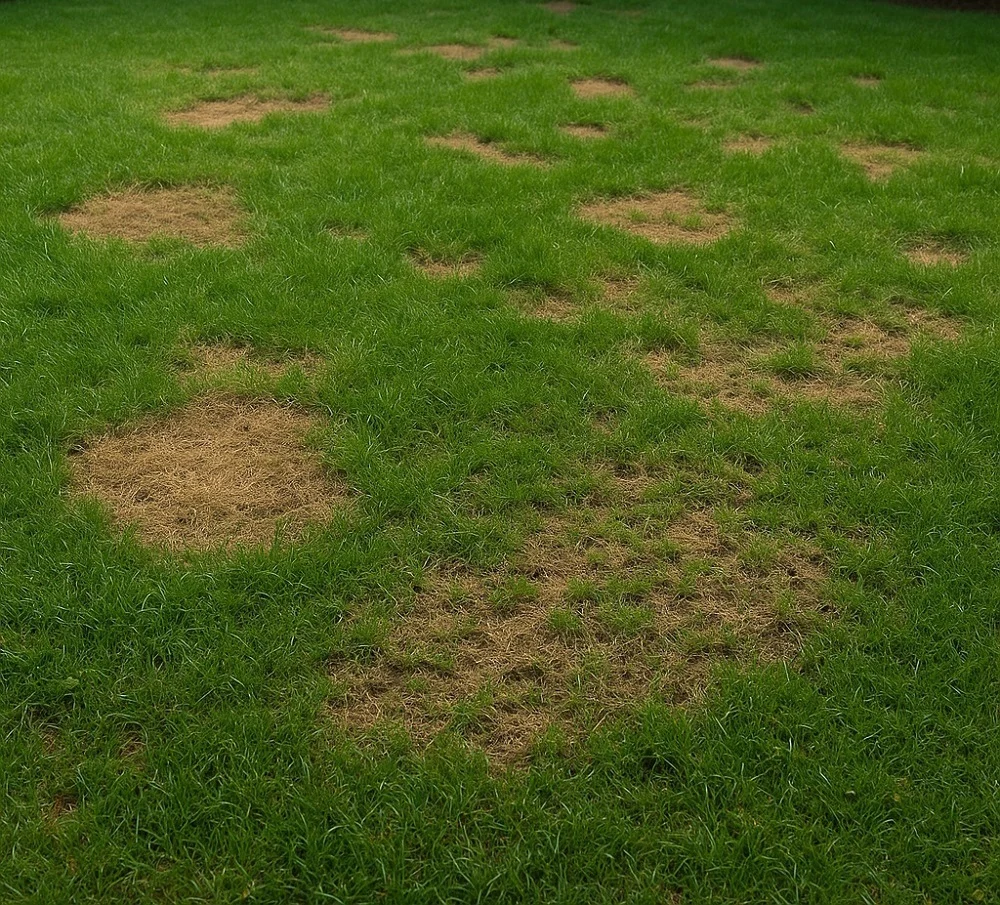
Image source: Bing (Web (fair-use with source credit))
How to Figure Out What the Grubs in Your Yard Are Eating
Now that you know the major species and their diets, here's a practical process for figuring out what's happening in your specific situation.
Step 1: Collect a Sample
Dig up a section of turf at the boundary between healthy and damaged grass. Go about 2 to 4 inches deep. Place the soil and turf on a white surface and sift through it.
Count every C-shaped larva you find.
Step 2: Identify the Species
Look at the grub's size, color, and the pattern of hairs on its raster (the underside of the tail end). Japanese beetle grubs have a distinctive V-shaped raster pattern. June bug grubs have a more random arrangement.
If you're not sure, your local cooperative extension office can help with identification, often for free.
Step 3: Match the Species to Its Diet
Once you know the species, you know what it's eating. Japanese beetle grubs and June bug grubs are eating your grass roots. Green June beetle grubs are eating thatch and decomposing matter.
Billbug grubs are boring into grass stems and crowns.
Step 4: Assess Whether the Feeding Is Causing Real Damage
Not every grub in your lawn is a crisis. A few grubs per square foot is normal and not worth treating. The thresholds vary by grass type:
- Cool-season grasses: Treatment warranted at 10+ grubs per square foot
- Warm-season grasses: Can tolerate 20 to 30+ grubs per square foot in many cases
- Mixed turf: Use the lower threshold if cool-season grasses dominate
Step 5: Decide Whether Action Is Needed
If you're below threshold, you can monitor and revisit next season. If you're above threshold, treatment options depend on the time of year and the species involved. Preventive products work best when applied before grubs hatch and start feeding.
Curative products target existing larvae but need to be applied when larvae are small and vulnerable.

Image source: Wikimedia Commons / MarioM (CC BY-SA)
When Grub Eating Habits Actually Matter for Treatment Decisions
Understanding what a grub eats isn't just academic. It directly affects which control method you choose and when you apply it.
Why Diet Determines Control Strategy
Root-feeding grubs like Japanese beetle larvae and June bug larvae are vulnerable to soil-applied insecticides and biological controls like beneficial nematodes because they're in direct contact with the soil where you apply treatments. Billbug larvae, which bore into plant tissue, are harder to reach with soil drenches because they're inside the grass stem, not in the soil. Green June beetle grubs feeding on thatch and decomposing matter may not respond well to products designed for root-feeding species.
Timing Around Feeding Behavior
Most lawn grubs feed most aggressively in late summer and early fall. That's when preventive products for the following year should be applied (typically June through July, depending on the species and region). Curative treatments work best in late summer when larvae are small and actively feeding near the soil surface.
By late fall, many species have burrowed deeper for winter and are harder to reach with any treatment.
Biological Controls and Their Specific Targets
- Milky spore (Paenibacillus popilliae): Targets Japanese beetle grubs specifically. Takes 2 to 3 years to establish in soil but provides long-term control.
- Beneficial nematodes (Heterorhabditis bacteriophora): Effective against multiple white grub species. Applied to moist soil in late summer when larvae are active.
- Beauveria bassiana (fungal biocontrol): Works against several grub species but requires specific humidity and temperature conditions to be effective.
Common Mistakes People Make About Grub Diets and Control
We've seen these errors repeatedly, and they usually lead to wasted money or unnecessary lawn damage.
Treating Every Grub the Same
Not all grubs eat the same things, and not all grubs are pests. Applying a broad-spectrum grub killer to a lawn full of beneficial decomposer larvae kills the good insects along with any pests. Always identify before you treat.
Ignoring Beneficial Decomposer Grubs
Some beetle larvae in your soil are doing valuable work. They break down organic matter, improve soil structure, and recycle nutrients. If you find grubs in your compost pile or garden bed that aren't damaging living plants, leave them alone.
Misreading Damage Timelines
Grub damage in September might be the result of feeding that started in August. By the time you see brown patches, the larvae have already done significant root damage. Waiting to treat until you see visible damage means you're already behind.
If you've had grub problems in previous years, preventive treatment is more effective than trying to catch up after damage appears.
Applying Products at the Wrong Life Stage
Preventive insecticides like chlorantraniliprole work best on small, newly hatched larvae. If you apply them when larvae are already large and mature, efficacy drops significantly. Curative products like trichlorfon work on larger larvae but need to be applied when they're still actively feeding near the soil surface, not when they've burrowed deep for winter.
Frequently Asked Questions
What do white grubs eat in lawns?
White grubs primarily feed on turfgrass roots. The most common lawn pest species, including Japanese beetle larvae and June bug larvae, sever root systems as they feed through the soil. This causes the characteristic brown, peeling patches of grub damage.
Are grubs eating my plant roots?
Possibly, but not necessarily. Some grub species feed on living plant roots, while others consume decaying organic matter. If you find grubs in garden soil near damaged plants, dig up a sample and identify the species before assuming the grubs caused the problem.
What do grubs eat in compost?
Compost-dwelling grubs feed on decaying plant material, helping break down organic matter. They're detritivores, not root feeders. Species found in compost are generally beneficial and accelerate the decomposition process.
Do grubs eat grass roots or just leaves?
Lawn pest grubs eat grass roots, not leaves. They live underground in the soil and feed on the root system below the surface. The visible damage appears above ground when roots are too compromised to support the grass.
What do Japanese beetle grubs eat specifically?
Japanese beetle grubs feed almost exclusively on the roots of cool-season turfgrasses. Kentucky bluegrass, perennial ryegrass, tall fescue, and fine fescues are their preferred food sources. They can also feed on the roots of some garden vegetables and ornamental plants when populations are high.
How long do grubs feed before becoming beetles?
Most lawn grub species feed as larvae for about one year before pupating and emerging as adult beetles. June bug species are the exception, spending two to three years in the larval feeding stage. The adult beetles then lay eggs that hatch into a new generation of feeding larvae.