If you’ve ever spent a Saturday trying to level out a bumpy lawn with a round-point shovel, you already know the frustration. The best shovel for leveling ground isn’t the one you grab first from the garage. It’s the one actually built for the job, and most homeowners don’t have one.
A square-point shovel with a flat blade and a well-matched handle changes everything. Manufacturer specifications show that a stiff 14-gauge tempered steel blade slices through high spots without gouging, while a long fiberglass handle spares your back. When we dug into aggregate user reviews, one point kept surfacing: the shovel that scrapes clean and pulls smooth saves hours of backbreaking work.

Image source: Web (Bing) / amazon.com (Web image (fair-use with source credit))
Quick Answer
The best shovel for leveling ground is a square-point shovel with a long fiberglass handle. The flat blade shaves high spots and drags soil into dips. A 14-gauge tempered steel blade holds its shape under pressure.
A D-handle offers extra control in tight spaces. Round-point shovels dig. They don’t level.
Why the Wrong Shovel Turns Leveling Ground Into a Frustrating Mess
Grabbing a round-point shovel to level ground is like using a soup spoon to spread butter. The curved tip on a round-point shovel is designed to penetrate soil, not skim across the surface. When you try to drag it backward to smooth a patch of dirt, the pointed nose catches and digs in.
You end up gouging the very area you’re trying to flatten.
A transfer shovel creates a different headache. Its wide, scooped blade holds a lot of material, but it’s clumsy for fine grading. The load slides off unevenly.
You wind up dumping more dirt in one spot and too little in another. Then you’re chasing high and low spots across the whole area.
The real problem isn’t effort. It’s tool mismatch. University extension advice consistently points out that proper site preparation and grading tools reduce water pooling and future lawn damage.
A professional lawn leveling rake can rescue a rough grade, but the foundation starts with a shovel that scrapes evenly. Without that, you’ll spend twice as long correcting your own mistakes.
What Actually Makes a Shovel Good for Leveling Ground
A leveling shovel needs four things: a flat blade, a stiff mid-section, a handle length that matches your body, and enough weight to cut without bouncing. Blade shape is the non-negotiable. Any curve in the blade lip will catch soil instead of feathering it out.
That’s why square-point and flat transfer-style shovels dominate grading work.
Blade rigidity matters just as much. A thin 16-gauge blade flexes under the kind of backward pull you use when dragging the shovel across the ground. That flex wastes motion.
You push, but the blade gives rather than cutting. A 14-gauge hardened steel blade runs about 0.075 inches thick. It holds firm against the drag load.
It also resists bending if you accidentally strike a rock or root.
Handle length controls your leverage and back safety. A short D-handle puts you closer to the work, which is better for precision around beds or edges. A long straight handle, typically 54 to 60 inches, lets you stand nearly upright while back-dragging.
That reduces lower back strain during a full day of grading. Fiberglass handles add a touch of flex to absorb shock without the extra weight of solid steel.
Here’s a quick look at the main shovel blade types and their leveling worth.
| Blade Type | Leveling Suitability | Primary Use |
|---|---|---|
| Square-point (flat blade) | Excellent | Grading, slicing high spots, back-dragging |
| Transfer shovel (scoop) | Good for spreading, poor for slicing | Moving loose material, top-dressing |
| Round-point shovel | Poor | Digging holes, cutting roots, trenching |
| Garden spade | Fair for small tight spaces | Edging, transplanting, clean cuts in sod |
What you’re after is a blade that works like a miniature drag box. A square-point shovel pulled backward does exactly that. It skims the high spots and deposits the material into the low spots in one motion.
For larger areas, you might switch to a dedicated heavy-duty leveling rake to speed things up.
Square-Point Shovels: The Flat-Bladed Grading Champion
A square-point shovel is built for leveling in a way no other shovel matches. The blade is straight across the front edge with a slight lift at the back. That design lets you slide it under a thin layer of soil and carry it forward or back-drag it without snagging.
Most models come with a turned step, a reinforced metal ledge at the top of the blade. You can press your full weight onto that step to cut through compacted dirt when you’re chopping down a high spot.
Brands like Razor-Back, True Temper, and Ames produce square-point shovels specifically marketed as grading or leveling shovels. Bully Tools offers a heavy-duty flat shovel with a closed-back design that prevents dirt from caking up between the blade and handle socket. That matters when you’re working with damp clay.
Wet soil packed into that socket adds weight, unbalances the shovel, and gets harder to swing.
The blade width on these shovels typically runs 8 to 10 inches. That’s wide enough to move meaningful material but narrow enough to steer around landscape stakes or sprinkler heads. Some users prefer an even wider 14-inch scoop for spreading big piles of topsoil, but they sacrifice control.
For most leveling work, the standard 9-inch square blade hits the sweet spot between capacity and precision.
A good square-point shovel also does more than level. Flip it sideways and it cuts sod. Use the front edge to slice along a string line when you need a crisp border between lawn and path.
For a full lawn renovation, you might use the shovel to rough-grade first, then follow up with a top-dressing session using a walk-behind spreader to feed the turf evenly.
Round-Point Shovels: Where They Help (and Where They Hurt)
Not all round-point shovels are useless for leveling. They just aren’t the star of the show. A round-point shovel is a digging tool.
The pointed tip concentrates your body weight into a small area. That’s perfect for breaking through roots, cutting into packed clay, or trenching along a fence line. When you try to drag that tip across loose topsoil, it plows a furrow instead of feathering it smooth.
Where a round-point shovel earns its keep is in the prep phase. Before you can level, you often have to break up hard lumps or remove deep-rooted weeds. A round-point shovel chops through tough soil faster than a flat blade, the point goes in deep and the curved sides pry the clod apart.
Use it to attack thick sod, rocky fill, or compacted builder’s backfill. Then set it aside.
Once the soil is loosened, switch to the square-point to do the actual leveling. Many homeowners try to do everything with one shovel. You’ll see them flipping the round shovel over and dragging the back of the blade across the dirt.
It sort of works. But the blade has no real flat surface. It rides on the curved back of the spoon rather than a true cutting edge.
The result is an inconsistent grade. You’ll spend the next hour bent over with a rake, fixing what the shovel should have finished. A better starting grade means less time fixing, and less time fixing leaves you more time to focus on getting a deep green lawn.
The D-Handle vs. Long Straight Handle Debate for Leveling Control
Handle choice splits into two camps: the D-handle for precision and the long straight handle for reach and back relief. Both have a place, and the right one depends on your project size and your physical comfort.
A D-handle shovel puts a closed loop at the end of the shaft. Your dominant hand grabs there while your other hand grips farther down. The D-grip gives you more twisting control.
You can angle the blade with a flick of your wrist. That’s valuable when you’re skimming a thin layer of dirt off a tight area, like leveling a small patch between shrubs or edging a planter bed. The trade-off is reach.
D-handle shafts usually run 48 inches or less. You’ll bend over more, which tires your back after an hour or two.
A long straight handle, typically 57 to 60 inches, lets you stand taller while working. You don’t have to hunch down to get the blade flat on the ground. For a large lawn or a long driveway strip where you’re walking backward and dragging for minutes at a stretch, the straight handle pays off in comfort.
Leverage favours the long handle too. You can push and pull with less effort because your body position creates a longer lever. However, you sacrifice some fine control.
Twisting the blade to fit into odd corners is harder without the D-grip.
Our research found that many pros keep both. They use the long-handle square-point for the bulk of the grading and swap to a D-handle flat shovel for the edges and touch-up work. If you’re buying just one shovel for leveling, consider your yard.
A small urban lawn with raised beds calls for a D-handle. A wide suburban lawn that needs a complete regrade wants a long straight handle. For those bigger lawns, an even surface also helps your mower do its job.
A self-propelled mower for hills rides more smoothly and scalps less when the ground is truly flat.
Here’s how the two handle styles compare head to head for leveling tasks.
| Feature | D-Handle Shovel | Long Straight Handle |
|---|---|---|
| Typical Length | 48 in | 57–60 in |
| Best For | Tight spaces, detail work, short sessions | Large open areas, extended use |
| Back Strain | Higher (more bending) | Lower (more upright posture) |
| Wrist/Fine Control | Excellent | Moderate |
| Leverage for Dragging | Lower | Higher |
| Weight | Lighter overall | Slightly heavier due to longer shaft |
Handle material plays a role too. Fiberglass handles dominate the long straight category because they stay stiff while absorbing vibration. Wood handles feel nicer in the hand but can snap if you pry aggressively.
We’ll dig into handle materials in detail later.
Material Matters: Fiberglass, Wood, and Steel Handles Under Real Use
Handle material is the part you feel every time you put weight on the shovel. A bad handle turns a good blade into a chore. Fiberglass has become the default for leveling shovels, and for good reason.
It’s stiff enough to transfer force directly from your arms to the blade. It also absorbs shock better than wood or steel, especially when you’re chopping into hard-packed soil. Manufacturer specs from brands like Fiskars and Bully Tools show that pultruded fiberglass handles resist bending and splintering far longer than wood.
Wood handles, usually ash, are lighter and warmer in the hand. They flex a bit under load, which some users prefer for feel. The downside is durability.
A wood handle left out in the rain swells and cracks at the grain. Over-aggressive prying will snap it clean at the socket. If you treat a wood handle well, storing it dry and sealing it once a year, it can last several seasons.
Steel handles are uncommon in leveling shovels. They’re heavy and unforgiving on the hands after repeated impact. But they’re nearly indestructible.
For commercial grading crews who treat tools rough, a solid steel shaft can make sense. For a homeowner leveling a lawn once or twice a year, fiberglass offers the best balance of weight, comfort, and longevity.
Transfer Shovels and Garden Spades: When They’re the Better Choice
A transfer shovel, sometimes called a scoop shovel, has a wide, shallow blade with upturned sides. It’s built to move loose material, not grade it. But for the spreading phase of leveling, it shines.
If you’ve dumped a pile of topsoil or compost and need to broadcast it evenly across a patch, a transfer shovel moves more volume per scoop than a square-point. The broad blade flings material in a wide arc. Just don’t expect it to cut high spots cleanly.
The curved lip will ride over them instead of shaving them down.
Garden spades look like smaller, stiffer square-point shovels. Their blades run 6 to 7 inches wide with a very flat front edge. They’re perfect for tight-leveling work around plants, in raised beds, or along walkways where a full-size shovel feels clumsy.
The short D-handle on most spades gives you pinpoint control. Use one to touch up edges after a bigger shovel has done the bulk grading.
Think of it this way: the square-point is your primary grading tool, the transfer shovel is your spreader, and the garden spade is your detail tool. Having all three isn’t necessary, but knowing when to swap saves time. For spreading lighter amendments like peat moss, you might also consider a dedicated compost peat moss spreader to get a truly uniform layer.
Side-by-Side Shovel Comparison: Blades, Handles, and Real Performance
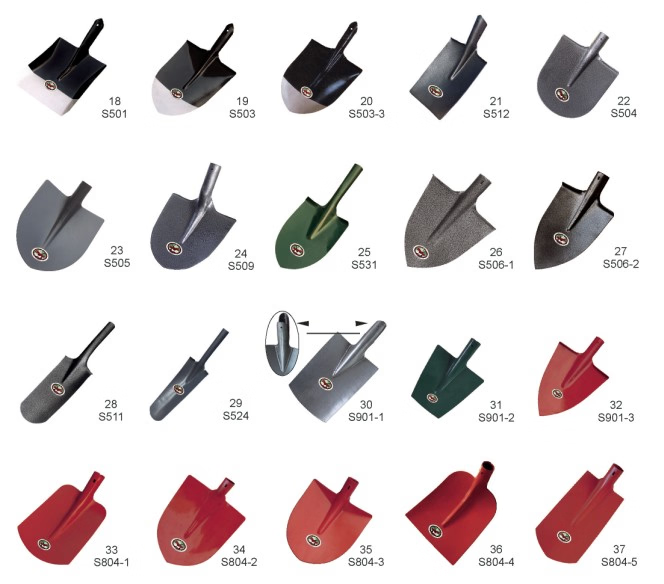
Image source: Web (Bing) / storage.googleapis.com (Web image (fair-use with source credit))
When you set four common shovel types next to each other, the differences in leveling ability become obvious. Blade shape dictates everything. A square-point blade sits flush against the ground and peels a thin, even layer.
A round-point blade enters the soil with intent to dig. A transfer blade scoops and carries. A garden spade cuts clean edges but lacks the blade area for fast grading.
Handle style changes the user experience. A D-handle gives wrist control for precision work. A long straight handle gives reach for open areas.
The photo here shows the blade contours that matter most. Note how the square-mouth shovel has a perfectly flat front lip. That’s the feature that lets you back-drag soil smooth.
Any shovel with a pronounced curve at the tip will snag and leave a trail of small divots.
Aggregate user reviews consistently rate square-point shovels highest for leveling. The next-best option for small, detailed work is a garden spade with a D-grip. Transfer shovels earn praise for spreading large volumes quickly but receive low marks for precision grading.
Avoid round-point shovels entirely for the leveling pass. Keep one around for the initial cleanup phase only.
The Right Shovel for Your Soil Type and Project Size
Soil type changes how a shovel behaves. Loose, sandy soil slides easily off any blade. You can get away with a lighter aluminum scoop or a thinner 16-gauge steel square-point and still get clean results.
Damp clay is a different animal. It sticks to uncoated steel and adds weight to the blade with every pass. A powder-coated steel blade with a 14-gauge thickness resists flex and sheds wet soil better.
Some users wipe the blade with a light coat of cooking spray before starting to reduce sticking.
Project size matters just as much. Leveling a 10-by-10-foot patch for a patio demands a different approach than smoothing out a 2,000-square-foot lawn. For small areas, a D-handle garden spade or a short square-point shovel gives you the control to hit the right grade without overshooting.
For large lawns, a long-handle square-point shovel with a wide blade makes faster progress. You might pair it with a walk-behind spreader to top-dress after leveling, especially if you plan to use a broadcast spreader for seed or fertilizer right after.
Rocky soil adds another layer. A thin blade will nick and dull quickly. A forged steel blade with a reinforced footstep holds up.
Don’t expect any shovel to cut through heavy rock without a fight. In that case, do the rough breaking with a pick or a round-point shovel, then switch to the flat shovel for finishing.
How Much a Quality Leveling Shovel Costs (and Why It’s Worth It)
A good square-point shovel for leveling runs between $25 and $55 as of early 2026. That’s not a lot of money for a tool you’ll use across multiple projects. At the lower end, around $25 to $35, you’ll find standard-duty shovels with wooden handles and 16-gauge blades.
They work fine for light, occasional use. The blade might flex under heavy drag, but for a small lawn touch-up once a year, it gets the job done.
Stepping up to the $40 to $55 range buys a 14-gauge tempered steel blade and a fiberglass handle. The step is reinforced and the blade holds its edge longer. These shovels weigh a bit more, but the stiffer blade transfers your effort more efficiently.
Verified buyer feedback from brands like Razor-Back and Bully Tools shows that users keep these shovels for years without needing a replacement handle.
Spending more than $60 usually means you’re buying a specialty grading shovel with a curved blade lift designed for asphalt or heavy construction. Those aren’t necessary for lawn leveling. The sweet spot is a fiberglass-handle, 14-gauge square-point shovel in the mid-$40s.
It’s durable enough for multiple seasons and versatile enough to spread gravel, sand, or compost when the leveling job is done. For total lawn care, you’ll keep your mower in top shape too, and a flat grade helps that machine run cleaner with less scalping.
Mistakes That Ruin a Perfect Grade When Leveling With a Shovel
The biggest mistake is dragging the shovel blade at the wrong angle. Tip it too flat and it rides over the soil without cutting. Tip it too steep and it gouges in.
The sweet spot is a slight downward tilt, just enough for the front lip to skim a thin layer. Keep your hands low on the handle for better blade feel.
Another common error is working with wet soil. Damp dirt clumps under the blade and moves in chunks instead of feathering out. Wait until the ground is moist but not sticky.
If your boots leave deep prints, stop and let it dry. A few hours of patience beats redoing the whole grade later.
Expert Tips for Fast, Even Ground Without Heavy Equipment
Back-drag in long, overlapping strokes. Walk backward in a straight line, pulling the flat blade toward you with even pressure. Overlap each pass by half the blade width so no ridges form.
String lines set at finished grade height help you spot high spots quickly. Squat down occasionally to sight across the ground at eye level.
After the shovel pass, a quick drag with a piece of chain-link fence or an old pallet smooths out the last imperfections. The University of Minnesota Extension notes that a properly graded lawn drains better and establishes stronger roots. For finishing work on a large lawn, pairing your shovel with a professional leveling rake cuts touch-up time in half.
Frequently Asked Questions About Leveling Shovels
Can I use a round-point shovel to level ground?
A round-point shovel digs well but doesn't level well. Its curved tip catches and gouges instead of slicing flat. Use it to break up clods first, then switch to a square-point shovel for the actual leveling pass.
What's the best handle length for a leveling shovel?
A 57 to 60-inch long straight handle works best for large open areas. It lets you stand upright while back-dragging. For tight spaces or detail work, a 48-inch D-handle gives better wrist control.
Is a fiberglass handle better than wood for leveling?
Fiberglass handles last longer and absorb shock better. They won't splinter or rot like wood. Wood handles are lighter and warmer in the hand but require more care.
For most leveling work, fiberglass is the more durable choice.
Do I need more than one shovel for leveling?
For most projects, a square-point shovel handles the main grading. A garden spade helps with edges and tight spots. A transfer shovel speeds up spreading loose material like topsoil.
One good square-point covers most needs.
The Best Shovel for Leveling Ground: Our Final Picks by Use Case
For general lawn leveling, a 14-gauge square-point shovel with a long fiberglass handle is the all-around pick. Bully Tools and Razor-Back both offer models in the $45 range that hold up season after season. For small beds and detail work, a D-handle garden spade gives tighter control.
If you spread loose amendments often, add an aluminum scoop shovel for faster loading.