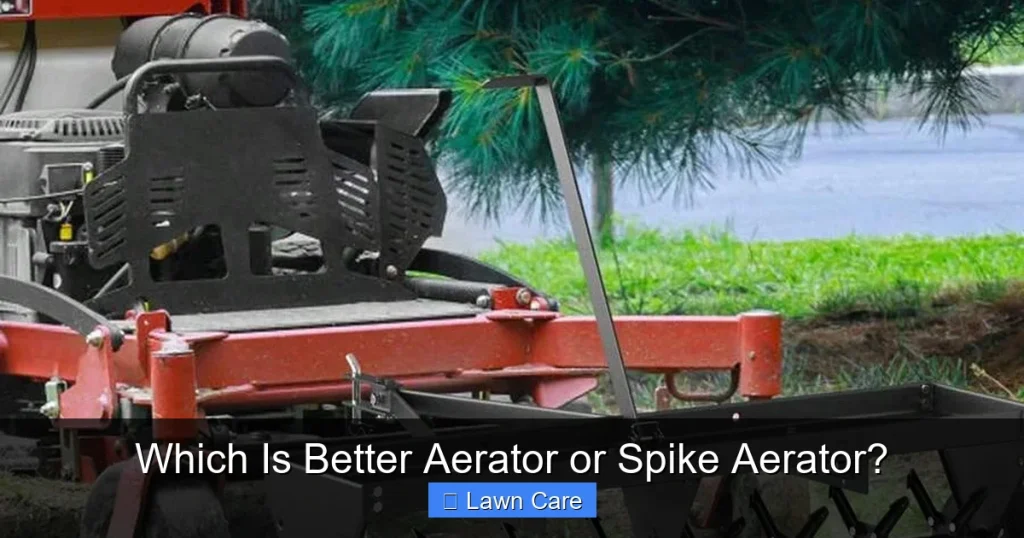
Choosing between an aerator and a spike aerator depends on your lawn’s specific needs. Core aerators remove plugs of soil for deeper compaction relief, ideal for heavily compacted areas and clay soils. Spike aerators poke holes but can worsen compaction in some cases. Understanding these differences helps you make the right choice for a healthier lawn.
Are you staring at your lawn, noticing it’s looking a bit sad, waterlogged, or just not as vibrant as it could be? You’ve probably heard that aeration is the key to unlocking a healthier, greener turf. But then comes the next big question: which kind of aerator should you use? The market offers two main types: the standard aerator (often referred to as a core aerator) and the spike aerator. They look similar, and both aim to improve your lawn, but they work quite differently and have distinct benefits and drawbacks. It’s like choosing between a gentle nudge and a strong poke – both might achieve something, but the outcome can be very different.
Deciding between a core aerator and a spike aerator isn’t just a minor detail; it’s a decision that can significantly impact your lawn’s long-term health. The wrong choice might not only fail to solve your lawn’s problems but could even create new ones. So, let’s break down these two common lawn tools, understand how they function, and figure out which one is the champion for your specific lawn care needs. We’ll explore their mechanisms, the types of lawns they benefit most, and what to consider before you grab a tool.
## Understanding Core Aerators
When most lawn care professionals talk about aeration, they’re usually referring to core aeration. This is the gold standard for addressing compacted soil and improving overall turf health. A core aerator, whether it’s a manual push model, a tow-behind attachment for a mower, or a walk-behind machine, works by physically removing small plugs or cores of soil from your lawn.
### How Core Aerators Work
Imagine tiny, hollow tines on the machine. As you push or pull it across your lawn, these tines penetrate the soil and extract cylindrical cores of soil and thatch. These cores are then deposited on the surface of your lawn. At first, this might look a little messy, but don’t worry – it’s a good sign! These removed plugs create a network of holes throughout your turf.
The process of removing these soil cores is crucial. It relieves soil compaction by creating channels for essential elements to penetrate deep into the root zone. Think of it as creating tiny airways and superhighways for your grass.
### Benefits of Core Aeration
The benefits of core aeration are numerous and profound:
* **Combating Soil Compaction:** This is the primary benefit. Over time, foot traffic, heavy equipment, and even natural soil settling can lead to compaction. Compacted soil restricts the movement of air, water, and nutrients, suffocating your grass roots and hindering growth. Core aeration breaks up this compaction effectively.
* **Improved Airflow to Roots:** Grass roots need oxygen to thrive. Core aeration opens up channels, allowing oxygen to reach the root system.
* **Enhanced Water Penetration:** When soil is compacted, water tends to run off the surface, leading to wasted water and potentially shallow root development. Aeration holes allow water to soak deeper into the soil, reaching the roots where it’s needed most. This also helps prevent overwatering issues, a common problem many homeowners face.
* **Better Nutrient Uptake:** Fertilizers and soil amendments can easily penetrate the soil through the aerated channels, ensuring that your grass receives the nutrients it needs for healthy growth.
* **Reduced Thatch Buildup:** Thatch is a layer of dead grass and debris that can accumulate between the soil and the green grass blades. A thick thatch layer can harbor pests and diseases and prevent water and air from reaching the soil. Core aeration helps break down this thatch layer by allowing beneficial microbes to work more effectively.
* **Promoting Stronger Root Growth:** With better access to air, water, and nutrients, grass roots can grow deeper and stronger, making your lawn more resilient to drought, heat, and stress.
### When to Choose Core Aeration
Core aeration is the ideal choice for lawns experiencing significant soil compaction. This is particularly common in:
* Lawns with heavy clay soil, which tends to compact easily.
* High-traffic areas, such as play areas for children or pets, pathways, or areas where lawn equipment is frequently used.
* Lawns that feel hard and spongy underfoot.
* Lawns where water tends to pool or run off easily after rain or watering.
If you’re seeing these issues, a core aerator is likely your best bet for a robust and healthy lawn. It’s a more intensive treatment, but the results are usually well worth the effort. For many, it’s the most effective way to address serious lawn problems.
## Understanding Spike Aerators
Spike aerators, also known as spoon aerators, are a simpler tool designed to poke holes into the soil surface. They come in various forms, from manual “aeration sandals” you strap onto your shoes to larger, walk-behind machines. The fundamental principle is to create openings by driving spikes into the ground.
### How Spike Aerators Work
Unlike core aerators, spike aerators do not remove soil. Instead, they compress the soil around the spike as they penetrate. The idea is to create channels that allow air and water to penetrate the soil. The depth and effectiveness of these holes depend heavily on the spike’s length and the force applied.
On the surface, it looks like the spike aerator is doing a similar job to a core aerator by creating holes. However, the mechanism of action and the impact on the soil are quite different.
### Potential Drawbacks of Spike Aeration
While spike aerators might seem like a quick and easy solution, they come with significant potential downsides, especially for lawns that are already compacted:
* **Can Worsen Compaction:** This is the most critical issue. By merely compressing the soil around the spike, a spike aerator can actually increase compaction in the surrounding soil. This is particularly problematic in clay soils or heavily compacted areas. Instead of relieving compaction, it can make it worse.
* **Shallow Penetration:** The holes created by spike aerators are often shallow. This means that air, water, and nutrients may only reach the upper layers of the soil, not the deeper root zone where they are most needed.
* **Limited Effectiveness on Severe Compaction:** For heavily compacted lawns, spike aerators simply aren’t powerful enough to create lasting improvement. The soil is too dense for the spikes to penetrate effectively and create meaningful channels.
* **Temporary Relief:** Any perceived benefits from spike aeration are often short-lived because the underlying compaction isn’t properly addressed.
### When Spike Aeration Might Be Considered
Despite their drawbacks, spike aerators do have a niche, albeit a limited one:
* **Very Light Compaction:** If your lawn has only minor compaction issues and you can easily push a screwdriver into the soil, a spike aerator might offer some minimal, temporary relief.
* **Loosening the Top Layer:** For lawns that are not significantly compacted but could benefit from a slight loosening of the very top layer of soil, a spike aerator might be used.
* **As a Pre-Treatment (with caution):** Some gardeners might use spike aerators before applying topdressing or overseeding on lawns with very light compaction. However, this should be done with extreme caution, as it can still exacerbate compaction.
It’s important to reiterate that for most common lawn issues like poor drainage, water runoff, or thin turf due to compaction, spike aerators are generally **not** the recommended solution. Their potential to worsen compaction makes them a risky choice for many homeowners.
## Core Aerator vs. Spike Aerator: The Key Differences
Let’s distill the comparison into the most important distinctions:
* **Mechanism:** Core aerators remove soil plugs; spike aerators push spikes into the soil.
* **Impact on Compaction:** Core aeration relieves compaction; spike aeration can worsen it.
* **Depth of Action:** Core aeration reaches deeper into the root zone; spike aeration is mostly superficial.
* **Effectiveness:** Core aeration offers significant, long-lasting benefits; spike aeration offers minimal, often temporary, benefits.
* **Soil Type Suitability:** Core aeration is excellent for clay and compacted soils; spike aeration can be detrimental to clay and compacted soils.
Think of it this way: If your lawn is a stuffy room, a core aerator opens windows and doors for fresh air and light, while a spike aerator might just poke a few tiny holes in the wall that don’t let much through and could even weaken the wall.
## Choosing the Right Aerator for Your Lawn
The decision hinges on your lawn’s specific condition. Here’s a practical guide to help you choose:
### Assess Your Lawn’s Needs
Before you even look at aerators, walk your lawn.
* Does it feel hard and resistant to a shovel or screwdriver?
* Does water pool on the surface after rain or watering?
* Is your grass thin and struggling to establish, especially in sunny spots?
* Do you have a lot of clay in your soil?
* Is it a high-traffic area?
If you answered “yes” to most of these questions, your lawn is likely suffering from soil compaction, and a **core aerator** is your best friend.
### Consider Your Soil Type
* **Clay Soil:** Clay soils are notorious for compacting easily and becoming dense. They retain moisture poorly and can become waterlogged. For clay soil, **core aeration** is essential to break up this density and allow for proper drainage and airflow. Spike aerators will likely only compact the clay further.
* **Sandy Soil:** Sandy soils drain very well, sometimes too well, and can be prone to nutrient leaching. While they don’t compact as severely as clay, aeration can still be beneficial. A **core aerator** can still help improve nutrient retention and water holding capacity by creating more consistent soil structure and allowing amendments to be incorporated. Spike aerators might offer minimal benefits but carry less risk of worsening compaction.
* **Loam Soil:** Loam is generally considered ideal, offering a good balance of sand, silt, and clay. Loam soils are less prone to severe compaction. However, even loam can benefit from periodic **core aeration**, especially in high-traffic areas, to maintain optimal soil structure and health.
### Lawn Type and Grass Species
While the type of aerator is more about soil condition than grass type, some lawns might benefit more. For example, if you have tough, wear-resistant grasses like Bermudagrass or Zoysia grass (often found in warmer climates), they tend to be able to recover well from core aeration. If you’re wondering which grass might be best for your climate, you might want to research topics like which grass is better St Augustine or Bermuda, as different grasses have different needs and resilience. St. Augustine grass, for instance, can be more sensitive to soil conditions.
## Practical Tips for Aeration
Regardless of the type of aerator you choose, timing and technique are crucial for success.
### Best Time to Aerate
The ideal time to aerate depends on your grass type:
* **Cool-Season Grasses (Fescue, Bluegrass, Ryegrass):** Aerate in the early fall (September/October) or early spring (March/April) when the grass is actively growing. This allows it to recover quickly from the process. If you’re curious about specific cool-season grasses, checking out which is better Kentucky bluegrass or fescue can provide more context.
* **Warm-Season Grasses (Bermuda, Zoysia, Bahia):** Aerate in late spring or early summer (May/June) when the grass is actively growing and can recover fastest. For those interested in warm-season varieties, learning about which is better Bermuda or Bahia grass might be helpful.
### How Often to Aerate
* **Severely Compacted Lawns:** Once a year or even twice a year (spring and fall) might be necessary until compaction is significantly reduced.
* **Moderately Compacted Lawns:** Once every 1-2 years.
* **Lightly Compacted Lawns:** Once every 2-3 years.
The question of is it necessary to use an aerator really comes down to observation and understanding your lawn’s specific needs.
### Post-Aeration Care
* **Watering:** Water your lawn lightly after aeration to help wash soil particles into the holes. Following up with is it better to water deeply or frequently advice can help maximize the benefits of aeration.
* **Fertilizing:** If you plan to fertilize, now is a great time to do so, as the nutrients will penetrate easily. Consider using a slow-release fertilizer, especially if it’s summer.
* **Overseeding:** Aeration is the perfect time to overseed. The seeds will fall into the open holes, establishing better contact with the soil for improved germination.
* **Mowing:** You can typically mow your lawn again a day or two after aeration, but be mindful of the soil plugs. You can leave them to break down naturally, or rake them up if you prefer a tidier appearance.
## Buying vs. Renting
When it comes to acquiring an aerator, you have a choice: buy or rent. This decision often depends on the frequency of use and the size of your property. If you have a large property that requires frequent aeration or you’re very serious about lawn care, investing in your own core aerator might be cost-effective in the long run. For smaller lawns or occasional use, renting a core aerator can be a more economical option. For those considering this, exploring buying vs. renting a lawn aerator which is more cost-effective can provide valuable insights.
## Conclusion: Core Aerator is Generally Better
In the debate of aerator vs. spike aerator, the **core aerator** emerges as the clear winner for most lawn care scenarios. Its ability to remove soil plugs and effectively relieve compaction makes it the superior tool for improving soil structure, drainage, and nutrient uptake. While spike aerators might seem like a simpler alternative, their potential to worsen compaction makes them a risky choice.
Understanding your lawn’s soil type and its specific issues is key. For a truly healthy, vibrant, and resilient lawn, investing in or renting a core aerator is almost always the best path forward. It’s a foundational step in achieving that lush green carpet you desire.
- Core aerators remove soil plugs, creating more significant pathways for air, water, and nutrients to reach the root zone.
- Spike aerators poke holes into the soil, which can be less effective on heavily compacted ground and may even worsen compaction in certain conditions.
- Core aeration is generally considered more beneficial for lawns with severe compaction and clay-heavy soils.
- Spike aeration can be suitable for very light compaction or for simply loosening the top layer of soil.
- The type of soil you have plays a crucial role in determining which aerator is more effective and less damaging.
- Consider the size and type of your lawn and the specific problems you’re trying to address when making your decision.
Quick Answers to Common Questions
What is the main difference between a core aerator and a spike aerator?
The main difference is how they work: core aerators remove plugs of soil, while spike aerators poke holes into the soil without removing it.
Can spike aerators damage my lawn?
Yes, spike aerators can potentially worsen soil compaction, especially in clay or already compacted soils, by compressing the soil around the spikes.
When is the best time to use a core aerator?
The best time depends on your grass type: early fall or spring for cool-season grasses, and late spring or early summer for warm-season grasses.
Are core aerators effective on clay soil?
Yes, core aerators are highly effective on clay soil because they break up the dense structure and allow for better airflow and water penetration.
Should I choose a spike aerator for very light compaction?
While a spike aerator might offer minimal, temporary relief for very light compaction, a core aerator is still generally a more beneficial and less risky option for long-term lawn health.
Frequently Asked Questions
What is soil compaction and why is it bad for my lawn?
Soil compaction is when soil particles are pressed closely together, reducing pore space. This makes it difficult for air, water, and nutrients to reach grass roots, leading to stunted growth, shallow roots, and poor drainage.
How do I know if my lawn is compacted?
You can test for compaction by trying to push a screwdriver or a thin rod into the soil; if it’s difficult, your soil is likely compacted. You might also notice water pooling on the surface after rain or watering.
Can I use an aerator on an established lawn?
Yes, aeration is specifically designed for established lawns. It’s a crucial maintenance practice for improving the health and vitality of existing turf.
How long does it take for a lawn to recover after aeration?
With proper timing during the active growing season, most lawns can recover within a few weeks. The soil plugs from core aeration will break down naturally and disappear.
Is it better to rent or buy a lawn aerator?
Renting is often more cost-effective for occasional use or smaller lawns, while buying can be a good investment for large properties or frequent aeration needs.
What should I do after aerating my lawn?
After aerating, it’s beneficial to water lightly, fertilize to help nutrients penetrate, and consider overseeding to fill in any thin patches. You can also leave the soil plugs to decompose naturally.