
Image source: Wikimedia Commons / Сарапулов (CC BY)
When should grub killer be applied? That's the question every homeowner asks the moment they see brown patches spreading across their lawn. The honest answer is that timing depends on what you're trying to do: prevent grubs from ever causing damage, or kill the ones already chewing through your roots.
Get the timing right and one application does the job. Get it wrong and you've wasted money while the damage keeps spreading.
Here's what our research shows: grub control products fall into two categories, and each one targets a completely different stage of the beetle life cycle. The treatment threshold most university extension services cite is 5 to 10 grubs per square foot. Below that number, your lawn can usually handle the stress.
Above it, you need to act, and when you act depends entirely on which product you're using and where you are in the season.
Image source: Wikimedia Commons / Сарапулов (CC BY)
Quick Answer
Apply preventive grub killer in late spring to early summer, typically May through June. Apply curative grub killer in late summer, usually late July through September. The exact timing depends on your region and the product's active ingredient.
Always confirm grubs are present before treating.
The Real Answer: When to Apply Grub Killer Depends on Your Situation
There's no single "best day" to apply grub killer. The right window shifts based on your climate, your grass type, and whether you're trying to prevent an infestation or stop one that's already happening. What matters most is matching the product to the grub's life cycle stage.
Here's the core issue. Most grub species lay eggs in mid to late summer. Those eggs hatch into tiny larvae within a few weeks.
The young larvae are most vulnerable to treatment because they're small, feeding near the surface, and haven't yet caused visible damage. That's your sweet spot for preventive products. If you wait until you see brown patches, the grubs are already mature and much harder to kill.
So the real question isn't just "when." It's "when relative to what stage of the grub's life?" Once you understand that, the timing becomes straightforward.
How Grub Life Cycles Dictate Your Timing
Why the calendar date matters less than what's happening underground
Grub species vary by region, but the most common lawn pests in the United States follow a similar annual cycle. Adult beetles emerge in early to mid-summer. They mate, fly to nearby turf, and lay eggs in the soil.
Japanese beetles, for example, typically peak in activity during June and July across the Northeast and Midwest. European chafers follow a similar pattern but often peak a bit earlier.
Those eggs hatch within two to three weeks. The tiny larvae start feeding on grass roots almost immediately. By late summer, they're growing fast and causing the brown, spongy patches most homeowners notice.
Come fall, the mature larvae burrow deeper into the soil to overwinter. They return to the root zone the following spring for one more round of feeding before pupating.
The critical window for control is when larvae are young and close to the surface. That's typically mid-July through September for most regions. Miss that window and you're fighting a much tougher battle.
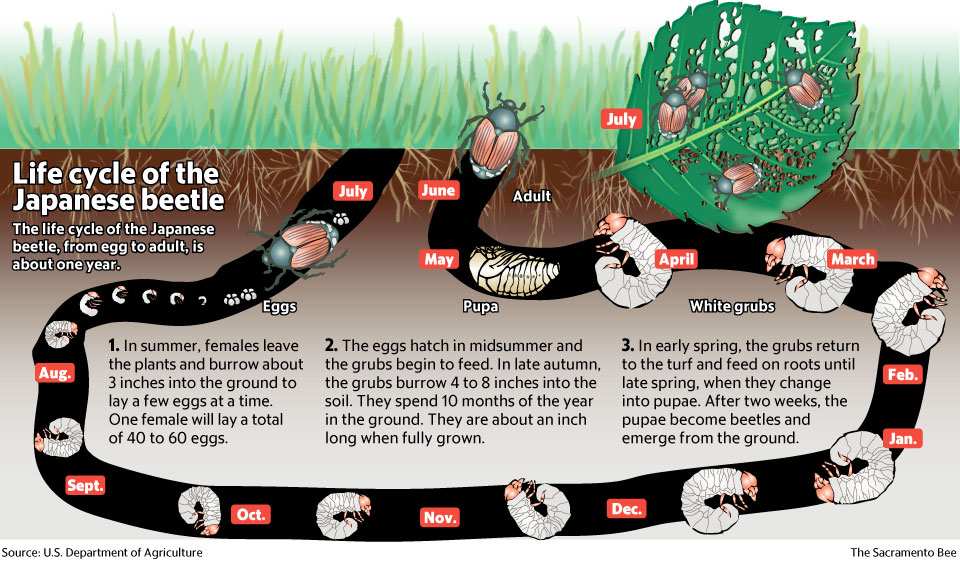
Image source: Bing (Web (fair-use with source credit))
Preventive vs. curative: they're completely different strategies
This is where most people go wrong. They grab a product without understanding whether it's designed to prevent or to cure. These two categories work at completely different points in the life cycle.
Preventive products need to be applied before the eggs hatch. The active ingredient sits in the soil and kills larvae as soon as they emerge. If you apply a preventive product in September, it's already too late.
The grubs are too big and the product won't work effectively.
Curative products are designed to kill grubs that are already feeding. They work fast because they target larger, active larvae. But they have a shorter window of effectiveness in the soil, so they need to be applied when grubs are actively present and feeding.
Here's a quick breakdown of how the two approaches compare:
| Factor | Preventive | Curative |
|---|---|---|
| Best application window | May through June | Late July through September |
| Target stage | Newly hatched larvae | Actively feeding larvae |
| Speed of action | Slow (works as larvae emerge) | Fast (kills within days) |
| Soil residual | Long (months) | Short (weeks) |
| Visible damage at time of application | None yet | May already be present |
| Typical active ingredients | Chlorantraniliprole, imidacloprid | Trichlorfon, carbaryl |
The Decision Tree: Which Product and When
Let's make this practical. Here's how to decide what to do based on where you are right now.
If it's late spring through early summer (May–June)
This is your preventive window. If you've had grub problems in previous years, or you live in a region with heavy Japanese beetle pressure, this is the time to act. Apply a preventive product containing chlorantraniliprole (commonly sold as GrubEx) or imidacloprid.
Water it in thoroughly so the active ingredient reaches the root zone where larvae will hatch.
The key here is patience. You won't see immediate results because there's nothing visible to kill yet. The product is building a barrier in the soil.
When the eggs hatch in a few weeks, the larvae ingest the active ingredient and die before they ever damage your lawn.
If it's mid-to-late summer (July–August)
Now you're in decision mode. If you didn't apply a preventive, you need to assess what's happening. Check your lawn for signs of damage: brown patches that peel back like carpet, increased animal activity (skunks and raccoons dig for grubs), or actual grubs visible when you pull back dead turf.
If you find more than 5 to 10 grubs per square foot, it's time for a curative product. Trichlorfon (sold as Dylox) is the go-to option because it works fast, often killing grubs within one to three days. Apply it in the evening and water it in immediately.
The larvae are feeding actively at this time of year, so they'll encounter the treated soil quickly.
If it's fall (September–October)
This is the last chance for curative treatment, but it gets trickier. In warmer regions, grubs are still feeding near the surface through September. In cooler regions, they may already be starting to burrow deeper for winter.
If they're deep in the soil profile, even a curative product won't reach them effectively.
If you're finding grubs at this point, apply a curative product as soon as possible. But honestly, if you're seeing heavy damage in October, your better move is often to plan for a preventive application the following spring and let the winter kill off some of the overwintering population naturally.
How to Confirm You Actually Have a Grub Problem
The simple test: cut a flap and count
Before you spend a dime on any product, make sure you're actually dealing with grubs. Brown lawn patches can come from drought stress, fungal disease, dog urine, chinch bugs, or a dozen other causes. Grub damage has a telltale signature: the dead turf lifts up easily because the roots have been eaten away.
Here's the test. Cut a one-foot-square flap of turf in the damaged area. Peel it back and look at the soil underneath.
Count the grubs you see. Then check two or three more spots around the damaged area.
- Fewer than 5 grubs per square foot: Your lawn can usually recover on its own. Hold off on treatment.
- 5 to 10 grubs per square foot: This is the treatment threshold. Consider control, especially if damage is visible.
- More than 10 grubs per square foot: Treat as soon as possible. Significant lawn loss is likely without intervention.
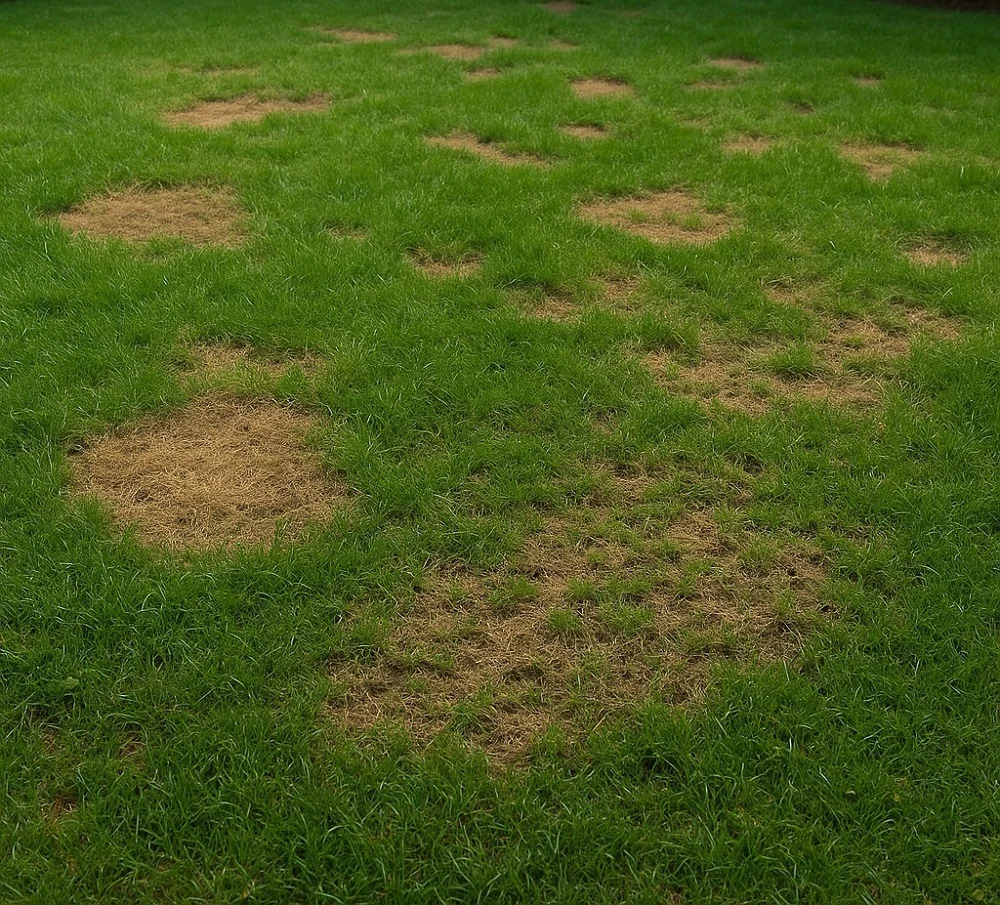
Image source: Bing (Web (fair-use with source credit))
When the damage isn't grubs at all
Drought stress is the most common misdiagnosis. If your lawn is turning brown but the turf doesn't pull up easily, you're probably looking at a water issue. Fungal diseases like brown patch or dollar spot create circular patterns but won't show grubs when you dig.
Chinch bugs cause similar browning but are tiny insects you'd find at the soil surface, not curled white grubs underneath.
Taking the time to confirm saves you from applying a product that won't solve your actual problem. It also saves money and keeps unnecessary chemicals out of your soil.
Preventive Grub Control: How It Works and When to Use It
Best products for prevention
Preventive grub control is the most reliable approach if you know you have a history of grub problems. The two most widely used active ingredients for prevention are chlorantraniliprole and imidacloprid. Both are systemic, meaning they get taken up into the plant tissue and kill larvae as they feed on roots.
Chlorantraniliprole (GrubEx) has become the standard preventive choice as of 2026. It's targeted specifically at beetle larvae, has a long soil residual, and is considered lower risk for non-target organisms when applied according to the label. One application in late spring typically provides season-long protection.
Imidacloprid is another option, though it's a broader-spectrum neonicotinoid. Some states have placed restrictions on neonicotinoid use due to pollinator concerns, so check your local regulations before choosing this option. It's still effective, but the regulatory landscape has shifted in recent years.
Apply preventive products with a broadcast spreader for even coverage. The most critical step comes after spreading: you need to water the product into the soil. Without irrigation or rainfall within a day or two, the active ingredient won't reach the root zone where larvae feed.
Aim for about a quarter to half inch of water.
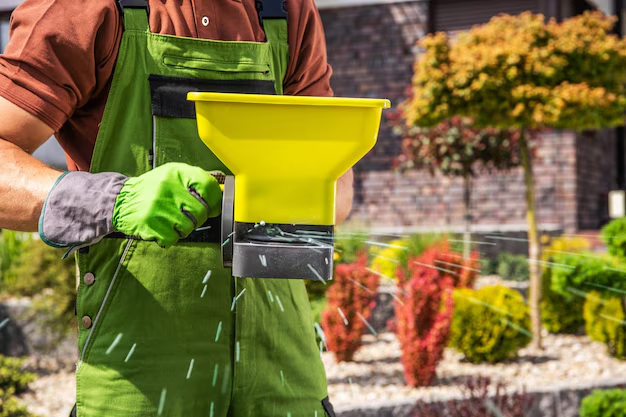
Image source: Bing (Web (fair-use with source credit))
When preventive timing fails
The biggest mistake with preventive products is applying too late. If you apply in August, the eggs have already hatched and the larvae have been feeding for weeks. The preventive product won't kill them because it's designed for newly hatched larvae, not established ones.
Another common failure point is uneven application. If you miss spots with your spreader, grubs will thrive in the untreated areas. Overlap your spreader passes slightly to avoid gaps.
Calibrate your spreader to the rate listed on the product label. Too little product means ineffective control. Too much means wasted money and potential environmental concern.
Finally, preventive products need soil moisture to activate. If you apply during a prolonged dry spell and don't irrigate, the product just sits on the surface doing nothing. Always plan your application around a watering schedule.
Curative Grub Control: When You Need to Kill What's Already There
Best products for active infestations
Curative products are your rescue option when grubs are already damaging your lawn. The most effective curative active ingredient available to homeowners is trichlorfon, commonly sold as Dylox. It works on contact and through ingestion, meaning grubs die when they either touch the treated soil or feed on roots that have absorbed the product.
Trichlorfon acts fast. Manufacturer specifications indicate that most grubs die within one to three days of exposure. That speed matters when you're watching brown patches spread week by week.
The downside is that trichlorfon breaks down relatively quickly in the soil. It doesn't provide long-term residual protection, so it's strictly a knock-down treatment, not a preventive.
Carbaryl is another curative option found in some combination lawn insect products. It's effective but has a shorter track record of reliable control compared to trichlorfon in university trial data. Where carbaryl shines is in situations where you're dealing with multiple lawn pests at once, since it has a broader target range.
Why curative products have a tighter window
Unlike preventive products that can sit in the soil for months waiting for larvae to hatch, curative products need to hit grubs that are actively feeding right now. That means your application timing has to align with when grubs are near the surface and taking bites of grass roots.
In most regions, that active feeding window runs from mid-July through September. Apply too early and the grubs haven't hatched yet. Apply too late and they've already burrowed deep for winter.
The product simply can't reach them at that depth.
Watering in is just as critical with curative products as it is with preventives. The active ingredient needs to move down into the root zone where grubs are feeding. Without adequate irrigation after application, the product stays at the surface and the grubs keep feeding below it, completely unaffected.
Common Mistakes That Waste Your Time and Money
Applying too early and watching it wash away
One of the most frequent timing errors is applying a preventive product in early spring, thinking you're getting ahead of the season. The problem is that most preventive insecticides have a soil residual of several months at best. Apply in April and much of the active ingredient has degraded by the time eggs hatch in July.
You've spent money on protection that expired before you needed it.
The exception here is products containing chlorantraniliprole, which have shown longer residual activity in controlled studies. Even so, the recommended application window is late spring, not early spring. Patience pays off with these products.
Applying too late after the damage is done
On the flip side, waiting until you see widespread brown patches in October means the grubs have been feeding unchecked for months. At that point, even a curative product may not save the damaged turf. You'll kill the grubs, but you'll still need to reseed or sod the dead areas the following spring.
The best approach if you're seeing damage in fall is to apply a curative product immediately to protect any remaining green areas, then plan a preventive application for the following May or June. That two-step strategy stops the current infestation and prevents the next one.
Skipping the watering-in step
This mistake is so common that university extension services specifically call it out in their grub management guidelines. Granular products need water to move from the soil surface down to the root zone where grubs live. Without watering, the granules just sit on top of the grass, slowly breaking down without ever reaching their target.
Apply your product in the evening, then run your sprinklers for about 15 to 20 minutes. That's usually enough to move the active ingredient into the top inch or two of soil. If you're relying on rainfall, check that you're actually getting meaningful precipitation.
A light sprinkle won't do the job.
Treating the wrong pest entirely
Chinch bugs, sod webworms, and billbugs can all cause brown patches that look similar to grub damage. Each one requires a different treatment approach and different timing. Applying grub killer for a chinch bug problem wastes your money and lets the real pest keep spreading.
Always confirm what you're dealing with before you treat. The one-foot-square flap test takes two minutes and saves you from treating the wrong problem. If you're not sure, your local university extension office can usually identify the pest from a photo or a physical sample.
Regional Timing Differences You Need to Know
Northern and cool-season grass regions
If you're in the Northeast, Upper Midwest, or Pacific Northwest, your grub season tends to run a bit later. Japanese beetles and European chafers typically peak in egg-laying during July. Eggs hatch in August, and the heaviest larval feeding occurs in August and September.
For these regions, the preventive window is late May through mid-June. The curative window is August through mid-October, though earlier is always better once you confirm grubs are present. Cool-season grasses like Kentucky bluegrass and tall fescue have deeper root systems and can tolerate moderate grub feeding better than some warm-season species, but they're far from immune.
Southern and warm-season grass regions
Southern lawns face a different challenge. Warmer soil temperatures mean beetles emerge earlier and eggs hatch sooner. In states like Georgia, Alabama, and Texas, egg hatch can begin as early as late June.
That shifts the preventive window to May and the curative window to July and August.
Warm-season grasses like Bermuda and St. Augustine are particularly vulnerable during drought stress. A lawn that's already struggling from heat and low water has less capacity to recover from grub feeding.
If you're in the South and seeing brown patches in July, don't wait. Check for grubs immediately.
Alternatives to Chemical Grub Killer
Milky spore
Milky spore is a naturally occurring bacterium (Paenibacillus popilliae) that specifically targets Japanese beetle grubs. When larvae ingest the spores while feeding, they develop milky spore disease and die. It's a biological control that can persist in the soil for years after a single application.
The catch is that milky spore takes time to establish. In our research, most university trial data shows it takes one to three years to build up enough spore density in the soil to provide effective control. It also works best in warmer climates where soil temperatures stay above 65°F for extended periods.
In northern regions, it's less reliable.
Beneficial nematodes
Heterorhabditis bacteriophora is a species of entomopathogenic nematode that actively seeks out grubs in the soil. These microscopic worms enter the grub's body and release bacteria that kill the host within 24 to 48 hours. They're a good option for homeowners who want a non-chemical approach.
Nematodes need to be applied when soil temperatures are between 60 and 85°F. They also need moist soil to move effectively, so water before and after application. The downside is that nematodes have a short shelf life and need to be applied immediately after purchase.
They're a same-day product, not something you can buy and store for weeks.
When biological controls make sense
Biological options work best as part of a long-term management strategy rather than an emergency response. If you've got active damage right now, a curative chemical product will give you faster results. But if you're planning ahead and want to reduce chemical inputs over time, milky spore and beneficial nematodes can be effective components of your approach.
Many experienced turf managers use a combination strategy: a preventive chemical application for the first couple of years while establishing biological controls in the soil. Over time, the biological agents take over and chemical use decreases.
Costs, Expectations, and What Results Look Like
What you'll spend
For a typical residential lawn of 5,000 to 7,000 square feet, expect to spend between $20 and $50 per application for a DIY granular product. Preventive products tend to be on the lower end of that range. Curative products like trichlorfon often cost a bit more per bag.
Professional lawn care companies typically charge $75 to $150 per application for grub control, depending on your lawn size and location. If you're dealing with a large property or severe infestation, professional application may be worth the cost for more thorough coverage.
How fast it works
Preventive products don't show visible results because they're killing larvae before damage occurs. You'll know they worked by the absence of brown patches in late summer. Curative products containing trichlorfon typically show results within one to three days.
Grubs stop feeding almost immediately and die shortly after.
Don't expect dead grubs to disappear. They'll decompose in the soil. The real indicator of success is that your lawn stops developing new brown patches and existing damage doesn't spread further.
How long protection lasts
Preventive products containing chlorantraniliprole generally provide season-long protection from a single application. Imidacloprid products offer similar duration. Curative products like trichlorfon provide short-term control, typically two to three weeks.
They're not designed for extended residual activity.
If you're in a region with heavy beetle pressure, a single annual preventive application is usually sufficient. In areas with multiple beetle species that emerge at different times, you may need to monitor more carefully and potentially make a second targeted application.
Frequently Asked Questions
Can I apply grub killer and fertilizer at the same time?
Yes, many combination products pair grub control with lawn fertilizer. Just make sure the timing matches your goal. If you're applying a preventive, a spring fertilizer combination works well.
For curative treatment, apply separately so you can control the timing and watering for each product.
Will grub killer harm earthworms?
Most modern grub control products have minimal impact on earthworms when applied at labeled rates. Chlorantraniliprodole and trichlorfon are both considered low-risk for earthworms. Imidacloprid has shown some toxicity to earthworms in laboratory studies, though field impacts appear limited at normal application rates.
How long after applying can my pets be on the lawn?
The general recommendation is to keep pets off the treated area until the product has been watered in and the grass is completely dry. This is typically a 24-hour window. Check the specific product label for exact guidelines, as recommendations vary by formulation.
Is it too late to treat grubs in November?
In most regions, yes. By November, mature grubs have typically burrowed below the treatment zone to overwinter. A curative application at that point is unlikely to reach them effectively.
Your better move is to plan a preventive application for the following late spring.
Do I need to treat every year?
Not necessarily. If you've had confirmed grub damage in previous years, annual preventive treatment is a reliable strategy. If you've never had a grub problem, you may not need treatment at all.
The key is monitoring. Check your lawn in mid to late summer, and treat only if you find grubs above the threshold level.
Final Decision Guide: Your Situation, Your Move
Here's a quick-reference table to match your situation with the right action:
| Your Situation | Product Type | When to Apply | Key Action |
|---|---|---|---|
| No prior damage, want prevention | Preventive (chlorantraniliprole) | May through June | Water in after spreading |
| Found 5-10 grubs per sq ft in July | Curative (trichlorfon) | Immediately | Water in, expect results in 1-3 days |
| Brown patches spreading in August | Curative (trichlorfon) | Right now | Treat all damaged and adjacent areas |
| Seeing damage in October | Curative if grubs still shallow | As soon as possible | Plan preventive for next spring |
| History of annual grub problems | Preventive every year | Late May to early June | Mark your calendar annually |
The bottom line is this. If you're preventing, apply in late spring before eggs hatch. If you're curing, apply the moment you confirm grubs are present.
And if you're past October with deep grubs already underground, save your money and plan for a preventive application next year. Timing is everything with grub control, and now you know exactly when to act.