Knowing exactly when apply grub control is the difference between a thick, healthy lawn and a patchy mess by late summer. The timing isn't a single date on the calendar. It depends on what product you're using, what stage the grubs are in, and where you live.
Here's the core issue: most people wait until they see damage, but by that point the grubs have already done their worst. The right window is narrow, and it shifts depending on whether you're preventing an outbreak or trying to kill one that's already happening. Get the timing right and one application handles the whole season.
Get it wrong and you've wasted money and time.

Image source: Wikimedia Commons / Сарапулов (CC BY)
Quick Answer
Apply preventive grub control in late spring to early summer, typically May through early July. Apply curative products in mid to late summer when grubs are small and actively feeding. Soil temperature at 4 inches deep should be around 50°F when eggs begin hatching.
Always check your product label for the specific timing window.
The Short Answer: It Depends on Your Product Type
The single biggest factor in timing is whether you're using a preventive or curative product. These two categories work completely differently, and applying one at the wrong time makes it nearly useless.
Preventive products like chlorantraniliprole (found in Scotts GrubEx) and imidacloprid need to be in the soil before grubs hatch. They create a protective zone that kills young larvae as soon as they start feeding. If you apply these in August, you've already missed the window.
Curative products like trichlorfon (Dylox) work on contact and through ingestion by existing grubs. You apply these when you can actually find grubs in the soil, typically mid through late summer. Applying Dylox in May would be pointless because the grubs aren't there yet.
Here's a simple breakdown:
| Product Type | Active Ingredient Examples | Best Application Window | How It Works |
|---|---|---|---|
| Preventive | Chlorantraniliprole, Imidacloprid | Late spring to early summer (May through early July) | Kills newly hatched larvae before they grow |
| Curative | Trichlorfon, Carbaryl | Mid to late summer (late July through September) | Kills existing grubs on contact and through feeding |
| Biological | Nematodes, Milky spore | Late summer through early fall | Uses living organisms to infect and kill grubs |
Why Timing Is Everything With Grub Control
White grubs go through a predictable life cycle each year, and your treatment has to align with it. Adult beetles emerge in early summer, mate, and lay eggs in the turf. Those eggs hatch within two to three weeks, and the tiny larvae immediately start feeding on grass roots.
The young larvae are the most vulnerable stage. They're small, they're near the soil surface, and they haven't built up any resistance. That's when preventive products do their job.
As grubs grow through late summer and into fall, they get larger, burrow deeper, and become much harder to kill.
This is why applying preventive grub control in September doesn't work. The product has a limited residual window, and by the time those grubs are actively feeding in fall, the chemical barrier has already broken down. You'd need a curative product at that point.
The cost of poor timing is real. A lawn with heavy grub damage often needs complete renovation: removing dead turf, reseeding or sodding, and months of recovery. That runs hundreds of dollars in materials and labor.
A single well-timed application of preventive grub control costs a fraction of that.
Understanding the Grub Life Cycle (And Why It Dictates Your Schedule)
The grub life cycle follows the same pattern every year, though exact dates shift by region. Adult beetles emerge from the soil in early summer, usually June through July depending on your location. Japanese beetles are the most common culprit in the Northeast and Midwest, while European chafers and masked chafers dominate other areas.
After emerging, adult beetles feed on trees and shrubs for a few weeks, then females burrow back into the lawn to lay eggs. Each female can lay 40 to 60 eggs in the top two inches of soil. Those eggs hatch within 10 to 14 days under normal conditions.
The newly hatched larvae are tiny, less than a quarter inch long. They feed on grass roots through late summer, growing to about one inch by September. As soil temperatures drop in fall, grubs burrow deeper, sometimes six to eight inches down, and enter a dormant state.
They return to the root zone the following spring for a short feeding period before pupating.
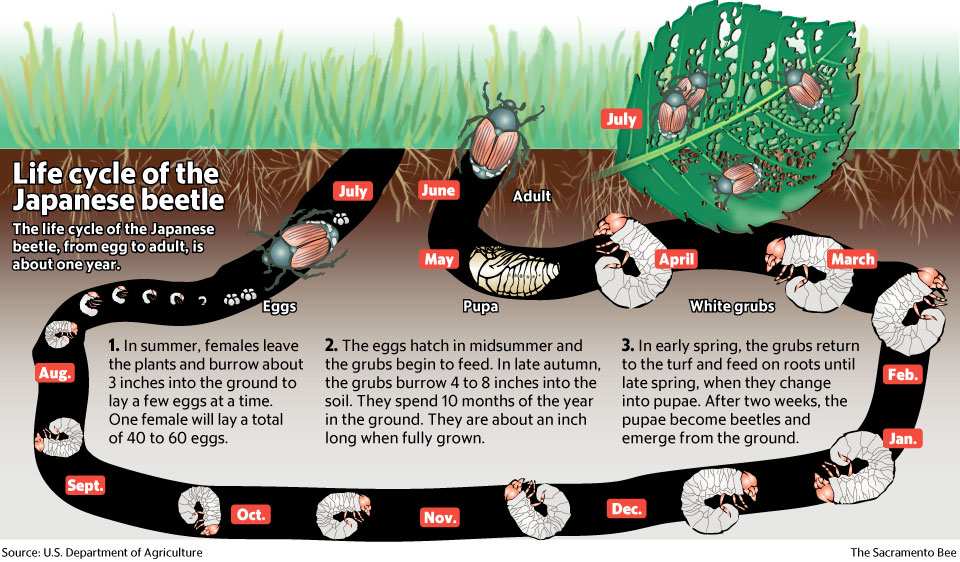
This cycle is why preventive products target the egg hatch window and curative products target the active feeding stage in late summer. Miss either window and you're fighting an uphill battle.
Preventive vs. Curative: Which Approach Determines Your Window
Before you pick a date, you need to decide which approach fits your situation. This choice drives everything else.
Go preventive if:
- You've had grub problems in the past two years
- Your neighbor's lawn had damage last season
- You live in a region with heavy beetle pressure
- You want one application to cover the whole season
- You're using chlorantraniliprole or imidacloprid
Go curative if:
- You're finding grubs right now in mid or late summer
- You missed the preventive window and want to limit damage
- You need fast results (trichlorfon works within one to three days)
- You're dealing with a confirmed outbreak
Most lawn care professionals lean toward preventive applications because they're more reliable and less stressful. You make one application in late spring and you're done. Curative treatments require you to catch the grubs at the right size, and if they've already grown large or burrowed deep, even curative products struggle.
There's also a middle ground. Some homeowners apply a preventive product in spring and then scout their lawn in August. If they find more than six to ten grubs per square foot, they follow up with a curative treatment.
This belt-and-suspenders approach works well in high-pressure areas.
The key takeaway: your product choice comes first, and the timing follows from there. Don't pick a date and then try to find a product that fits it.
Branch 1: When to Apply Preventive Grub Control
Preventive products need to go down before the eggs hit. That means you're targeting the window when adult beetles are actively laying, which typically runs from mid-June through late July in most of the United States. The sweet spot for application is usually late May through early July, depending on your region.
Chlorantraniliprole, the active ingredient in Scotts GrubEx, has become the go-to preventive choice because of its lower toxicity to bees and longer residual activity. It provides three to four months of protection from a single application. You want it in the soil and actively working by the time those first eggs hatch.
Imidacloprid products work similarly but have a shorter residual window, around two to three months. That means timing matters even more precisely. If you apply imidacloprid too early in spring, it may break down before the late-hatching eggs produce larvae.
The general rule: apply preventive grub control when soil temperatures at 4 inches depth consistently reach 50°F. This usually coincides with full bloom on dogwood trees and lilacs in many parts of the country. It's a reliable natural indicator that beetle activity is ramping up.
After application, water the lawn with at least a quarter inch of irrigation. This moves the active ingredient into the root zone where grubs will be feeding. Without watering in, most of the product stays on the surface and breaks down in sunlight.
Branch 2: When to Apply Curative Grub Control
Curative products are your response when you've already got grubs actively feeding. The best window runs from mid-July through September, when grubs are small, near the surface, and consuming roots aggressively.
Trichlorfon (Dylox) is the most widely recommended curative option. It works fast, often killing grubs within one to three days. The downside is a short residual period, so you're treating the grubs that are there now, not preventing future generations.
Apply it when grubs are less than half an inch long for best results.
Carbaryl (Sevin) also has curative activity against grubs but works more slowly. It's a good option if you're treating early in the season and want some knock-down power, but it's not as fast-acting as trichlorfon.
For curative treatments, skip the watering in for the first 24 hours if rain isn't in the forecast. You want the product to stay where the grubs are feeding. Heavy irrigation right after application can push it below the active zone.
One critical point: don't apply curative products too early in summer. If the eggs haven't hatched yet, the product breaks down before the larvae show up. Scout your lawn first.
Cut a one-foot square of sod and peel it back. If you find more than six to ten grubs in that sample, it's time to treat.
Branch 3: When to Apply Biological Controls (Nematodes and Milky Spore)
Biological controls take a completely different approach, and their timing reflects that. Beneficial nematodes, specifically Heterorhabditis bacteriophora, are microscopic worms that seek out and kill grubs from the inside. They work best in late August through early September when soil is warm and grubs are actively moving through the root zone.
Nematodes are living organisms, so handling matters. Apply them in the early morning or late evening because UV light kills them fast. Water the lawn before application and keep the soil moist for at least two weeks afterward.
Soil temperature should be above 60°F for nematodes to remain active.
Milky spore disease, caused by Paenibacillus popilliae, targets Japanese beetle grubs specifically. It takes longer to establish, often two to four years before you see full effectiveness. The best application time is late summer through early fall when grubs are feeding and can pick up the spores.
Once established in the soil, milky spore can remain effective for a decade or more.
Biological options work well for households with pets, children, or heavy pollinator activity. They won't give you the immediate knockout that chemical curatives do, but they offer a sustainable, long-term solution for recurring grub problems.
How Soil Temperature Acts as Your Signal

Image source: Wikimedia Commons / Henry G. Gilbert Nursery and Seed Trade Catalog Collection.; Peter Henderson & Co.
Soil temperature is the most reliable indicator for timing grub control, more so than calendar dates. Beetle activity and egg development are directly tied to how warm the soil gets, and that varies significantly from year to year.
Eggs typically begin hatching when soil at 4 inches depth reaches 50°F. You can track this with an inexpensive soil probe thermometer from any garden center. Start checking in late spring and take readings in the morning for consistency.
Here's how soil temperature maps to treatment decisions:
| Soil Temperature (4 inches) | What's Happening | Recommended Action |
|---|---|---|
| Below 50°F | Beetles dormant, eggs not yet hatching | Too early for preventive treatment |
| 50-60°F | Beetle flight beginning, eggs being laid | Apply preventive products now |
| 60-70°F | Egg hatch underway, young larvae feeding | Preventive window closing, curative products viable |
| Above 70°F | Grubs growing, actively feeding on roots | Curative treatment window is open |
In cooler regions like the Northeast or Upper Midwest, you may not hit the 50°F threshold until late May or early June. In warmer areas like the Mid-Atlantic or Transition Zone, it can arrive in late April. Pay attention to your local conditions rather than following a generic calendar.
One other factor: soil moisture matters alongside temperature. Dry, compacted soil heats up slower than well-watered turf. If you've had a cool, wet spring, the hatch may lag behind what the calendar suggests.
Scout your lawn and confirm before treating.
How to Confirm You Actually Have a Grub Problem
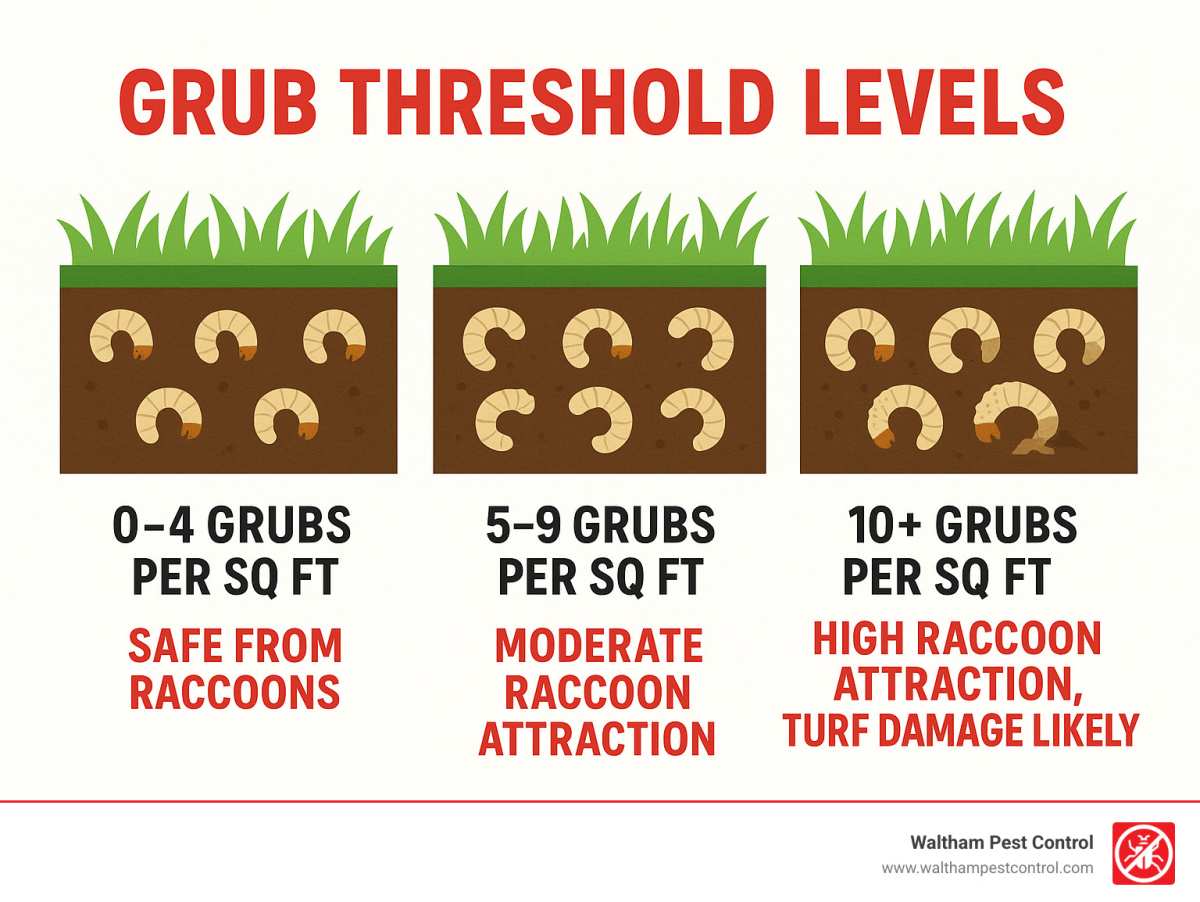
Image source: Bing (Web (fair-use with source credit))
Not every brown patch in your lawn is caused by grubs. Drought stress, fungal disease, dog urine, and compaction can all mimic grub damage. Treating when you don't have grubs wastes money and puts unnecessary product on your property.
Grub damage has a distinct look. The turf feels spongy underfoot and rolls back like loose carpet because the roots have been chewed through. You'll see irregular brown patches that don't respond to watering.
In severe cases, skunks, raccoons, or birds will dig up the lawn overnight searching for grubs.
To confirm, cut a one-foot-square section of turf at the edge of the damaged area. Peel it back and examine the top two inches of soil. Count the grubs you find there.
| Grub Count per Square Foot | What to Do |
|---|---|
| 0 to 5 | No treatment needed, lawn can tolerate this |
| 6 to 10 | Consider curative treatment if damage is visible |
| 10 or more | Treat immediately with curative product |
After counting, replace the sod and water it back in. The small disturbance won't cause long-term harm. This simple check takes five minutes and prevents you from guessing wrong.
Also pay attention to animal activity. If you're finding patches of torn-up sod early in the morning, that's a strong indication of a heavy grub population. Raccoons and skunks can do more visible damage in one night than grubs do in a week.
Regional Timing Differences You Should Know
Your location shifts the calendar significantly. Beetle species vary by region, and so do soil temperatures and seasonal patterns.
In the Northeast and Upper Midwest, European chafers and Japanese beetles dominate. Egg hatch typically begins in late June through mid-July. Preventive applications work best from late May through late June.
Curative treatments should go down in August.
In the Mid-Atlantic and Transition Zone, warmer springs push the timeline earlier. You may need preventive products in May. The longer growing season also means grubs feed later into fall, extending the curative window into October.
The Southeast deals with a different set of species, including masked chafers and the Asiatic garden beetle. These beetles fly and lay eggs earlier, sometimes starting in May. Preventive applications may need to go down in April or early May.
Warm-season grasses like Bermuda and zoysia also recover differently from damage, which affects your urgency.
In the Pacific Northwest, European chafer has become a major problem in recent years. The cooler, wetter climate shifts timing slightly later. Late June through July is the typical preventive window.
The Cost of Getting the Timing Wrong
Applying preventive grub control too late is the most common mistake. If you put down chlorantraniliprole in August, most of the eggs have already hatched and the larvae are growing. The product won't kill established grubs effectively.
You've spent money for little benefit.
Applying curative products too early is the other pitfall. If you put down trichlorfon in June before eggs hatch, the active ingredient degrades before larvae appear. You'll need a second application, doubling your cost.
A single well-timed preventive application typically costs $20 to $40 for an average-sized lawn. A failed application followed by curative treatment and potential lawn renovation can easily run $200 to $500. The math favors getting it right the first time.
Mistakes Most People Make Each Season
Beyond timing, several other errors undermine grub control efforts.
Applying granular product to wet grass causes granules to stick to blades instead of reaching the soil. Mow first, then apply to dry turf. Water afterward to move product down.
Skipping calibration of your spreader leads to uneven coverage. Too little product leaves gaps where grubs survive. Too much wastes money and increases environmental impact.
Follow the spreader settings on the product label and do a test pass.
Ignoring the watering-in step is another common failure. Most granular products need at least a quarter inch of water within 24 hours to activate. Without it, the active ingredient sits on the surface and degrades.
Treating the whole lawn when only one area has grubs is unnecessary. Spot-treat the affected zones and a buffer around them. Save product and money.
State Rules and Label Compliance You Need to Know
Grub control products are pesticides, and they're regulated at both federal and state levels. The product label is a legal document. Following it isn't optional.
Some states restrict certain active ingredients. Neonicotinoids like imidacloprid face limitations in several states due to pollinator concerns. Check with your state department of agriculture before purchasing.
Buffer zones near water bodies are required for many products. Don't apply within a specified distance of streams, ponds, or storm drains. Runoff carries active ingredients into waterways.
Commercial applicators need state licenses and must keep application records. Homeowners applying their own product still need to follow all label directions regarding PPE, re-entry intervals, and application rates.
Your Decision Guide: Which Schedule Fits Your Situation
If you've had grub damage in the past two years, go preventive in late spring. Use chlorantraniliprole for the longest residual and lowest bee toxicity.
If you're scouting now in August and finding grubs, go curative with trichlorfon. Treat as soon as possible while grubs are still small and near the surface.
If you're in a high-pressure area with recurring problems, consider a combined approach: preventive in spring, scout in August, and spot-treat if needed.
If you prefer organic methods, apply beneficial nematodes in late summer and milky spore in early fall. Be patient, as these take longer to show results.
Frequently Asked Questions
Can I apply grub control and fertilizer at the same time?
Yes, many homeowners combine a preventive grub control application with their early summer fertilizer round. Just make sure both products are compatible and water in thoroughly afterward.
How long after applying grub control can my pets go back on the lawn?
Most granular products are safe for pets once the granules have been watered in and the lawn has dried. Check the specific product label, as re-entry intervals vary.
Will grub control kill earthworms?
Chlorantraniliprole and imidacloprid have low toxicity to earthworms when used according to label directions. Trichlorfon has moderate toxicity. Biological options like nematodes do not harm earthworms.
What if it rains heavily right after I apply?
Heavy rain within 24 hours of application can wash product off target. If you get more than an inch of rain, you may need to reapply. Light rain or irrigation is actually beneficial.
Do I need to treat every year?
Not necessarily. If scouting shows fewer than five grubs per square foot and no visible damage, you can skip treatment that year. Monitor annually and treat when populations exceed the threshold.
Calibrating Your Spreader and Watering In Correctly
Proper spreader calibration ensures even coverage across your entire lawn. Start by checking the product label for the recommended spreader setting. Run a test pass over a measured area and check the distribution pattern.
Adjust until granules spread uniformly without thin spots or heavy clumps.
After application, water the lawn with a quarter to half inch of irrigation within 24 hours. This moves the active ingredient into the top two inches of soil where grubs feed. Early morning watering works best to minimize evaporation.
What Happens If You Miss the Window This Year
If you missed the preventive window, scout your lawn in August. Finding more than six to ten grubs per square foot means a curative treatment is still worthwhile. Trichlorfon applied in late August or early September can still reduce damage before grubs burrow deep for winter.
If you also missed the curative window, focus on lawn recovery. Reseed damaged areas in early fall when soil is still warm. Next year, mark your calendar for late spring and apply preventive product on schedule.
Final Recommendation
The right timing comes down to your product choice and local conditions. For most homeowners, a single preventive application of chlorantraniliprole in late May through June delivers the best results with the least effort. Scout your lawn each August to confirm effectiveness.
Adjust your schedule based on soil temperature, not the calendar, and you'll stay ahead of grubs year after year.