As an editorial team that has researched turfgrass pest identification across multiple university extension programs and field guides, we can tell you that "what does grub look like" is the single most important question for protecting your lawn. Get this visual ID wrong and you'll waste time, money, and sometimes the entire treatment window. Get it right and you'll know exactly what you're dealing with before you spend a dollar on control.
The good news is that white grubs and their look-alikes follow a handful of reliable visual patterns. Once you know what to check, you can separate a true scarab grub from a billbug larva or a sod webworm in under a minute.
Quick Answer
A grub is a C-shaped, soft-bodied larva with a distinct head capsule and three pairs of tiny legs right behind the head. Most lawn grubs range from cream-white to pale yellow with a brownish head. Body length runs from ¼ inch for young larvae up to 1½ inches at full maturity.
The underside tip of the abdomen holds a pattern of hairs and spines that specialists use to pinpoint the exact species.
Why Grub Identification Actually Matters
Identifying the larva correctly changes everything that comes after. Different species feed on different parts of the grass plant, at different depths in the soil, and at different times of year. A European chafer grub that looks almost identical to a Japanese beetle grub will actually require a slightly different treatment window and a different product choice.
If you misidentify a billbug larva as a white grub (an honest mistake, we'll show you why), you'll grab a product designed to attack root-feeding scarab larvae and apply it at the wrong point in the insect's life cycle. Billbugs don't respond to the same timing. You'll burn through a full season's worth of control budget and the damage keeps spreading.
Large-scale turf management operations spend serious money on correct larval identification. The same logic applies at your kitchen table. A five-minute visual inspection saves you from buying the wrong product, applying at the wrong time, or treating a problem your lawn doesn't actually have.
The stakes scale up. Golf course superintendents, sports field managers, and sod farm operators all rely on accurate grub ID as the first line in their integrated pest management plan. Homeowners and property managers follow that same playbook on a smaller scale.
What a Grub Looks Like at a Glance
A white grub follows a signature body plan that turfgrass entomologists teach as the starting point for every larval ID session. If the specimen in your hand doesn't match these basics, you're probably looking at a different insect entirely.
Here's the checklist your eyes run through first:
- C-shaped curl, A healthy grub curls tightly into a C or U shape when disturbed or placed on a flat surface. This is the single most reliable first clue.
- Body color, Fresh grubs are cream, ivory, or pale yellowish-white. Older specimens or those nearing pupation take on a slightly darker, more translucent yellow.
- Head capsule, A hardened, shiny brown head that stands out from the pale body. The shade ranges from light tan-brown to nearly jet black depending on species and maturity.
- Three pairs of legs, All true grubs have three small pairs of legs clustered right behind the head. They're tiny but visible under modest magnification.
- Legless abdomen, The tail section of the body has no legs. No prolegs, no fleshy stubs, nothing. This is a big deal for separating grubs from caterpillar-like larvae.
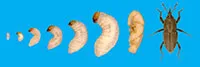
Size varies a lot. A freshly hatched first-instar grub measures about ⅛ inch long and is almost translucent. By the third instar (the stage when most feeding damage peaks), you're looking at something between ¾ inch and 1½ inches depending on the species.
The Key Visual Features That Define a Grub
Drilling into the anatomy gets you past "some kind of bug" and into species-level territory. University extension guides from programs like Penn State and Purdue train turf professionals on these exact markers.
Head capsule color and texture
The head is the most solid part of the grub's body. European chafer grubs tend toward a pale orange-brown head. Japanese beetle larvae carry a darker, reddish-brown to almost black head capsule.
May and June beetle grubs hold a warm tan-brown. These color differences become reliable once you've looked at enough specimens side by side, but they're never the sole ID key on their own.
Body segmentation and translucency
Running your eyes down the grub's length you'll see clear body segments. Younger grubs feel softer and more translucent. Third-instar larvae are plumper and more opaque.
The body wall lets you glimpse dark gut contents through the skin in many species, which signals active feeding.
Leg structure
The three pairs of true legs near the head are jointed and slightly darker than the surrounding body tissue. Use a hand lens or phone macro mode to confirm these legs. This feature alone separates white grubs from billbug larvae, which we cover in the next section.
The raster pattern
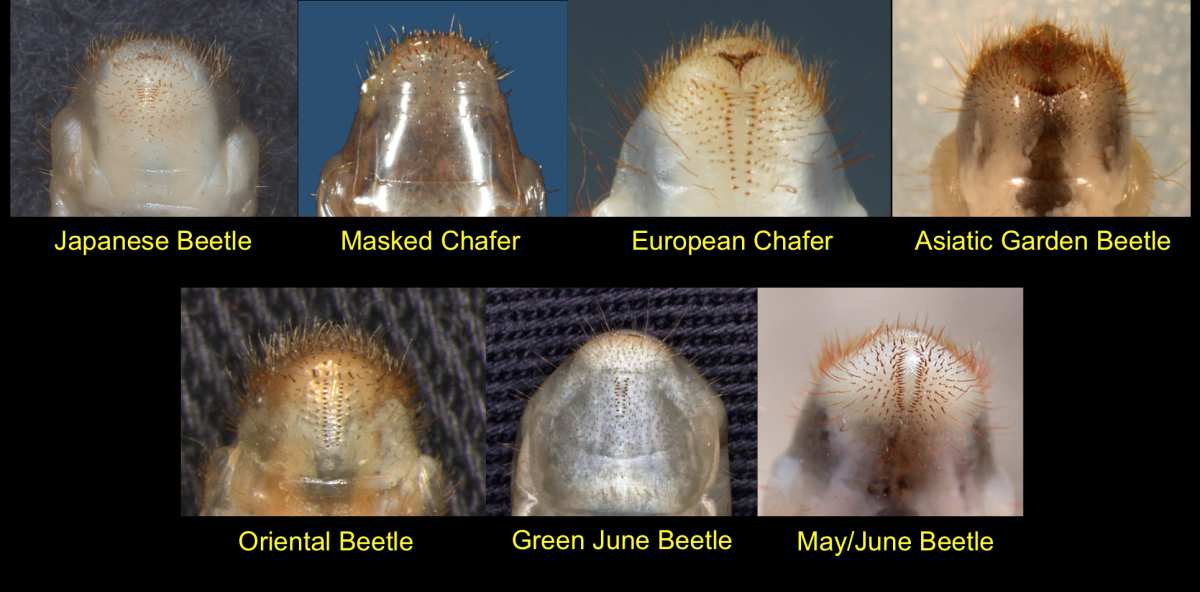
If you flip a grub onto its back and examine the underside of the last abdominal segment with magnification, you'll see a distinctive arrangement of hairs, spines, and bare patches called the raster pattern. This is the gold-standard identification marker. European chafer grubs show two diverging rows of spines.
Japanese beetle grubs display a V-shaped pattern of fine hairs. Masked chafer grubs carry a more random scatter. No two species share the exact same raster layout.
| Feature | European Chafer Grub | Japanese Beetle Grub | Green June Beetle Grub |
|---|---|---|---|
| Head capsule color | Pale orange-brown | Reddish-brown to dark brown | Tan-brown |
| Body color | Cream-white | Cream-white, darker gut contents | Yellowish-white, often darker |
| Body length at maturity | ~1 inch | ~1 inch | Up to 1½+ inches |
| Raster pattern | Two parallel rows of spines forming an inverted V | V-shaped arrangement of fine hairs | Scattered patches, less defined |
| Unique note | Active earlier in fall | Most common lawn pest species in the Northeast | Often found in compost-rich soil, climbs surface at night |
How to Tell a White Grub From a Billbug Larva
This is the identification trap that catches most people. Billbug larvae (Sphenophorus species) live in the same turf, show up at roughly the same time of year, and their damage looks indistinguishable from grub damage to the untrained eye. But under close inspection they're easy to separate.
Billbug larvae have no legs. Zero. They're completely legless, which is the fastest way to rule them out as a true white grub.
A white grub will always show three short pairs of legs behind the head. If the specimen you're holding has a smooth, legless body from end to end, you're holding a billbug larva, not a scarab grub.
The feeding habit differs too. Billbug larvae bore down into grass stems and crowns. They also tunnel into the thatch layer.
White grubs feed exclusively on roots below the soil line. This distinction matters enormously for product selection and application timing. Many effective grub control products won't touch billbugs because those larvae are insulated inside the plant tissue.
Here's your quick field comparison:
- White grub, Three pairs of legs, C-shaped, feeds on roots below soil, responds to soil-applied insecticides and biologicals like milky spore or beneficial nematodes.
- Billbug larva, Legless, slightly less curved, feeds inside plant crowns and stems, requires stem-penetrating contact insecticides or adult-targeted sprays timed to egg-laying.
Colorado State University Extension, Ohio State University, and the University of Maryland all publish paired identification guides for these two pests because the confusion is so widespread.
Common Look-Alike Larvae and How to Spot the Difference
Beyond the billbug problem, several other soil-dwelling larvae end up under your magnifying glass during a lawn inspection. Here's how to sort them out quickly.
Sod webworm larvae
These are caterpillars, not grubs. Sod webworms are the larval stage of lawn moths. Proportionally skinnier than white grubs, they have a darker head capsule and a body covered in fine hairs or spots.
They build silk-lined burrows in the thatch layer and feed on grass blades above the soil line, not on roots. If you find a larva actively feeding on grass blades rather than lurking in the soil, you're looking at webworms, not grubs.
Cutworm larvae
Cutworms look plump and smooth like grubs at first glance, but they have a completely different posture and no strong C-curl. They have five pairs of abdominal prolegs (fleshy leg-like stubs along the belly) that grubs lack. Cutworms feed at the soil surface at night, chewing through grass stems near the base.
They hide in debris or shallow burrows during the day.
Armyworm larvae
Armyworms move in groups across the lawn surface. Striped or patterned body, five pairs of prolegs, and active daytime movement across grass blades. They never burrow into the soil the way grubs do.
If the larva you're seeing crawls openly across the turf surface, it's not a grub.
Green June beetle grub
This is a true scarab grub but its behavior is different. Green June beetle larvae (Cotinis nitii) are larger than most lawn grubs, reaching over 1½ inches at full size. They're more active on the soil surface at night and leave shallow burrow holes across infested lawns.
If you find large grubs crawling on the turf surface after dark rather than curled under the soil, suspect Green June beetle.
Annual bluegrass weevil larva
Smaller and more slender than white grubs, ABW larvae have an orange-yellow head capsule. They hollow out grass stems from the inside. Found mainly in closely mown turf like golf course fairways and greens.
Their damage is often mistaken for disease until a stem is pulled and opened.
The unifying rule: if the larva feeds below ground on roots, has a brown head, three pairs of legs, and C-curves when handled, you're dealing with a white grub. Anything complicates that picture and you should compare against the species breakdown we'll cover below.
What Grub Size and Color Tell You About the Species
Body dimensions and coloration narrow down the identification list fast. These two traits give you practical shortcuts in the field without requiring a reference key.
Size categories by maturity stage
Use head capsule width to gauge which instar the grub is in:
| Instar | Approximate length | Head capsule width | Feeding impact |
|---|---|---|---|
| 1st instar | ⅛ to ¼ inch | ~1 mm | Minimal root damage |
| 2nd instar | ¼ to ½ inch | ~1.8 to 2.2 mm | Noticeable in high populations |
| 3rd instar | ½ to 1½ inches | ~3 to 4+ mm | Severe root destruction |
Most homeowners first spot damage when 3rd instar larvae are actively feeding. That's the stage where grass lifts off the soil like loose carpet. Young grubs cause no visible symptoms even when present in moderate numbers.
Species-level color clues
Japanese beetle larvae develop a slightly darker gut line visible through the body wall. European chafer grubs tend to be more uniformly pale. Green June beetle larvae often show a brownish tint on the head and a more mottled body tone.
Masked chafer grubs run similar in color to European chafers but have a slightly different raster arrangement that's visible under magnification.
Body color alone will never confirm a species. But it eliminates options and, combined with your geographic region, gets you to a confident guess before you even reach for a hand lens. Northeast US lawns are overwhelmingly European chafer or Japanese beetle territory, while Midwest lawns commonly host May/June beetle and masked chafer pressure.
Soil and climate context matters more than most people realize. Green June beetle grubs thrive across the Southeast and mid-South. Black turfgrass ataenius prefers cool-season turf in the Northeast and Pacific Northwest.
If you're in New England finding grubs in a home lawn, you're almost certainly dealing with European chafers or Japanese beetles, not Green June beetles.
The Raster Pattern: The One Detail Most People Miss
Flipping that grub over is the single most powerful identification move you can make. The raster pattern on the underside of the rear abdominal segment separates every scarab species you'll encounter in managed turf. Most homeowners never have reason to examine it, which is why they either guess based on color or skip identification entirely and throw a broad-spectrum product at the problem.
A 10x hand lens from any hardware store is enough to read the pattern. Soil from a shovel and a flat white surface like a dinner plate also help. Place the larva belly-up on the plate at ground level and let the sun or a flashlight illuminate the rear segment from the side.
Here's what the most common species show:
- Japanese beetle, Two roughly parallel rows of fine hairs that converge into a V-shape near the anal slit. The arrangement is symmetrical and orderly.
- European chafer, Two diverging rows of spines that angle outward from the center. Sometimes described as a Y-shaped or wishbone-shaped pattern. The spacing is slightly wider than on Japanese beetle grubs.
- Masked chafer, A less structured, more random scattering of hairs, often with a central bare area lacking spines. The arrangement looks less tidy compared to Japanese beetles.
- May/June beetle, Two somewhat irregular rows of hairs, sometimes with three distinct spines. Slightly harder to read than the Japanese beetle pattern.
- Asiatic garden beetle, An irregular patch of spines with a more jagged outer line. Often overlooked because this species is less common in residential turf.
Reading the raster pattern takes practice. Our recommendation is to collect a few specimens from different areas of the lawn and compare them side by side on a white plate. The differences become obvious after looking at four or five specimens in sequence.
Some extension services and state IPM programs publish high-resolution photos of species-level raster patterns. Use those as your reference library rather than guessing from a description alone.
How to Inspect Your Lawn and Actually Find Grubs
Knowing what a grub looks like when it's in your hand is one thing. Sampling your lawn systematically gets you the specimen in the first place.
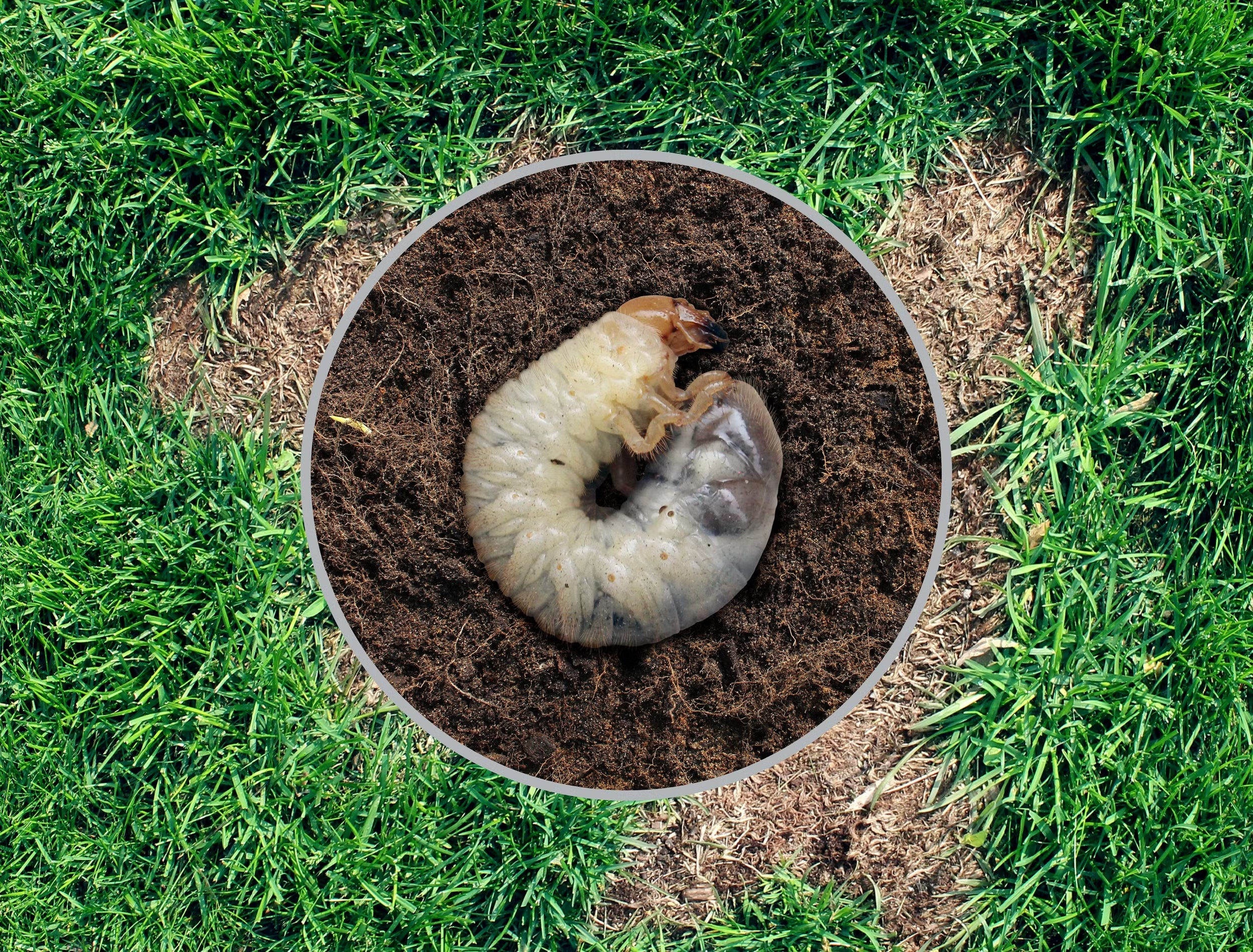
The standard method uses a spade or sharp shovel to cut a 1-square-foot plot, 2 to 4 inches deep. Kick or pry the sod cap backward to expose the root zone and shake or sort through the loose soil carefully with your fingers. Most white grubs will be in the top two inches of soil during active feeding.
Repeat this process in three to five different spots across the lawn. Focus on areas where the turf shows early warning signs like wilted or yellowing patches that don't respond to irrigation. Grub damage often starts in a few concentrated zones rather than spreading uniformly.
Average the counts across your samples. The standard treatment threshold for cool-season turf residential lawns is typically 5 to 10 grubs per square foot. Slightly lower thresholds apply to golf course fairways and sports turf because those surfaces are maintained at lower mowing heights and have less root mass reserve.
Late July through mid-September is the efficient window for scouting in most regions. That's when larvae are small, feeding actively, and close to the soil surface. Eggs hatch midsummer, and the young grubs grow fast.
October into fall, they burrow deeper for winter, making detection harder.
If you're dealing with damaging levels, collect a few intact specimens and examine them using the features we covered above. Match head capsule color, body size, and if possible, the raster pattern. Record where in the lawn you found them.
A photo on a white background helps your local extension office confirm the ID if you're unsure.
When Grub Appearance Points to a Bigger Problem
Finding one or two grubs in a random soil sample is not a crisis. A few grubs per square foot are part of a functioning soil ecosystem. The numbers you're looking at tell the real story.
Consistent counts above 10 per square feet across multiple samples indicate a damaging population that warrants action. At 15 to 20 per square feet, you're looking at significant root loss and likely visible turf decline within weeks if no treatment occurs.
Root damage is the real problem, not the grub itself. When enough larvae are feeding at once, they prune roots to the point where grass can't access moisture or nutrients. Turf under grub attack wilts faster during dry spells and recovers more slowly after rain.
The telltale sign is turf that lifts easily off the soil with almost no root resistance. That pulling-apart feeling is the equivalent of a medical red flag in turf management.
Look closely at the root system of any pulled-up turf sample. Healthy roots are dense, white, and penetrate several inches into the soil. Damaged roots appear stubby, brown, or entirely absent.
Compare the root zone on the damaged side with a sample taken from a healthy section ten to fifteen feet away. The contrast is often dramatic.
Some populations cycle naturally. Heavy grub years are often followed by lighter ones. This happens partly because predators and parasitic wasps move in.
If your counts are moderate rather than severe, natural population reduction is a real possibility.
Mistakes People Make When Identifying Grubs
Errors in grub identification usually come from rushing or skipping one of the key examination steps. Avoiding common mistakes saves wasted effort.
Skipping the leg check
We covered this already, but it's the number one error people make. Assumptions without checking for legs lead straight to confusion between white grubs and billbug larvae. Spend ten seconds on the leg check every time.
Relying on body color alone
A cream-colored larva is not automatically a white grub. Multiple species share that general body tone. Check the head capsule color and also the body proportions, posture, and feeding location to confirm.
Sampling at the wrong time
Checking in early spring when grubs are deep in the soil or already pupating wastes time. Late summer scouting in the second two weeks of July and August gets you larvae at the most detectable instar stage.
Overreacting to low counts
Three grubs per square foot in a sample is not a crisis on its own. Healthy turf can handle that pressure. Rush to treatment without averaging numbers across several sampling zones and you risk unnecessary pesticide use.
Not looking at feeding location
A larva sitting on a grass blade or crawling across the lawn surface is not a grub. Repeat that to yourself. Grubs feed on roots below the soil line.
If it's up top interacting with grass tissue above ground, narrow your identification to webworms, cutworms, or armyworms.
Ignoring local context
Every region has a narrower set of common species than the national list. Cooperative Extension publications for your state and turf management plans from regional university programs tell you which species dominate locally. Use those narrow guides rather than wading through every possibility in the country.
Assuming damage equals grubs
Brown lawn patches with no grubs in the soil sample point toward disease, heat stress, compaction, nematodes, or chemical injury. Always confirm the presence of larvae before selecting a treatment.
One critical reminder: accurate identification is step one of any sound turf management plan. Skipping it and blanket-applying products leads to resistance development and unnecessary cost.
Quick Reference: Grub Species Visual Comparison
This table pulls together the key visual markers for the most common species you'll encounter in residential turf. Use it as a field reference after collecting specimens.
| Species | Head color | Body color | Legs | Raster pattern | Typical size at maturity |
|---|---|---|---|---|---|
| Japanese beetle | Reddark brown | Cream-white, dark gut line | 3 pairs | V-shaped hair rows | ~1 inch |
| European chafer | Pale orange-brown | Uniform cream-white | 3 pairs | Two diverging spine rows | ~1 inch |
| Masked chafer | Tan-brown | Cream-white | 3 pairs | Scattered, less defined | ~¾ to 1 inch |
| May/June beetle | Tan-brown | Cream-white | 3 pairs | Irregular hair rows | ~1 to 1¼ inches |
| Green June beetle | Brown | Yellowish-white, mottled | 3 pairs | Scattered patches | Up to 1½+ inches |
| Black turfgrass ataenius | Orange-brown | Cream-white | 3 pairs | Two short spine rows | ~½ inch |
| Asiatic garden beetle | Reddish-brown | Cream-white | 3 pairs | Irregular spine patch | ~¾ inch |
When in doubt, photograph the specimen on a white plate from above and below. Send both views to your local Cooperative Extension office. Most will confirm identification within a few days at no cost.
What to Do Once You've Identified the Grub
Correct identification drives every decision that follows. Match your treatment to the species, the larval stage, and the time of year.
If you're dealing with Japanese beetle or European chafer grubs in the 1st or 2nd instar stage (late July through August), preventive insecticides like those containing chlorantraniliprole work well. Curative options such as trichlorfon are better suited for heavier infestations of larger larvae.
Beneficial nematodes (Heterorhabditis bacteriophora) offer a biological control option that targets a broad range of white grub species. Apply them when soil temperatures are above 60°F and water thoroughly after application. Milky spore (Paenibacillus popilliae) is a long-term biological control specific to Japanese beetle grubs.
It takes several years to build up in the soil but can provide lasting suppression.
If your identification points to billbugs instead of white grubs, switch strategies entirely. Target adult billbugs with a perimeter spray in early spring before egg-laying. Use a product labeled for billbug control and follow the timing recommendations from your state extension service.
Always read and follow the product label. The label is a legal document. Application rates, timing restrictions, and re-entry intervals are all specified there.
State regulations may impose additional restrictions on certain active ingredients. Check with your local extension office for current guidance.
Frequently Asked Questions
How can I tell if a grub is alive or dead?
A live grub will curl into a C-shape when disturbed and show slight movement. Dead grubs often straighten out, turn darker or grayish, and feel dry or shriveled. Fungal infections can also kill grubs and leave them stiff and discolored.
Do all grubs turn into beetles?
Yes. White grubs are the larval stage of scarab beetles. Japanese beetles, European chafers, May and June beetles, and masked chafers all go through a grub stage before pupating and emerging as adults.
Can I identify grubs without magnification?
You can confirm the basic grub body plan without magnification. Species-level identification usually requires at least a 10x hand lens to examine the raster pattern and head capsule details.
What time of year are grubs easiest to find?
Late July through September is the prime window. Larvae are small, actively feeding, and concentrated in the top few inches of soil. By late October, most species burrow deeper for winter.
Are grubs harmful to humans or pets?
White grubs pose no direct harm to people or pets. The damage is entirely to turf and plant roots. Pets may dig in infested areas chasing the grubs, which can add to the lawn disruption.
How many grubs per square foot is too many?
Most extension services recommend treatment when counts exceed 5 to 10 grubs per square foot in residential turf. Lower thresholds apply to high-maintenance turf like golf courses and sports fields.