You walk outside and notice ugly brown patches spreading across your lawn. At first you think it is drought or maybe a sprinkler issue. But the real answer to what does grass with grubs look like is more specific than you might expect, and catching it early saves you a lot of repair work.
Here is the key piece of context that changes everything: grass with grubs looks almost identical to several other common lawn problems. The fastest way to know for sure is not by staring at the color of the grass. It is by getting your hands on the turf and checking what is happening underneath.
Quick Answer
Grub-damaged grass shows up as yellow or brown patches that do not green up with watering. The turf feels spongy underfoot and peels back easily from the soil. Sod lifts like loose carpet because grubs have chewed through the roots.
If you dig into the affected area, you will find C-shaped white larvae in the top few inches of soil.
Why You Can't Rely on Words Alone to Spot Grub Damage
This topic lives or dies on visuals. Brown patches in a lawn are one of the most over-diagnosed problems in home turf care. The reason is simple.
Drought stress, dog urine, fungal disease, and grub damage can all produce nearly identical symptoms from ten feet away.
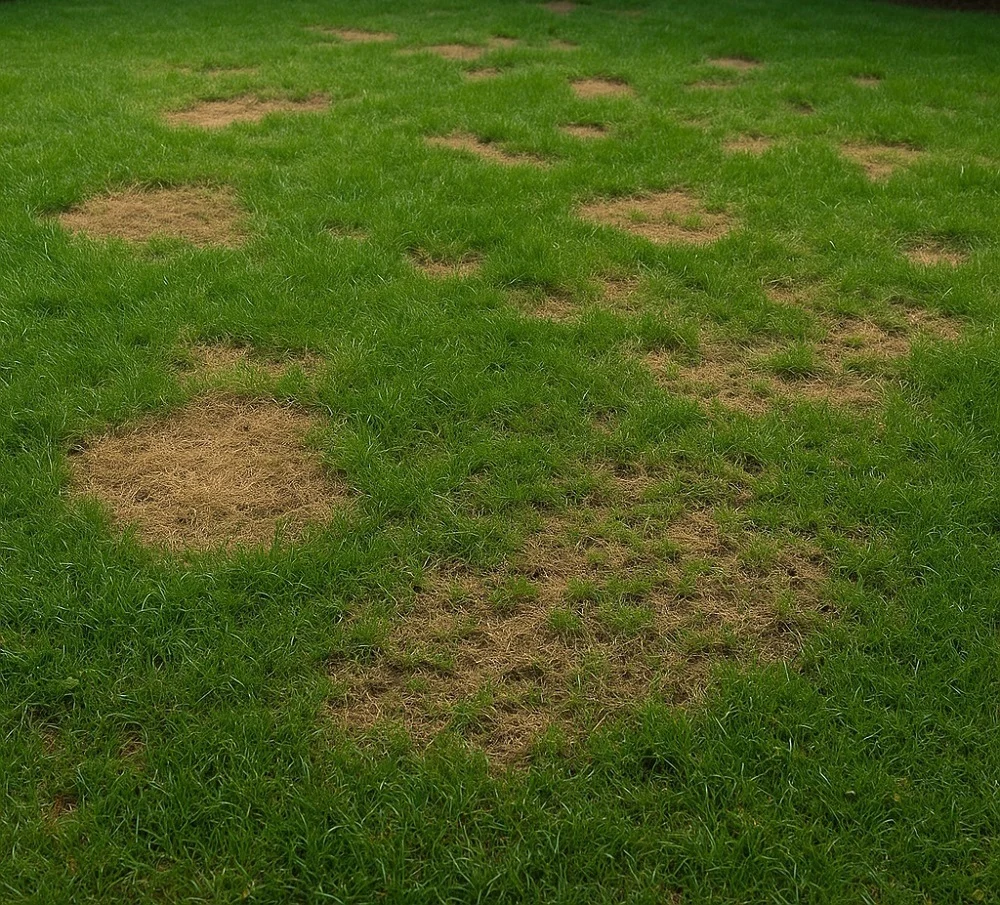
When you zoom in on what actually separates grub damage from everything else, the differences are structural. Grubs eat roots. That means the grass loses its anchor in the soil.
No other common lawn problem causes turf to detach that cleanly.
Text descriptions help you build a checklist. But the real confirmation comes from two things you have to do physically. You pull on the grass and check if it lifts.
Then you peel it back and count what is in the dirt. We will walk through both steps in detail shortly.
What Grub-Damaged Grass Actually Looks Like (Step-by-Step Visual Cues)
Grub damage does not announce itself overnight. It builds over weeks as larvae feed on grassroots below the surface. The visible signs follow a fairly predictable progression.
Early stage (subtle, often missed):
The grass takes on a dull, yellowish cast. It looks thirsty even though the soil is moist. You might notice one area that greens up slower than the rest after watering.
The turf may feel slightly soft or springy when you walk on it, but nothing dramatic.
Middle stage (unmistakable if you look closely):
Patches turn from yellow to straw-brown. They are irregular in shape, not perfect circles. The affected area does not respond to fertilizer or extra water.
When you step on it, the turf feels spongy or loose, almost like walking on a rug that is not tacked down.
Late stage (advanced damage):
The grass is dead and dried out. The edges of the patches expand as grubs spread outward to find fresh roots to feed on. In severe cases, you can grab a handful of what used to be healthy turf and pull it straight up.
There is almost no resistance because the roots are gone. The sod rolls back like carpet to expose the soil and the grubs underneath.
| Stage | Color | Texture | Response to Water |
|---|---|---|---|
| Early | Dull yellow-green | Slightly spongy | Minimal or delayed greening |
| Middle | Straw-brown patches | Loose turf, lifts easily | No recovery |
| Late | Dead, dried brown | Detaches completely | Irreversible without reseeding |
The Tug Test: The Fastest Way to Confirm Grubs Are the Problem
Forget guessing based on color alone. The tug test takes thirty seconds and immediately separates grub damage from almost every other lawn issue.
Here is how you do it. Grab a handful of grass at the edge of a damaged patch where brown meets green. Pull upward with moderate, steady pressure.
Healthy grass holds firm because the roots are intact. Grub-damaged grass peels up with almost no effort because the root system has been chewed away.
Compare that to drought-stressed grass. Dry turf may look brown, but the roots are still there. It feels dry and brittle, and it does not lift easily.
Fungus-killed grass might thin out, but it still has resistance when you tug.
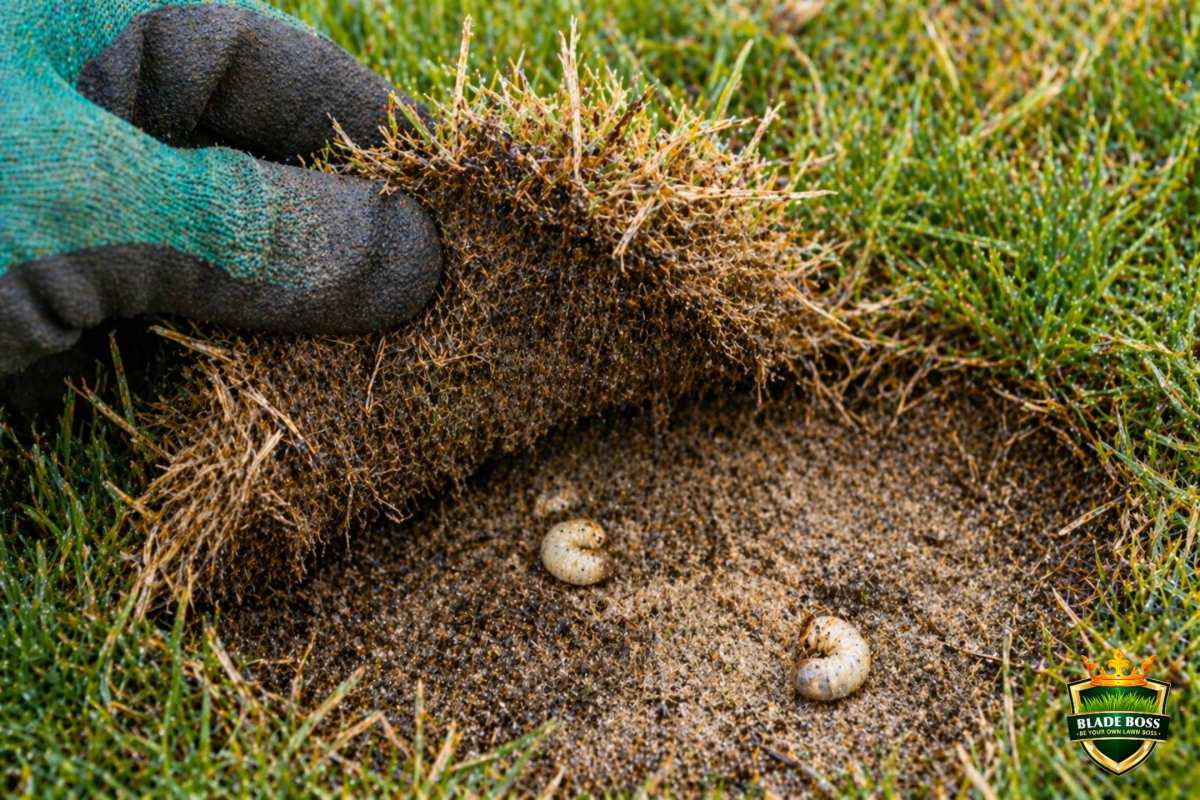
If your turf rolls back like a loose doormat, grubs are almost certainly the culprit. That single test is more reliable than any color-based diagnosis.
Counting Grubs: How Many Is Too Many
Once the tug test confirms that something is wrong, the next step is quantifying the problem. Not every grub in the lawn is an emergency. Treatment thresholds are based on numbers, not just presence.
Grab a flat shovel or a hand trowel. Cut a square about one foot across and two to three inches deep at the border between damaged and healthy turf. Peel it back and examine the root zone.
Flip through the soil and thatch layer and count what you find.
| Grubs per Square Foot | Severity | Action Needed |
|---|---|---|
| 1–4 | Low | Usually not treatment-worthy. Birds and natural predators keep numbers in check. |
| 5–9 | Moderate | Worth monitoring. Consider treatment if damage is spreading or animals are digging. |
| 10+ | High | Treat. At this level, visible damage is likely already occurring or will appear soon. |
| 20+ | Severe | Act immediately. Significant turf loss is expected without intervention. |
University extension programs across the US generally cite five to ten grubs per square foot as the point where treatment becomes worthwhile for cool-season grasses. Warm-season turf like Bermuda can sometimes tolerate slightly higher numbers before showing visible stress, but the five-to-ten range is a solid rule of thumb for most lawns.
Do this in a few spots around the yard. Grub populations are rarely uniform. One area might have fifteen per square foot while another has two.
That spatial distribution is normal and actually helps you target treatment to the worst zones.
What the Grubs Themselves Look Like (Size, Shape, and Color)

Image source: Bing (Web (fair-use with source credit))
After you peel back the sod, here is what you are looking for. White grubs are the larval stage of scarab beetles, and they all share a similar appearance regardless of species.
They are C-shaped when at rest, which is the single most reliable identifying feature. Their bodies are soft, creamy white, and slightly plump. The head capsule is tan to dark brown and noticeably firmer than the rest of the body.
You will also see three pairs of legs clustered right behind the head.
Size varies by species and age. Japanese beetle grubs max out around one inch long when fully grown. European chafer grubs are slightly smaller, typically half to three-quarters of an inch.
Masked chafer grubs from the black turfgrass ataenius beetle are the smallest of the group, often under half an inch.
One thing that trips people up is confusing grubs with other soil-dwelling larvae. Here is a quick comparison to keep you oriented.
| Feature | White Grubs | Armyworm Caterpillars | Weevil Larvae |
|---|---|---|---|
| Shape | C-shaped | Elongated, caterpillar-like | C-shaped but legless |
| Head | Brown, hard | Dark, hard | Tan, hard |
| Legs | 3 pairs near head | Multiple pairs along body | None |
| Body color | Creamy white | Green, brown, or striped | Creamy white |
The brown head and the C-curve are your two confirmation points. If the larva has a dark brown head and curls into a tight C when disturbed, you are looking at a scarab grub.
Grub Damage vs. Everything Else That Looks the Same
This is where most homeowners waste time and money. Brown patches in turf are incredibly common, and grubs are only one of several possible causes. Watching the progression of symptoms over a week or two is often more telling than a single snapshot.
Drought stress: The grass turns uniformly blue-gray, then brown. It recovers within a day or two of a good soak. The tug test is negative.
Roots are intact even though everything above ground looks dead.
Dog urine: Damage is concentrated in small, round spots roughly three to six inches across. The center is dead brown with a ring of dark green around the edge. Grub damage, by contrast, is irregular and spreads over larger areas.
Brown patch fungus: This one mimics grub damage more closely than people realize. Look closely at individual blades. Brown patch causes distinct lesions on the leaf blade itself, usually tan with a dark brown border.
Grubs do not cause leaf spots. The damage comes entirely from the roots being severed.
Sod webworms: These leave patchy thinning during summer and early fall. The key difference is size. Webworm damage rarely produces the same large dead zones that heavy grub feeding creates.
You will also notice small green fecal pellets in the thatch layer with webworms, which grubs do not leave behind.
Chinch bugs: These are most active in hot, sunny areas during midsummer. Damage appears in localized patches that spread outward. You can confirm chinch bugs by pushing a bottomless coffee cup into the受损 turf and filling it with water.
Chinch bugs will float to the surface within ten minutes.
| Cause | Patch Shape | Tug Test | Recovery After Watering |
|---|---|---|---|
| Grubs | Irregular, spreading | Positive (lifts easily) | None |
| Drought | Uniform across dry areas | Negative | Fast recovery |
| Dog urine | Small, round spots with green rings | Negative | Slow, depends on severity |
| Brown patch fungus | Circular or irregular | Negative | Only with fungicide treatment |
| Chinch bugs | Localized in hot, sunny zones | Negative | Only with insecticide treatment |
If the turf lifts like carpet and you cannot find leaf spots or floating chinch bugs, grubs are almost certainly the answer.
What Causes Animals to Dig Up Your Lawn (and Why It's a Dead Giveaway)
When skunks, raccoons, armadillos, or flocks of birds start tearing up your lawn overnight, they are hunting. They can detect grubs moving through the soil and will dig concentrated holes or peel back sections of sod to get at them.

This secondary damage is often the first thing homeowners notice, sometimes before the grass itself shows visible discoloration. A single skunk can destroy a night's worth of perfectly healthy-looking turf in its search for a protein-rich meal.
The pattern of animal damage is distinctive. Skunks leave cone-shaped divots, about three to four inches deep, scattered across the affected area. Raccoons go bigger, sometimes rolling back entire sections of sod like they are unrolling a carpet.
Crows and starlings leave narrow, pencil-sized holes from their beaks probing the soil.
If you see this happening, count it as a strong indicator. Multiple animal species are independently arriving at the same conclusion your soil sample would confirm. The good news is that animal digging actually helps you map the worst grub concentrations.
Focus your inspection effort where the animals are doing the most work.
Be aware that some animals will return to the same area repeatedly once they have identified it as a reliable food source. This creates a compounding problem. You have grub damage expanding radially from the original infestation point, plus physical destruction from above.
Treating the grubs stops both problems at once.
When Grub Damage Shows Up: Seasonal Timing by Species
Not all grubs cause damage at the same time of year. Knowing which species is common in your region helps you predict when symptoms will appear and when treatment will be most effective.
Japanese beetles: Adults emerge in June and July. Eggs hatch in late July and August. The young larvae feed aggressively through early fall, which is when damage typically becomes visible.
A second wave of feeding happens the following spring before pupation.
European chafers: These follow a similar timeline to Japanese beetles but tend to cause damage slightly earlier in the season. Peak feeding runs from August through October in most northern climates.
June beetles (May beetles): These have a longer life cycle, often two to three years. Damage can appear in patches across multiple seasons because different age groups are feeding simultaneously.
Masked chafers: Adults fly in late June and early July. Larvae feed through late summer and into fall. Damage often peaks in September and October.
Black turfgrass ataenius: This species can produce two generations per year in warmer climates. Damage may show up in both midsummer and early fall, which confuses people who expect a single damage window.
| Species | Peak Damage Window | Region Most Affected |
|---|---|---|
| Japanese beetle | August–October | Eastern and Midwestern US |
| European chafer | August–October | Northeast US, UK |
| June beetle | September–November (multi-year) | Widespread across US |
| Masked chafer | September–October | Eastern and Midwestern US |
| Black turfgrass ataenius | July–August and September–October | Warmer regions, two generations |
If you are seeing damage outside these windows, consider whether another cause is responsible. Late-spring brown patches are more likely fungal. Mid-summer damage during a heat wave is more likely drought or chinch bug related.
How to Inspect Your Lawn Properly: A Simple Process
A thorough inspection takes about fifteen minutes for an average-sized yard. You do not need special tools. A flat shovel, a trowel, and a bucket of water are enough.
Step 1: Walk the property and map the damage. Note every area that looks discolored, thin, or spongy. Mark the boundaries mentally or with small flags. Pay special attention to south-facing slopes and areas near outdoor lights, which attract adult beetles that lay eggs nearby.
Step 2: Perform the tug test at each mapped location. Grab grass at the edge of each patch and pull. Record which areas lift easily and which hold firm. This immediately narrows your focus to the zones that actually need soil inspection.
Step 3: Cut a one-foot square in the worst areas. Use your shovel to slice three sides of a square about two to three inches deep. Peel it back like a flap. Examine the top three inches of soil and the thatch layer above it.
Step 4: Count and collect. Pick out every grub you find and place them in your bucket. Count them and divide by the square footage you sampled. One square foot is your standard unit.
If you sampled a larger area, adjust accordingly.
Step 5: Check multiple spots. Grub populations cluster. One square foot might have twenty grubs while another has none. Sample at least three to four locations across the property to get a realistic picture.
Step 6: Replace the sod. Press the peeled-back turf firmly into place and water it. It will re-root within a week or two if the grubs are gone or if you have not removed so many that the area cannot recover on its own.
Repeat this process every two to three weeks during peak season if you are monitoring an active infestation. It gives you a clear picture of whether the population is growing, stable, or declining.
What to Do Once You've Confirmed Grubs
If your counts are above five to ten per square foot and the tug test is positive, it is time to act. Your approach depends on the time of year and how severe the infestation is.
Curative treatment (late summer through fall): Products containing trichlorfon work fast and can knock down an active infestation within a few days. These are your best option when damage is already visible and grubs are actively feeding. Apply when soil is moist and water in lightly according to the label.
Preventive treatment (late spring to early summer): Products with imidacloprid or chlorantraniliprole are applied before eggs hatch. They create a residual barrier in the soil that kills young larvae as they begin feeding. This is the preferred approach if you have had grub problems in previous years.
Biological control: Beneficial nematodes, specifically Heterorhabditis bacteriophora, seek out and kill grubs in the soil. They require specific conditions to work well. Soil temperatures need to be above 60°F and the ground must stay moist for at least two weeks after application.
Milky spore disease targets Japanese beetle grubs specifically and can provide long-term suppression, but it takes two to three years to build up effective populations in the soil.
After any treatment, re-inspect the area in two to three weeks. Dead grubs will turn brown or yellowish and lose their firm C-shape. If you are still finding healthy white grubs after that window, a follow-up application may be needed.
Common Mistakes People Make When Diagnosing Grub Damage
The biggest mistake is treating based on color alone. Brown patches get hit with fungicide, extra fertilizer, or more water when the real problem is underground. That wastes money and lets the grub population grow unchecked.
Another common error is waiting too long. By the time damage is obvious across a large area, the grubs have been feeding for weeks. Early detection through the tug test catches the problem while it is still localized.
Applying preventive products in September is another frequent misstep. By that time, grubs are large and feeding aggressively. Preventive chemistry works on newly hatched larvae, not mature ones.
You need a curative product instead.
People also tend to treat the entire lawn when only a few zones are affected. Spot-treating the confirmed problem areas saves product and reduces unnecessary chemical load in the soil.
Finally, forgetting to water in granular products is a surprisingly common oversight. Most grub control granules need about a quarter-inch of water to move the active ingredient into the root zone where grubs are feeding. Without that irrigation step, the product sits on the surface and does very little.
Expert Tips for Catching Grub Damage Early
Walk your lawn regularly during late summer and early fall. Pay attention to any areas that feel different underfoot. Sponginess is often the first physical sign, appearing well before visible discoloration.
Check near outdoor lighting. Adult beetles are attracted to lights at night and tend to lay eggs in the surrounding turf. These zones often develop the heaviest grub concentrations.
Keep an eye on bird activity. A sudden increase in starlings, crows, or grubs probing your lawn is worth investigating. Birds are excellent grub detectors and will concentrate their feeding where populations are highest.
If you have had grub damage in the past, mark those areas on a calendar. Grubs tend to return to the same zones year after year because adult beetles preferentially lay eggs in areas where they themselves developed. Targeted preventive treatment in those known hotspots is far more efficient than blanketing the entire yard.
Maintain healthy turf through proper mowing height and irrigation. Thick, well-rooted grass can tolerate a low grub population without showing visible damage. The five-to-ten threshold assumes average turf conditions.
A dense, vigorous lawn may handle slightly higher numbers before symptoms appear.
Frequently Asked Questions
Can grass recover from grub damage?
Yes, if the damage is caught early and grub feeding has stopped. Water the area well and apply a light fertilizer to encourage regrowth. Severely damaged areas where the root system is completely destroyed will need reseeding or new sod.
What time of year is worst for grub damage?
Late August through October is the peak window for most species in the northern US and UK. Young larvae are feeding aggressively during this period and turf damage becomes most visible.
How deep do grubs live in the soil?
Most feeding occurs in the top two to three inches of soil, right in the root zone. During winter, they burrow deeper to avoid freezing, sometimes down to six inches or more. They return to the surface in spring.
Do all grubs damage lawns?
No. Some scarab beetle larvae feed on decaying organic matter and do not harm turf. The species that cause lawn damage are primarily Japanese beetles, European chafers, June beetles, masked chafers, and black turfgrass ataenius.
Is it safe to apply grub control products around pets?
Most granular grub control products are safe once they have been watered in and the treated area has dried. Always read the specific product label for re-entry intervals and pet safety instructions. Some active ingredients have stricter restrictions than others.
How long does it take for grub damage to appear after eggs hatch?
Typically two to three weeks of feeding before visible symptoms develop. Young larvae start small and consume relatively little root tissue. As they grow through late summer, their feeding rate increases dramatically and damage accelerates.