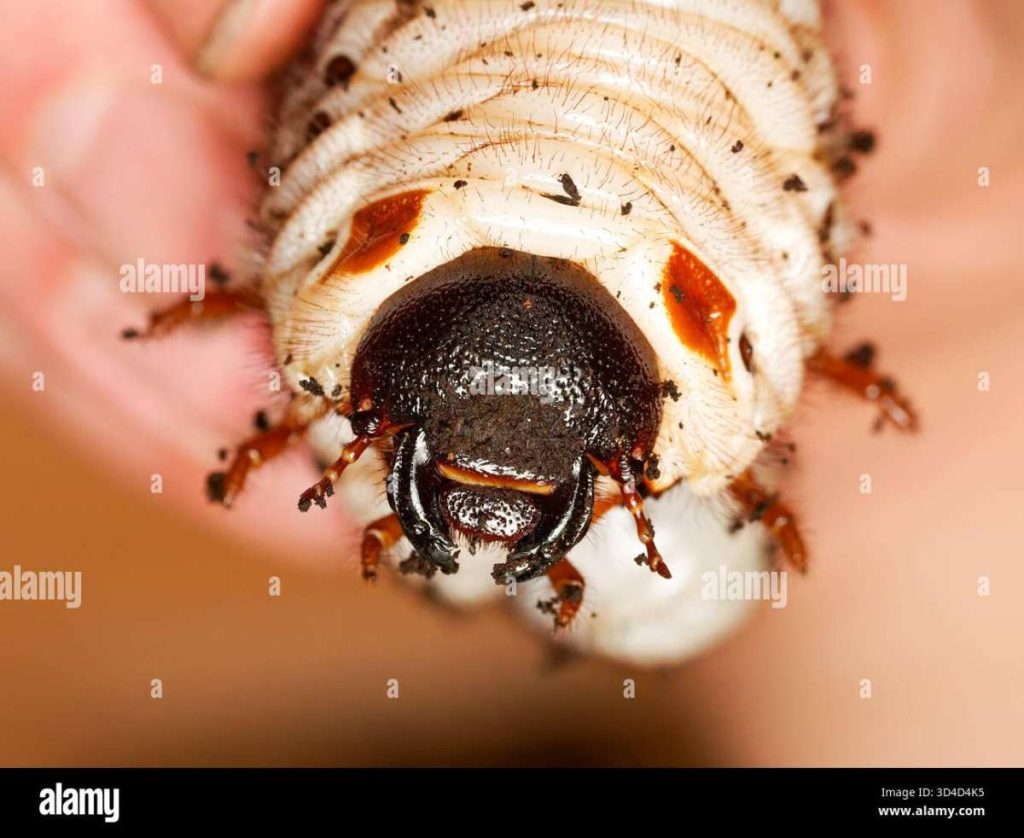
If you've ever flipped over a patch of dead sod and found a pale, squirming critter curled up in the dirt, you've probably asked yourself: what does a grub worm look like, exactly? The term "grub worm" gets tossed around a lot, but it's not a precise scientific name. Most of the time, people are talking about the larval stage of scarab beetles, and those larvae have a very specific look once you know what to check for.
Getting the identification right matters more than you'd think. Treat for the wrong pest and you'll waste time, money, and product while your lawn keeps dying. A true white grub has a handful of visual markers that separate it from the caterpillars, worms, and beetle larvae people commonly mistake it for.
Let's walk through each one.

Image source: Wikimedia Commons / Tim Gage (CC BY-SA)
Quick Answer
A white grub is the C-shaped larva of a scarab beetle. It has a cream or white body, a tan or brown head capsule, and three pairs of small legs near its head. Its body is plump and smooth, and the rear end often looks darker because you can see digested plant material inside.
Most turf-dwelling white grubs range from ¼ inch to 1½ inches long depending on their age and species.
Why You Can't Just Google "Grub Worm" and Trust the First Picture
Search results for "grub worm" are a mess. You'll get photos of mealworms, caterpillars, earthworms, and half a dozen beetle larvae that have nothing to do with your lawn. The term itself is imprecise.
"Grub" technically refers to the larvae of beetles in the family Scarabaeidae, but plenty of gardeners and homeowners use it for any fat, pale larva they find in soil.
The problem is that several common soil-dwelling larvae look superficially similar. Cutworms, wireworms, leatherjackets, and billbug larvae all get called "grubs" by someone. Each one requires a different management approach.
Spray a caterpillar treatment on a scarab grub and nothing happens. Apply milky spore to a billbug larva and you've wasted your money.
That's why visual identification, not just a label, is what actually matters here.
What a Real White Grub Actually Looks Like
A true white grub, meaning a scarab beetle larva, has a consistent set of physical features. Once you've seen a few, you can pick them out of a soil sample pretty fast.
Image source: Wikimedia Commons / Tim Gage (CC BY-SA)
The C-Shaped Body Curl
The single most recognizable trait is the C-shape. When you disturb a white grub, it curls its body into a crescent or letter C. This isn't unique to grubs, but combined with the other features below, it's a strong first clue.
Newly hatched larvae are small and may not curl as tightly, but by the second and third instar, that C-posture is unmistakable.
Head Capsule, Legs, and Body Color
Look at the head end. A white grub has a hardened, tan-to-brown head capsule that's clearly distinct from the rest of the body. Right behind the head, you'll see three pairs of short, jointed legs.
These are true insect legs, not the fleshy prolegs you'd see on a caterpillar.
The body itself is smooth, slightly shiny, and cream to white. The rear third or so often looks darker, grayish or brownish, because you're seeing digested organic material through the body wall. That's completely normal and actually confirms you're looking at a root-feeding grub.
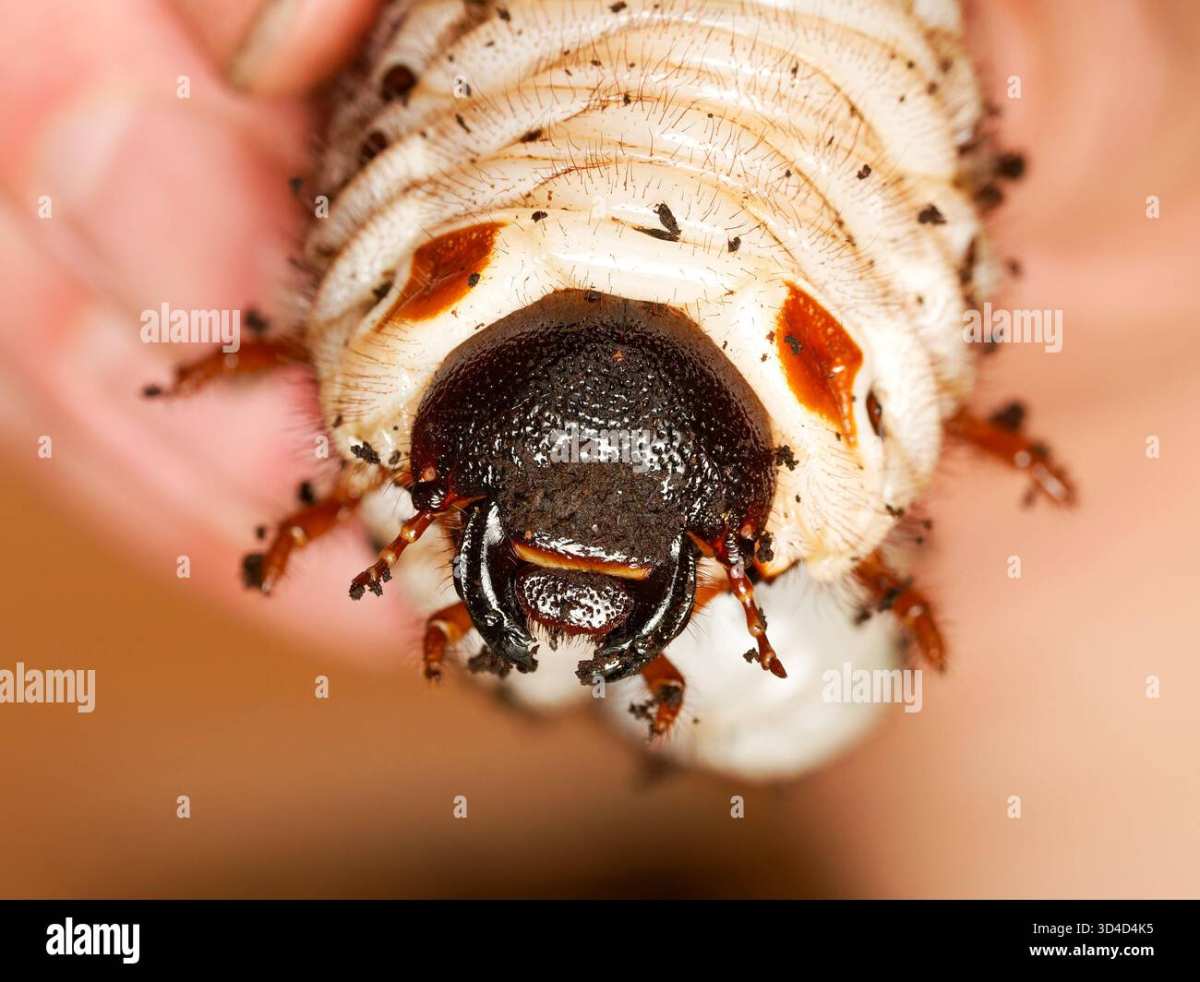
Image source: Bing (Web (fair-use with source credit))
Size and Growth Stages
White grubs go through three larval instars. First instar larvae are tiny, roughly ¼ inch long. By the third instar, which is when they cause the most turf damage, they can reach 1 to 1½ inches depending on the species.
Japanese beetle larvae tend to top out around 1 inch, while European chafer larvae can get slightly larger. Size alone won't confirm the species, but it helps narrow things down.
The Visual Checklist: How to Confirm You're Looking at a White Grub
When you pull a larva out of your lawn, run through this checklist before you decide what you're dealing with:
- Body shape: C-shaped or crescent-shaped when at rest.
- Color: Cream, white, or pale gray body with a darker rear section.
- Head: Hardened, tan or brown head capsule, clearly visible.
- Legs: Three pairs of jointed legs right behind the head.
- Body texture: Smooth, plump, slightly shiny, no visible hairs or bristles (aside from the raster pattern on the abdomen tip, which needs magnification).
- Size: ¼ inch to 1½ inches depending on age.
If your specimen checks all six boxes, you're almost certainly looking at a scarab beetle larva. If one or two don't match, you might be dealing with a look-alike.
Grub Look-Alikes That Fool Most People
This is where most misidentifications happen. Several common lawn and garden larvae get called "grubs" even though they're completely different insects with different life cycles and different management needs.
Cutworms and Armyworms
Cutworms and armyworms are caterpillars, the larvae of moths. They're elongated, not C-shaped, and they have more legs. A cutworm has five pairs of fleshy prolegs along its abdomen in addition to the three pairs of true legs near its head.
They're usually brown, gray, or green, not pale cream. If you find a larva that's stretched out and actively crawling rather than curled up, it's probably a caterpillar, not a grub.
Wireworms
Wireworms are the larvae of click beetles. They're elongated, cylindrical, and hard-bodied, with a dark brown or yellowish color. They don't curl into a C-shape, and their body feels tough and leathery compared to the soft, plump body of a white grub.
Wireworms are more common in vegetable gardens and newly sodded lawns than in established turf.
Leatherjackets (Crane Fly Larvae)
Leatherjackets are probably the most common source of confusion, especially in the Pacific Northwest and parts of the Northeast. They're the larvae of crane flies, and they look like fat, grayish-brown worms with no visible legs and no distinct head capsule. They're legless, which immediately separates them from true white grubs.
If you're in the Pacific Northwest and finding pale, legless larvae in your lawn, you're likely dealing with European crane fly, not a scarab grub.
Billbug Larvae
Billbug larvae look almost identical to white grubs at first glance. They're C-shaped, cream-colored, and roughly the same size. The key difference: billbug larvae have no legs at all.
They're weevil larvae, and weevils are in a completely different beetle family. If your C-shaped larva has a brown head capsule but zero legs, it's a billbug larva, not a white grub. This distinction matters because milky spore and most biological grub controls target scarab larvae specifically and won't touch billbugs.
Side-by-Side: White Grub vs. Common Imposters
| Feature | White Grub | Cutworm | Wireworm | Leatherjacket | Billbug Larva |
|---|---|---|---|---|---|
| Body shape | C-shaped | Elongated | Elongated, cylindrical | Elongated, worm-like | C-shaped |
| Color | Cream/white, dark rear | Brown, gray, green | Dark brown, yellow | Gray-brown | Cream/white |
| Head capsule | Hardened, tan/brown | Visible, softer | Hardened, distinct | Not clearly visible | Hardened, tan/brown |
| Legs | 3 pairs near head | 3 pairs + 5 prolegs | 3 pairs near head | None | None |
| Body texture | Soft, plump, smooth | Soft, smooth | Hard, leathery | Soft, smooth | Soft, plump |

Image source: Bing (Web (fair-use with source credit))
Where and When to Find Them in Your Yard
White grubs live in the top few inches of soil, feeding on turfgrass roots. The easiest way to find them is to look for damage first, then dig. Grub-damaged turf feels spongy underfoot and pulls up easily because the roots have been chewed away.
Peel back a square foot of damaged sod and check the soil underneath.
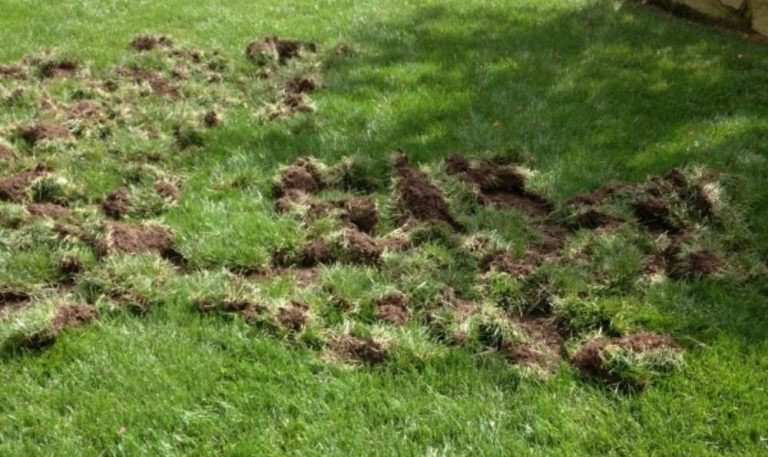
Image source: Bing (Web (fair-use with source credit))
Timing varies by species and region, but in most of the US and southern Canada, the best window for finding young, actively feeding grubs is late July through September. That's when second and third instar larvae are closest to the surface and doing the most damage. By late October, most species have burrowed deeper to overwinter and won't return to the root zone until the following spring.
In the Northeast, European chafer larvae peak in September. Japanese beetle larvae follow a similar calendar. In the upper Midwest, the window shifts a week or two earlier.
Your local cooperative extension office can give you a species-specific calendar for your area.
What the Raster Pattern Tells You (And Why It Matters)
If you want to get down to the species level, you need to look at the raster pattern. That's the arrangement of hairs, spines, and bare spots on the underside of the larva's last abdominal segment. Each scarab species has a distinct raster pattern, and entomologists use it to tell species apart under magnification.
For practical purposes, most homeowners don't need to identify down to the species. But if you're working with a biological control like milky spore, which targets Japanese beetle larvae specifically, knowing your species matters. Your local extension agent can help with a confirmed ID if you send in a clear close-up photo of the raster area.
How Many Grubs Is Too Many? The Treatment Threshold
Finding a few grubs doesn't automatically mean you need to treat. Healthy turf can tolerate a low population without visible damage. The general treatment threshold for most cool-season turfgrasses is 6 to 10 grubs per square foot.
Warm-season grasses like bermudagrass can sometimes handle slightly more.
To check your count, cut a 1-foot square of turf at the edge of a damaged area, peel it back, and count the grubs in the soil underneath. Do this in three or four spots and average the results. If you're consistently above 10 per square foot, it's time to consider treatment.
Below that, you might be better off focusing on cultural practices like proper irrigation and overseeding.
What to Do Once You've Confirmed It's a White Grub
Once you've confirmed you're dealing with true scarab grubs, your treatment options depend on timing and your tolerance for chemical controls.
For preventive control (applied before damage appears):
- Products containing chlorantraniliprole applied in mid to late spring can prevent grub establishment for the season.
- Imidacloprid is another preventive option, though some states have restricted its use on turf.
For curative control (applied when grubs are actively feeding):
- Trichlorfon (Dylox) works on contact and is most effective on young, small grubs in late summer.
- Carbaryl is another curative option with a shorter residual window.
For biological control:
- Milky spore (Paenibacillus popilliae) targets Japanese beetle larvae specifically and can persist in the soil for years.
- Beneficial nematodes, specifically Heterorhabditis bacteriophora, can be applied as a soil drench in late summer when soil temperatures are above 60°F. They require moist soil to move and find hosts.
The key is matching your treatment to the grub's life stage. Preventive products won't kill large, mature grubs. Curative products won't prevent next year's population.
Read the label carefully and time your application to the grub's active feeding window.
Frequently Asked Questions
Are grubs and worms the same thing?
No. Grubs are beetle larvae. They have a distinct head capsule, three pairs of legs, and a segmented body.
Earthworms are annelids with no legs, no head capsule, and a completely different body structure. The term "grub worm" is a misnomer that confuses the two.
What time of year are grubs most visible?
Late summer into early fall, roughly August through October in most regions. That's when larvae are largest, closest to the surface, and actively feeding on roots. Spring grubs are usually deeper in the soil and harder to find.
Can I identify grubs by the damage alone?
You can suspect grubs based on the damage pattern, brown patches that peel back easily, but you need to find and examine the larvae to confirm. Other issues like fungal disease, drought stress, and dog urine damage can look similar from above.
Do all white grubs damage lawns?
Most turf-dambling grubs are scarab larvae, but not every scarab species is a pest. Some are rare or feed on decaying organic matter rather than living roots. The common lawn pests in North America are Japanese beetle, European chafer, masked chafer, Oriental beetle, and a few others.
How deep do grubs go in winter?
Most species overwinter 4 to 8 inches below the surface, below the frost line. They return to the root zone in spring when soil temperatures rise above 50°F, though by then they're often in the pupal stage and no longer feeding heavily.
The Bottom Line: Know What You're Dealing With Before You Treat
The whole point of learning what a white grub looks like is to avoid treating the wrong pest. A C-shaped, cream-colored larva with a brown head and three pairs of legs is a scarab grub. Anything else, legless, elongated, hard-bodied, or covered in prolegs, is something different.
Take sixty seconds to run through the visual checklist before you buy a product or call a lawn care company. It'll save you money and it'll actually solve the problem. And if you're still not sure, snap a clear photo and send it to your local extension office.
They'll tell you exactly what you're looking at, usually within a day or two.
What the Raster Pattern Tells You (And Why It Matters)
If you want to get down to the species level, you need to look at the raster pattern. That's the arrangement of hairs, spines, and bare spots on the underside of the larva's last abdominal segment. Each scarab species has a distinct raster pattern, and entomologists use it to tell species apart under magnification.
For practical purposes, most homeowners don't need to identify down to the species. But if you're working with a biological control like milky spore, which targets Japanese beetle larvae specifically, knowing your species matters. Your local extension agent can help with a confirmed ID if you send in a clear close-up photo of the raster area.
How Many Grubs Is Too Many? The Treatment Threshold
Finding a few grubs doesn't automatically mean you need to treat. Healthy turf can tolerate a low population without visible damage. The general treatment threshold for most cool-season turfgrasses is 6 to 10 grubs per square foot.
Warm-season grasses like bermudagrass can sometimes handle slightly more.
To check your count, cut a 1-foot square of turf at the edge of a damaged area, peel it back, and count the grubs in the soil underneath. Do this in three or four spots and average the results. If you're consistently above 10 per square foot, it's time to consider treatment.
Below that, you might be better off focusing on cultural practices like proper irrigation and overseeding.
What to Do Once You've Confirmed It's a White Grub
Once you've confirmed you're dealing with true scarab grubs, your treatment options depend on timing and your tolerance for chemical controls.
For preventive control (applied before damage appears):
- Products containing chlorantraniliprole applied in mid to late spring can prevent grub establishment for the season.
- Imidacloprid is another preventive option, though some states have restricted its use on turf.
For curative control (applied when grubs are actively feeding):
- Trichlorfon (Dylox) works on contact and is most effective on young, small grubs in late summer.
- Carbaryl is another curative option with a shorter residual window.
For biological control:
- Milky spore (Paenibacillus popilliae) targets Japanese beetle larvae specifically and can persist in the soil for years.
- Beneficial nematodes, specifically Heterorhabditis bacteriophora, can be applied as a soil drench in late summer when soil temperatures are above 60°F. They require moist soil to move and find hosts.
The key is matching your treatment to the grub's life stage. Preventive products won't kill large, mature grubs. Curative products won't prevent next year's population.
Read the label carefully and time your application to the grub's active feeding window.
Frequently Asked Questions
Are grubs and worms the same thing?
No. Grubs are beetle larvae. They have a distinct head capsule, three pairs of legs, and a segmented body.
Earthworms are annelids with no legs, no head capsule, and a completely different body structure. The term "grub worm" is a misnomer that confuses the two.
What time of year are grubs most visible?
Late summer into early fall, roughly August through October in most regions. That's when larvae are largest, closest to the surface, and actively feeding on roots. Spring grubs are usually deeper in the soil and harder to find.
Can I identify grubs by the damage alone?
You can suspect grubs based on the damage pattern, brown patches that peel back easily, but you need to find and examine the larvae to confirm. Other issues like fungal disease, drought stress, and dog urine damage can look similar from above.
Do all white grubs damage lawns?
Most turf-dambling grubs are scarab larvae, but not every scarab species is a pest. Some are rare or feed on decaying organic matter rather than living roots. The common lawn pests in North America are Japanese beetle, European chafer, masked chafer, Oriental beetle, and a few others.
How deep do grubs go in winter?
Most species overwinter 4 to 8 inches below the surface, below the frost line. They return to the root zone in spring when soil temperatures rise above 50°F, though by then they're often in the pupal stage and no longer feeding heavily.
The Bottom Line: Know What You're Dealing With Before You Treat
The whole point of learning what a white grub looks like is to avoid treating the wrong pest. A C-shaped, cream-colored larva with a brown head and three pairs of legs is a scarab grub. Anything else, legless, elongated, hard-bodied, or covered in prolegs, is something different.
Take sixty seconds to run through the visual checklist before you buy a product or call a lawn care company. It'll save you money and it'll actually solve the problem. And if you're still not sure, snap a clear photo and send it to your local extension office.
They'll tell you exactly what you're looking at, usually within a day or two.
The Bottom Line: Know What You're Dealing With Before You Treat
The whole point of learning what a white grub looks like is to avoid treating the wrong pest. A C-shaped, cream-colored larva with a brown head and three pairs of legs is a scarab grub. Anything else, legless, elongated, hard-bodied, or covered in prolegs, is something different.
Take sixty seconds to run through the visual checklist before you buy a product or call a lawn care company. It'll save you money and it'll actually solve the problem. And if you're still not sure, snap a clear photo and send it to your local extension office.
They'll tell you exactly what you're looking at, usually within a day or two.