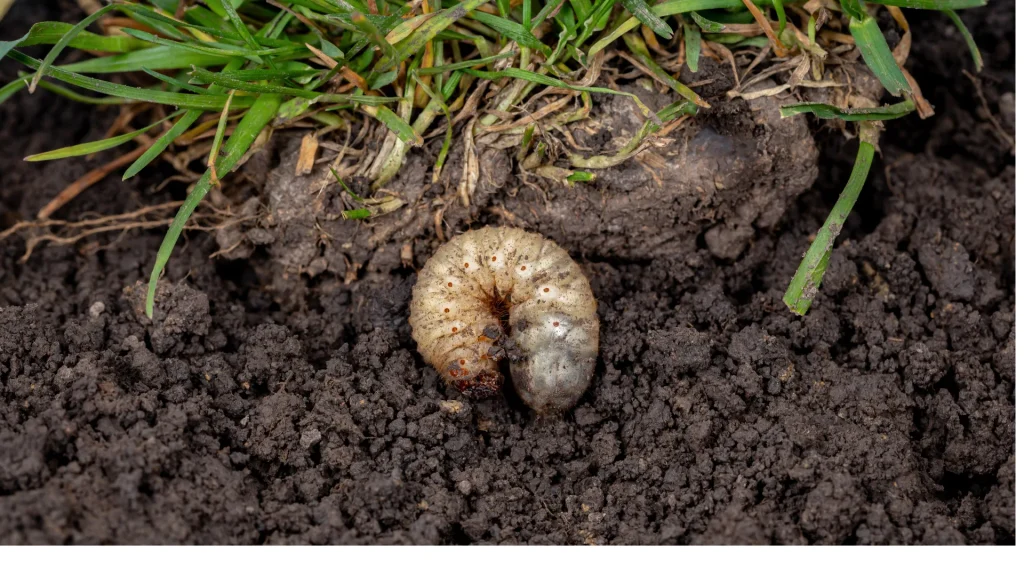
You've probably got brown patches in your grass and a sneaky suspicion something's living under there. Before you can fix the problem though, you need to know exactly what you're dealing with. Understanding what lawn grubs look like is the first real step, because the wrong ID leads to wasted time, money, and a lawn that still looks terrible by spring.
Grubs aren't just one thing either. There are multiple species that attack turf across the US and UK, and they each look slightly different up close. Research from university extension programs consistently shows that the treatment threshold for most grub species is 5 to 10 grubs per square foot, so getting a positive identification isn't academic.
It's the difference between grabbing a targeted product and throwing chemicals at a problem you haven't even confirmed yet.
Quick Answer
Lawn grubs are the soil-dwelling larvae of scarab beetles. They have a distinct C-shaped body, creamy white to grayish coloring, and a brown or tan head capsule. You'll notice three pairs of legs clustered near the head.
They range from about ¼ inch (newly hatched) to over 1½ inches (mature), depending on the species.
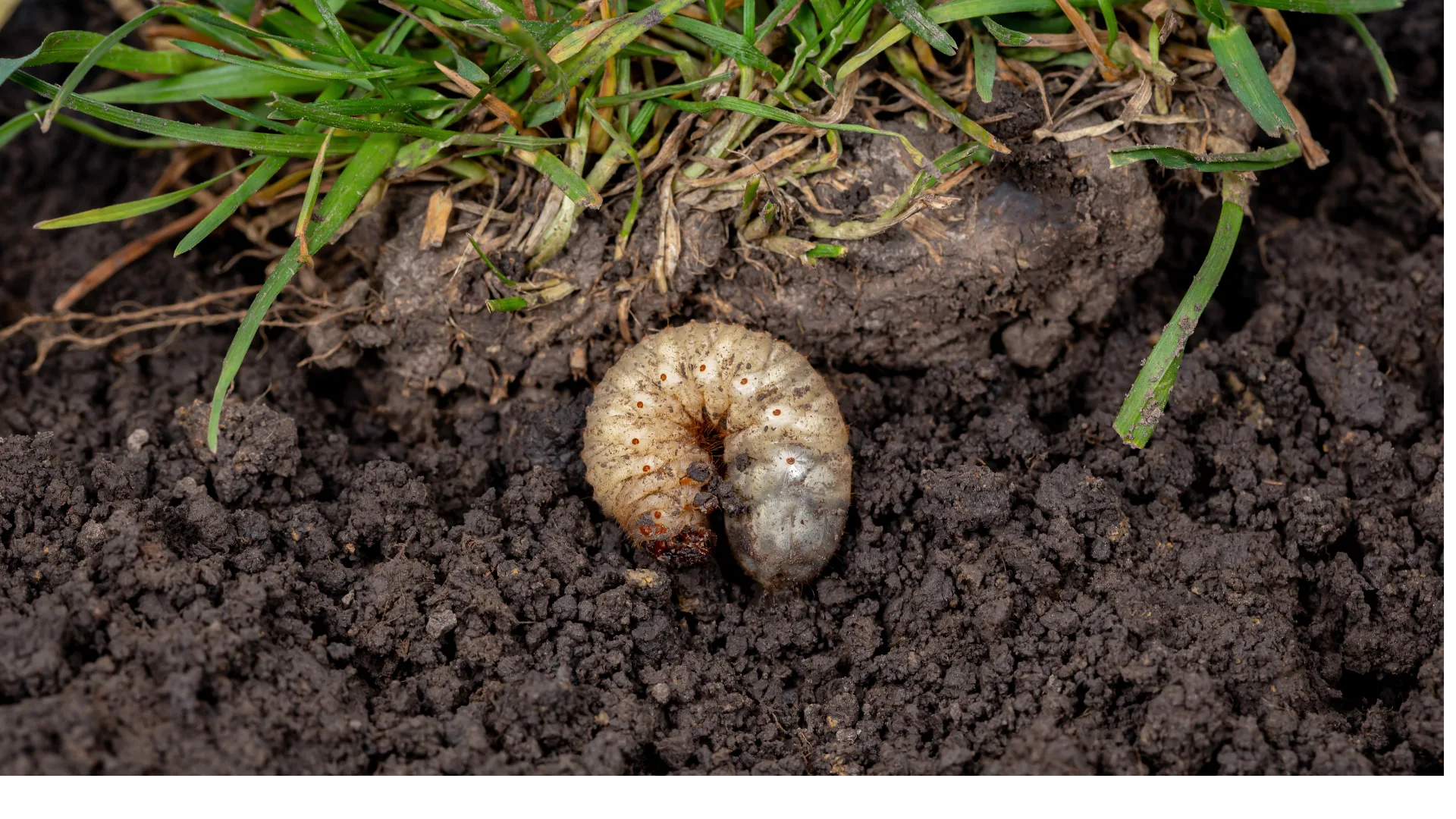
Image source: Bing (Web (fair-use with source credit))
What Lawn Grubs Actually Look Like Up Close
The classic image most people have in their head is a fat, pale, slightly curled worm. That's roughly right, but it misses the details that actually help you identify what species you're dealing with.
Mature white grubs share a common body plan across nearly all species found in residential lawns. The body is soft, slightly wrinkled, and curled into a C shape when you dig one out. That curled posture is one of the most reliable visual cues, since almost nothing else in your soil looks like that.
The head capsule is hard and typically brown, ranging from light tan to dark reddish-brown depending on the species. At the front of the head you'll see mouthparts, including mandibles that look disproportionately large for the body. Those mandibles are what chew through grass roots, so if you see them up close, you understand why even a modest grub population can cause real damage.
The body itself doesn't have the distinct segmentation you'd see on a caterpillar or earthworm. It looks smooth and slightly plump, almost like a tiny pale bean. The color is usually a dull white or cream, sometimes with a grayish or yellowish tinge on the underside where gut contents are visible through the skin.
Young newly hatched grubs are much smaller and often a translucent white. Mature grubs just before pupation become more opaque and can look slightly darker.
One thing that trips people up: the legs. Grabs have three pairs of small, jointed legs right behind the head. They're visible but not earthworm-like or stubby.
If what you're looking at has no legs and looks like a pale worm, you might be looking at a billbug larva instead, which is a common point of confusion we'll cover later.
The Key Visual Features That Separate Grubs from Everything Else
When you pull something out of your soil, you need a quick way to decide whether it's actually a grub or just another soil organism. Here are the most reliable markers:
C-shaped body posture. This is the single biggest giveaway. Grabs naturally curl into a tight C when disturbed or removed from soil. Earthworms stretch out.
Caterpillars may curl loosely but don't have that consistent tight C.
Brown head capsule. All true scarab beetle larvae have a well-defined, hardened head that's clearly a different color from the body. It stands out as a darker cap at the front end.
Three pairs of legs near the head. Count them. Three pairs, clustered in the front third of the body, means you're looking at an insect larva, not a worm or slug.
Body size and shape. Most lawn grub species fall in the ½ inch to 1¼ inch range when mature, with a plump cylindrical body that tapers slightly at both ends. They don't flatten out like a worm, and they're not as round and grub-like as a mealworm (which is a different beetle family altogether).
Color. Dull white to cream on top, sometimes with a yellowish or grayish tint underneath where you can see gut contents through the skin. No stripes, spots, or vivid coloring.
If what you've got checks most of those boxes, you're very likely looking at a scarab beetle larva. The next step is narrowing down which species, because that affects when to treat and what product to use.
The Raster Pattern
There's one identification tool that separates serious grub ID from guesswork: the raster pattern. This is the arrangement of hairs, spines, and bare patches on the underside of the very last segment of the grub's abdomen. You need a magnifying glass or a good phone macro shot to see it clearly.
Each grub species has a distinct raster pattern, almost like a fingerprint. Japanese beetle grubs have a distinctive V-shaped or Y-shaped arrangement of hairs on that last abdominal segment. European chafer grubs have a Y-shaped pattern but with a different orientation and spacing.
June bug grubs have a more open, random-looking pattern.
State extension services and university entomology departments publish raster pattern identification keys specifically because it's the most reliable way to separate grub species. If you're treating your lawn and want to get the timing and product right, it's worth looking up a raster key for your region.
How to Tell the Major Grub Species Apart by Sight
Not all grubs are created equal. The species that's damaging your lawn determines when it feeds, how deep it sits in the soil, and which control products will actually work. Here are the most common culprits in residential lawns, with the visual traits that set them apart.
Japanese Beetle Grubs (Popillia japonica)
The most notorious turf grub across much of the eastern and midwestern United States. These grubs are creamy white with a tan to brown head capsule and typically reach about 1 inch when fully grown. The V-shaped raster pattern on the underside of the last abdominal segment is the gold-standard identification feature.
They tend to feed in the uppermost soil layer, just below the thatch, which means damage shows up faster and more aggressively than with deeper-feeding species.
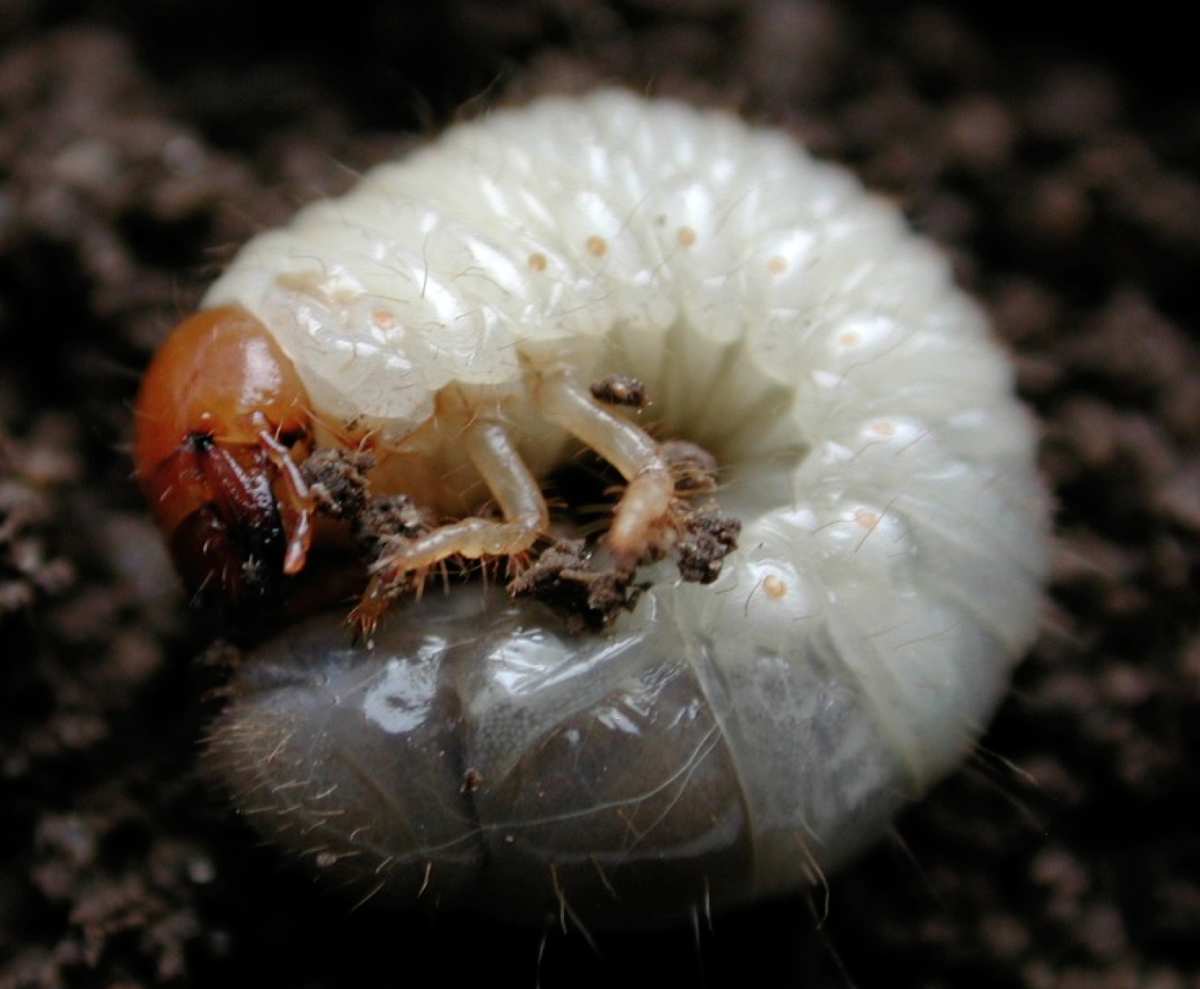
Image source: Bing (Web (fair-use with source credit))
European Chafer Grubs (Amphimallon majale)
Becoming increasingly common in the Northeast, mid-Atlantic, and parts of the Midwest. They're slightly larger than Japanese beetle grubs, reaching up to 1¼ inches, with a longer body profile and a lighter tan head capsule. The raster pattern is shaped like a Y with the two arms of the Y diverging more widely than in Japanese beetle grubs.
European chafer adults are tan colored, not the metallic green and copper you'd see on a Japanese beetle.
June Bug Grubs (Phyllophaga species)
These are the big ones. Commonly called May beetles or June bugs depending on your region, their larvae are the largest lawn grubs you'll encounter, often exceeding 1¼ inches and sometimes pushing close to 1½ inches at full maturity. They have a robust, noticeably plump body with a dark brown head capsule and a much less organized raster pattern than Japanese beetles or chafers.
June bug grubs also have a three-year life cycle in many regions, compared to the single-year cycle of Japanese beetles and chafers, which means you can find multiple size classes in the same lawn at the same time.
Masked Chafer Grubs (Cyclocephala species)
Common across the upper Midwest and into the Northeast, masked chafer grubs are similar in size and color to Japanese beetle grubs but lack the crisp V-shaped raster pattern. The raster pattern on masked chafer grubs is more chaotic, with hairs scattered without a clear geometric arrangement. Adults are a dull tan or brown June bug, not the striking metallic green of Japanese beetles.
Oriental Beetle Grubs (Anomala orientala)
Found predominantly in the Northeast, these grubs are smaller and more slender than Japanese beetle grubs, typically topping out around ¾ inch. They have a distinctive raster pattern with two parallel rows of hairs that run lengthwise on the last abdominal segment, which is unique among the common lawn grub species.
Black Turfgrass Ataenius Grubs (Ataenius spretulus)
A smaller grub species, often only ⅜ to ½ inch long, that's particularly common on golf course fairways and closely mowed lawns. They're easy to miss because of their small size, and they're light cream colored with a reddish-brown head. Their small stature and preference for short-cut turf mean they cause damage that looks a lot like drought stress or fungal disease, making misidentification very common.
| Species | Mature Size | Body Color | Head Color | Key Raster Pattern | Common Region |
|---|---|---|---|---|---|
| Japanese beetle | ≈1 inch | Creamy white | Tan/brown | V-shaped | Eastern & midwestern US |
| European chafer | ≈1¼ inches | Creamy white | Light tan | Wide Y-shape | Northeast, mid-Atlantic, Midwest |
| June bug (Phyllophaga) | up to 1½ inches | Creamy white | Dark brown | Scattered, random | Nationwide |
| Masked chafer | ≈1 inch | Creamy white | Tan/brown | Chaotic, no clear shape | Upper Midwest, Northeast |
| Oriental beetle | ≈¾ inch | Creamy white | Tan | Two parallel rows | Northeast |
| Black turfgrass ataenius | ⅜–½ inch | Light cream | Reddish-brown | Not a primary key | Nationwide, especially short-mowed turf |
Grub Look-Alikes: What You're Probably Mistaking for Grubs
One of the most common mistakes in lawn pest diagnosis is calling every pale, legless thing in the soil a grub. Several other organisms look superficially similar, and some of them require completely different management approaches.
Billbug larvae. These are the most frequent source of confusion. Billbug larvae are also white or cream colored with a darker head, but they're completely legless. If what you've got has no legs at all, it's probably a billbug larva, not a grub.
Billbugs tend to damage grass from the inside out, hollowing out stems and leaving a sawdust-like frass, rather than chewing roots from below. Spotting the grub-like body without the characteristic C-shaped curl can be misleading. Unlike grubs, billbug larvae don't have legs.
That's the quickest way to separate the two.
Sod webworms. These are caterpillars, not beetle larvae, and they live above the soil surface in silken tunnels in the thatch layer. They're tan or greenish with darker spots and visible legs all along the body. If you're finding pests in the thatch and they have legs running the full body length, you're dealing with sod webworms, not grubs.
Sod webworm damage shows up as small, irregular brown patches that look like close-cropped grass, often with tiny green fecal pellets visible in the thatch.
Earthworms. More people than you'd think pull up an earthworm and worry it's a grub. Earthworms are elongated, have no visible head capsule, and have no legs. Their body is segmented in a way grub bodies aren't.
They also tend to be pinkish or reddish rather than the dull white of grubs. More importantly, earthworms are beneficial for your lawn, so you absolutely do not want to treat for them.
Ground beetle larvae. These predatory larvae are beneficial insects that feed on actual grubs and other soil pests. They're elongated, dark colored (not white or cream), and have prominent, visible legs and large mandibles. If you find these in your soil, consider them a sign of a healthy soil ecosystem, not a problem.
Mealworms. Technically beetle larvae, but from darkling beetles, not scarabs. They're more golden-brown, harder-bodied, and have a more clearly segmented appearance. You're unlikely to find these in a lawn, but they can show up in compost or mulch beds near the lawn and get mistaken for grubs.
| Organism | Legs | Body Color | Head | Where Found | Is It a Pest? |
|---|---|---|---|---|---|
| Scarab beetle grub (true grub) | 3 pairs, near head | Creamy white, C-shaped | Hard, brown cap | Soil, 1–4 inches deep | Yes, damages roots |
| Billbug larva | None | Creamy white | Hard cap | Inside grass stems | Yes, hollows stems |
| Sod webworm | Full body rows | Tan/green, spotted | Small, dark | Thatch layer | Yes, chews blades |
| Earthworm | None | Pinkish/red | None visible | Deep soil | No, beneficial |
| Ground beetle larva | Full body rows | Dark brown/black | Prominent | Soil surface | No, beneficial |
| Mealworm | 3 pairs, near head | Golden brown | Small | Compost/mulch | Rarely, not in lawns |
What Grub Damage Looks Like vs. Other Lawn Problems
Grub damage has a signature look, but it's easy to confuse with several other common lawn problems if you're not paying attention. Here's how to tell what you're really looking at.
The hallmark of grub damage is that the affected grass lifts easily off the soil like a loose carpet. That's because grubs have chewed through the root system, detaching the turf from the ground underneath. If you can grab a handful of brown grass and peel it back with zero resistance, that's a strong indicator of grub activity underneath.
You'll typically find the grubs in the soil right at the edge of the dead patch, where they're actively feeding on still-living roots.
The damage starts as irregular yellow or brown patches that gradually expand. Unlike drought stress, which tends to show up uniformly across exposed areas, grub damage appears in scattered, uneven patches that don't correlate with sun exposure, slope, or soil type. The patches also feel spongy or soft underfoot because the root structure has been compromised, creating a loose, detached mat.
A key distinction: grub damage typically appears in late summer through fall (August through October in most regions), whereas drought stress is most common during the peak heat of July and August. Fungal diseases like brown patch and dollar spot also favor warm, humid conditions, but they produce distinctive lesions on individual grass blades that grub damage doesn't. If you're examining the grass blades themselves and finding spots, lesions, or discolored edges, you're likely dealing with disease, not grubs.
Dog urine damage is another common misdiagnosis. Dog spots are small, circular, and surrounded by a ring of dark green grass where the nitrogen in urine acts as a fertilizer. Grub damage patches are larger, irregularly shaped, and don't have that telltale dark green border.

Image source: Bing (Web (fair-use with source credit))
Signs pointing toward grubs:
- Grass lifts easily off the soil like loose carpet.
- Damage appears in scattered, irregular patches during late summer or fall.
- Brown patches don't correlate with sun, slope, or irrigation uniformity.
- You find an increase in skunk, raccoon, or bird activity tearing up your lawn (they're digging for grubs).
- The soil feels spongy or detached underfoot.
Signs pointing toward something else:
- Grass doesn't lift easily but has spots or lesions on individual blades (likely disease).
- Damage follows a pattern matching irrigation heads, slopes, or sun exposure (likely drought or heat stress).
- Small circular dead spots with a dark green border (likely animal urine).
- Damage appears in early summer when grubs are still too small to cause significant harm.
How to Inspect Your Lawn and Actually Find Grubs
You can't identify what you can't see, and grubs don't exactly advertise their presence. A proper inspection takes about 10 minutes and a flat spade or sharp knife.
Start by choosing a spot at the edge of a damaged area, where brown grass meets green. That's where active feeding is happening. Cut a 12-inch square of turf about 3 inches deep, like you're removing a piece of sod.
Peel it back carefully and examine the soil and root zone underneath.
Count every grub you find in that square foot. Flip the sod over and check the underside too, since grubs often cling to the root mat. Then dig down another 2 to 3 inches into the soil below, breaking it apart with your fingers or a trowel.
Grabs move deeper during dry or cold conditions, so a surface-only check can miss a significant portion of the population.
Repeat this process in three or four spots across the lawn, especially in areas showing early signs of stress. Average your counts to get a reliable estimate of grubs per square foot.
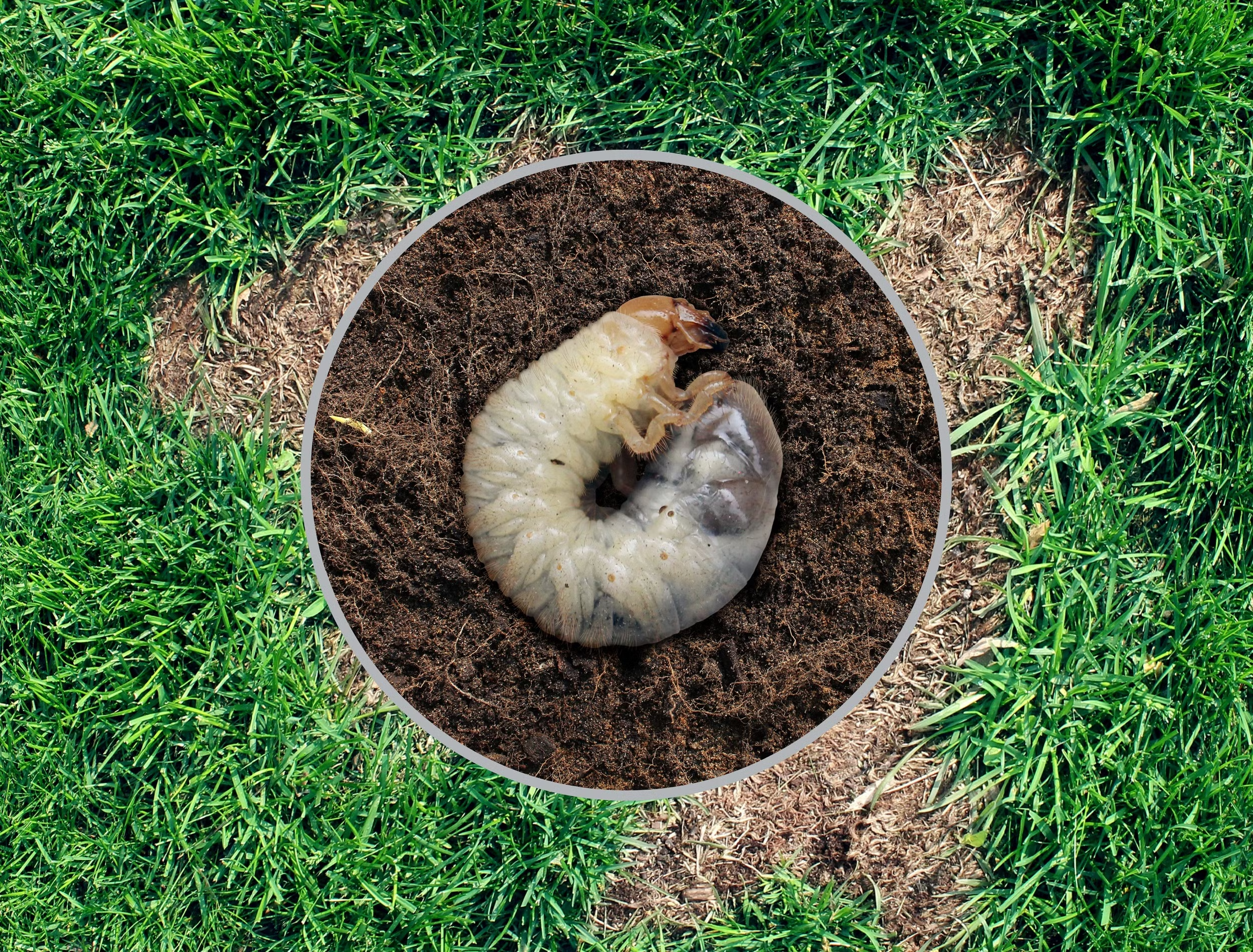
Image source: Bing (Web (fair-use with source credit))
Quick inspection checklist:
- Cut a 12-inch square, 3 inches deep at the edge of damaged areas.
- Count grubs in the sod and the soil beneath.
- Check multiple spots and average the results.
- Replace the sod and water it back in so you're not creating more dead patches.
When to Look: Seasonal Timing for Grub Identification
Timing matters enormously when you're trying to find and identify grubs. Look at the wrong time of year and you'll either miss them entirely or find them at a stage that doesn't match the reference photos you're comparing against.
The best window for inspection is mid-August through October in most temperate regions. That's when grubs are mature, actively feeding near the soil surface, and large enough to identify confidently. By November in northern climates, many species have already burrowed deeper into the soil to overwinter, making them much harder to find.
Spring inspections can be misleading. Grubs that survived the winter move back toward the surface in April and May, but they're preparing to pupate and stop feeding. They're often darker, less active, and beginning the transformation into adult beetles.
You can still find them, but they won't match the classic "fat white grub" photos as closely, and they're causing minimal turf damage at that point.
If you're trying to confirm whether grubs caused damage you noticed earlier in the summer, inspect as soon as you see the damage. Don't wait. By the time large brown patches are visible in July or August, mature grubs may have already done their worst and started moving deeper.
How Many Grubs Is Too Many? The Numbers That Matter
Finding a grub or two in your soil isn't a crisis. Most lawns can tolerate a low grub population without visible damage. The threshold where treatment becomes worthwhile depends on your turf type and overall lawn health.
Research from university extension programs generally cites 5 to 10 grubs per square foot as the treatment threshold for most cool-season turfgrasses. Kentucky bluegrass and fine fescue tend to show damage at the lower end of that range. Tall fescue, with its deeper and more robust root system, can often handle 8 to 10 grubs per square foot before you see browning.
Warm-season grasses like Bermuda and zoysia have different tolerances. Their aggressive growth habit and deeper root systems give them more resilience, but heavy grub pressure can still cause significant damage during peak summer heat when the grass is already stressed.
If your inspection turns up more than 10 grubs per square foot in multiple spots, that's a strong signal to take action. Below that threshold, especially if the lawn is otherwise healthy and well-watered, you might be better off monitoring and letting natural predators like ground beetles and birds keep the population in check.
Common Mistakes People Make When Identifying Grubs
The most frequent error is treating before confirming. People see brown grass, assume grubs, and apply a preventive insecticide in spring. That's often wasted effort, since spring-applied products target newly hatched grubs that haven't caused damage yet, and the active ingredient may degrade before peak feeding season arrives.
Another common mistake is digging in the wrong spot. If you sample the center of a dead patch, you might find nothing because the grubs have already moved to the edges where green grass still has roots to eat. Always sample at the margin between damaged and healthy turf.
Misidentifying the species is a quieter but costly error. Japanese beetle grubs and European chafer grubs have different peak feeding periods and slightly different susceptibility to certain control products. Treating at the right time for the wrong species can mean the product never reaches the grubs effectively.
Finally, people often overlook the depth factor. If you only check the top inch of soil, you'll miss grubs that have moved down to 3 or 4 inches during dry spells. Dig deep enough to get a complete picture.
Expert Tips for Confirming What You're Dealing With
If you've found C-shaped, white larvae with brown heads and three pairs of legs near the head, you're almost certainly looking at scarab beetle grubs. But if you want to be certain before investing in treatment, here's what experienced turf managers recommend.
Take a clear macro photo of the underside of the last abdominal segment and compare it to a raster pattern key from your state's cooperative extension service. Most extension websites publish free identification guides with detailed diagrams. This single step eliminates most of the guesswork.
If you're still unsure, place a few specimens in a sealed container with some soil and grass roots, and take it to your local extension office. Many offer free pest identification services, and a definitive ID takes an entomologist about 30 seconds under a magnifier.
Don't forget to look for secondary evidence. Increased bird activity, skunks or raccoats tearing up your lawn at night, and spongy turf that lifts easily all support a grub diagnosis even before you dig. When the visual ID and the circumstantial evidence line up, you can move forward with confidence.
Frequently Asked Questions
What time of year are grubs easiest to identify?
Late August through October is the prime window. Grabs are mature, actively feeding near the surface, and large enough to identify with confidence. Spring grubs are often pupating and don't match standard reference images as closely.
Can I identify grubs without digging up my lawn?
Not reliably. Surface signs like brown patches and animal digging strongly suggest grubs, but a positive ID requires examining the soil directly. A quick 12-inch square sample at the edge of damaged turf takes less than 10 minutes.
Do all lawn grubs look the same?
No. While they share the basic C-shaped body plan, species differ in size, head color, and the raster pattern on the underside of the last abdominal segment. Japanese beetle grubs, European chafer grubs, and June bug grubs all look distinct up close.
How deep in the soil do grubs live?
Most feeding activity happens in the top 1 to 3 inches of soil, just below the thatch layer. During dry spells or as temperatures drop in fall, grubs can move down to 4 to 8 inches to find moisture and insulation.
What should I do if I find grubs but my lawn looks fine?
Monitor the population. If you're below 5 grubs per square foot and the turf is healthy, natural predators and the lawn's own growth can usually keep up. Reinspect in a few weeks if conditions change or damage starts to appear.
What to Do Once You've Confirmed Grubs in Your Lawn
You've dug, you've counted, and you've got a positive ID. Now the question is what to do about it.
If your count is above the treatment threshold for your turf type, a curative insecticide applied in late summer or early fall gives you the best results. Products containing trichlorfon or carbaryl work on contact and don't require the long residual window that preventive products need. Apply them when grabs are small and actively feeding near the surface, typically August through mid-September in most regions.
For preventive control the following year, products containing imidacloprid or chlorantraniliprole should be applied in late June to early July, before adult beetles lay eggs. These work on newly hatched grabs and need time to move into the soil profile before the larvae arrive.
If you're below the threshold or prefer a non-chemical approach, beneficial nematodes (Heterorhabditis bacteriophora) can reduce grub populations when applied to moist soil in late August. Milky spore disease (Paenibacillus popilliae) targets Japanese beetle grabs specifically and can provide long-term suppression in warmer climates, though it takes two to three years to build up in the soil.
Water the lawn lightly after any treatment application to move the product into the root zone where grabs are feeding. Then monitor the following spring for any residual damage and reinspect in late summer to see if the population rebounds.