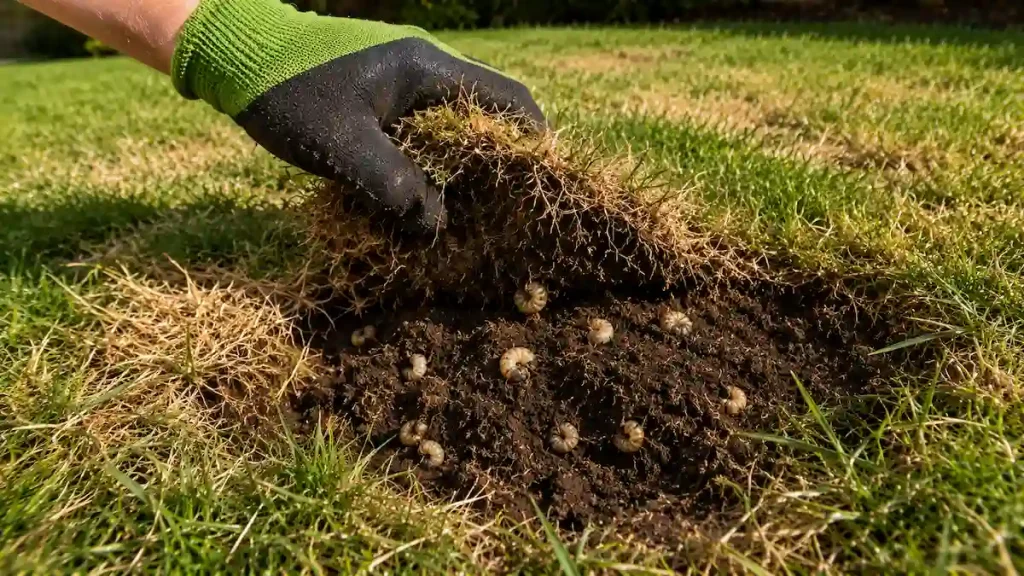
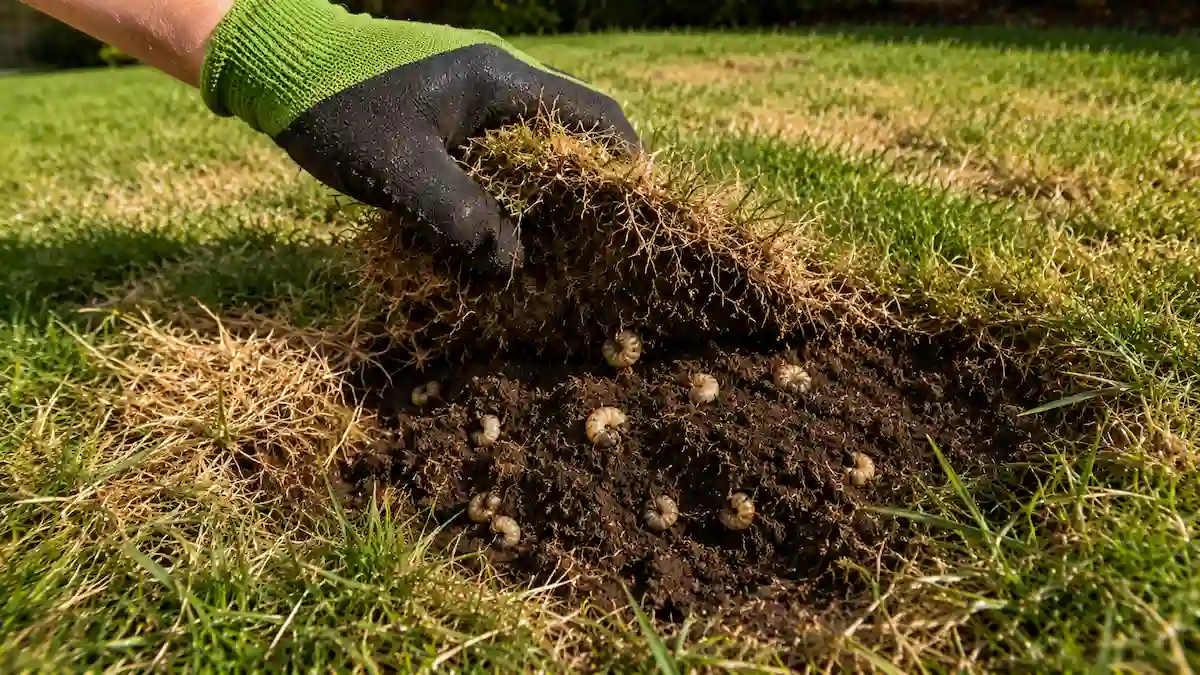
Image source: Bing (Web (fair-use with source credit))
Figuring out how to tell if you have grubs in your lawn starts with knowing what you're actually looking for. Brown patches, spongy turf, and animals digging at odd hours are all clues, but none of them confirm grubs on their own. The only way to know for sure is to get your hands in the soil and see what's down there.
White grubs are the larval stage of scarab beetles, and they feed on grass roots just below the surface. Per Penn State Extension Turfgrass Science, most cool-season lawns can tolerate around 5 to 10 grubs per square foot before real damage sets in. The trick is confirming they're there, identifying which species you're dealing with, and understanding whether the number you're finding actually warrants action.
Quick Answer
Check for grubs by peeling back a square foot of turf in a damaged area. Count the C-shaped larvae in the top 2 to 3 inches of soil. More than 5 to 10 per square foot on cool-season grass usually means treatment is warranted.
Confirm the species by examining the raster pattern on the grub's underside. Early fall is the best time to inspect, when grubs are small and actively feeding near the surface.
What Grub Damage Actually Looks Like on Your Lawn
Grub damage doesn't announce itself overnight. It builds slowly, and by the time you notice brown patches, the larvae have been feeding for weeks. The first sign is usually turf that looks wilted or off-color even though you've been watering.
The grass thins out, turns a dull straw-brown, and feels spongy underfoot because the root system has been chewed away.
Here's what makes grub damage tricky. It looks almost identical to drought stress, fungal disease, and fertilizer burn. The difference is that grub-damaged turf lifts away from the soil easily.
The roots are gone, so the sod peels back like a loose carpet. If you can grab a handful of grass and it comes up with almost nothing holding it down, that's a strong indicator.
Animal activity is another telltale sign. Skunks, raccoons, crows, and armadillos will tear up sections of lawn overnight to get at grubs. If you're finding small cone-shaped holes or patches of torn-up sod, something is digging for a food source below the surface.
That doesn't guarantee grubs, but it's reason enough to investigate.
The damage typically appears in late summer and early fall for most species in the Northeast and Midwest. In warmer southern states, it can show up earlier and progress faster. Patches start small and irregular, then merge into larger dead zones as feeding continues.
The Two-Step Quick Check Any Homeowner Can Do
Before you grab a shovel, start with a walk-through. Look for areas where the grass color doesn't match the rest of the lawn. Pay attention to spots that stay brown even after a good rain.
Then do the tug test, which takes about ten seconds.
Grab a handful of grass at the edge of a suspect patch and pull upward firmly. Healthy turf resists. Grub-damaged turf lifts cleanly because the roots have been severed.
If it rolls back like a piece of sod you just laid, you've got a problem below the surface.
The second step is a simple dig. Use a flat spade to cut a 1-foot square about 3 inches deep at the border between damaged and healthy grass. That border zone is where grubs are most concentrated.
Flip the square over and examine the root zone and the soil underneath. Count every grub you see in that square.
If you find more than 5 to 10 grubs in a single square foot on cool-season grass like Kentucky bluegrass or tall fescue, you've crossed the threshold where treatment makes sense. Below that number, most lawns can outgrow the damage with proper watering and fertilization.
What a Grub Looks Like vs. Other Lawn Pests You Might Be Confusing It With
White grubs are cream-colored to grayish-white, C-shaped, and have a distinct brown head capsule with three pairs of legs near the head. They range from about a quarter inch to over an inch long depending on the species and how mature they are. When you find one in the soil, it's usually curled into that characteristic C shape.
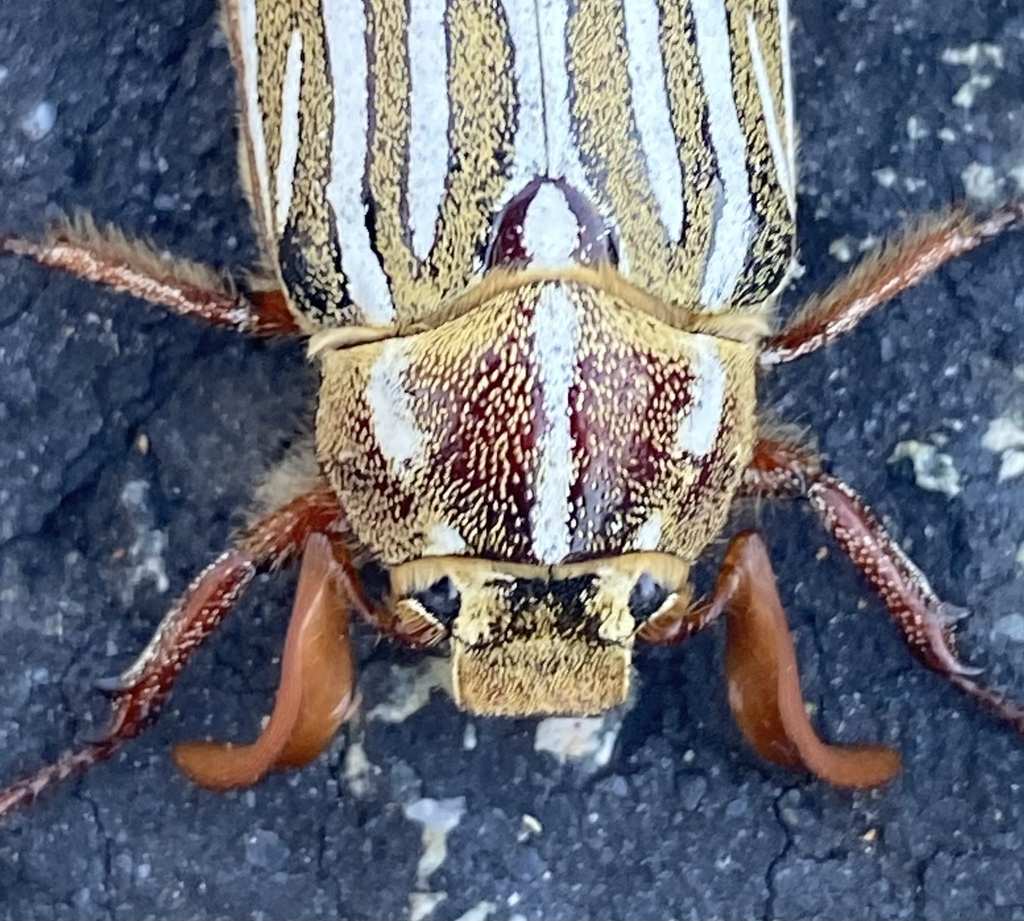
Image source: iNaturalist / Irene
Now here's where people get tripped up. Not every white larva in your lawn is a scarab grub. Billbug larvae look similar at a glance but have no legs at all and tend to be straighter rather than tightly curled.
Sod webworms are caterpillars, not beetle larvae, and they live in the thatch layer above the soil, not below it. Chinch bugs are tiny black insects with white wings that you'd find on the surface, not underground.
The key visual differences come down to a few specific traits:
- Scarab grubs (Japanese beetle, European chafer, May/June beetle): C-shaped, cream-colored, three pairs of legs, brown head, raster pattern visible on the underside tip of the abdomen.
- Billbug larvae: Legless, straight or slightly curved, creamy white with a darker head, often found inside grass stems rather than free in the soil.
- Sod webworms: Caterpillars with distinct body segments and visible prolegs, found in silken tunnels in the thatch, not in the root zone.
If you're not sure what you're looking at, that's completely normal. Even experienced lawn care professionals send samples to their county extension office for confirmation when the species matters for treatment timing.
Why the Species Matters More Than You Think
Not all grubs are created equal. The species determines when they hatch, how long they feed, how deep they go in winter, and which treatments will actually work. Treating at the wrong time for the wrong species is one of the most common mistakes homeowners make.
Japanese beetle grubs are among the most widespread in the eastern and midwestern United States. They hatch in mid to late summer, feed aggressively through fall, and are small and near the surface during August and September. That's your window for curative treatment.
European chafer grubs follow a similar timeline but tend to be active a bit earlier in the season. They're particularly common in parts of the Northeast, Michigan, and Ohio. May/June beetle grubs, on the other hand, can take two to three years to mature, which means you might find multiple size classes in the same lawn at the same time.
The way to tell species apart is by examining the raster pattern. That's the arrangement of hairs and spines on the underside of the grub's last abdominal segment. Each species has a distinct pattern, and extension offices use these patterns the way a field guide uses plumage to identify birds.
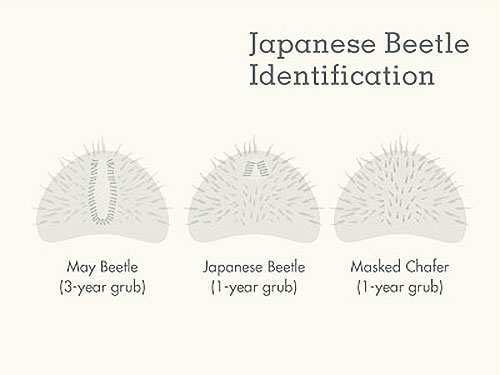
Image source: Bing (Web (fair-use with source credit))
Japanese beetle grubs have a V-shaped raster pattern. European chafers have two parallel rows of hairs that look like an opening Oriental beetle grubs have a single transverse row. If you have a hand lens or even a phone camera with decent macro capability, you can photograph the underside and compare it to identification guides from your state's extension service.
Why does this matter practically? Because curative insecticides work best when grubs are small and actively feeding near the surface. If you misidentify the species and treat too late, the grubs may have already moved too deep in the soil for the product to reach them.
You'd be spending money and applying chemicals for no real effect.
The Tug Test and Other Fast Field Tests That Confirm Grubs
The tug test is the fastest way to narrow down whether grubs are your problem. Walk to the edge of a brown or thinning patch, grab a fistful of grass, and pull. If the turf lifts away easily with no resistance, the root system has been compromised.
That doesn't prove grubs on its own, but it tells you something is wrong below ground.
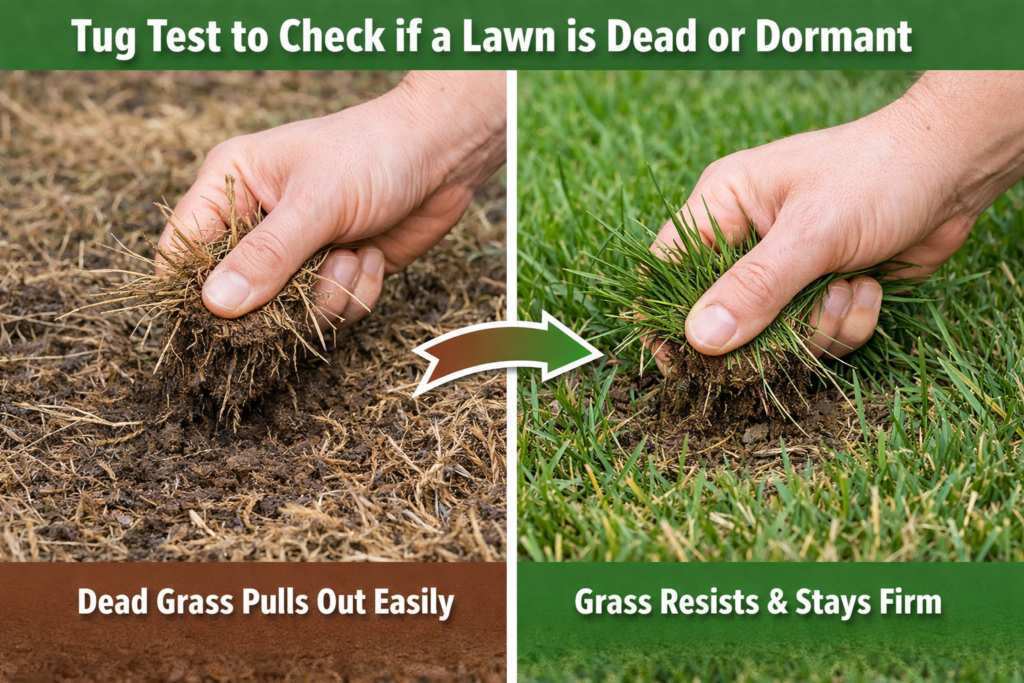
Image source: Bing (Web (fair-use with source credit))
Another quick method is the flotation test. Cut the top and bottom out of a coffee can or similar cylinder, press it into the soil in a suspect area, and fill it with water. Grubs near the surface will float up within a few minutes as the water displaces the air around them.
This works best in moist soil and when grubs are actively feeding in the top 2 inches.
A soap flush can also bring grubs and other insects to the surface. Mix a couple of tablespoons of liquid dish soap in a gallon of water and pour it over a square yard of turf. Wait a few minutes and watch for movement.
This method is less specific than digging, but it's useful for a quick scan of a larger area.
None of these field tests replace a proper square-foot dig for an accurate count. They're screening tools. If any of them come back positive, that's your cue to get a spade and do a real sample.
If they all come back negative and your lawn is still struggling, the problem is probably something else entirely.
The Square-Foot Dig: How and Where to Sample Properly
The square-foot dig is the gold standard for confirming grubs. It's simple, it's fast, and it gives you a number you can actually use to make a decision. The key is doing it in the right spot and at the right depth.
Start at the edge of a damaged area, not the center. Grubs feed outward from a central point, so the highest concentration is usually where the brown meets the green. Use a flat spade to cut three sides of a 1-foot square, slide the blade under about 3 inches deep, and flip the whole piece over.
Break apart the soil and root zone with your hands. Count every grub you find in that square. Then probe another inch or two deeper with your fingers, because larger grubs may have moved down.
Record the number and move to a second location at least 20 feet away. Sample three to four spots across the lawn to get a reliable average.
Grubs are rarely evenly distributed. You might find 15 in one square and zero in the next. That's normal.
The average across multiple samples is what matters for deciding whether to treat.
How Many Grubs Is Too Many? Explaining Treatment Thresholds
Finding a few grubs doesn't mean you need to panic. Most healthy lawns can handle a low population without visible damage. The threshold where treatment becomes worthwhile depends on your grass type and how much stress the lawn is already under.
Here are the general benchmarks used by university extension programs:
| Grass Type | Treatment Threshold (grubs per sq ft) | Notes |
|---|---|---|
| Kentucky bluegrass | 8 to 10 | Deep-rooted, tolerates moderate feeding |
| Perennial ryegrass | 5 to 8 | Shallow roots, shows damage sooner |
| Tall fescue | 6 to 10 | Bunch-type, can recover if not overstressed |
| Fine fescue | 3 to 5 | Low-input grass, less tolerant of root loss |
| St. Augustinegrass | 4 to 6 | Southern grass, sensitive to heavy feeding |
These numbers assume the lawn is otherwise healthy and well-watered. If your grass is already struggling from drought, compaction, or disease, even a low grub count can push it over the edge. In those cases, treating at half the normal threshold makes sense.
The species of grub also affects the equation. Japanese beetle grubs tend to cause more visible damage at lower numbers because they feed in dense clusters. European chafers spread out more, so the same count might produce less obvious symptoms.
Seasonal Timing: When You Can (and Can't) Accurately Find Grubs
Timing your inspection correctly makes a huge difference in what you find. Grubs aren't at the same depth or the same size throughout the year, and checking at the wrong time can give you a false negative.
The ideal window for detection is mid-July through September in most of the Northeast and Midwest. That's when current-season grubs are small, actively feeding, and concentrated in the top 2 to 3 inches of soil. You'll find them easily with a standard square-foot dig.
By late October and into November, most species start moving deeper to overwinter. They can be 4 to 8 inches down by then, and a surface dig will miss them entirely. In early spring, they return to the surface briefly before pupating, but they're larger and harder to kill with curative products.
If you're checking in June and finding nothing, that doesn't mean you're in the clear. The eggs may not have hatched yet. Wait until mid-July and sample again.
Conversely, if you're inspecting in November and your lawn looks terrible, the grubs have likely already done their damage and moved on. At that point, focus on reseeding rather than treating.
In the Southeast and Gulf Coast states, the timeline shifts earlier. Grubs can be active and detectable from May through August depending on the species. Your local extension office can provide a region-specific calendar based on beetle flight patterns and soil temperature data.
Signs That Something Else Is Causing Your Lawn Problem
Brown patches don't automatically mean grubs. Several other common lawn issues produce similar symptoms, and treating for grubs when the real culprit is something else wastes time and money.
Drought stress is the most frequent misdiagnosis. Grass goes dormant during dry spells and turns brown, but the roots are intact. The tug test will confirm this.
Dormant grass holds firm because the root system is still there, just waiting for water.
Fungal diseases like brown patch, dollar spot, and Pythium blight create circular or irregular dead zones. Brown patch often shows a darker "smoke ring" border in the early morning when dew is present. Dollar spot produces smaller, silver-dollar-sized patches.
These diseases thrive in humid conditions and often respond to fungicides, not insecticides.
Dog urine causes small, uniformly round dead spots with a dark green ring around the outside. The concentrated nitrogen burns the center while fertilizing the edges. The pattern is distinct and usually appears near walkways or property edges.
Fertilizer burn or chemical spills create irregular dead zones that often correspond to application patterns. If the damage appeared shortly after you or a lawn service applied something, suspect the product before suspecting pests.
If you've done the tug test, the dig, and the flotation test and found zero grubs, look at these other causes first. A county extension agent can help diagnose fungal issues from a photo or a physical sample.
How to Send a Sample to Your County Extension for Definitive ID
When you need to know exactly which species you're dealing with, your county extension office is the best resource. Most offer free or low-cost insect identification services, and the agents who handle these requests see thousands of samples every year.
Collect five to ten of the grubs you've found and place them in a sealed container with some of the surrounding soil. Keep the container cool and get it to the extension office within a day or two. If you can't deliver it right away, store it in a refrigerator, not a freezer.
Freezing kills the specimen and makes identification harder.
Include a brief note with your contact information, the address where the sample was collected, and a description of the lawn symptoms. Photos of the damaged areas help the agent understand the full picture. Most offices will respond within a week with a species identification and management recommendations tailored to your region.
This step is especially worth doing if you're dealing with a recurring problem year after year. Knowing the exact species lets you time preventive treatments to the egg-hatch window, which is far more effective than guessing.
Next Steps: What to Do Once You've Confirmed Grubs Are There
Once you've confirmed grubs and counted enough to cross the treatment threshold, you have two paths. Curative treatment targets the grubs currently in your lawn. Preventive treatment stops next year's generation before they cause damage.
Curative products work best when grubs are small and feeding near the surface, typically August through early October. Look for active ingredients like trichlorfon or carbaryl on the product label. These work fast but have a narrow application window.
Apply them as soon as you confirm the problem, water them in according to the label, and keep pets and kids off the treated area until it's dry.
Preventive products use different chemistry, such as chlorantraniliprole or imidacloprid. These are applied in late spring to early summer before adult beetles lay eggs. They target newly hatched grubs and provide season-long control.
This approach requires planning ahead, but it's generally more reliable than trying to kill larger, established grubs in fall.
Biological options are worth considering if you prefer to avoid synthetic insecticides. Beneficial nematodes, specifically Heterorhabditis bacteriophora, are microscopic worms that seek out and kill grubs in the soil. They need to be applied when soil temperatures are above 55 degrees Fahrenheit and the soil is moist.
Milky spore disease (Paenibacillus popilliae) targets Japanese beetle grubs specifically and can persist in the soil for years, but it takes two to three years to build up effective populations.
Whatever route you choose, read the EPA-approved label completely before buying or applying any product. The label tells you the legal application rate, timing, safety precautions, and which species the product is registered to control. Skipping this step risks poor results and potential legal issues, especially in states with restricted-use regulations.
Frequently Asked Questions
Can I just water my lawn more to fix grub damage?
Extra water won't repair roots that have already been eaten. It can help surviving grass recover if the grub population is low, but once the turf lifts easily, those areas need reseeding or resodding after the grubs are controlled.
How deep do grubs go in winter?
Most species move 4 to 8 inches below the surface once soil temperatures drop in late fall. That's why fall treatments become less effective as the season progresses. The grubs are simply too deep for the product to reach them.
Do all grubs turn into Japanese beetles?
No. The term "white grub" covers larvae from multiple scarab beetle species. European chafers, May/June beetles, Oriental beetles, and masked chafers all produce white grubs that look similar but have different life cycles and behaviors.
Is it normal to find one or two grubs and nothing else?
Yes. A low grub population is completely normal and actually indicates healthy soil biology. You only need to act when counts exceed the treatment threshold for your grass type.
Will grub damage heal on its own?
If the grub population is below threshold and you maintain proper watering and fertilization, the lawn can often recover. If the root loss is severe, the dead areas won't come back without reseeding. The grubs need to be controlled first, or they'll just attack the new grass.
How long does it take to get results from a county extension sample?
Most extension offices return identifications within five to seven business days. During peak summer season, it may take up to two weeks. Call ahead to confirm their submission process and hours.