If you've dug up a fat, pale creature in your lawn and wondered whether it's the real culprit behind those brown patches, you're not alone. When people ask "what do grub worms look like," they're usually standing in their yard trying to decide if they've got a pest problem or just another harmless soil critter. The challenge is that dozens of larvae live in turf and garden soil, and most of them get lumped together under the word "grub" even though only some of them actually damage grass.
Getting the ID right matters more than most people realize. A white grub from a scarab beetle looks completely different from a cutworm or a millipede once you know what to check, and the species determines whether you need to do anything at all. Treatment thresholds vary, but university extension programs generally flag 5 to 10 grubs per square foot as the point where action makes sense for most cool-season lawns.
Let's walk through exactly what to look for so you can tell what's in your soil with confidence.

Image source: Bing (Web (fair-use with source credit))
Quick Answer
Grub worms, more accurately called white grubs, are the larval stage of scarab beetles. They have a distinct C-shaped body, a creamy white or off-white abdomen, and a tan to brownish head capsule. You'll see three pairs of true legs clustered near the head.
Their size ranges from about 1/4 inch when newly hatched to over 1 inch when mature.
What Grub Worms Actually Look Like: The Visual Breakdown
A white grub has a body that curls into that signature C-shape when you pull it from the soil. This is the single easiest way to rule out a lot of look-alikes right away. The body itself is soft, plump, and slightly translucent, sometimes showing a dark area through the body wall near the tail end.
That dark spot is digested plant material visible through the skin, and it's actually a helpful clue you're looking at a scarab grub rather than something else.
The head capsule is hardened and colored tan, amber, or reddish-brown depending on the species. Behind the head, the first three segments each carry a pair of short, jointed legs. Those legs are fully formed and visible, though they're smaller and sturdier than what you'd see on a caterpillar.
The rest of the body, roughly 8 to 10 abdominal segments, is legless and smooth.
Size depends heavily on the species and age of the grub. Newly hatched Japanese beetle grubs are barely 2 millimeters long and can be harder to spot in soil. Mature larvae of larger scarab species like May beetles reach 1.5 inches.
Most grubs you'll encounter in a typical lawn fall somewhere in the middle, around 1/4 to 1 inch if you're checking in late summer when damage starts showing up.
Movement is another giveaway. Grubs wriggle and curl when you place them on a flat surface, but they don't crawl with any real speed or direction. They're not built for surface travel.
If the creature in your hand is zipping across the sidewalk, it's not a grub.
The Key Physical Features That Separate Grubs from Everything Else
Here's where most identification confusion happens. Your lawn soil is home to a surprising number of pale-bodied, worm-like creatures that get mistaken for grubs. Learning a few specific features will save you a lot of unnecessary worry and probably some unnecessary pesticide use too.
What to check on any grub-like find:
- Body shape: True grubs hold that tight C-curve even when relaxed. Earthworms stretch out. Millipedes stay relatively straight or curl into a spiral, not a C.
- Leg count and placement: Grubs have exactly three pairs of six legs, all up front near the head. Caterpillars have those three pairs plus additional fleshy prolegs along the body. Millipedes have dozens of legs on virtually every segment.
- Head capsule: A grub has a distinct, hardened head that's a different color from its body. Earthworms don't have a separate head at all. Leatherjackets (crane fly larvae) are legless and lack that defined head structure.
- Skin texture: Grub skin is smooth and slightly shiny. Cutworms tend to be hairier or more leathery. Pillbugs have a hard, segmented, armor-like exterior.
- Underside of the abdomen tip: This is the raster pattern, a cluster of tiny spines and hairs near the tail end. It's the gold standard for species-level ID, and we'll cover it in detail in a moment.
If you're still unsure after checking these features, snap a close-up photo and send it to your local university extension office. Most will identify a grub species from a clear image within a day or two, and the service is free.
How to Tell a White Grub from a Cutworm, Millipede, or Caterpillar
People mix these up constantly, and it's understandable. They're all roughly the same size, they all show up in soil or garden beds, and they all look vaguely "worm-like" to a quick glance. But the differences are clear once you know what to look at.
White grub vs. cutworm: Cutworms are the larvae of certain moth species. They have longer, more cylindrical bodies that don't curl into a C-shape. Their skin is usually darker, often gray, brown, or greenish, and it's frequently hairy or has visible stripes.
Cutworms also tend to be more active on the soil surface at night, while grubs stay underground feeding on roots.
White grub vs. millipede: Millipedes are arthropods, not insects, and it shows. They have a long, segmented body with two pairs of legs per segment, giving them that signature "hundred legs" look. Their body is harder and more cylindrical.
Millipedes curl into a tight spiral when disturbed, not a C-shape. They feed on decaying organic matter and rarely damage healthy turf.
White grub vs. caterpillar: Caterpillars have the three pairs of true legs near the head, just like grubs, but they also have fleshy prolegs along the abdomen, usually four to five pairs. Their bodies are more elongated and they move with a looping or inching motion. Most caterpillars you'll find in a lawn are actually cutworms or sod webworm larvae, and they feed on grass blades above ground rather than roots below.
White grub vs. pillbug (roly-poly): Pillbugs are crustaceans, not insects at all. They have a segmented, armor-like body with seven pairs of legs and they roll into a perfect ball when disturbed. They feed on decaying plant material and don't cause the kind of turf damage people associate with grubs.
The table below summarizes the key differences at a glance:
| Creature | Body Shape | Legs | Head | Feeds On |
|---|---|---|---|---|
| White grub | C-shaped, soft | 3 pairs near head | Hardened, tan/brown | Grass roots |
| Cutworm | Elongered, cylindrical | 3 pairs + prolegs | Small, dark | Grass stems at soil line |
| Millipede | Long, hard, segmented | Dozens (2 per segment) | Small, rounded | Decaying organic matter |
| Caterpillar | Elongated, soft | 3 pairs + 4-5 proleg pairs | Distinct, often patterned | Leaves, stems |
| Pillbug | Oval, armored, segmented | 7 pairs | Small, tucked under | Decaying plant matter |
Species-Specific ID: Japanese Beetle Grubs vs. June Bug Grubs vs. European Chafers
Not all white grubs are the same species, and knowing which one you're dealing with affects when and how you treat. The three most common lawn-damaging species in North America are the Japanese beetle grub, the June bug grub (also called May beetle), and the European chafer grub. They look nearly identical at a glance, but a close look at the raster pattern on the underside of the abdomen tip tells them apart.
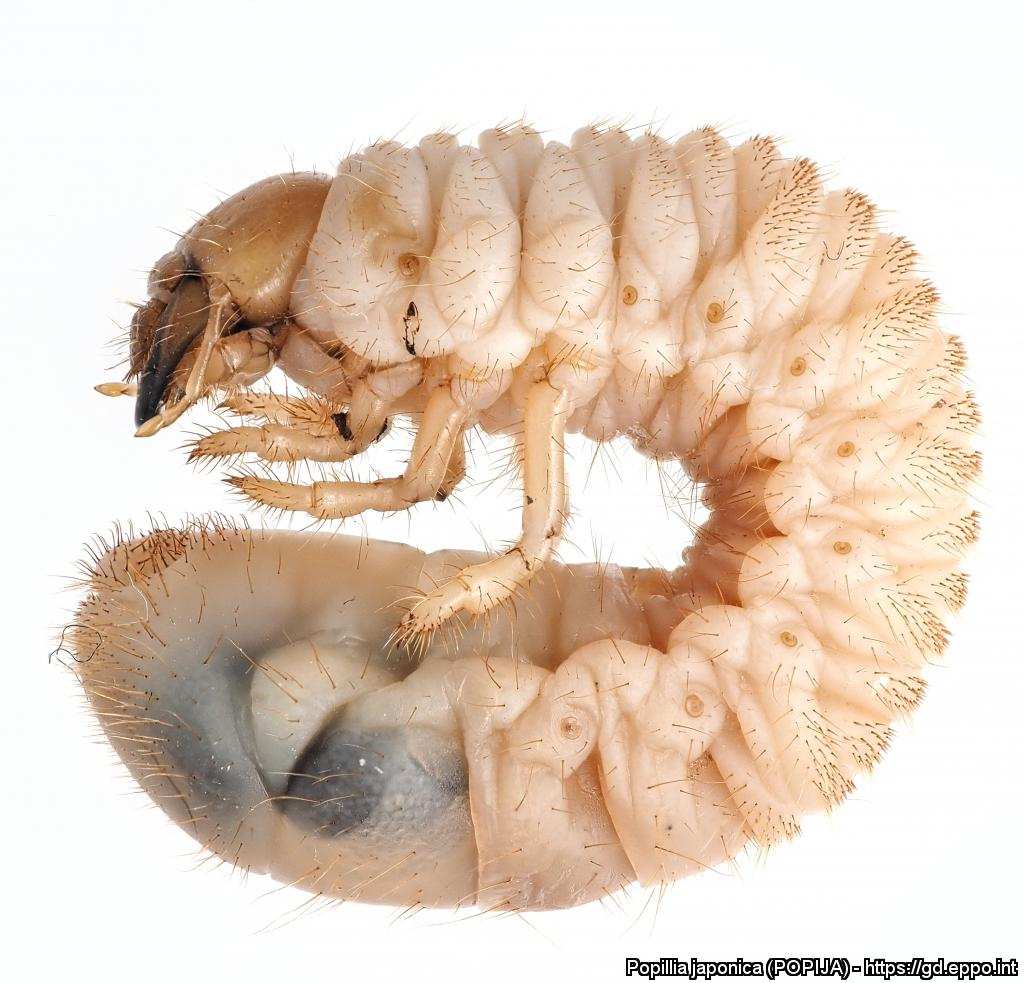
Image source: Bing (Web (fair-use with source credit))
Japanese beetle grub (Popillia japonica): This is probably the most widespread lawn grub in the eastern and midwestern United States. The mature larva reaches about 1 inch in length. Its raster pattern, the arrangement of tiny spines on the last abdominal segment, forms a distinct V-shape.
Japanese beetle grubs are the species most commonly targeted by milky spore disease, a biological control that specifically affects this beetle's larvae.
June bug grub / May beetle (Phyllophaga spp.): These grubs tend to be slightly larger than Japanese beetle grubs, sometimes reaching 1.5 inches. They have a longer life cycle, often taking two to three years to mature compared to one year for Japanese beetles. Their raster pattern shows two parallel rows of spines rather than a V-shape.
June bug grubs are found across most of North America and are particularly common in transition zone and southern lawns.
European chafer grub (Amphimallon majale): Slightly smaller than the other two, usually around 3/4 inch when mature. The raster pattern forms a Y-shaped opening, which is the key distinguishing feature. European chafers are concentrated in the Northeast and Upper Midwest and have become a significant turf pest in those regions since their introduction.
They're also a favorite food source for skunks and raccoons, so secondary digging damage can be severe.
Green June beetle grub (Cotinis nitida): This one's a bit of an outlier. Unlike the other species, green June beetle grubs are often found crawling on the soil surface rather than burrowing underground. They're larger, sometimes over 2 inches, and they have a more elongated, less tightly curled body.
They're common in the southeastern United States and can cause significant tunneling damage in turf.
If you're trying to ID a grub at home, a simple hand lens or magnifying glass is usually enough to see the raster pattern. Place the grub belly-up on a flat surface, wait for it to uncurl slightly, and examine the area just below the anus. The arrangement of spines there is consistent within each species and is the method extension entomologists use for definitive identification.
The Raster Pattern: The One Detail That Confirms What You're Looking At
If there's one feature that separates confident grub guessing from actual identification, it's the raster pattern. This is the arrangement of tiny spines, hairs, and setae on the underside of the last abdominal segment, just below the anus. Every scarab beetle grub species has a consistent and distinctive raster pattern, and entomologists use it as the primary diagnostic tool for species-level ID.

Image source: Bing (Web (fair-use with source credit))
Examining the raster pattern at home takes nothing more than a basic 10x hand lens. Place the grub on its back, wait a moment for it to uncurl, and look at the very tip of the abdomen. A smartphone camera with a macro mode or even just zooming in with your phone's camera can sometimes capture enough detail to compare against published reference images.
Japanese beetle grub: The raster forms a distinct V-shaped row of spines that opens toward the head. This is the single most important feature for confirming Japanese beetle species in the field, and it's what milky spore product labels reference when describing their target pest.
European chafer grub: The raster shows a Y-shaped pattern with a short central stem. This is notably different from the two parallel rows you'll see on June bug grubs, which is why close examination matters.
June bug / May beetle grub: Two roughly parallel rows of spines with no V or Y configuration. These rows are more evenly spaced and less convergent than the Japanese beetle pattern.
Penn State Extension and Purdue University both publish photographic reference guides to grub raster patterns, and those are widely considered the most accessible visual identifiers available. If you're dealing with a suspected Japanese beetle infestation, matching your specimen's raster pattern to a verified guide image is the most reliable confirmation method before committing to a treatment product like milky spore or beneficial nematodes.
What Grub Damage Looks Like vs. Drought, Disease, and Other Lawn Problems
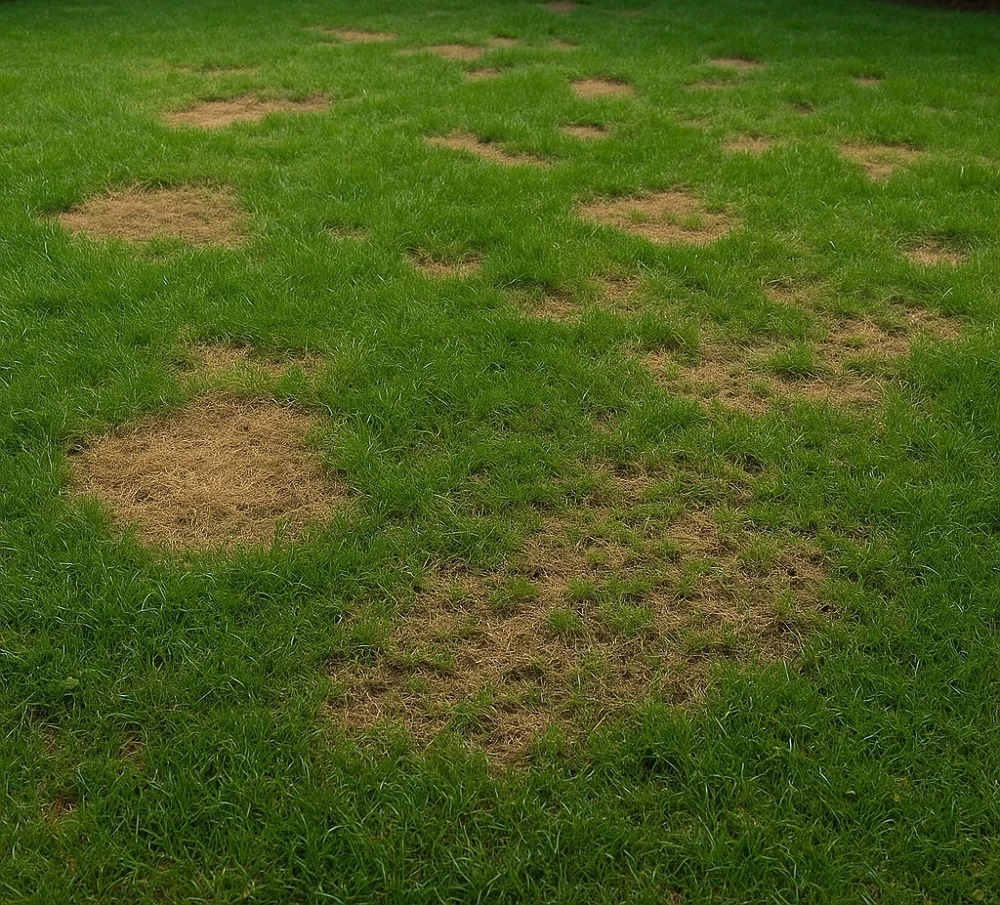
Image source: Bing (Web (fair-use with source credit))
Grub damage has a signature look, but it's surprisingly easy to confuse with other common lawn issues if you're only looking at the surface. Understanding what to look for above ground can help you decide whether digging for grubs is even worth your time.
Image source: Bing (Web (fair-use with source credit))
Classic grub damage pattern: Irregular patches of brown, dead-looking grass that start small and expand over days to weeks. The key difference from drought is that grub-damaged turf lifts up easily, almost like peeling back a carpet, because the roots have been chewed away. If you can grab a handful of brown grass and pull it up with almost no resistance, that's a strong indicator of grub feeding.
Drought stress: Grass turns a uniform bluish-gray before browning, and the color change tends to be across larger, more consistent areas rather than irregular patches. The turf doesn't pull up easily because roots are intact, just dehydrated. You'll also notice drought stress on slopes and south-facing areas first, while grub damage shows up more randomly.
Fungal disease (brown patch, dollar spot): Fungal diseases often show a "smoke ring" pattern of darker grass around the patch edge, or you'll spot visible fungal growth on individual grass blades in the early morning. Dollar spot creates smaller, more distinct silver-dollar-sized spots rather than the larger irregular patches typical of grub activity.
Earthworm castings vs. grub damage: Earthworms leave small mounds of granular soil on the surface, which can smother grass in tiny spots. This looks different from the broad brown patches grub feeding produces. If your lawn has scattered small dead dots but the surrounding grass is healthy and roots are intact, earthworms are the more likely explanation.
Secondary animal damage is another clue. Skunks, raccoons, and birds will rip up turf at night looking for grubs as food. If your lawn has patches of torn-up sod, especially in late summer or early fall, that's often a more reliable sign of grubs than the brown patches themselves.
Animals are excellent grub detectors.
How to Do a Simple Grub Count Test in Your Own Yard
Counting grubs is the only way to know whether your population has crossed the threshold where treatment actually makes sense. It's a straightforward test you can do anytime from mid-August through October, which is when grubs are feeding closest to the surface and most vulnerable to control.
Here's how to do it properly:
Pick a damaged area. Choose a spot where the turf is showing brown patches, ideally near the border between damaged and healthy grass where grub feeding is most active.
Cut a 1-square-foot section. Use a spade or shovel to cut a square about 12 by 12 inches. Go down 2 to 3 inches deep, which is roughly where most scarab grubs are feeding on fine grass roots.
Peel back the turf and examine. Lift the square of sod and break apart the soil beneath, looking for grubs in the root zone and the top few inches of soil. Count every grub you find.
Check two to three additional spots. Grub populations aren't evenly distributed, so a single sample can be misleading. Test at least three separate areas and average your counts.
Replace the turf. Press the squares back into place and water them. The grass will usually re-root within a week or two if the roots are still partially intact.
What the numbers mean:
- 0 to 4 grubs per square foot: Generally below the damage threshold for most cool-season turf. No treatment needed.
- 5 to 9 grubs per square foot: Borderline. Monitor the area and consider treatment if you've had damage in previous years or if the lawn is stressed by heat or drought.
- 10 or more grubs per square foot: Treatment is recommended. At this level, visible turf damage is likely, and the population will probably grow next season without intervention.
These thresholds come from integrated pest management guidelines published by multiple university extension programs. Warm-season grasses like bermudagrass and zoysia can often tolerate slightly higher grub populations before showing visible damage, but the 5 to 10 range is a solid general benchmark.
When Grub Numbers Mean You Actually Need to Treat
Finding a few grubs in your lawn doesn't automatically mean you need to reach for a product. Healthy turf with adequate moisture and good root depth can tolerate a low-level grub population without any visible damage. The decision to treat should be based on actual grub counts, not just the presence of larvae.
Timing matters as much as numbers. Grub treatments are most effective when applied while larvae are small and actively feeding near the soil surface. For Japanese beetle grubs, that window is typically mid-August through early October in most of the northern United States.
By late fall, grubs have burrowed deeper into the soil to overwinter, and surface-applied treatments won't reach them effectively.
Curative treatments (applied when you've already confirmed high grub counts) work best with products containing trichlorfon or carbaryl. These are faster-acting but have a shorter application window. Preventive treatments (applied before you know grub numbers, based on past history) typically use imidacloprid or chlorantraniliprole and need to be applied in late spring or early summer before eggs hatch.
Biological controls like milky spore (Paenibacillus popilliae) and beneficial nematodes (Heterorhabditis bacteriophora) are slower-acting but can provide multi-year suppression. Milky spore specifically targets Japanese beetle grubs and takes two to three years to build up effective populations in the soil. Beneficial nematodes need to be applied when soil temperatures are above 60°F and require adequate soil moisture to move through the turf profile.
If you're unsure whether treatment is warranted, your local cooperative extension office can help interpret grub count results and recommend species-appropriate options for your region. Many offices offer free or low-cost soil pest identification services.
Common Mistakes People Make When Identifying Grubs
Even experienced gardeners get grub identification wrong sometimes. The most common errors aren't about missing obscure details, they're about jumping to conclusions based on incomplete observation.
Mistake 1: Assuming every white larva is a grub. As we covered earlier, cutworms, leatherjackets, and even some fly larvae can look superficially similar. Always check for the C-shape, the three pairs of legs, and the hardened head capsule before calling it a grub.
Mistake 2: Confusing grub damage with other lawn problems. Brown patches have dozens of possible causes. Always do a tug test and a grub count before assuming grubs are the culprit. Treating for grubs when the real problem is fungal disease wastes money and doesn't fix the lawn.
Mistake 3: Treating based on grub presence alone. Finding two or three grubs in a square foot of soil is normal and not a cause for action. Treatment thresholds exist for a reason. Unnecessary pesticide applications kill beneficial soil organisms and can create resistance issues over time.
Mistake 4: Applying treatments at the wrong time. Grub insecticides have specific application windows based on the pest's life cycle. Applying a preventive product in September or a curative product in June is almost always ineffective. Check with your local extension service for timing recommendations specific to your region and grub species.
Mistake 5: Ignoring the raster pattern. If you're investing in a species-specific control like milky spore, you need to confirm you actually have Japanese beetle grubs. Treating for the wrong species is a waste of time and money.
What to Do Once You've Confirmed You Have Grubs
If your grub counts are above the treatment threshold, you have several options depending on the species, the time of your year, and your comfort with different product types.
For immediate, curative control (late summer/early fall application):
- Trichlorfon-based products work fast and kill existing grubs within a few days. They have a short application window and are best when grubs are actively feeding near the surface.
- Carbaryl-based products offer similar curative action with a slightly narrower window.
For preventive control (the following spring/early summer):
- Imidacloprid and chlorantraniliprole are applied before egg hatch, typically June to early July depending on your region. They work on newly hatched larvae before they grow large enough to cause significant root damage.
For biological, long-term management:
- Milky spore disease (Paenibacillus popilliae) specifically targets Japanese beetle grubs. It takes two to three years to establish in the soil but can provide suppression for years after. This option works best if Japanese beetles are confirmed through raster pattern ID.
- Beneficial nematodes (Heterorhabditis bacteriophora) are live organisms you apply to soil. They actively seek out and kill grubs, and they're most effective when soil temperatures stay above 60°F and the ground is kept moist for a week after application.
Always follow label directions for any chemical product. State regulations vary on which active ingredients are approved for residential turf use. Some states restrict neonicotinoid applications during bloom periods to protect pollinators, which is worth checking before you buy.
Frequently Asked Questions
Are grub worms harmful to humans or pets?
White grubs themselves pose no direct health risk to people or pets. Dogs and cats sometimes eat them while digging in lawns, which is generally harmless in small numbers. Real concern is with chemical treatments you might apply to control them, which is why you should follow label instructions and keep pets off treated areas until products have fully dried or been watered in.
How do grub worms turn into beetles?
White grubs are the larval stage of scarab beetles. After feeding through summer and fall, they pupate in the soil over winter or early spring. Adult beetles emerge to lay eggs in turf, and those eggs hatch into new grubs to restart the cycle.
Japanese beetles complete this cycle in one year, while June bugs take two to three years.
What is the difference between a grub and an earthworm?
Grubs are insect larvae with six legs near the head, a hardened head capsule, and a C-shaped body. Earthworms have no legs, no distinct head, and a long cylindrical body made of ringed segments. Earthworms are beneficial for soil health and should not be targeted for control.
When is the best time to check for grubs?
Mid-August through October is the ideal window in most regions. Grubs are actively feeding near the surface during this period, making them easier to find and more vulnerable to treatments. Spring checks can be hit or miss since some species have already stopped feeding or moved deeper into the soil.
How do I know if a grub is a Japanese beetle grub?
Confirm the V-shaped raster pattern on the underside of the abdomen tip using a hand lens or magnifying glass. Mature Japanese beetle grubs reach roughly 1 inch with a tan head capsule and visible dark gut contents near the tail. If the raster pattern shows parallel rows or a Y-shape instead, you're looking at a different species.