Image source: Wikimedia Commons / Conard & Jones Co. (West Grove, Pa.); Henry G. Gilbert Nursery and Seed Trade Catalog Collection.
New leaves on a cut rose can mean very different things depending on the situation. A stem sitting in a vase, a cutting planted in soil, and a pruned garden bush each tell a completely different story. Understanding which scenario you're dealing with is the first step toward knowing what to do next.
The good news is that new foliage confirms the stem is still alive and drawing on stored energy. That is true across all three scenarios. But whether that growth leads to a thriving new plant or is just a temporary flush before decline depends on a handful of factors we will walk through below.
As of 2026, extension services and horticultural bodies like the RHS still recommend soil or medium-based propagation over water for reliable results.
Quick Answer: Is New Growth on a Cut Rose Good or Bad?
New leaves on a cut rose mean the stem is still living and drawing on stored energy. That is a positive sign in every scenario. But new growth alone does not guarantee the plant will survive long-term.
Whether you have a cutting in water, a cutting in soil, or a pruned garden rose determines what those leaves actually predict. Read the sections below to match your situation and take the right next steps.
Three Scenarios: Cutting in Water, Cutting in Soil, or Pruned Bush
Before anything else, figure out which scenario matches yours. The advice changes completely depending on the situation.
- Cut stem in a vase: Your rose was likely a florist bouquet. It is growing leaves but sits in water with no rooting medium. Long-term survival is unlikely.
- Cutting planted in soil or a medium: You or someone else stuck a rose stem into potting mix, perlite, or another rooting medium with the intent to propagate. New leaves here are more encouraging.
- Established rose bush after pruning: A rose plant in your garden was cut back and is now pushing out new leafy shoots from existing roots. This is the healthiest scenario by far.
The rest of this article walks through each scenario one at a time. Understanding which situation you are in is the single most important step before you do anything else.
Scenario 1: Your Rose Is a Cut Stem Sitting in a Vase of Water
Image source: Wikimedia Commons / Henry G. Gilbert Nursery and Seed Trade Catalog Collection.; Peter Henderson & Co.
This is the most common situation people ask about. The flowers start to fade, and then you notice a little green leaf or two pushing out from a node on one of the stems. It feels like a win.
And in a narrow sense, it is, the stem is clearly still alive.
Here is the reality though. Most florist roses are bred for vase life and flower quality, not for rooting ability. The stems have been cut, transported, cooled, and treated with floral preservatives.
All of that reduces the odds of successful propagation. New leaves appear because the stem is using stored carbohydrates and hormones to push out one last flush of growth before it exhausts itself.
According to guidance from the Royal Horticultural Society, propagating roses from bouquet stems is possible but unreliable. Success rates are well below what you would get with cuttings taken from a living garden plant at the right time of year. Even if roots do form, they tend to be weak and may not support transplanting.
What the New Leaves Are Really Telling You
New foliage on a vase stem means the vascular system is still functional. Water and nutrients stored in the stem are moving upward. Auxins, the natural plant hormones concentrated at the nodes, are triggering bud break.
This is a normal physiological response in a freshly cut stem.
What those leaves are not telling you is whether roots are forming. Root initiation requires different hormonal signals and conditions than leaf growth. A stem can push out several healthy-looking leaves and still have zero root development at the submerged end.
Think of it this way. The leaves are running on stored battery power. The real question is whether the stem is plugging itself into a longer-term energy source, meaning a root system.
Without roots, those leaves are living on borrowed time.
Why Vase Cuttings Almost Never Form Proper Roots
A few factors stack the odds against bouquet roses rooting successfully.
- Floral preservatives: Most commercial bouquets come pre-treated with solutions containing sugars, biocides, and acidifiers designed to suppress bacterial growth. These compounds can also discourage root initiation.
- Stem condition: Florist stems are often cut days before they reach you. The cut end may have already begun to seal over or develop microbial biofilm, reducing the surface area available for root formation.
- Variety selection: Many modern cut-flower roses are hybrid teas or spray roses grafted onto vigorous rootstock. The stem you see may not be a rooted plant at all. It is a scion cutting that was never genetically programmed to establish its own root system.
- No rooting hormone: Without dipping the cut end into a rooting hormone containing indole-3-butyric acid (IBA), the hormonal trigger for root formation is much weaker. In controlled propagation settings, rooting hormone can raise success rates from around 20% to 40% up to 50% to 80%, depending on the variety.
What to Do If You Still Want to Try Propagating a Bouquet Rose
If you want to give it a go, here is the best approach.
- Pick the healthiest stem. Look for one with at least two nodes and firm, green tissue. Avoid any stem that feels mushy, slimy, or smells off.
- Recut the stem. Use a clean, sharp blade and make a fresh diagonal cut about half an inch below the lowest node. Cut at a 45-degree angle to maximize surface area.
- Remove lower leaves. Strip off any leaves that would sit below the waterline. Leave one or two small leaves at the top for photosynthesis.
- Optional: use rooting hormone. If you have a rooting hormone powder or gel containing IBA, dip the freshly cut end in before placing it in water.
- Use clean, room-temperature water. Change it every two to three days to prevent bacterial buildup.
- Place in bright indirect light. Avoid direct midday sun. Temperatures between 65 and 75 degrees F (18 to 24 degrees C) are optimal.
- Be patient and watch for callus. After two to four weeks, look for a white or pale lump of callus tissue forming at the cut end. Root tendrils may take six to eight weeks or longer.
Avoid the Common Mistake of Waiting Too Long
The biggest mistake with water-propagated cuttings is leaving them in water indefinitely once roots appear. Water roots are structurally different from soil roots. They are thinner and adapted to absorb oxygen from water rather than from air pockets in soil.
Move the cutting into a lightweight potting mix as soon as the roots are roughly one inch long. Perlite mixed with peat or coir works well. Keep humidity high around the cutting for the first week after transplanting.
A clear plastic bag loosely draped over the pot creates a simple humidity dome.
Scenario 2: Your Rose Cutting Is Planted in Soil or a Rooting Medium

Image source: Pixabay / bernswaelz (Pixabay Content License)
A cutting that is already in a rooting medium has a significantly better shot at becoming a standalone rose plant. New leaves appearing here tell a different story than they do in a vase.
When a cutting in soil pushes out fresh foliage, it means the stem is actively photosynthesizing. That is a stronger signal than leaf growth on a water-only cutting, because the stem has to be drawing at least some moisture from the medium. It is a step closer to independence.
Still, new leaves alone are not proof of roots. You need to check further before concluding anything.
New Leaves in Soil, A More Promising Sign
Soil-based cuttings have access to a rooting medium that provides both moisture and oxygen around the buried node. Perlite, vermiculite, coarse sand, and coir are common choices. These materials hold water without becoming waterlogged, which is critical because a node sitting in pure water can suffocate and rot before roots form.
New leaf growth in this context suggests the cutting has transitioned from passive survival mode to active growth. The stem is no longer just spending stored energy. It is starting to generate new energy through those emerging leaves.
That said, the cutting is likely still running on reserves if roots have not fully formed yet.
Why New Growth Does Not Guarantee Roots Yet
A cutting can push out leaves and still fail to root. Here is why.
The hormonal triggers for leaf development and root development are different. Leaf buds respond to cytokinins and auxins at lower concentrations. Root initiation requires a higher localized concentration of auxins, typically at the buried node, along with adequate moisture, oxygen, and warmth.
Several things can interrupt root formation even when leaves are growing. Stem rot from an overly wet medium is common. The cutting may wilt suddenly from damping-off fungi attacking at the soil line.
Insufficient nodes buried below the surface weaken the rooting signal. And cuttings taken in late fall or winter have much lower success rates because the plant is entering dormancy.
The Checklist: How to Know Your Cutting Has Actually Rooted
New leaves are a good start. Proof of roots requires different evidence. Here is what to look for.
| Sign | What It Means |
|---|---|
| Steady leaf expansion over three or more weeks | The cutting is photosynthesizing actively and likely drawing moisture from roots |
| Resistance when gently tugged | Root fibers are anchoring in the medium. Easy pull-out means roots have not formed |
| New buds forming below the leaf line | Vigorous growth signals overall plant health, often linked to root development |
| Medium drying faster than before | The cutting is transpiring and pulling water through a root system |
| Visible roots at drainage holes | Definitive confirmation. White or light tan roots at the pot bottom mean the cutting is well-rooted |
The gentlest test is the tug test. After about four to six weeks, hold the stem near the soil line and give it a very light upward pull. If you feel resistance, fine root fibers are holding the cutting in place.
Do not yank hard. New roots are fragile and snap easily.
Scenario 3: An Established Rose Bush Is Sprouting New Leaves After a Prune
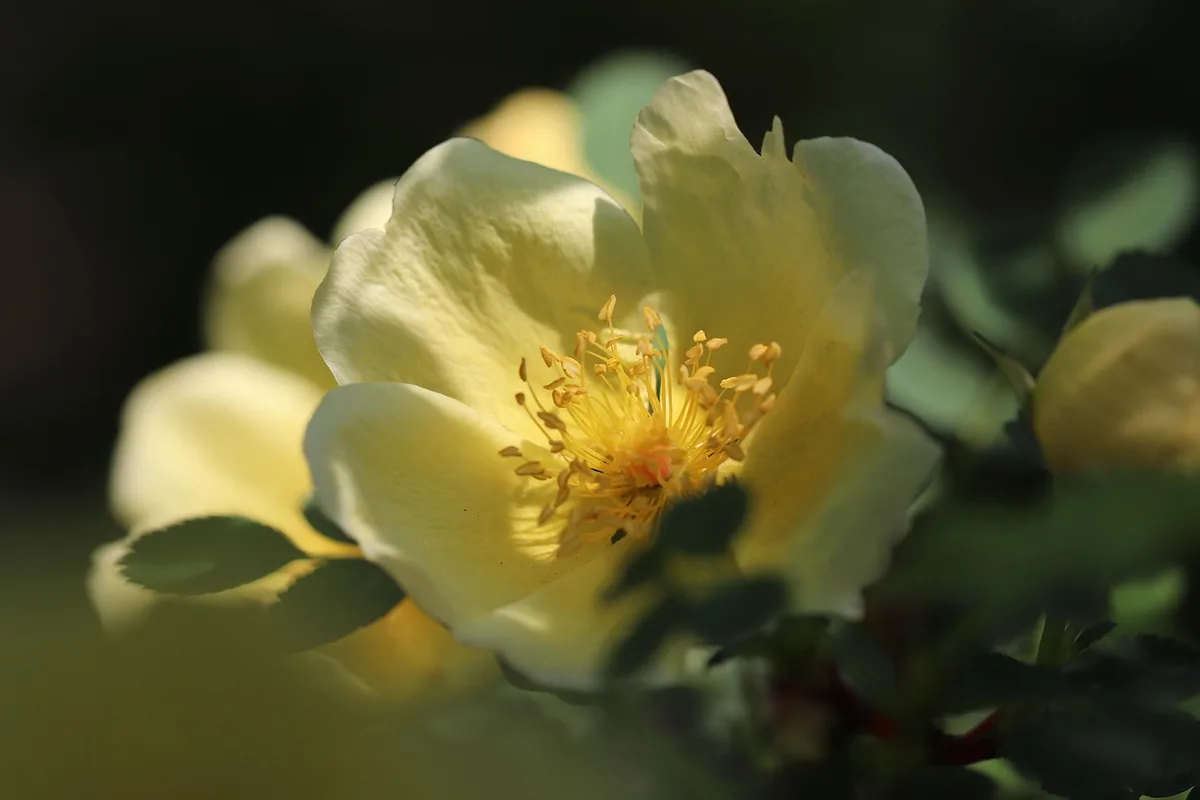
Image source: Pixabay / Nennieinszweidrei (Pixabay Content License)
If a rose bush in your garden is pushing out new leaves after being pruned, everything is working as it should. The plant has an intact root system underground. Those new leaves are powered by a mature energy base, not stored reserves in a detached stem.
Pruning triggers exactly this kind of response. When you cut back a rose stem, you remove the apical bud that was producing auxin to suppress lower buds. Once that dominant bud is gone, growth hormones redistribute and the remaining buds break dormancy.
New shoots emerge from nodes below the cut.
This is fundamentally different from a cutting trying to root. A pruned bush does not need to establish new roots. It just needs to activate the next set of buds on an already-mature root system.
This Is the Best-Case Scenario
New leaves on a pruned rose bush within one to three weeks of cutting back is exactly what you want to see. It means the plant is healthy, the roots are functional, and the pruning cuts were made correctly.
Look for firm, reddish or bright green shoots emerging from nodes just below where you cut. Basal breaks coming from the crown of the plant are especially valuable. They become the main structural canes for the next growing season.
If new leaves are small, pale, or yellowing, that can signal a nutrient deficiency or overwatering. But healthy green growth is a strong indicator that your timing and technique were on point.
What Normal Post-Prune Growth Looks Like
Healthy post-prune growth follows a predictable pattern. New shoots emerge from the uppermost remaining buds first. These shoots elongate over two to six weeks, producing compound leaves with five to seven leaflets depending on the variety.
By mid to late spring in most temperate climates, those shoots should be actively growing and beginning to set flower buds. Hybrid tea roses typically produce their first flush of blooms six to eight weeks after the main spring prune.
Dead or weak wood will not respond. If a cane shows no sign of new growth four to five weeks after pruning and the wood looks dry and brown when you scratch the bark, that cane is likely dead. Remove it by cutting back to live tissue or to the crown.
Feeding and Watering After Pruning for Strong Regrowth
Apply a balanced granular rose fertilizer within two weeks of pruning. A second application six to eight weeks later supports the first flush of blooms. Roses prefer deep, infrequent watering, aim for the equivalent of one inch of water per week in one or two sessions.
Water at the base to keep foliage dry and reduce fungal disease risk.
A two-to-three-inch layer of organic mulch around the base conserves moisture and moderates soil temperature. Keep the mulch a couple of inches away from the main canes to prevent rot. In colder climates, pruning in early spring once the last hard frost has passed gives the bush the maximum growing window.
Step by Step: How to Propagate a Rose Cutting the Right Way
This method works with cuttings taken from a living garden rose. Timing and preparation matter as much as the technique itself.
Selecting the Right Stem
Choose a stem that has just finished flowering. Cut it just below a faded bloom. The stem should be green and flexible but not overly soft.
This is called a semi-hardwood cutting. The ideal diameter is roughly pencil-thick.
Avoid stems still carrying an open flower. Those put energy into the bloom, not into rooting. Also avoid very thin, soft new growth.
It wilts too fast.
Preparing the Cutting
Cut a four-to-six-inch section using clean, sharp bypass pruners. Make the bottom cut at a 45-degree angle about a quarter inch below a node. Make the top cut straight across about a half inch above a node.
Remove all leaves from the lower half and leave two to four small leaves at the top. If the remaining leaves are large, cut them in half horizontally to reduce water loss.
Choosing Water, Soil, or a Rooting Medium
Soil or a dedicated rooting medium is far more reliable than water. A mix of equal parts perlite and peat or coir gives excellent drainage and moisture retention. Water propagation is simpler but produces roots that struggle during transplant.
Managing Light, Temperature, and Humidity
Rose cuttings root best at 65 to 75 degrees F (18 to 24 degrees C). A propagation mat providing bottom heat speeds up root initiation significantly. Light should be bright but indirect.
Enclose the pot in a clear plastic bag or humidity dome and open it every other day to prevent mold.
Transplanting Once Roots Develop
When roots are one to two inches long and you see new leaf growth, pot the cutting into a small container with standard potting mix. Water thoroughly and keep it in a sheltered spot out of direct sun for the first week. Begin feeding with diluted liquid fertilizer at quarter strength once a month.
Hardening Off and Ongoing Care
Harden off indoor or protected cuttings over seven to ten days by placing them outside for increasing lengths of time each day. Once planted, water regularly through the first season and hold off on heavy pruning until the plant has been in the ground for at least one full year.
How Water Propagation Compares to Soil Propagation
Water propagation is the easiest to set up. You drop a stem in a jar and wait. But ease of setup does not equal reliability for roses.
University extension sources consistently report better results with medium-based propagation because the medium provides oxygen at the node zone and prevents rot.
Choose water propagation if you are running a casual experiment or working from a bouquet. Choose soil or medium propagation if you want the highest chance of a viable new plant from a garden rose cutting.
When to Use Rooting Hormone, And When You Can Skip It
Rooting hormone containing IBA significantly boosts success rates for difficult-to-root varieties like many hybrid teas. For easy-to-root types such as rugosas or shrub roses, you can often get decent results without it. If you are propagating a prized or rare variety, the small investment in rooting hormone is worth the improved odds.
Mistakes That Kill Rose Cuttings Before They Root
Using dull or dirty tools introduces pathogens into the fresh wound. Letting the cutting wilt before planting, even for 10 to 15 minutes on a warm day, causes irreparable damage to the vascular tissue. And burying the cutting upside down, with the top end in the medium, guarantees failure because root formation only happens at the morphologically lower end.
How Long the Whole Process Takes: Realistic Timelines
Callus tissue usually appears in two to four weeks. Root development takes four to eight weeks for most garden rose varieties. Potting into soil and establishing the young plant adds another six to twelve weeks.
From cutting to a bush capable of surviving outdoors, budget roughly three to five months under good conditions.
Can You Propagate Patented Rose Varieties? What You Should Know
Some modern rose varieties are protected under plant patents. Propagation of patented cultivars without authorization from the patent holder is legally restricted. Patent protection typically lasts 20 years from the filing date.
Check the plant tag or the USPTO records if you are unsure whether your variety is patented before propagating.
Frequently Asked Questions
Can you grow roses from a bouquet?
Yes, but success rates are low. Most florist roses have been treated with preservatives and are not bred for rooting. If you want to try, take a fresh cutting from the healthiest stem, dip it in rooting hormone, and plant it in a perlite-and-peat mix rather than water.
How do I know if my rose cutting has roots?
Give the cutting a very gentle tug after four to six weeks. If it resists, fine root fibers are holding it in place. You can also check for white roots emerging from drainage holes if the cutting is potted.
New leaf growth alone does not confirm rooting.
Why are my rose cutting leaves turning yellow?
Yellowing leaves often signal overwatering of the medium, insufficient light, or natural energy depletion. Check that the medium drains well and the cutting receives bright indirect light. Remove any fully yellow leaves to prevent fungal issues.
What is the best time of year to take rose cuttings?
Late spring to early summer is ideal for softwood cuttings taken from stems that just finished blooming. Semi-hardwood cuttings taken in late summer or early autumn also root well. Avoid taking cuttings during dormancy or extreme heat.
Do rose cuttings need direct sunlight?
No. Direct sun will overheat and dehydrate a cutting with no roots to replace lost moisture. Bright indirect light is best.
A spot with morning sun or filtered light through a sheer curtain works well. Once roots are established, gradually increase sun exposure.
How long can a rose cutting survive in water?
A cutting may survive in water for several weeks to a couple of months. But water roots are poorly suited for soil transplant. Move the cutting into a growing medium as soon as roots reach about one inch in length.
Leaving it in water longer makes transplant shock more severe.