Few things are more alarming than walking out to your cherry tree and finding the leaves hanging limp and lifeless. Cherry tree drooping leaves can look dramatic, but the cause isn't always what you'd expect. Sometimes the tree is screaming for water.
Other times, you've given it far too much.
The good news is that most drooping issues are fixable if you catch them early and diagnose correctly. The bad news is that the wrong fix, like watering a tree that's already drowning, can finish it off faster than the original problem. Let's walk through exactly what's going on and how to get your tree back on track.
Quick Answer
Cherry tree drooping leaves usually signal a water issue. The tree is either getting too much or too little. Heat stress can also cause temporary afternoon wilt in otherwise healthy trees.
Disease and root rot are less common but more serious causes. Check your soil moisture first. That single step rules out most possibilities.
The 5 Most Common Causes of Drooping Leaves on Cherry Trees
Drooping leaves are a symptom, not a diagnosis. The same limp, downward-hanging foliage can point to five very different problems.
1. Underwatering or Drought Stress
This is the first thing most people assume, and sometimes they're right. Cherry trees have shallow root systems relative to their canopy size, so they dry out fast during hot spells. Leaves go limp because there isn't enough water pressure inside the cells to hold them rigid.
That pressure is called turgor, and it's the simplest explanation for wilting.
2. Overwatering and Poor Drainage
Here's the trap. Overwatering produces nearly identical symptoms to underwatering because waterlogged roots can't absorb oxygen. They suffocate and stop functioning, which means the canopy effectively droughts out even though the soil is saturated.
If your tree is in heavy clay or a low spot that pools after rain, this is the likely culprit.
3. Heat Stress
On hot days, cherry trees sometimes wilt in the early afternoon and perk back up by evening. This is a normal protective response. The leaves lose water through transpiration faster than the roots can replace it.
If your tree recovers overnight and the leaves look crisp again in the morning, heat stress is the answer, not a crisis.
4. Transplant Shock
Newly planted cherry trees almost always droop for a few weeks after going in the ground. The root system is still establishing and can't yet support the full canopy. This is especially common in the first growing season and in trees planted during warm weather.
5. Disease (Root Rot, Verticillium Wilt, Bacterial Canker)
If drooping is accompanied by leaf discoloration, branch dieback, bark oozing, or a failure to recover overnight, you're likely dealing with a pathogen. Phytophthora root rot, Verticillium wilt, and bacterial canker (Pseudomonas syringae) are the three biggest threats to cherry trees specifically.
Image source: Pixabay / manseok_Kim (Pixabay Content License)
How to Check If Your Cherry Tree Is Overwatered or Underwatered
Before you change anything, you need to know what's actually happening in the soil. Guessing is what kills more cherry trees than the problems themselves.
Here's a simple diagnostic process you can do in about ten minutes with no special tools.
Step 1: Check the Time of Day
Look at the tree in the early morning. If the leaves are still limp after a cool night, you're dealing with something beyond simple heat stress. Morning wilt points to root damage, disease, or chronic overwatering.
Step 2: Test Soil Moisture at Root Depth
Stick your finger or a soil probe 3 to 4 inches into the soil around the drip line of the tree (the area under the outer edge of the canopy). The soil should feel cool and slightly moist, like a wrung-out sponge. If it's bone dry, underwatering is the issue.
If it's soggy or water drips out when you squeeze a handful, you've got a drainage or overwatering problem.
Step 3: Do a Drainage Check
If the soil feels waterlogged, dig a small hole about 12 inches deep near the tree and fill it with water. Time how long it takes to drain. A healthy planting site drains at 1 to 3 inches per hour.
If the water sits for more than 6 hours, you have a compaction or clay issue that's suffocating the roots.
Step 4: Inspect the Roots (If Practical)
For newly planted trees or container-grown specimens, gently examine the root ball. Healthy roots are white or light tan and firm. Rotted roots are dark brown or black, mushy, and often have a sour smell.
If you find rot, you need to address drainage immediately and consider whether the tree can be saved.
Image source: Pixabay / Ralphs_Fotos (Pixabay Content License)
Heat Stress vs. Root Rot: How to Tell the Difference
These two causes get confused constantly because both produce wilting that seems to come out of nowhere. But the timeline and the recovery pattern are completely different.
Heat stress follows the sun. Leaves droop in the early to mid-afternoon on hot days (usually above 85 degrees Fahrenheit). They firm back up in the evening or early morning.
The leaves stay green and crisp. It looks bad at 2 PM but perfectly fine at 7 AM. A mature cherry tree with good root health can lose significant turgor on a 95-degree day and completely recover overnight without any intervention.
Root rot doesn't follow a daily cycle. The drooping is progressive. It starts on one section of the canopy, maybe a single branch, and spreads over days or weeks.
The leaves often turn yellow or develop brown edges before they wilt. They do not perk up overnight. Pull back the mulch at the base of the tree and check the soil; if it smells sour or looks gray and anaerobic, the roots are in trouble.
Here's a quick comparison:
| Symptom | Heat Stress | Root Rot |
|---|---|---|
| Time of day drooping appears | Afternoon, especially midday | Any time, persistent |
| Recovery overnight | Yes, full recovery | No significant recovery |
| Leaf color | Stays green | Yellowing, browning edges |
| Affected area | Entire canopy evenly | Starts on one branch/section |
| Soil condition | May be dry or normal | Often waterlogged or compacted |
| Smell at root zone | None | Sour or musty odor |
| Tree age affected | Any age, especially young | Any age, worse in poor drainage |
Image source: iNaturalist / Tony Rebelo (CC BY-SA)
If you check your tree at 6 AM and the leaves are still drooping, skip straight to the root and soil inspection. Heat stress is off the list. You're looking at either watering problems or disease, and those need different responses.
Step-by-Step: What to Do When You First Notice Drooping Leaves
Don't panic. Go through this sequence in order, and you'll either fix the problem or know exactly what help you need.
1. Observe the pattern first. Check the tree at dawn and again in the late afternoon. Note which leaves are affected, whether the whole canopy is involved, and if other trees or plants nearby show similar symptoms.
2. Test the soil moisture at 3 to 4 inches deep. This is the single most important diagnostic step. Dry means increase watering frequency.
Soggy means stop watering and investigate drainage.
3. Check your recent watering and rain history. Have you watered in the last 48 hours? Has it rained heavily this week?
Are you on an automatic schedule that might be running too often? Cherry trees planted in clay soil may only need water every 7 to 10 days, even in summer.
4. Inspect the trunk and major branches. Look for oozing sap, sunken bark, dark streaks under the bark, or fungal growth at the base. Any of these findings shifts the diagnosis from a watering issue to a disease issue.
5. Correct water practices based on what you found. If the soil is dry, give the tree a slow, deep soak, water reaching 12 to 18 inches down, and mulch 2 to 4 inches deep around the root zone to conserve moisture. If the soil is wet, stop watering entirely for at least a week.
Consider aerating the soil with a broadfork rather than a shovel to avoid further root damage.
6. Wait and reassess in 3 to 5 days. Trees don't bounce back overnight from water stress. Give it several days of corrected conditions before judging whether your intervention is working.
7. Call in an expert if things get worse. If more branches wilt, the canopy starts thinning, or you see signs of disease you can't identify, contact your local university extension office. They can test soil and tissue samples and give you a specific diagnosis rather than a guess.
Soil, Drainage, and Mulching: The Foundation of Cherry Tree Health
Most cherry tree problems start underground. Get the soil and drainage right, and you'll prevent the majority of drooping issues before they ever show up in the canopy.
Cherry trees prefer loamy, well-drained soil with a pH between 6.0 and 7.0. Heavy clay holds too much water and compacts easily, which crushes the air spaces roots need to breathe. Sandy soil drains too fast and won't hold enough moisture between waterings.
If you're planting a new tree, amend the planting area with compost to improve both structure and nutrient content.
For existing trees in clay soil, you can't swap out the ground, but you can improve it over time. Top-dress the root zone with a thin layer of compost each spring. Avoid driving or parking near the tree because compaction around the root zone is one of the most common silent killers of backyard cherry trees.
Mulching is your best tool for moisture control, but only if you do it right. Apply 2 to 4 inches of organic mulch (shredded bark, wood chips, or straw) in a wide ring around the tree. Keep the mulch at least 3 to 6 inches away from the trunk itself.
Piling mulch against the bark ("volcano mulching") traps moisture against the trunk and invites fungal disease and bark rot.
Mulch does three things well. It reduces evaporation from the soil surface. It moderates soil temperature, keeping roots cooler in summer.
It suppresses grass and weeds that would otherwise compete with the tree for water and nutrients. Replace or refresh mulch once a year as it breaks down.
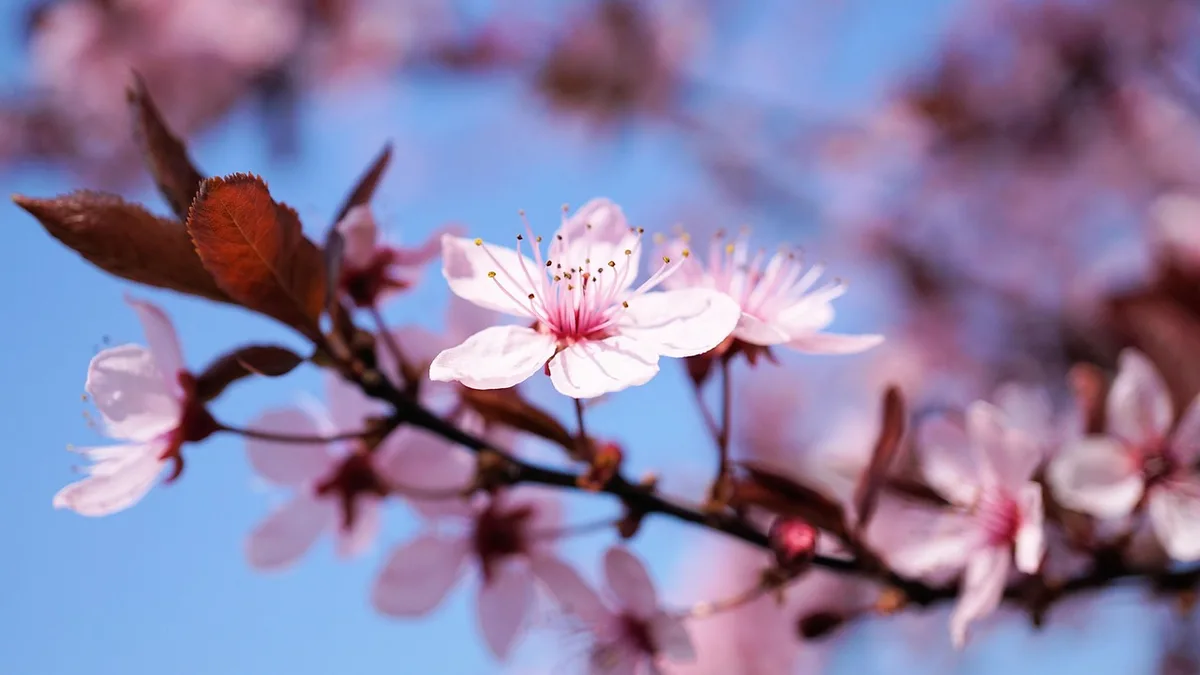
Image source: Pixabay / webandi (Pixabay Content License)
If drainage is already poor, consider creating a gentle slope away from the tree base or installing a French drain to redirect standing water. For container-grown cherry trees, make sure the pot has adequate drainage holes and use a well-draining potting mix rather than garden soil, which compacts in containers.
When Drooping Leaves Signal Disease (and What to Look For)
If you've ruled out water and heat issues, it's time to consider disease. Cherry trees are susceptible to several pathogens that cause wilting, and catching them early makes a real difference in outcomes.
Phytophthora Root Rot
This is the most common root disease in cherry trees planted in poorly drained soil. The Phytophthora fungus attacks the roots, causing them to decay and lose function. Above ground, the canopy wilts progressively, leaves turn yellow or reddish, and the tree declines over weeks or months.
Cut into an affected root and you'll see dark brown or black discoloration instead of healthy white tissue. There is no cure once the infection is advanced. Improving drainage and applying a phosphite-based fungicide to the soil can slow progression in early cases.
Verticillium Wilt
This soil-borne fungus enters through the roots and clogs the tree's vascular system. The hallmark sign is wilting on one side of the tree or a single branch while the rest looks healthy. Cut into an affected branch and you may see dark streaking in the wood beneath the bark.
Verticillium is difficult to manage once established. Removing affected branches and maintaining overall tree vigor through proper watering and fertilization is the standard recommendation from university extension programs.
Bacterial Canker (Pseudomonas syringae)
This disease causes sunken, oozing lesions on the bark of branches and the trunk. Leaves on affected branches wilt and turn brown, often during cool, wet spring weather. You may notice amber-colored gum oozing from the cankers, which is a classic sign in stone fruit trees.
Prune out affected branches during dry weather, cutting at least 6 inches below visible symptoms. Sterilize your pruning tools with a 10% bleach solution or 70% isopropyl alcohol between every cut to avoid spreading the bacteria.
Cherry Leaf Spot (Blumeriella jaapii)
This fungal disease primarily affects leaves rather than causing true wilting, but it's worth mentioning because heavy infections lead to premature leaf drop that can look like general decline. Look for small purple or brown spots on the upper leaf surface, sometimes with a white spore mass in the center. Raking and removing fallen leaves in autumn reduces the source of next year's infection.
Transplant Shock in Newly Planted Cherry Trees
If your cherry tree went in the ground within the last 12 months and the leaves are drooping, transplant shock is a strong possibility. This is especially true for trees planted in spring or early summer when temperatures climb before the roots have had time to establish.
Transplant shock happens because the tree lost a significant portion of its root system during digging and planting. The remaining roots can't supply enough water to support the full canopy, so the leaves wilt even when the soil is adequately moist. It's a temporary imbalance, not a death sentence.
The best thing you can do is keep the soil consistently moist (not soggy) for the first two growing seasons. Water deeply once or twice a week during dry weather, aiming for that 12 to 18 inch penetration depth. Mulch heavily to reduce evaporation.
Avoid fertilizing a newly planted tree for at least the first year because fertilizer salts can stress damaged roots further.
Some leaf drop is normal during transplant shock. If the branches are still flexible and the buds look plump, the tree is alive and working on root recovery. Scratch a small section of bark on a twig with your thumbnail.
Green tissue underneath means that branch is still viable. Brown and dry means that section has died back.
Most cherry trees recover fully from transplant shock by the second growing season if water and mulch are managed well. If a tree shows no new growth by mid-summer of its second year, the root system may have failed, and replacement is usually more practical than continued rescue attempts.
Cherry Tree Drooping Leaves: Decision Guide by Symptom
Use this quick-reference guide to match what you're seeing with the most likely cause and the right response.
Leaves droop in the afternoon, recover by morning
Likely cause: Heat stress. Action: No intervention needed. Ensure the tree has adequate mulch.
If the tree is young or newly planted, consider temporary shade cloth during extreme heat waves.
Leaves droop persistently, soil is dry 3+ inches down
Likely cause: Underwatering or drought stress. Action: Deep soak the root zone. Increase watering frequency to twice per week during hot, dry periods.
Apply mulch if not already present.
Leaves droop persistently, soil is wet or soggy
Likely cause: Overwatering or poor drainage. Action: Stop watering immediately. Check drainage with a percolation test.
If drainage is poor, aerate the soil and consider long-term grading or drainage solutions.
Leaves droop on one side or one branch only
Likely cause: Verticillium wilt, bacterial canker, or branch-specific damage. Action: Inspect the affected branch for bark lesions, oozing, or dark streaking in the wood. Prune affected branches with sterilized tools.
Submit a sample to your local extension office if the cause is unclear.
Leaves droop with yellowing, browning edges, or premature drop
Likely cause: Root rot, nutrient deficiency, or fungal disease. Action: Check root health and soil drainage. Rake and dispose of fallen leaves.
Consider a soil test to check pH and nutrient levels.
Newly planted tree drooping within weeks of planting
Likely cause: Transplant shock. Action: Maintain consistent soil moisture. Mulch well.
Do not fertilize. Monitor for new growth over the next several weeks.
Leaves droop with visible spots, oozing bark, or fungal growth at the base
Likely cause: Bacterial canker, Phytophthora, or other pathogen. Action: Prune affected areas with sterilized tools. Improve air circulation and drainage.
Contact your local university extension service for lab diagnosis if the problem spreads.
Common Mistakes That Make Drooping Worse
Even well-meaning gardeners can push a struggling cherry tree past the point of recovery. Here are the errors that show up most often.
Watering more because the leaves are wilted. This is the big one. If the soil is already wet, adding more water accelerates root rot. Always check soil moisture before reaching for the hose.
Fertilizing a stressed tree. Fertilizer forces new growth, which demands more water and energy from a root system that's already struggling. Hold off on any fertilization until the tree has fully recovered and is pushing healthy new growth.
Planting too deep. If the root flare (where the trunk widens at the base) is buried under soil or mulch, the trunk stays constantly wet and becomes vulnerable to rot and disease. The root flare should be visible at the soil surface. If it's buried, carefully remove excess soil and mulch.
Over-mulching or volcano mulching. More than 4 inches of mulch, or mulch piled against the trunk, creates a moist environment that invites fungal pathogens and can girdle the trunk over time. Keep mulch shallow and pulled back from the bark.
Ignoring drainage problems. If water pools around your tree after every rain, no amount of adjusted watering will fix the underlying issue. Poor drainage is a structural problem that needs a structural solution, whether that's regrading, adding organic matter, or installing drainage.
Pruning during wet weather. Wet conditions spread bacterial and fungal pathogens through open pruning cuts. Always prune cherry trees during dry weather, and always sterilize your tools between cuts, especially if disease is suspected.
When to Call an Arborist or Extension Expert
Most drooping leaf issues are manageable on your own, but there are situations where professional help is the smart move.
Call a certified arborist if more than a third of the canopy is affected and you can't identify the cause after checking soil moisture, drainage, and visible disease signs. Also call if the tree is large enough that pruning requires working at height. That's not a DIY job.
Your local university extension office is a free or low-cost resource that many gardeners overlook. They can test soil samples, identify pathogens from leaf or bark specimens, and give you region-specific advice. In the US, every state has a land-grant university with an extension service.
In the UK, the Royal Horticultural Society offers similar guidance.
Seek professional input quickly if you notice rapid decline, sudden large-branch dieback, or if multiple trees on your property show similar symptoms at the same time. A spreading pathogen or soil-borne disease can affect every tree in the area, and early intervention is the only thing that stops it.
Frequently Asked Questions
Can a cherry tree recover from drooping leaves?
Yes, in most cases. If the cause is underwatering, heat stress, or transplant shock, the tree will bounce back once conditions improve. Recovery from root rot or disease depends on how much of the root system is still functional.
Early detection gives you the best chance.
How often should I water a cherry tree with drooping leaves?
Water deeply once or twice a week during dry weather, letting the water penetrate 12 to 18 inches into the soil. The exact frequency depends on your soil type and weather. Always check moisture at root depth before watering.
Soggy soil means you need to water less, not more.
Should I prune drooping branches off my cherry tree?
Not immediately. Pruning a stressed tree adds more stress. First, correct the underlying issue (water, drainage, disease).
If a branch doesn't produce new leaves by mid-summer, then remove it. Always prune during dry weather and sterilize your tools between cuts.
Is drooping normal for cherry trees in summer?
Some afternoon wilt during extreme heat is normal and not a cause for concern. If the leaves recover by morning, the tree is fine. Persistent drooping that doesn't improve overnight points to a root or soil problem that needs attention.
What does root rot look like on a cherry tree?
Above ground, root rot looks like progressive wilting, yellowing leaves, and canopy thinning that doesn't respond to watering. Below ground, affected roots are dark brown or black, mushy, and may smell sour. The soil around the roots is often waterlogged or compacted.
Can overwatering cause drooping leaves?
Absolutely. Overwatering is one of the most common causes of drooping leaves on cherry trees. Waterlogged soil suffocates the roots, which stops them from absorbing water and nutrients.
The canopy wilts even though the soil is wet. Check your soil moisture before adding more water.