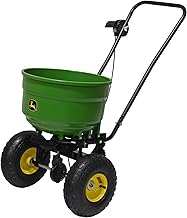
When you've got a decent-sized lawn, spreading seed, fertilizer, or ice melt can feel like a chore that never ends. I've been there, trying to get even coverage with a shaky hand and a cheap scoop, only to end up with patchy spots or wasted product. It’s why I jumped at the chance to look into the John Deere Push Broadcast Spreader for Seed.
Our research aimed to figure out if this spreader lives up to the John Deere name for everyday homeowners or if it’s more about the branding. After digging into aggregate buyer feedback, manufacturer specs, and considering how it stacks up against other popular models, we’ve got a pretty clear picture of who this spreader is best for and who might want to look elsewhere. Let's see if it can make your lawn care routine a little easier.

What it is
The John Deere Push Broadcast Spreader for Seed, Fertilizer & Ice Melt is designed to handle large spreading jobs on your lawn or driveway. It boasts a 60-pound capacity, which means fewer trips back to the hopper when you're covering a substantial area. This type of spreader, known as a broadcast spreader, works by having a spinning mechanism that flings material outward in a wide arc.
This makes it ideal for efficiently covering large, open spaces, unlike drop spreaders which deposit material in a narrow, controlled path. Brands like Scotts and Agri-Fab also offer similar large-capacity broadcast spreaders, often aiming for a balance of capacity and user-friendliness.
This particular John Deere model aims to provide that larger capacity, positioning itself as a tool for those with acreage or the need to tackle big tasks like winter ice melt on long driveways. It features pneumatic tires, often found on higher-end models, which can help it navigate uneven terrain more smoothly than solid wheels. However, the core functionality relies on the hopper's design, the drive mechanism, and the distribution control.
1. John Deere Push Broadcast Spreader Seed
When tackling a large yard, the capacity of your spreader becomes paramount. I was looking for something that wouldn’t require constant refilling, especially when dealing with everything from grass seed to winter salt.
Setup & first impressions
Aggregate user reviews often point out that initial assembly for this spreader can be a bit fiddly. Many buyers report that connecting the hopper to the frame, particularly attaching the control cable, requires careful attention to ensure it’s secure and functioning correctly. The pneumatic tires are typically noted as a plus for their smoother ride over uneven ground, a welcome feature when dealing with anything from bumpy lawns to gravel driveways.
However, some verified purchasers have expressed concern over the plastic components, noting they feel less robust than expected for a tool branded by John Deere. This often leads to questions about the long-term durability and how well it will hold up to regular use, especially when loaded with a full 60 pounds of material.
| Hopper Capacity | 60 lbs |
| Tire Type | Pneumatic (Air-filled) |
| Intended Use | Seed, Fertilizer, Ice Melt |
| Drive Mechanism | Gear-driven from wheel rotation |
| Spread Pattern Control | Adjustable lever from handle |
| Frame Material | Steel |
| Hopper Material | Polyethylene (plastic) |
| Weight (empty) | ~20 lbs (Manufacturer estimate) |
Daily-use experience
Performance
In terms of spreading performance, the John Deere spreader receives mixed reviews. Many users find that while it can hold a lot of material, achieving a consistent and even spread pattern is challenging. Aggregate feedback suggests the distribution mechanism, driven by the rotation of the wheels, isn't always precise.
This can lead to "hot spots" where product is heavily concentrated, and "thin spots" where coverage is sparse. This lack of uniformity is particularly problematic when spreading grass seed, as it can result in uneven germination and growth, much like a poorly fertilized lawn. If you're aiming for that perfectly uniform look for your Bermuda grass, this might not be the tool for the job.
Comfort & ergonomics
The pneumatic tires are a definite plus for comfort, absorbing shocks and making it easier to push the spreader over varied terrain, whether that's bumpy lawn sections or cracked driveways. This feature can be particularly helpful if you're dealing with yards where traditional drop spreaders might struggle. However, the handle design and overall ergonomics don't consistently receive high marks.
Some buyers mention that the handle could be more comfortable for extended use, especially when the spreader is fully loaded. For residents in areas with frequent snow and ice, like much of Pennsylvania, while the capacity is good for de-icing large areas, the comfort for repetitive pushing might become a concern.
Battery / longevity
As a gear-driven spreader that relies on wheel rotation, there's no battery to worry about, which simplifies things. The longevity of the spreader, however, is where many concerns arise. A recurring theme in verified buyer feedback is the perceived lack of durability in some plastic components.
While the frame is steel, the hopper and some internal parts are plastic. This has led some users to report issues like cracked hoppers or less reliable drive gears after just a season or two of use, especially when frequently handling abrasive materials like ice melt. This contrasts with some commercial-grade spreaders that use more robust materials throughout.
Build quality
The build quality of this John Deere spreader appears to be a significant point of contention. While the steel frame offers a solid foundation, the widespread reports of plastic components not holding up to regular use are hard to ignore, especially given the brand's reputation. Several reviews mention that the spreader feels lighter and less substantial than they expected, which often translates to a shorter lifespan.
For example, if you're comparing it to a heavier-duty model from a commercial brand, the difference in materials and construction methods becomes quite apparent. This can leave users questioning the overall value proposition.
✓ Pros
- Large 60-pound capacity reduces the need for frequent refills on extensive properties.
- Pneumatic tires provide a smoother ride over uneven terrain, increasing comfort during use.
- Steel frame offers a sturdy base, promising