You walked out to the garden this morning and your watermelon vine is wilting, yellowing, or collapsing. Now you need to know how to save a dying watermelon plant before you lose the whole thing. The fix depends entirely on what's causing the decline, and guessing wrong can kill it faster.
Watermelons need 1 to 2 inches of water per week, temperatures between 70 and 85°F, and well-drained soil with a pH of 6.0 to 6.8. When any of those conditions go sideways, the plant tells you. You just have to read the signs.
Image source: Pixabay / stevepb (Pixabay Content License)
Quick Answer
Check the soil moisture first. If it's soggy, stop watering and improve drainage. If the soil is bone dry, water deeply.
Look for pests like squash vine borers or powdery mildew on leaves. Treat the specific problem you find. If the stem is mushy or roots are brown and rotten, the plant may not survive.
The 30-Second Diagnosis: What's Actually Killing It
Before you grab the hose or spray anything, take a close look at your plant. The symptoms point to very different problems, and the treatment for one can make another worse.
Here's a quick reference to match symptoms to causes:
| Symptom | Likely Cause | What to Check Next |
|---|---|---|
| Wilting in midday, perks up by evening | Underwatering or heat stress | Soil moisture 2 inches down |
| Yellow lower leaves, soggy soil | Overwatering / root rot | Root color and smell |
| Sudden vine collapse, holes in stem | Squash vine borer | Sawdust-like frass at base |
| White powder on leaves | Powdery mildew | Underside of leaves |
| One-sided wilting, no soil issue | Fusarium or bacterial wilt | Stem splitting, oozing |
| Yellow leaves with green veins | Nutrient deficiency (Mg, N, K) | Soil test or fertilizer history |
The crown and roots tell the real story. If the base of the stem is soft, mushy, or oozing, you're dealing with a serious fungal problem. If the roots are brown and smell sour, root rot has set in.
But if the crown is still firm and roots look white or tan, there's a good chance you can bring it back.
Branch 1: Wilting, Yellow Leaves, and Soggy Soil — Overwatering and Root Rot
This is the number one reason watermelon plants die in home gardens. Most people see wilting and assume the plant needs water. They water more.
The roots, already drowning, rot even faster.
Overwatering deprives roots of oxygen. Once root rot sets in (usually from Pythium or Phytophthora fungi), the roots can't take up water anymore. The plant wilts even though the soil is wet.
It's a cruel trick.
How to confirm it
Push your finger 2 to 3 inches into the soil near the base. If it feels wet or muddy, overwatering is your problem. Gently dig around the root zone.
Healthy roots are white or light tan. Rotten roots are brown, soft, and smell bad.

Image source: Pixabay / adege (Pixabay Content License)
What to do right now
- Stop watering immediately. Let the top 2 to 3 inches of soil dry out before you even think about adding more water.
- Improve drainage. If your soil is heavy clay, gently loosen the surface around the plant with a hand fork. Don't damage healthy roots.
- Pull back any mulch that's holding moisture right against the stem. Mulch is great, but piled against the crown traps moisture and invites rot.
- If root rot is advanced, trim away the worst-affected roots with sanitized scissors. Dust the remaining roots with cinnamon or a thin layer of sulfur powder. Both have antifungal properties.
- Water only when the top inch of soil feels dry. Going forward, aim for deep, infrequent watering rather than light daily sprinkles.
When it's too late
If more than half the root system is brown and mushy, and the stem base is soft, the plant likely won't recover. Pull it out. Compost it only if your pile reaches at least 140°F.
Otherwise, bag it and toss it to avoid spreading the fungus to other plants.
Branch 2: Wilting in Midday Heat but Fine by Evening — Underwatering or Heat Stress
If your watermelon perks up in the evening or early morning but droops during the hottest part of the day, underwatering is the likely culprit. This is especially common in containers, sandy soil, or during heat waves above 95°F.
Watermelons have large leaves with a lot of surface area. They lose water fast through transpiration when temperatures climb. A single hot, windy day can drop a plant from healthy to wilted.
How to confirm it
Check the soil 2 to 3 inches down. If it's dry and crumbly, the plant needs water. Also check whether the wilting improves after sunset.
Underwatered plants recover quickly once temperatures drop.
What to do right now
- Water deeply at the base, not overhead. Give the plant a slow, thorough soaking so moisture reaches 6 to 8 inches deep.
- Apply 2 to 3 inches of mulch around the plant, keeping it 3 inches away from the stem. Straw or shredded leaves work well. This slows evaporation and keeps roots cool.
- If temperatures exceed 95°F, consider adding 30% shade cloth during the afternoon hours. Watermelons love sun, but extreme heat stresses even healthy plants.
- Water early in the morning so the plant is fully hydrated before the heat of the day hits.
Going forward
Watermelons need consistent moisture, especially once fruit is setting. Irregular watering causes blossom end rot and cracked fruit. Drip irrigation or a soaker hose on a timer is the most reliable way to keep soil evenly moist without overdoing it.
Branch 3: Sudden Vine Collapse with Holes or Sawdust — Squash Vine Borer
This one's heartbreaking. One day the plant looks fine. The next day, an entire vine collapses with no warning.
If you see small holes near the base of the stem and what looks like sawdust (technically frass), you've got squash vine borers.
The adult moth lays eggs at the base of the stem in late spring to early summer. The larvae bore into the stem and eat it from the inside out. By the time you see wilting, the damage is already severe.
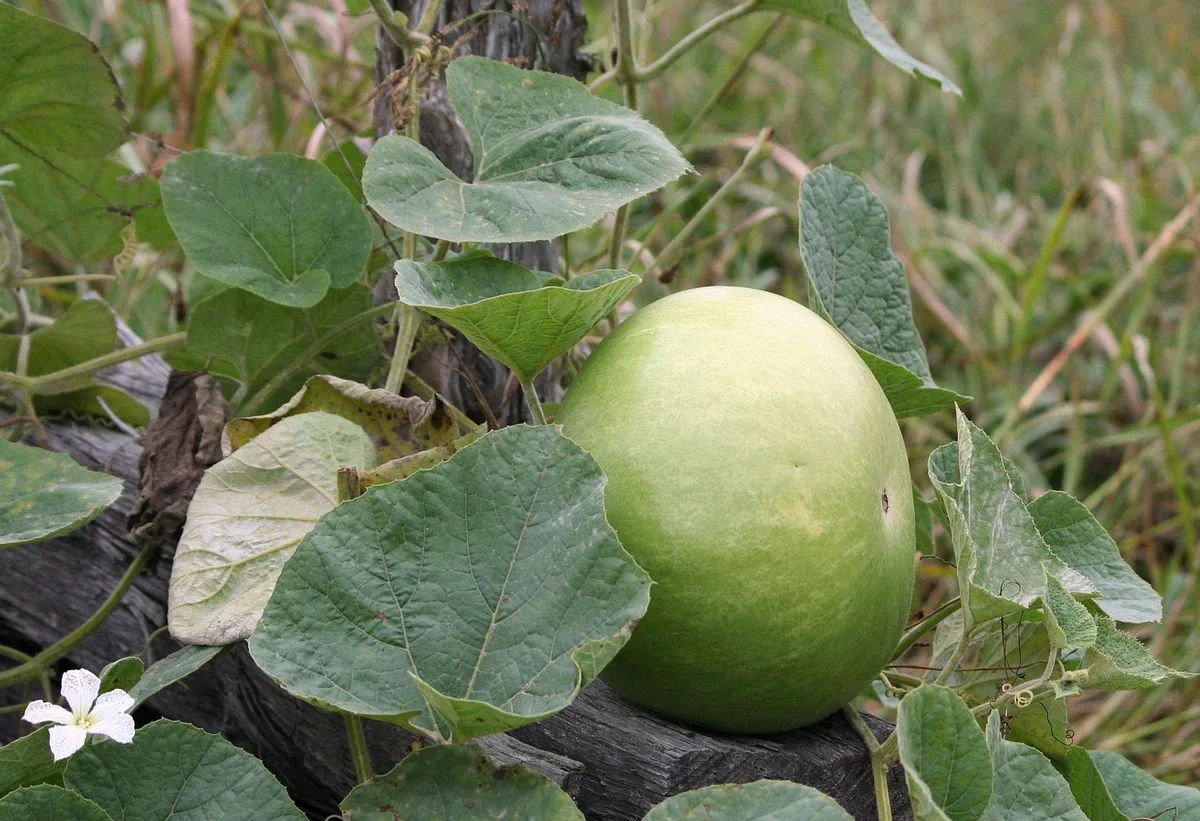
Image source: Pixabay / JamesDeMers (Pixabay Content License)
How to confirm it
Look for entry holes near the base of the stem, usually within a few inches of the soil line. The frass looks like wet, orange-green sawdust. If you carefully slit the stem open, you'll find a pale, inch-long caterpillar inside.
What to do right now
- Try surgery. With a sharp, clean blade, slit the stem lengthwise where you see the borer. Remove the caterpillar. Bury the damaged section under 3 to 4 inches of moist soil. Water it well. The plant may reroot from that buried section.
- Inject with Bt (Bacillus thuringiensis var. kurstaki) using a syringe into the entry hole. This kills the larvae without harming beneficial insects.
- Spray the stem base with neem oil or spinosad every 7 days to kill newly hatched larvae before they bore in. Focus on the lower 6 inches of stem.
Prevention for next season
- Wrap the base of the stem with aluminum foil or nylon stocking at planting time. This blocks egg-laying.
- Plant resistant varieties like 'Royal Sweet' or 'Crimson Sweet' which have some tolerance.
- Use floating row covers until flowering begins. Remove them when flowers appear so pollinators can do their job.
- Plant a second crop in early July to avoid peak borer season entirely.
Branch 4: White Powdery Coating on Leaves — Powdery Mildew or Downy Mildew
If you see a white or gray powdery coating on the leaves, you're dealing with a fungal disease. Powdery mildew is the most common on watermelons. It thrives in warm days, cool nights, and high humidity, especially when leaves stay wet overnight.
The fungus spreads fast. Left untreated, it covers the entire leaf surface, blocks photosynthesis, and the plant weakens. Fruit ripens poorly or not at all.

Image source: Pixabay / mkupiec7 (Pixabay Content License)
How to confirm it
Powdery mildew starts as small white spots on older leaves first. It spreads to cover the leaf surface with a powdery white film. Downy mildew, by contrast, shows as yellow patches on the top of leaves with gray-purple fuzz underneath.
What to do right now
- Remove the worst-affected leaves. Clip them off at the base and bag them. Don't compost them.
- Spray with neem oil (mixed per label instructions) every 7 to 10 days. Neem works as both a fungicide and a mild insecticide.
- Try a baking soda spray. Mix 1 tablespoon baking soda, 1 teaspoon liquid soap, and 1 gallon of water. Spray thoroughly on all leaf surfaces. This changes the leaf surface pH and inhibits fungal growth.
- For severe cases, use a copper-based fungicide or a biological fungicide containing Bacillus subtilis. Follow the label exactly, especially the pre-harvest interval if you have fruit developing.
Going forward
- Water at the base only. Overhead watering wets the leaves and creates ideal conditions for fungal growth.
- Space plants properly. Good airflow between vines helps leaves dry quickly after rain or dew.
- Choose resistant varieties like 'Sugar Baby' or 'Charleston Gray' which have better mildew tolerance.
Branch 5: Yellowing Leaves with Green Veins or Stunted Growth — Nutrient Deficiency
If your watermelon's leaves are yellow but the veins stay green, you're likely looking at a magnesium deficiency. If the yellowing starts on older, lower leaves and moves up, it could be nitrogen. Yellow leaf edges that turn brown often point to potassium shortage.
Watermelons are heavy feeders. They pull a lot of nutrients out of the soil during a single growing season, especially once fruit starts developing. If you haven't fertilized at all, or if your soil was never tested, deficiencies show up fast.
How to confirm it
- Magnesium deficiency: Yellowing between leaf veins on older leaves. Sometimes the edges curl upward.
- Nitrogen deficiency: Uniform pale yellow on older leaves. Plant looks thin and weak overall.
- Potassium deficiency: Leaf edges turn brown and crispy. Fruit may be small or misshapen.
A soil test from your local cooperative extension service gives you the definitive answer. It costs around $15 to $20 and tells you exactly what your soil has and what it's missing.
What to do right now
- For magnesium: Dissolve 1 tablespoon Epsom salt in 1 gallon of water. Spray on leaves in the evening. Repeat weekly for 3 weeks.
- For nitrogen: Side-dress with a balanced fertilizer like 10-10-10, about 2 tablespoons per plant, scratched into the soil 6 inches from the stem. Water it in well.
- For potassium: Apply sulfate of potash at 2 to 3 tablespoons per plant, or use a liquid seaweed foliar spray.
- General feeding: Compost tea watered in around the base gives a gentle, broad-spectrum nutrient boost. It won't fix a severe deficiency overnight, but it supports recovery.
A word of caution
Don't over-fertilize trying to fix the problem fast. Too much nitrogen burns roots and pushes leafy growth at the expense of fruit. Follow label rates.
More is not better.