Determining the right amount of grass seed per acre is crucial for a healthy, dense lawn. This guide breaks down the essential factors, from grass type to climate, to help you calculate the optimal seeding rate. Get the exact lbs of grass seed per acre you need for your specific lawn project and achieve professional results.
How Many Lbs of Grass Seed per Acre
Welcome to your ultimate guide on determining the correct amount of grass seed for your lawn! So, you’re wondering, “How many lbs of grass seed per acre do I need?” It’s a common and important question for anyone looking to establish a new lawn, overseed an existing one, or repair bare patches. Getting this right is the first step towards a lush, healthy, and beautiful green space.
Using too little seed can result in a thin, weedy lawn that struggles to establish. On the other hand, using too much seed is wasteful, can lead to unhealthy competition among seedlings, and may even encourage disease. This guide will equip you with all the knowledge you need to confidently calculate the right pounds of grass seed per acre for your specific needs. We’ll cover everything from understanding different grass types to accounting for your local climate.
- Seed Density is Key: The primary factor is the desired density of your turf, usually measured in seeds per square inch. This translates directly to pounds per acre.
- Grass Type Matters: Different grass species have vastly different seed sizes and germination rates, influencing the pounds of seed needed per acre. Fine-bladed grasses often require more seed than coarser varieties.
- Your Climate Plays a Role: Environmental conditions like temperature, rainfall, and soil type can affect germination and establishment, potentially requiring adjustments to your seeding rate.
- Seed Quality Impacts Needs: High-quality seed with a high germination rate means you’ll need fewer pounds per acre compared to lower-quality seed. Always check the seed tag.
- New Lawn vs. Overseeding: Establishing a brand-new lawn generally requires more seed per acre than overseeding an existing one to fill in thin spots.
- Application Method Influences Rate: The method you use to spread the seed can affect how evenly it’s distributed, sometimes necessitating a slightly higher rate to compensate for potential gaps.
Understanding the Basics: Why Seed Rate Matters
The amount of grass seed you need is measured in pounds per acre (lbs/acre). This rate isn’t arbitrary; it’s based on scientific principles and practical experience. The goal is to achieve a density of grass plants that provides a thick, resilient turf. This density is often expressed in terms of seeds per square inch.
Seed Count vs. Seed Weight
It might seem strange, but sometimes seed manufacturers will list their recommendations in seeds per square foot or even seeds per square inch. This is because seed sizes vary dramatically between grass types. A pound of tiny fescue seeds will contain far more individual seeds than a pound of larger ryegrass seeds. Therefore, to achieve the same plant density, you’ll need a different weight of seed depending on the species.
The Role of Germination Rate
Another critical factor is the germination rate of the seed. This is the percentage of seeds in the bag that are viable and expected to sprout. A high-quality seed mix with a 90% germination rate will perform better than a lower-quality mix with only 70%. This means you can achieve the desired plant density with fewer pounds of seed if the germination rate is high.
Factors Influencing Your Seeding Rate
Visual guide about How Many Lbs of Grass Seed per Acre
Image source: shuncy.com
Several key factors will dictate exactly how many pounds of grass seed you’ll need for your acre. Let’s break them down.
1. Grass Seed Type
Visual guide about How Many Lbs of Grass Seed per Acre
Image source: everythingbackyard.net
This is arguably the most significant factor. Different grass species have unique characteristics that affect their seeding rates.
Cool-Season Grasses
These grasses thrive in cooler climates and include species like:
- Kentucky Bluegrass: Known for its fine texture and density, it typically requires a higher seeding rate, often between 1 to 2.5 lbs per 1,000 square feet, which translates to roughly 43 to 108 lbs per acre.
- Perennial Ryegrass: This fast-germinating grass is often used in blends. Its seeding rate is usually around 2 to 5 lbs per 1,000 square feet, meaning 87 to 217 lbs per acre.
- Fine Fescues (Creeping Red, Chewings, Hard): These are shade-tolerant grasses that are often mixed with other types. They usually require 1.5 to 3 lbs per 1,000 square feet, or 65 to 130 lbs per acre.
- Tall Fescue: A more drought-tolerant and wear-resistant option, tall fescue has larger seeds. Its seeding rate is typically 4 to 8 lbs per 1,000 square feet, or 174 to 348 lbs per acre.
Warm-Season Grasses
These grasses prefer warmer climates and include species like:
- Bermuda Grass: This is a very popular warm-season grass known for its durability. Seeding rates can vary, but generally, it’s around 0.5 to 1 lb per 1,000 square feet, translating to 22 to 43 lbs per acre. For new lawns, you might lean towards the higher end.
- Zoysia Grass: Often planted from sod or plugs due to slow seed germination, but if seeding, rates are typically 0.5 to 1 lb per 1,000 square feet, or 22 to 43 lbs per acre.
- Centipede Grass: Known for its low-maintenance needs, centipede grass is seeded at about 1 to 2 lbs per 1,000 square feet, or 43 to 87 lbs per acre.
- St. Augustine Grass: This grass is almost exclusively established from sod or plugs, as seed is not readily available or effective for most home lawns.
2. Your Climate and Soil Conditions

Visual guide about How Many Lbs of Grass Seed per Acre
Image source: everythingbackyard.net
The environment where your lawn is located plays a crucial role in how successfully grass seed germinates and establishes.
Temperature and Rainfall
- Optimal Conditions: During ideal temperature ranges and with adequate rainfall, you might be able to use slightly lower seeding rates because more seeds will successfully germinate and grow.
- Harsh Conditions: In areas with extreme heat, drought, or inconsistent rainfall, you might want to increase your seeding rate slightly. This provides a buffer, ensuring that enough plants survive the challenging conditions to create a dense turf.
Soil Type and Health
- Poor Soil: If you have compacted, nutrient-poor, or sandy soil, grass seedlings will struggle. You might need to increase your seeding rate to compensate for a lower survival rate. Improving your soil with compost and proper amendments before seeding is always recommended. Learning how to choose the right soil for new grass seed is a vital first step.
- Well-Prepared Soil: Conversely, if you’ve diligently prepared your soil with good drainage and fertility, you can rely more on the recommended seeding rates.
3. New Lawn Establishment vs. Overseeding
The purpose of your seeding project will significantly impact the required pounds of grass seed per acre.
Establishing a New Lawn
When starting from scratch, your goal is to create a dense turf from bare ground. This requires a higher seeding rate to ensure complete coverage and eliminate any competition from weeds. For most grass types, you’ll use the higher end of the recommended range for establishing a new lawn. For example, when looking at how much grass seed for 1 acre to establish a new lawn, plan on using the full recommended amount.
Overseeding an Existing Lawn
Overseeding is the process of adding new grass seed to an already established lawn, typically to fill in thin spots, improve density, or introduce a more desirable grass species. Because there’s existing grass to help fill in gaps, you can generally use a lower seeding rate than for a new lawn. You’re essentially “thickening” what’s already there. The amount of seed needed will depend on how thin the existing lawn is. For patchy areas, you might even consider how many pounds of grass seed per square foot you need for those specific spots.
4. Seed Quality and Purity
The quality of the grass seed you purchase is paramount. Always look for a seed tag that clearly indicates the percentage of pure seed and the germination rate.
- High Purity and Germination: Seed with high purity (e.g., 95%+) and a good germination rate (e.g., 80%+) means you’re getting more viable seeds for your money and will need fewer pounds per acre to achieve your desired density.
- Low Purity and Germination: Seed with lower purity will contain more inert matter (chaff, weed seeds, etc.), and a lower germination rate means fewer seeds will actually sprout. You’ll need to buy more pounds per acre to compensate.
Calculating Your Seeding Rate: A Step-by-Step Approach
Now that you understand the influencing factors, let’s get to the practical calculation.
Step 1: Determine Your Area
First, you need to know the exact size of the area you plan to seed. If you have an acre, great! If not, you’ll need to convert your measurements.
- 1 Acre = 43,560 Square Feet
If you have a rough estimate, consider using online mapping tools or a measuring wheel for accuracy. Knowing your exact square footage is crucial for precise calculations.
Step 2: Find the Recommended Seeding Rate
Consult the grass seed packaging or a reliable horticultural resource for the recommended seeding rate for the specific grass type you’re using. These recommendations are usually given in pounds per 1,000 square feet (lbs/1,000 sq ft) or sometimes in pounds per acre (lbs/acre).
Example: Let’s say you’re planting Tall Fescue, and the bag recommends 6 lbs per 1,000 square feet for establishing a new lawn.
Step 3: Adjust for Your Specific Needs (If Necessary)
This is where you apply the knowledge from the previous sections.
- New Lawn vs. Overseeding: If you’re establishing a new lawn, use the recommended rate or slightly higher. If you’re overseeding a moderately thin lawn, you might reduce the rate by 25-50%.
- Climate/Soil Conditions: If your conditions are challenging, consider increasing the rate by 10-20%.
- Seed Quality: If the germination rate is significantly lower than 80%, you might need to increase the rate proportionally.
**Example Adjustment:** You’re seeding Tall Fescue for a new lawn in an area with slightly poor soil. You decide to increase the rate by 10%.
New rate = 6 lbs/1,000 sq ft * 1.10 = 6.6 lbs/1,000 sq ft
Step 4: Calculate Total Seed Needed
Now, use your area measurement and your adjusted seeding rate to find the total amount of seed required.
Calculating for an Acre:
If the recommendation is already in lbs/acre, you’re mostly done! Just apply any adjustments.
Example (using a direct acre rate): If a seed blend recommends 90 lbs/acre for a new lawn, and you’re overseeding, you might use 90 lbs/acre * 0.75 (for 25% reduction) = 67.5 lbs for your acre.
Calculating from lbs/1,000 sq ft:
To convert lbs/1,000 sq ft to lbs/acre, you need to know how many 1,000 sq ft sections are in an acre.
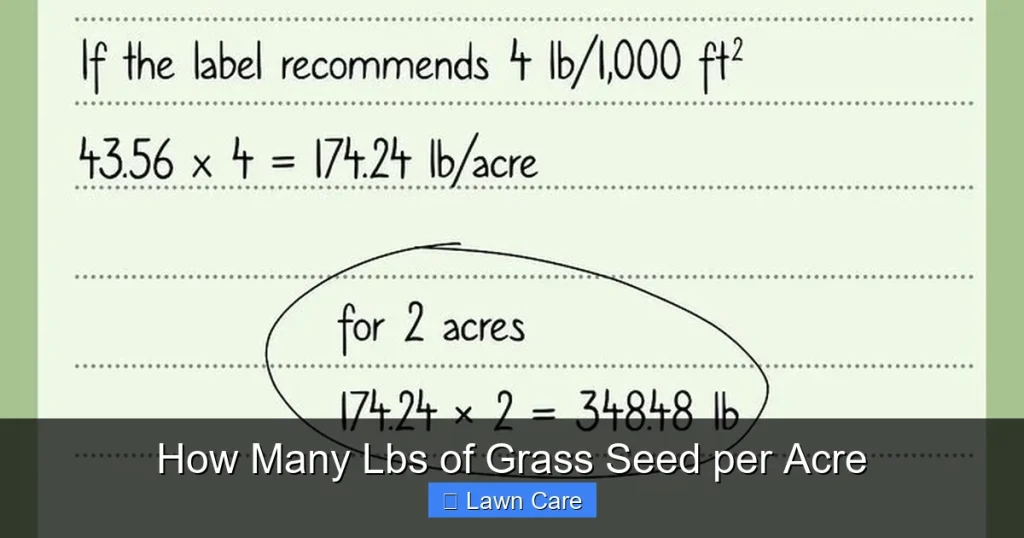
Number of 1,000 sq ft sections in 1 acre = 43,560 sq ft / 1,000 sq ft = 43.56
So, to find lbs/acre from lbs/1,000 sq ft:
Lbs/Acre = (Lbs/1,000 sq ft) * 43.56
**Example Calculation (using Tall Fescue from Step 2):**
Adjusted rate = 6.6 lbs/1,000 sq ft
Lbs/Acre = 6.6 lbs/1,000 sq ft * 43.56 = 287.5 lbs/acre
This means you would need approximately 287.5 pounds of Tall Fescue seed to cover one acre under your specific conditions.
Practical Tips for Accurate Seeding
Beyond just calculating the amount, how you apply the seed is just as important.
Read the Seed Bag Carefully
Always start by reading the instructions and recommendations on the specific grass seed bag you purchase. Manufacturers provide these rates based on their product.
Consider Seed Blends
Many lawn seed products are blends, meaning they contain multiple grass species. The seeding rate on the bag will be for the blend as a whole, taking into account the different characteristics of each grass type.
Factor in Seed Viability Testing
If you have old seed, you can test its viability. Place a small sample (e.g., 100 seeds) on a damp paper towel, seal it in a plastic bag, and keep it in a warm place for about a week. Count how many sprout. If only 60 sprout, your germination rate is 60%. This is important for older seed where the germination rate may have decreased. How to patch lawn with leftover grass seed can also involve testing its viability.
Think About Your Region
For large acreage projects, regional recommendations are often available from local agricultural extensions or university turf departments. These are invaluable resources tailored to your specific environment. For instance, when considering how much ryegrass seed per acre for cattle, local agricultural advice is crucial.
Use a Spreader
A broadcast spreader or a drop spreader ensures even distribution of the seed. Calibrate your spreader according to the seed bag’s instructions to apply the correct rate. Overlapping slightly with each pass can help ensure no thin strips are left. This is why knowing how much grass seed per acre is so important – to properly calibrate your spreader.
When in Doubt, Err Slightly High
If you’re on the fence between two amounts, it’s generally better to err slightly on the side of a higher seeding rate for new lawn establishment. A little extra seed is less problematic than a lawn that is too thin and prone to weeds.
Troubleshooting Common Seeding Issues
Even with careful planning, you might encounter issues.
Bare Patches After Seeding
This can happen due to uneven distribution, poor seed-to-soil contact, or lack of consistent moisture.
- Solution: Identify the bare areas and overseed them, ensuring good seed-to-soil contact by lightly raking. Keep these spots consistently moist.
Thin and Weak Grass
This is often a sign of under-seeding, poor seed quality, or insufficient sunlight.
- Solution: If the issue is under-seeding, plan for overseeding in the next appropriate season. Ensure the grass type is suited to your sunlight conditions. For example, if you planted a shade-intolerant grass like Bermuda in a shady spot, it won’t thrive. Check how many hours of sun does Bermuda grass need for specific grass requirements.
Excessive Weeds
If weeds are outcompeting your grass, it could be due to using too little seed, allowing weeds to establish before seeding, or not managing your lawn properly post-seeding.
- Solution: For new lawns, ensure you’ve prepared the soil thoroughly to reduce the existing weed seed bank. For overseeding, focus on a higher seeding rate and proper lawn maintenance practices, including appropriate mowing and fertilization.
Conclusion
Calculating the correct pounds of grass seed per acre is a vital step for achieving a beautiful and healthy lawn. By understanding the factors like grass type, climate, your project’s goal (new lawn vs. overseeding), and seed quality, you can make an informed decision. Remember that an acre is a large area, and precise measurement and calculation are key. Always read your seed packaging, adjust for your local conditions, and consider using a spreader for even application. With the right amount of seed and proper care, you’ll be well on your way to enjoying a dense, vibrant lawn for years to come. Happy seeding!