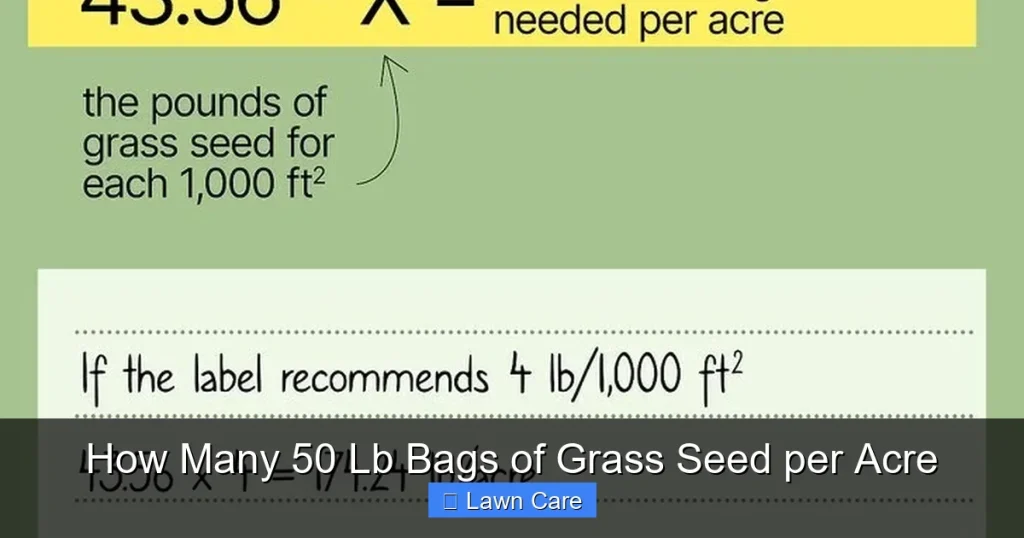
Determining the correct amount of grass seed for your lawn is crucial for a healthy, dense turf. This guide breaks down how many 50 lb bags of grass seed are needed per acre, considering factors like grass type, desired density, and lawn condition. Follow these steps to ensure you buy the right quantity for a beautiful, thriving lawn.
# How Many 50 Lb Bags of Grass Seed per Acre
Dreaming of a lush, green carpet of grass? Whether you’re starting a new lawn from scratch, overseeding an existing one, or trying to fill in those stubborn bare patches, knowing how much grass seed to buy is essential. One of the most common bag sizes available is the 50 lb bag. But how many of these bags do you actually need for an entire acre? The answer isn’t a simple one-size-fits-all number. It depends on several important factors.
In this comprehensive guide, we’ll break down exactly how to figure out how many 50 lb bags of grass seed you’ll need for one acre. We’ll cover everything from understanding seeding rates and calculating your area to considering different grass types and lawn conditions. By the end, you’ll be equipped with the knowledge to make an informed purchase and achieve that beautiful lawn you desire.
## Understanding Grass Seed Coverage Rates
The first and most crucial step in determining how many 50 lb bags of grass seed you need is to understand the concept of coverage rates. This refers to how much area a specific amount of grass seed is designed to cover. Manufacturers provide these rates on their product packaging, and they are usually expressed in square feet per pound or per bag.
### Why Coverage Rates Differ
You’ll quickly notice that not all grass seeds have the same coverage rate. Several things cause this variation:
* **Seed Size and Density:** Different grass species have seeds of varying sizes and weights. Fine-bladed grasses, like fescues, tend to have smaller, lighter seeds and therefore, more seeds per pound. This means a pound of fescue seed will cover a larger area than a pound of a coarser-bladed grass.
* **Species Characteristics:** Some grasses naturally grow into a denser turf than others. Those that produce tillers (new shoots from the base of the plant) can create a thicker lawn with fewer seeds.
* **Mixture Composition:** Many grass seed bags contain a blend of different grass species. The overall coverage rate of the mix will be an average of the individual components, influenced by the proportions of each type.
### Typical Coverage for a 50 Lb Bag
While it’s impossible to give a single number, a typical 50 lb bag of grass seed can cover anywhere from **2,500 to 10,000 square feet**. This is a broad range, so always pay close attention to the specific product you are buying.
* **Lower End (2,500 – 5,000 sq ft):** This might be for high-quality, fine-bladed seed mixes designed for maximum density, or for situations where a very dense turf is desired from the start.
* **Mid-Range (5,000 – 7,500 sq ft):** This is a common range for many general-purpose lawn seed blends.
* **Higher End (7,500 – 10,000 sq ft):** This could be for coarser grasses or for less dense seeding, perhaps for pasture or less frequently mowed areas.
## Calculating Your Acreage
An acre is a large area, and it’s easy to misjudge its size. Before you buy any seed, you need to accurately calculate the square footage of the area you intend to seed.
### What is an Acre?
One acre is equal to 43,560 square feet. This is a standard measurement that will be your benchmark.
### How to Measure Your Lawn
If you don’t know the size of your lawn, you’ll need to measure it.
#### Step 1: Measure the Dimensions
* For rectangular or square yards, simply measure the length and width of the area in feet.
* For irregularly shaped yards, break them down into smaller, manageable geometric shapes (rectangles, squares, triangles, circles) and calculate the area of each. Then, add these areas together. There are many online tools and apps that can help you with irregular shape measurements if you upload a sketch or aerial photo.
#### Step 2: Calculate the Area in Square Feet
* **Rectangles/Squares:** Area = Length x Width
* **Triangles:** Area = 0.5 x Base x Height
* **Circles:** Area = π (pi) x Radius² (where Radius is half the diameter)
#### Step 3: Convert to Acres (If Necessary)
Once you have the total square footage, you can divide by 43,560 to see what fraction of an acre you have. For example, if your lawn is 10,000 square feet, it’s approximately 10,000 / 43,560 = 0.23 acres.
### Using Online Tools
Many websites and mapping services offer tools to measure property sizes. You can often draw a polygon on a map to outline your lawn and get an estimated square footage.
## Determining the Right Seeding Rate
Now that you know your total area and have an idea of how much a bag covers, you need to determine the appropriate seeding rate for your specific situation. This is often expressed as pounds per 1,000 square feet.
### Typical Seeding Rates
Seeding rates can vary widely depending on the grass type and the purpose of the lawn. Here are some general guidelines for common lawn scenarios:
* **New Lawns:** For establishing a brand-new lawn from bare soil, you’ll generally need a higher seeding rate to ensure good coverage and minimize weed competition. This can range from **5 to 10 pounds per 1,000 square feet**.
* **Overseeding Existing Lawns:** When you’re adding seed to an established lawn to thicken it up or fill in thin spots, the rate can be slightly lower, typically **3 to 6 pounds per 1,000 square feet**. This is because there’s already grass present, and you’re supplementing it.
* **Specific Grass Types:** Different grasses have different recommended seeding rates. For example, some fine fescues might be recommended at 4-6 lbs/1,000 sq ft for overseeding, while a blend might be 5-8 lbs/1,000 sq ft for new lawns.
You can find detailed information on seeding rates for specific grass types by searching for articles on [how many pounds of grass seed per square foot](https://lawnhelpful.com/how-many-pounds-of-grass-seed-per-square-foot/) or by consulting your local extension office.
## Calculating the Number of 50 Lb Bags Needed
With all the pieces in place, you can now calculate how many 50 lb bags of grass seed you need.
### Step 1: Calculate Total Seed Needed in Pounds
Multiply your total lawn area (in square feet) by the recommended seeding rate (in pounds per 1,000 square feet). Remember to adjust the seeding rate if it’s given per 1,000 sq ft.
* **Formula:** Total Seed (lbs) = (Total Lawn Area (sq ft) / 1,000) x Seeding Rate (lbs/1,000 sq ft)
**Example:**
Let’s say you have a lawn that is 20,000 square feet and you are establishing a new lawn, requiring 8 lbs of seed per 1,000 square feet.
* Total Seed Needed = (20,000 sq ft / 1,000) x 8 lbs/1,000 sq ft
* Total Seed Needed = 20 x 8 lbs
* Total Seed Needed = 160 lbs
### Step 2: Calculate Number of 50 Lb Bags
Divide the total pounds of seed needed by the weight of each bag (50 lbs).
* **Formula:** Number of Bags = Total Seed Needed (lbs) / 50 lbs per bag
**Continuing the Example:**
You need 160 lbs of seed.
* Number of Bags = 160 lbs / 50 lbs per bag
* Number of Bags = 3.2 bags
### Step 3: Round Up!
You can’t buy parts of bags, so you always need to round up to the nearest whole number. In our example, you would need **4 bags** of grass seed. It’s better to have a little extra seed than to run short. Extra seed can be used for patching in the future.
## Factors Influencing Your Decision
While the calculation above provides a solid estimate, several other factors can influence how many 50 lb bags of grass seed you ultimately need.
### Grass Type Specifics
As mentioned, different grass types have different seeding needs.
* **Bermuda Grass:** Often requires a higher seeding rate, especially when starting from seed. A 50 lb bag of [Bermuda grass seed 50 lb bag](https://lawnhelpful.com/bermuda-grass-seed-50-lb-bag/) might cover less area than a cool-season grass blend. Remember that Bermuda grass needs ample sunlight, typically [how many hours of sun does Bermuda grass need](https://lawnhelpful.com/how-many-hours-of-sun-does-bermuda-grass-need/).
* **Fescues:** Fine fescues can be seeded at lower rates due to their dense growth habit.
* **Ryegrass:** Often used for overseeding or quick germination, ryegrass seeding rates can vary. For example, [how much ryegrass seed per acre for cattle](https://lawnhelpful.com/how-much-ryegrass-seed-per-acre-for-cattle/) might differ from residential lawn applications.
* **St. Augustine:** This grass is typically planted from sod or plugs, not seed, though there are some seed varieties. Understanding [how many types of St Augustine grass are there](https://lawnhelpful.com/how-many-types-of-st-augustine-grass-are-there/) can be helpful if you’re considering this grass.
### Desired Lawn Density
Do you want a golf-course-perfect, super-dense lawn, or are you okay with a slightly more open turf? The denser you want your lawn, the higher your seeding rate should be. Planting at the higher end of the recommended range ensures quicker coverage and better competition against weeds.
### Lawn Condition: New vs. Existing
* **New Lawn:** When starting from bare soil, you have a blank canvas. A higher seeding rate is crucial to ensure rapid germination and establishment, creating a thick turf that chokes out weeds.
* **Overseeding:** If you’re overseeding an existing lawn, there’s already grass present. You’re aiming to fill in thin areas and improve overall density. You can often get away with a slightly lower seeding rate, as the existing grass provides a good foundation. This is a great way to maintain a healthy lawn and avoid starting from scratch, especially if you know [how to patch lawn with leftover grass seed](https://lawnhelpful.com/how-to-patch-lawn-with-leftover-grass-seed/).
### Soil Preparation and Quality
While not directly affecting the number of bags, poor soil conditions can impact germination and establishment, potentially making you wish you’d bought a bit more seed. Ensure you have [how to choose the right soil for new grass seed](https://lawnhelpful.com/how-to-choose-the-right-soil-for-new-grass-seed/) and that your soil is properly prepared before seeding.
### Climate and Growing Season
Consider your local climate. In areas with short growing seasons or challenging conditions, a slightly higher seeding rate can help your lawn establish before adverse weather sets in.
## Practical Tips for Seeding
Once you’ve determined how many bags you need, here are some tips to ensure successful application:
### Always Check the Bag!
This cannot be stressed enough. The most accurate information regarding coverage rates and recommended seeding rates for your specific grass seed blend will always be printed on the bag itself. Manufacturers test their products extensively, so trust their guidance.
### Measure Your Area Accurately
Don’t guess. Use a tape measure, measuring wheel, or online mapping tools to get the most precise measurements of your lawn. Small errors in measurement can lead to buying too much or too little seed.
### Use a Spreader
For even application, a broadcast spreader or a drop spreader is essential. This ensures you apply the seed at a consistent rate across the entire area. Calibrate your spreader according to the grass seed manufacturer’s recommendations.
### Spread in Two Directions
To ensure uniform coverage, it’s often recommended to spread half the seed in one direction (e.g., north to south) and the other half in the perpendicular direction (e.g., east to west).
### Follow Up with Proper Watering
Water is critical for seed germination. Keep the seeded area consistently moist, especially in the first few weeks. Aim for light, frequent watering. You can learn more about this by reading [how to water new grass seed properly](https://lawnhelpful.com/how-to-water-new-grass-seed-properly/).
## Troubleshooting Common Issues
### Running Out of Seed
If you miscalculate and run out of seed before finishing your lawn, don’t panic. You can often purchase more of the same seed blend to finish the job. However, try to avoid significant gaps if possible, as they can be difficult to fill in later. If you do have gaps, refer to resources on [how to patch lawn with leftover grass seed](https://lawnhelpful.com/how-to-patch-lawn-with-leftover-grass-seed/) for guidance.
### Buying Too Much Seed
Having extra seed isn’t a disaster. Store it in a cool, dry place, and it can be used for overseeding or patching bare spots in the following seasons. Properly stored grass seed can remain viable for several years.
### Uneven Germination
If some areas germinate well and others are sparse, it could be due to uneven seed distribution, poor soil contact, or inconsistent moisture. You may need to reseed those sparse areas.
## Conclusion
Figuring out how many 50 lb bags of grass seed you need per acre involves a few key steps: understanding coverage rates, accurately measuring your area, and applying the correct seeding rate for your grass type and lawn goals. While a general rule of thumb can be helpful, always defer to the specific recommendations on your chosen grass seed bag. By following this guide, you’ll be well on your way to achieving a dense, healthy, and beautiful lawn, ensuring you purchase the right amount of seed for the job. Happy seeding!
Key Takeaways
- Grass seed coverage varies significantly: A single 50 lb bag can cover anywhere from 2,500 to 10,000 square feet, depending on the specific grass type and manufacturer recommendations.
- Calculate your acreage accurately: Knowing the exact size of the area you need to seed is the first step in determining the number of bags.
- Grass type is a primary factor: Fine-bladed grasses often require more seed per square foot than coarser varieties.
- Desired lawn density matters: For a thick, weed-resistant lawn, you’ll generally need a higher seeding rate.
- Lawn condition influences the amount: Overseeding an existing lawn or filling in bare patches may require a different amount than starting a new lawn from scratch.
- Always check the bag: The most precise information for your specific seed blend is always found on the product packaging.