
Image source: Wikimedia Commons / Juan de Vojníkov (CC BY-SA)
Why Watering in Grub Killer Properly Actually Matters
Getting how long to water in grub killer wrong is the number one reason people spend money on a treatment that does nothing. You apply the product, you walk away, and two weeks later the brown patches are still spreading. The grubs are still there because the active ingredient never reached them.
Almost every failed grub treatment traces back to the same mistake. It wasn't the product. It wasn't the timing.
It was the watering.
The good news is this is entirely fixable once you understand what's actually happening below the surface. The right watering approach depends entirely on what type of product you're using, what your soil looks like, and when you're treating. Let me walk you through it so you get it right this time.
Quick Answer
Water granular grub killer with about 1/4 to 1/2 inch of water immediately after application. Most granular labels require watering within 24 hours. Liquid grub killers need less water, often just a light rinse.
Always follow your specific product label first. The label overrides any general guideline.
How Grub Killer Works Once It Hits the Soil
Here's what most people don't realize. The active ingredient in grub killer doesn't work on contact from above. It needs to dissolve and move down into the top 1 to 3 inches of soil where grubs are actually feeding.
That zone is where the roots are, where the thatch layer sits, and where the larvae live.
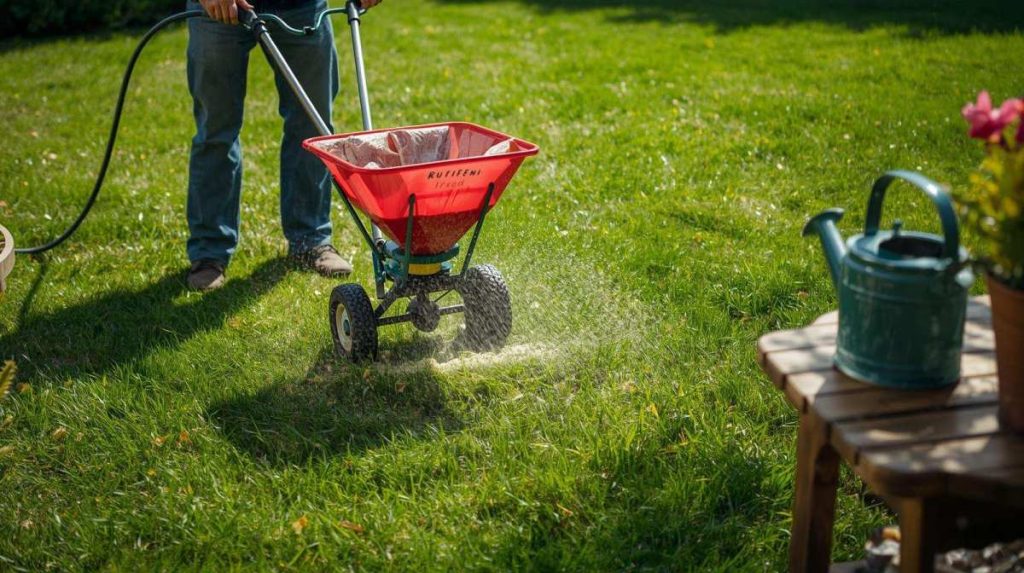
Granular products are designed to sit on the surface until water dissolves the carrier and carries the chemical downward. Without that water, those granules just sit there doing absolutely nothing. They're not slow release in the way people think.
They're water activated. No water, no activation.
Liquid products work differently. They're already in solution, so they penetrate faster. But they still need some irrigation to push the chemical past the thatch layer and into the root zone.
Think of it like this. The thatch is a sponge sitting on top of the soil. You need enough water to soak through that sponge and reach what's underneath.
The depth target matters because grubs feed at different depths depending on the time of year. In late summer and early fall, they're close to the surface. In spring, they can be deeper.
Your watering needs to match where the grubs actually are.
Condition #1 — You're Using a Granular Grub Killer
If you've got a bag of granular grub killer, watering is not optional. It's the single most important step in the whole process. Here's what the research and manufacturer specifications tell us about getting it right.
Most granular products, including those containing trichlorfon (Dylox) or carbaryl (Sevin), need approximately 1/4 to 1/2 inch of water after application. That's the standard range you'll see across EPA registered labels. Some specific products may call for slightly more or less, which is why the label always wins.
The timing matters too. For curative products like Dylox, you want to water in right away. Don't wait.
The faster that chemical reaches the grubs, the better your kill rate. For some preventive granular products, you've got a slightly wider window, often up to 48 hours. But sooner is always better.
Here's a practical breakdown of what this looks like in real terms.
| Product Type | Water Amount | Timing | Notes |
|---|---|---|---|
| Granular curative (trichlorfon/Dylox) | 1/4 to 1/2 inch | Immediately, same day | Grubs are active and feeding now |
| Granular preventive (imidacloprid) | 1/4 to 1/2 inch | Within 24-48 hours | Needs to reach root zone before rain |
| Granular carbaryl (Sevin) | 1/4 inch | Within 24 hours | Less water needed than some alternatives |
One thing worth noting. If rain is in the forecast within 24 hours and it's expected to deliver at least 1/4 inch, you can let nature do the work. But don't gamble on a chance of showers.
If the rain doesn't materialize, you've wasted the application. When in doubt, water it in yourself.
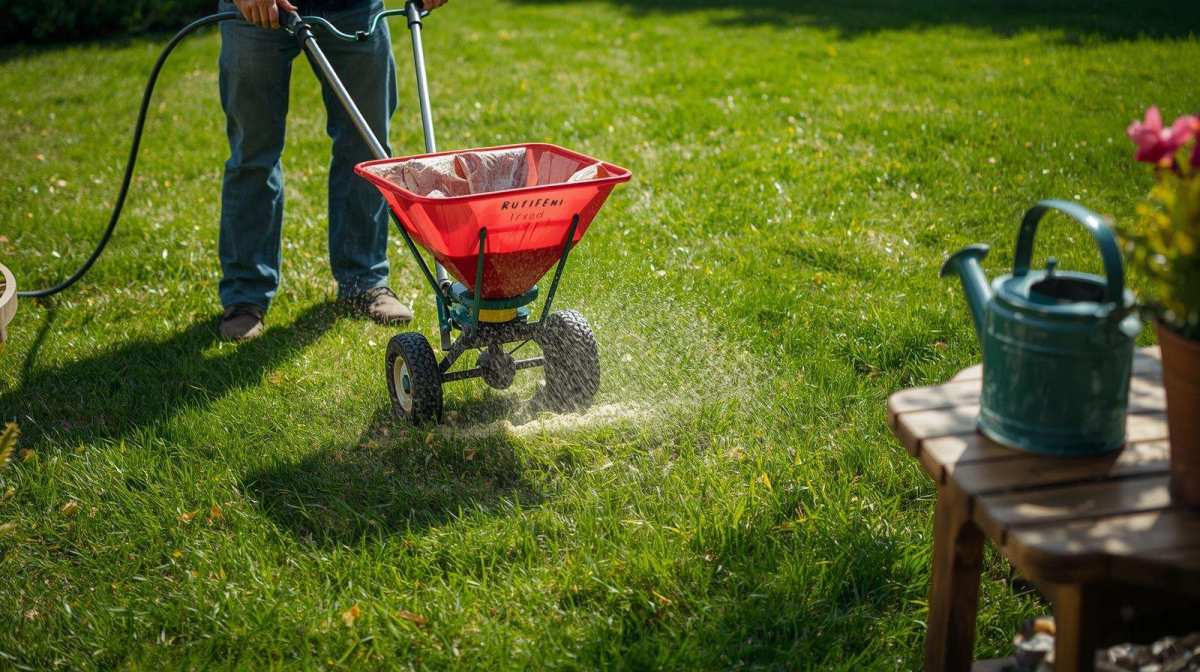
Image source: Bing (Web (fair-use with source credit))
Condition #2 — You're Using a Liquid Grub Killer
Liquid formulations change the equation. You're not dissolving a granule anymore. You're pushing an existing solution down through the thatch and into the soil profile.
The watering requirements are lighter, but they still matter.
Most liquid grub killers applied with a hose end sprayer already contain enough water in the mix to start the penetration process. The product is diluted in water as you spray it. That initial application gets the chemical onto and slightly into the thatch layer.
What you're doing with post application watering is pushing it the rest of the way down.
For liquid applications, a light watering of about 1/8 to 1/4 inch is usually sufficient. You're not trying to soak the lawn. You're giving the chemical a nudge downward.
Overwatering a liquid application can actually work against you by pushing the active ingredient below the root zone where grubs are feeding.
The other advantage of liquid products is speed. Because they're already in solution, they start working faster than granular options. You'll often see label language about applying liquid products in the early morning or late evening when grubs are closer to the surface and temperatures are cooler.
The watering in step is quicker, which means less time for the product to break down in sunlight.
If you're using a concentrated liquid that you mix yourself, follow the dilution rate on the label precisely. More concentrated is not better. It can damage your turf and still won't improve grub control.
The label rate is calibrated to deliver the right amount of active ingredient per square foot.
Condition #3 — Your Soil Type Is Working Against You
This is where a lot of people get tripped up. The 1/4 to 1/2 inch guideline assumes you're working with decent loamy soil. If your soil is heavy clay or very sandy, that number changes.
Clay soil absorbs water slowly. If you apply 1/2 inch all at once, you'll get runoff before the water penetrates. The chemical runs off with it, into the street, down the storm drain, and into local waterways.
That's wasted product and an environmental problem. For clay soil, apply water in two shorter cycles. Run your sprinklers for about 10 minutes, let it soak in for 30 minutes, then run them again for another 10 minutes.
You'll get better penetration without the runoff.
Sandy soil is the opposite problem. Water drains through it fast, sometimes too fast. The chemical can leach below the grub zone before it has time to work.
For sandy soil, you want to apply the full amount of water in one go, but keep it on the lower end of the range. About 1/4 inch is usually enough. You're trying to get the chemical into the top 2 inches, not push it down to 6 inches where it's useless.
Compacted soil, common in high traffic lawns, behaves similarly to clay. Water pools on the surface and runs off. If your lawn has compaction issues, consider aerating before you treat.
It improves both water penetration and product effectiveness. You'll get a better result from the same product just by preparing the soil first.
Here's a quick reference for adjusting your watering based on soil type.
| Soil Type | Water Strategy | Amount | Key Concern |
|---|---|---|---|
| Loamy | Standard single application | 1/4 to 1/2 inch | Ideal conditions, follow label |
| Clay | Split into two cycles | 1/4 to 1/2 inch total | Runoff risk, slow absorption |
| Sandy | Single light application | 1/4 inch | Leaching below root zone |
| Compacted | Aerate first, then standard | 1/4 to 1/2 inch | Poor penetration, pooling |
Condition #4 — You're Treating at Different Times of Year
When you apply grub killer changes how you should water it in. The biology of the grubs and the condition of your turf are different in spring versus fall, and your approach needs to reflect that.
Late summer into early fall, roughly August through September in most of the US, is the prime window for curative treatments. Grubs are small, actively feeding, and close to the surface. This is when products like Dylox work best.
Watering in is straightforward here. Apply the product, water with 1/4 to 1/2 inch, and the chemical reaches the grubs quickly because they're right there in the top inch or two of soil.
Spring treatments are trickier. Grubs are larger and often deeper in the soil. They're also getting ready to pupate, so they're less actively feeding.
If you're using a curative product in spring, you may need to water a bit more to push the chemical deeper. Some university extension programs recommend up to 3/4 inch of water for spring curative applications to reach grubs that have moved down 3 to 4 inches.
Preventive treatments, typically applied in late spring to early summer (May through early July), have different watering needs. Products containing imidacloprid or halofenozide need to be in the root zone before the beetle eggs hatch. The watering goal here is even distribution through the top 2 inches of soil.
You're not chasing existing grubs. You're creating a treated zone that kills larvae as they emerge.
The table below summarizes the seasonal differences.
| Season | Treatment Type | Grub Depth | Water Amount | Goal |
|---|---|---|---|---|
| Late summer/early fall | Curative | 1-2 inches | 1/4 to 1/2 inch | Kill active grubs quickly |
| Spring | Curative | 3-4 inches | Up to 3/4 inch | Reach deeper feeding grubs |
| Late spring/early summer | Preventive | N/A (eggs not hatched) | 1/4 to 1/2 inch | Create treated root zone |
One more thing on timing. If you're treating in the heat of summer, water early in the morning. Midday watering loses too much to evaporation before it penetrates.
Evening watering works too, but avoid leaving the lawn wet overnight if possible, as that can encourage fungal issues. Morning is the sweet spot.
Step-by-Step: How to Water In Grub Killer the Right Way
Let's put it all together into a clear process you can follow regardless of which product you're using. This workflow covers the full sequence from preparation through post application watering.
Step 1: Read your product label completely before you do anything else.
I know this sounds obvious, but most people skip it. The label tells you the exact water amount, timing, and any special instructions for your specific formulation. Everything else is secondary to what the label says.
Step 2: Mow your lawn one to two days before application.
Short turf lets the granules or liquid reach the soil surface more easily. You're removing the barrier of tall grass blades that can intercept the product before it gets where it needs to go.
Step 3: Apply the product at the rate specified on the label.
Use a broadcast spreader for granular products. Calibrate it properly. Over applying doesn't kill more grubs.
It wastes money and increases the risk of runoff into waterways. For liquid products, use a hose end sprayer or pump sprayer and cover the area evenly.
Step 4: Measure your sprinkler output before you start watering in.
Place a rain gauge or several tuna cans around the lawn. Run your sprinklers and time how long it takes to collect 1/4 inch. This gives you a baseline for your specific system.
Most residential sprinklers deliver 1/4 inch in 15 to 30 minutes, but yours may differ.
Step 5: Water in the product according to your product type and soil conditions.
Granular products get 1/4 to 1/2 inch immediately. Liquid products get a lighter rinse of 1/8 to 1/4 inch. Adjust for clay or sandy soil as outlined above.
Step 6: Keep foot traffic off the treated area for 24 to 48 hours.
This lets the chemical settle into the soil without disturbance. Keep pets off too. Most labels specify a re entry interval.
Follow it.
Step 7: Do not mow for at least 48 hours after application.
Mowing too soon can remove product that hasn't fully penetrated. Give it time to get into the soil profile.
How to Measure 1/4 to 1/2 Inch of Water Using a Rain Gauge or Tuna Cans
You don't need fancy equipment to get this right. A simple rain gauge from any hardware store works perfectly. So do clean tuna cans placed at different spots across your lawn.
The goal is to measure how much water your sprinklers actually deliver, not how long they run.
Here's the method. Place five to six tuna cans or small containers at various points around the area you're treating. Run your sprinklers for exactly 15 minutes.
Then measure the water depth in each container with a ruler. Average the numbers. If you collected an average of 1/8 inch in 15 minutes, you need 30 minutes to reach 1/4 inch and 60 minutes to reach 1/2 inch.
This matters because sprinkler output varies wildly. Two systems that both run for 20 minutes can deliver very different amounts of water depending on water pressure, sprinkler head type, and spacing. Measuring takes the guesswork out.
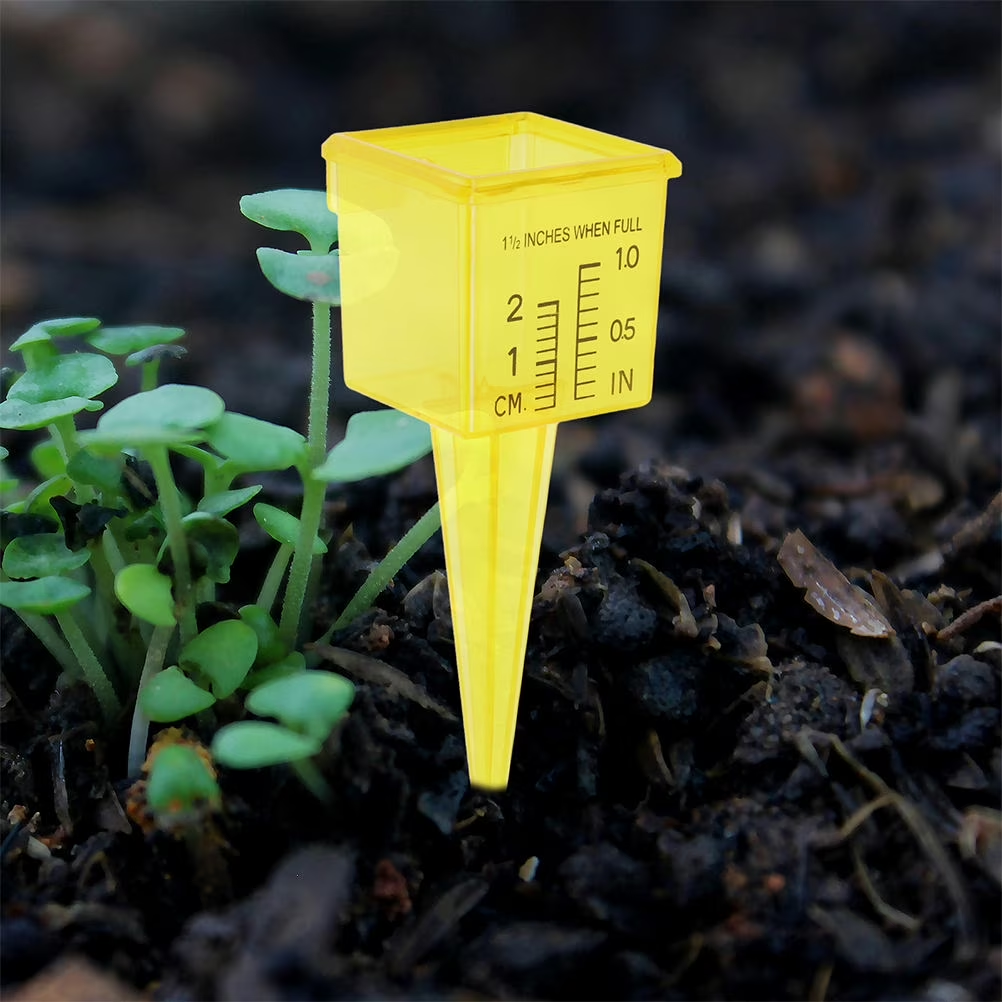
Image source: Bing (Web (fair-use with source credit))
If you don't have a rain gauge, here's a rough conversion. 1/4 inch of water equals about 0.154 gallons per square foot. 1/2 inch equals about 0.308 gallons per square foot. For a 5,000 square foot lawn, 1/4 inch of water is roughly 770 gallons total. That gives you a sense of the volume involved.
One common mistake is assuming that if the surface looks wet, you've watered enough. Surface moisture doesn't tell you what's happening at the 2 inch depth where grubs live. Measure it.
Don't eyeball it.
What Happens If You Don't Water In Grub Killer
The consequences of skipping or skimping on watering are predictable and consistent. Here's what actually happens to your lawn and your wallet when the product doesn't reach the grub zone.
The granules sit on the surface. Wind and foot traffic scatter them. Birds eat some of them.
UV light begins breaking down the active ingredient. Within a week, a significant portion of the product has degraded without ever touching a grub. You've paid for a treatment that never had a chance to work.
Meanwhile, the grubs keep feeding. They're chewing through grass roots just below the surface. The turf loses its ability to take up water and nutrients.
Brown patches appear and expand. By the time you notice visible damage, the grubs have been feeding for weeks. The lawn starts to feel spongy underfoot because the root system is compromised.
In severe cases, you can roll the turf back like carpet because there's nothing holding it to the soil anymore.
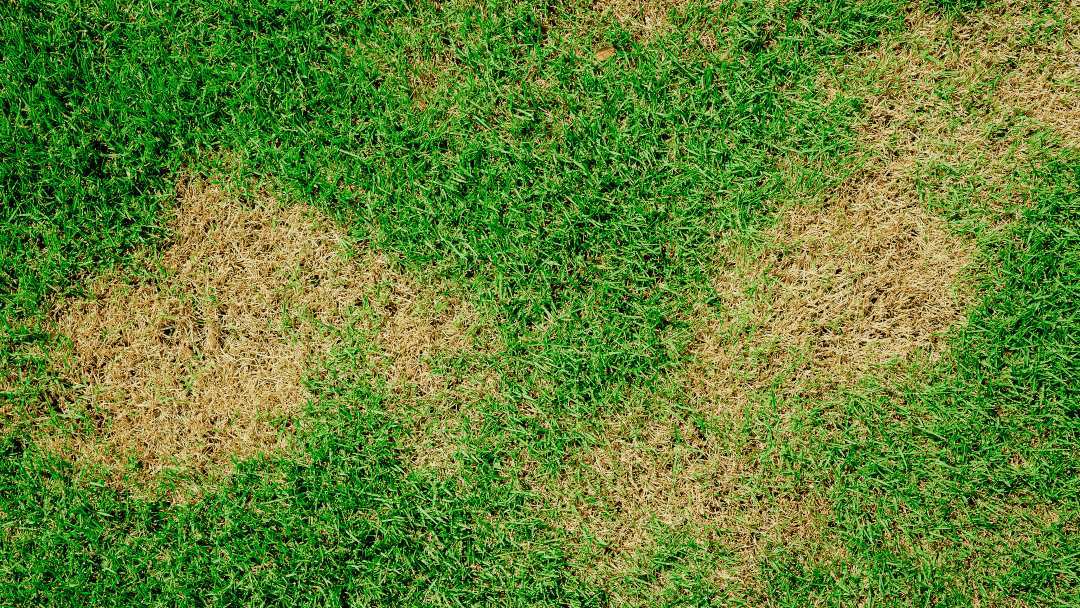
Image source: Bing (Web (fair-use with source credit))
There's also the environmental angle. Product that sits on the surface and doesn't get watered in is more likely to run off during the next rain. It ends up in storm drains and local waterways.
You're not just wasting money. You're contributing to pesticide runoff that affects aquatic ecosystems. Watering in properly keeps the product where it belongs, in the soil, targeting the pests you're trying to control.
The other risk is that you'll reapply too soon. When the first treatment appears to fail, many people assume they need more product. They apply a second round, often at a higher rate.
This increases chemical load in the soil unnecessarily and can harm beneficial organisms like earthworms. The original treatment probably just needed water.
Common Mistakes People Make When Applying Grub Killer
After looking at aggregate user feedback and extension service guidance, the same mistakes come up again and again. Here are the ones that cause the most treatment failures.
Applying granular product right before heavy rain. A downpour delivers too much water too fast. The granules wash away before they can dissolve and penetrate. You end up with product in your driveway, your sidewalk, and the street.
If heavy rain is forecast, water in the product yourself with a controlled amount before the storm hits.
Watering too little. This is the most common error. People run sprinklers for five minutes, see the surface is damp, and call it done. Five minutes might deliver 1/16 inch of water.
That's nowhere near enough to carry the chemical to grub depth. Measure your output and water for the full duration needed.
Watering too much. On the other end, some people soak the lawn for an hour thinking more is better. Excess water pushes the active ingredient below the root zone. The chemical ends up where grubs aren't feeding.
You've essentially flushed your treatment down the drain.
Ignoring the thatch layer. Thatch thicker than 1/2 inch acts like a sponge that traps granules and liquid near the surface. If your lawn has heavy thatch, the product may never reach the soil. Dethatch or aerate before treating for best results.
Applying at the wrong time. Preventive products applied in fall won't work because the grubs are too large and the chemical targets newly hatched larvae. Curative products applied in early summer miss the grubs entirely because they're still eggs. Timing and product type need to match.
Not calibrating the spreader. An uncalibrated spreader can apply double the labeled rate in some spots and almost nothing in others. Both are problems. Over application wastes product and risks turf damage.
Under application leaves grubs alive. Calibrate your spreader before every use.
Skipping the label. Every product is different. Active ingredients, concentrations, and formulations vary. The label is a legal document that tells you exactly how to use that specific product.
General advice is a starting point. The label is the final word.
Grub Killer vs. Grub Prevention: Different Products, Different Watering Rules
People often confuse curative and preventive grub products, and the watering requirements are different enough that mixing them up leads to failure. Here's how to tell them apart and what each one needs from you.
Curative products are designed to kill grubs that are already present and actively feeding. The active ingredients in this category include trichlorfon (Dylox) and carbaryl (Sevin). These work fast, often within 24 to 72 hours.
They need to be watered in immediately because the goal is rapid penetration to reach grubs right now. The window for curative treatment is late summer to early fall when grubs are small and near the surface.
Preventive products are designed to kill grubs before they cause damage. Active ingredients include imidacloprid, halofenozide, and chlorantraniliprole. These are applied before grubs hatch, typically in late spring to early summer.
They work more slowly and persist in the soil longer. Watering requirements are similar in volume, but the timing is more flexible. You've usually got up to 48 hours to water in a preventive product.
Here's the critical difference. If you apply a preventive product in September to treat visible grub damage, it won't work. Preventive products target newly hatched larvae.
They're not effective against large, mature grubs. You need a curative product for active infestations. Using the wrong type at the wrong time is one of the most common reasons people think grub killer doesn't work.
| Feature | Curative Products | Preventive Products |
|---|---|---|
| Active ingredients | Trichlorfon, carbaryl | Imidacloprid, halofenozide, chlorantraniliprole |
| When to apply | Late summer/early fall | Late spring/early summer |
| Target | Active, feeding grubs | Newly hatched larvae |
| Watering urgency | Immediate, same day | Within 24-48 hours |
| Speed of kill | 24-72 hours | Gradual, as larvae feed |
| Residual activity | Short (days to weeks) | Long (months) |
If you're not sure which type you have, check the active ingredient on the label. That tells you everything you need to know about when to apply and how urgently you need to water it in.
Biological Alternatives: When to Skip Chemical Grub Control Entirely
Chemical grub killers aren't the only option, and in some situations they're not even the best one. Biological controls have come a long way, and for certain situations they make more sense.
Beneficial nematodes, specifically Heterorhabditis bacteriophora, are microscopic worms that seek out and kill grubs in the soil. They're applied as a liquid, so the watering requirements are similar to liquid chemical products. Keep the soil moist for about two weeks after application to keep the nematodes active.
They need moisture to move through the soil and find hosts.
Milky spore disease, caused by Paenibacillus popilliae, is another biological option. It specifically targets Japanese beetle grubs. The bacteria are applied as a granular powder and need to be watered in.
Once established in the soil, milky spore can persist for years, providing long term control without repeated applications.
The tradeoff with biological options is speed. They work more slowly than chemical insecticides. Nematodes can take one to two weeks to significantly reduce grub populations.
Milky spore can take one to three years to build up to effective levels in the soil. If you've got active lawn damage right now, a biological approach won't save your turf this season. But for long term management, they're effective and avoid the environmental concerns of synthetic pesticides.
Here's when each approach makes the most sense.
| Situation | Best Approach | Why |
|---|---|---|
| Active lawn damage, grubs visible | Chemical curative | Fast kill, stops damage now |
| Preventive maintenance, no current damage | Chemical preventive or milky spore | Long term protection |
| Organic lawn care preference | Beneficial nematodes | No synthetic chemicals |
| Heavy Japanese beetle pressure | Milky spore + nematodes | Targeted, persistent control |
| Pets and children frequent the lawn | Nematodes or milky spore | Lower toxicity concern |
One important note on nematodes. They're living organisms. They can't sit on a shelf for months.
Buy them from a reputable source that ships them cold, and apply them as soon as possible after arrival. Dead nematodes don't kill grubs. Store them in the refrigerator if you can't apply immediately, and never leave them in a hot car.
Final Decision Guide: Your Grub Killer Watering Plan in 5 Minutes
Let's cut through everything and give you a straightforward decision process. Answer these questions and you'll know exactly what to do.
What type of product are you using?
If it's granular, plan on 1/4 to 1/2 inch of water applied immediately after spreading. If it's liquid, a lighter rinse of 1/8 to 1/4 inch is usually enough.
What does your product label say?
This overrides everything else. If the label says 1/4 inch, use 1/4 inch. If it says water within 48 hours, you've got time.
If it says water immediately, don't wait.
What's your soil type?
Loamy soil gets the standard treatment. Clay soil needs split watering cycles to prevent runoff. Sandy soil needs a single lighter application to prevent leaching.
What time of year is it?
Late summer and early fall treatments are curative. Water in right away. Spring treatments may need more water to reach deeper grubs.
Preventive treatments in late spring have a wider watering window.
Do you have a rain gauge or tuna cans?
Use them. Measure your sprinkler output before you start. Guessing leads to under or over watering, and both waste your treatment.
Here's the five minute plan. Read your label. Mow the lawn.
Apply the product at the labeled rate. Measure your sprinkler output. Water in the amount your label specifies.
Keep off the lawn for 24 to 48 hours. Done.
That's it. No mystery, no complexity. The product works when you get it into the soil where the grubs are.
Everything else is just details.
Frequently Asked Questions
Can I apply grub killer before rain?
You can, but it's risky. If the forecast calls for at least 1/4 inch of rain within 24 hours, you can let nature water it in. But if the rain doesn't come or delivers too much, you've got a problem.
When in doubt, water it in yourself with a controlled amount.
How soon after applying grub killer should I water?
For curative granular products, water immediately on the same day. For preventive granular products, most labels allow up to 48 hours. Liquid products should be watered in within a few hours of application.
Always check your specific label for timing.
What if it rains heavily after I apply grub killer?
Heavy rain can wash away granular product before it dissolves. If a downpour hits within a few hours of application, check the treated area. If granules are visibly washed away or pooled in low spots, you may need to reapply.
Light to moderate rain is actually beneficial.
Do I need to water in grub killer during a drought?
Yes, and this is actually when watering in matters most. During drought, the top layer of soil dries out and becomes hydrophobic, meaning water runs off instead of soaking in. You may need to water in two cycles to get proper penetration.
Pre watering the area lightly before applying the product can also help.
How long does grub killer stay effective after watering in?
It depends on the active ingredient. Curative products like trichlorfon break down in days to a couple of weeks. Preventive products like imidacloprid can persist for two to four months in the soil.
Milky spore bacteria can remain active for years once established.
Can I apply grub killer and fertilizer at the same time?
Many combination products exist that pair grub control with fertilizer. If you're using separate products, check both labels for compatibility. In most cases, applying them together is fine as long as you water in according to the grub killer's requirements.
The fertilizer won't interfere with the insecticide's effectiveness.
Grub killer doesn't distinguish between nuisance grubs and beneficial insects. The same chemical that kills Japanese beetle larvae will kill the ground beetles, rove beetles, and other predatory insects that naturally regulate soil pests. Broad-spectrum insecticides like carbaryl are particularly indiscriminate.
Once you apply them, you're resetting the ecological balance in your soil for weeks or months.
There are documented cases of grub control applications creating secondary pest outbreaks. By killing off predatory beetle populations, you remove natural checks on other lawn pests. You may solve one problem while creating two more.
The responsible approach is targeted treatment. If you've confirmed grub damage in a specific area, treat just that section. Spot treating dr
astically reduces the chemical footprint across your lawn while
stillprotecting vulnerable turf. It costs less, requires less water for irrigation in, and has minimal impact on non-target organismsin untreated sections.
Water responsibly. That means no application before heavy rain events, no overflowing onto hardscaping or into gutter drains, and using a rain gauge so you are not guessing applications. For areas near watercourses or drainage systems, buffer zones around the treatment area may be required.
Depending on jurisdiction or local municipality ordinances, some grub killers may require special handling or licensing. Check with your county extension office whenever you are unsure.
After watering in, you will want to keep off the grass for the reentry interval typically indicated on the product label. Call your veterinarianfor short-term lawn reentry questions related specifically to your pet. Never allow runoff to reach surface water directly.
Grub killer doesn't distinguish between nuisance grubs and beneficial insects. The same chemical that kills Japanese beetle larvae will kill the ground beetles, rove beetles, and other predatory insects that naturally regulate soil pests. Broad-spectrum insecticides like carbaryl are particularly indiscriminate.
Once you apply them, you're resetting the ecological balance in your soil for weeks or months.
There are documented cases of grub control applications creating secondary pest outbreaks. By killing off predatory beetle populations, you remove natural checks on other lawn pests. You may solve one problem while creating two more.
The responsible approach is targeted treatment. If you've confirmed grub damage in a specific area, treat just that section. Spot treating drastically reduces the chemical footprint across your lawn while still protecting vulnerable turf.
It costs less, requires less water for irrigation in, and has minimal impact on non-target organisms in untreated sections.
Water responsibly. That means no application before heavy rain events, no overflowing onto hardscaping or into gutter drains, and using a rain gauge so you are not guessing applications. For areas near watercourses or drainage systems, buffer zones around the treatment area may be required.
Depending on jurisdiction or local municipality ordinances, some grub killers may require special handling or licensing. Check with your county extension office whenever you are unsure.
After watering in, you will want to keep off the grass for the reentry interval typically indicated on the product label. Call your veterinarian for short-term lawn reentry questions related specifically to your pet. Never allow runoff to reach surface water directly.