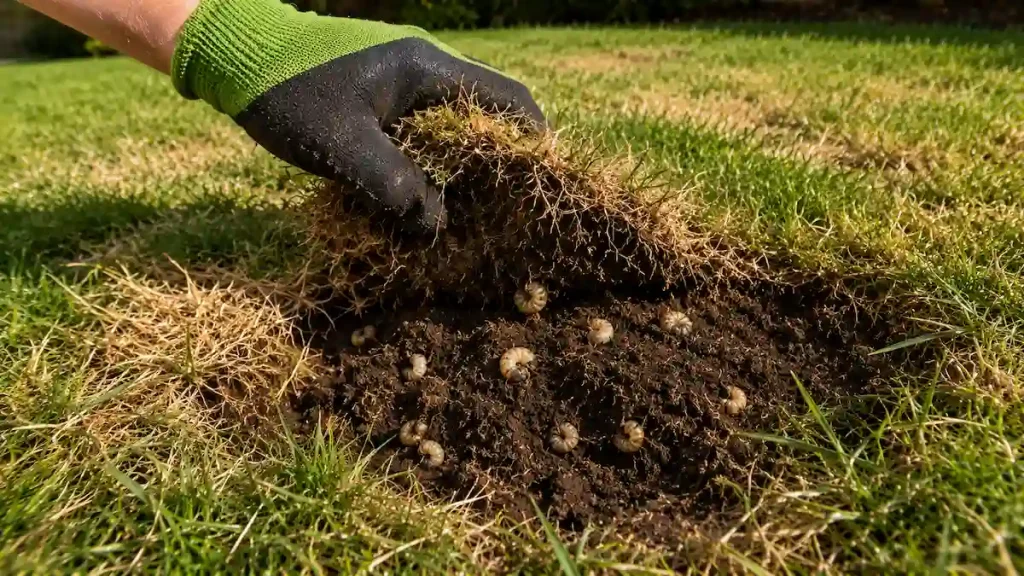
If you've noticed brown patches spreading across your lawn and you're wondering how do I know if I have grubs, you're asking the right question at the right time. White grubs, the larval stage of scarab beetles like Japanese beetles and European chafers, feed on turfgrass roots just below the surface. The damage they cause can look a lot like other lawn problems, so guessing usually leads to wasted effort and money.
The good news is that confirming a grub problem doesn't require special equipment or a degree in entomology. A simple field test takes about two minutes and gives you a definitive answer. Here's exactly what to look for, how to check, and what the results mean for your lawn.
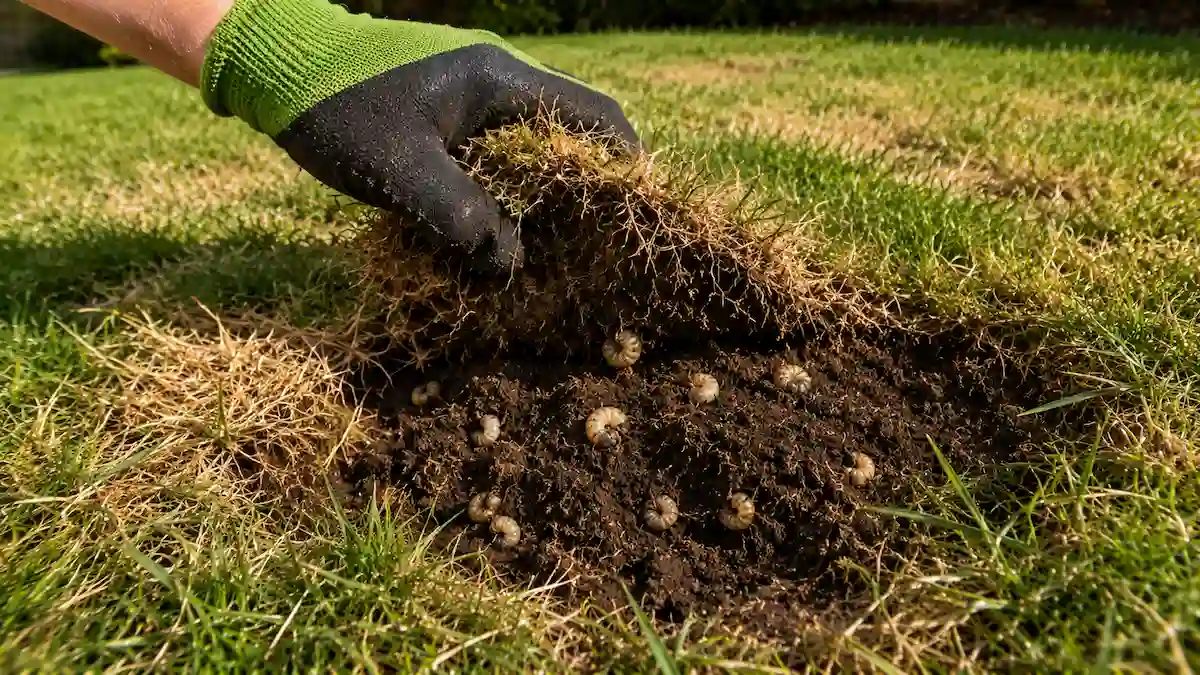
Image source: Bing (Web (fair-use with source credit))
Quick Answer
Look for irregular brown patches that feel spongy underfoot. Peel back a one-foot square of turf in the damaged area. Count the white grubs in the top two inches of soil.
More than five to ten grubs per square foot in healthy turf means treatment is warranted. Fewer than that, and your brown patches likely have a different cause.
What Grub Damage Actually Looks Like (And What Gets Mistaken for It)
Grub damage follows a pattern that's distinct once you know what to watch for. The affected areas start as irregular brown patches, not perfect circles. They often appear first in sunnier, drier sections of the lawn where the soil warms up earlier.
The turf may look wilted or drought-stressed even when the surrounding grass is green and well-watered.
Here's the telltale sign that separates grub damage from almost everything else. The damaged sod lifts up easily, almost like peeling back a carpet. That's because the larvae have severed the root system holding the turf in place.
If you can roll back a section of brown grass with minimal resistance and find the soil underneath full of C-shaped larvae, you've confirmed the problem.
But not every brown lawn has grubs. Several common conditions produce similar-looking damage, and treating for grubs when you actually have a fungal issue or irrigation problem won't help at all. That's why the physical test matters more than visual inspection alone.
Key visual signs of grub damage:
- Irregular brown patches that expand over weeks
- Spongy or soft feel when you walk across the damaged area
- Sod that peels back easily from the soil surface
- Increased animal activity, skunks, raccoons, or birds digging in the lawn
- Damage that appears in late summer through fall, not during spring green-up
The Quick Sod-Lift Test: Your Fastest Way to Know for Sure
This is the single most reliable way to confirm whether grubs are present. You don't need any tools beyond a flat shovel or even a sturdy trowel. Pick a spot right at the edge of a brown patch, where damaged grass meets healthy grass.
That transition zone is where feeding activity is usually highest.
Cut a square about one foot by one foot, going roughly two inches deep. Fold the sod back like you're opening a book. Examine the soil surface and the underside of the turf mat.
Count every grub you see in that square foot. Then press the sod back into place and water it. Healthy turf will re-root within a week or two.
Repeat this test in three or four different spots around the lawn. Grubs rarely distribute themselves evenly, so checking multiple areas gives you a much more accurate picture than a single sample.
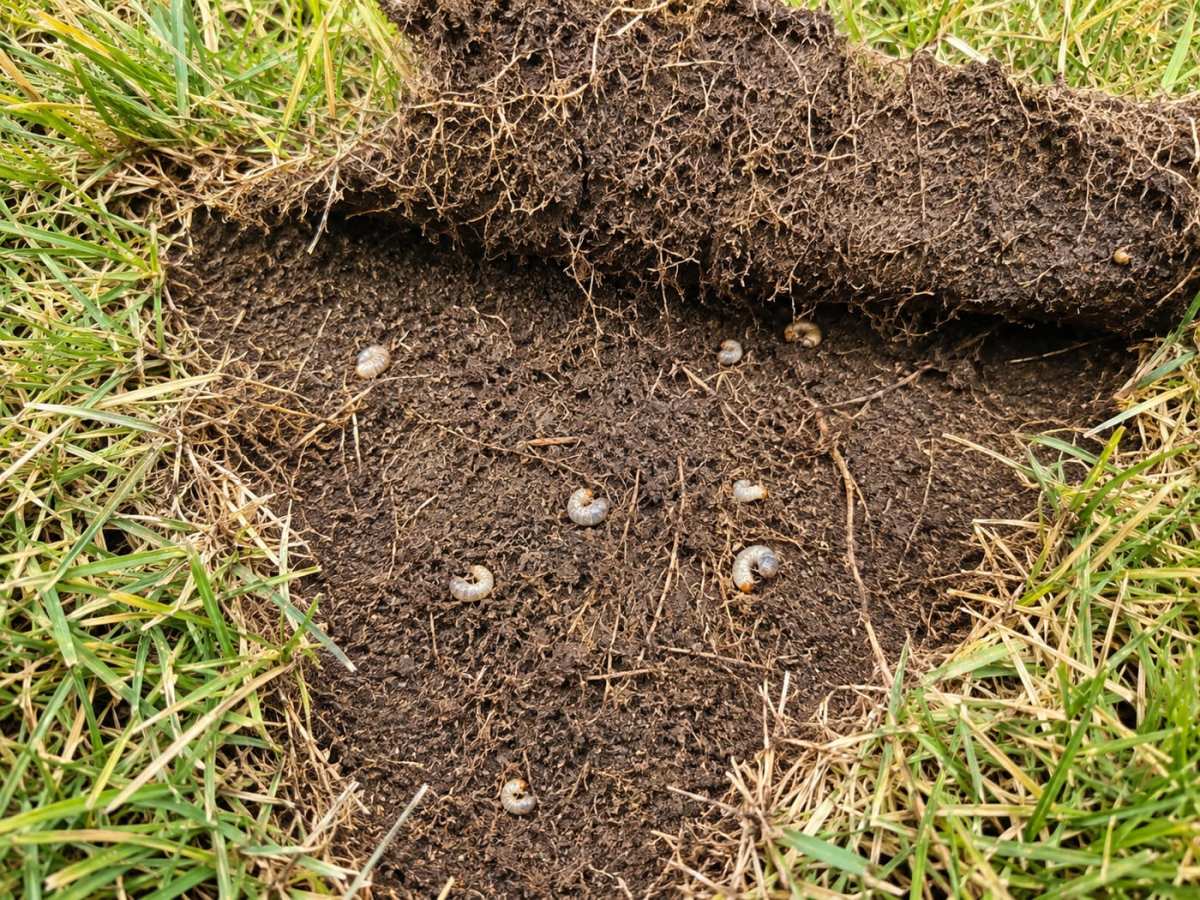
Image source: Bing (Web (fair-use with source credit))
What you're looking for during the test:
- C-shaped larvae, cream or white body with a brown head capsule
- Three pairs of legs visible near the head
- Size ranging from about a quarter inch up to over an inch, depending on species and age
- Grubs resting in the top one to three inches of soil
If you find zero grubs across multiple test spots, your brown patches have a different cause. Move on to checking for fungal disease, irrigation issues, or other pests before spending money on grub control products.
How Many Grubs Is Too Many? Understanding Damage Thresholds
Finding a few grubs doesn't automatically mean you have a problem. Most lawns can tolerate a low population without showing visible stress. The threshold depends on your grass type, overall lawn health, and how much irrigation you provide.
For a well-maintained, regularly watered lawn with cool-season grasses like Kentucky bluegrass or tall fescue, the general damage threshold sits around five to ten grubs per square foot. Below that number, the root system can usually regenerate faster than the larvae can feed. Above it, you'll start seeing the brown patches and spongy turf that sent you looking for answers in the first place.
Stressed lawns tell a different story. If your grass is already struggling from compacted soil, heavy shade, or inconsistent watering, damage can appear at three to five grubs per square foot. Newly sodded lawns with shallow root systems are especially vulnerable.
Even a modest grub population can cause noticeable damage in these conditions.
Here's a practical breakdown of what different grub counts mean for your lawn:
| Grubs per Square Foot | Healthy Lawn | Stressed or New Lawn |
|---|---|---|
| 0 to 4 | No action needed | Monitor closely |
| 5 to 9 | Monitor, treat if damage appears | Consider treatment |
| 10 to 14 | Treatment recommended | Treatment strongly recommended |
| 15+ | Treatment necessary | Significant damage likely already occurring |
These thresholds come from university turfgrass research programs and represent general guidelines. Your local conditions may shift the numbers slightly. When in doubt, your county extension office can provide region-specific thresholds based on the grub species common in your area.
Grub Damage vs. Everything Else: Ruling Out Lookalikes
This is where most people go wrong. They see brown grass, assume grubs, and buy a product that does nothing for the actual problem. Several lawn conditions mimic grub damage closely enough to fool even experienced gardeners.
Drought stress is the most common lookalike. Grass that isn't getting enough water will turn brown in irregular patches, and the turf may feel slightly loose if the thatch layer has dried out. But drought-stressed grass won't peel back cleanly from the soil.
The roots are still intact, holding the sod firmly in place. If you can't lift the turf easily, grubs probably aren't your issue.
Fungal diseases like brown patch and dollar spot also cause circular or irregular brown areas. Brown patch, caused by Rhizoctonia solani, produces rings of damaged grass with a darker border. Dollar spot creates smaller, silver-dollar-sized spots.
Neither condition produces the spongy, rolling-sod feel of grub damage. A close inspection of the grass blades themselves often reveals the lesions or spotting patterns that point to disease rather than insect feeding.
Dog urine spots are another frequent suspect. These show up as circular brown patches with a darker green ring around the edge, where the nitrogen concentration is lower. They're usually smaller and more uniform than grub damage.
If you have a dog and the spots appear in areas where the pet regularly goes, urine burn is the more likely culprit.
Chinch bugs and sod webworms also feed on turfgrass but cause damage in different patterns. Chinch bugs tend to strike in hot, dry areas first and produce yellowing that progresses to brown. Sod webworms create small, closely mown-looking patches where the grass appears scalped.
Neither produces the root-severing, carpet-lifting effect of white grubs.
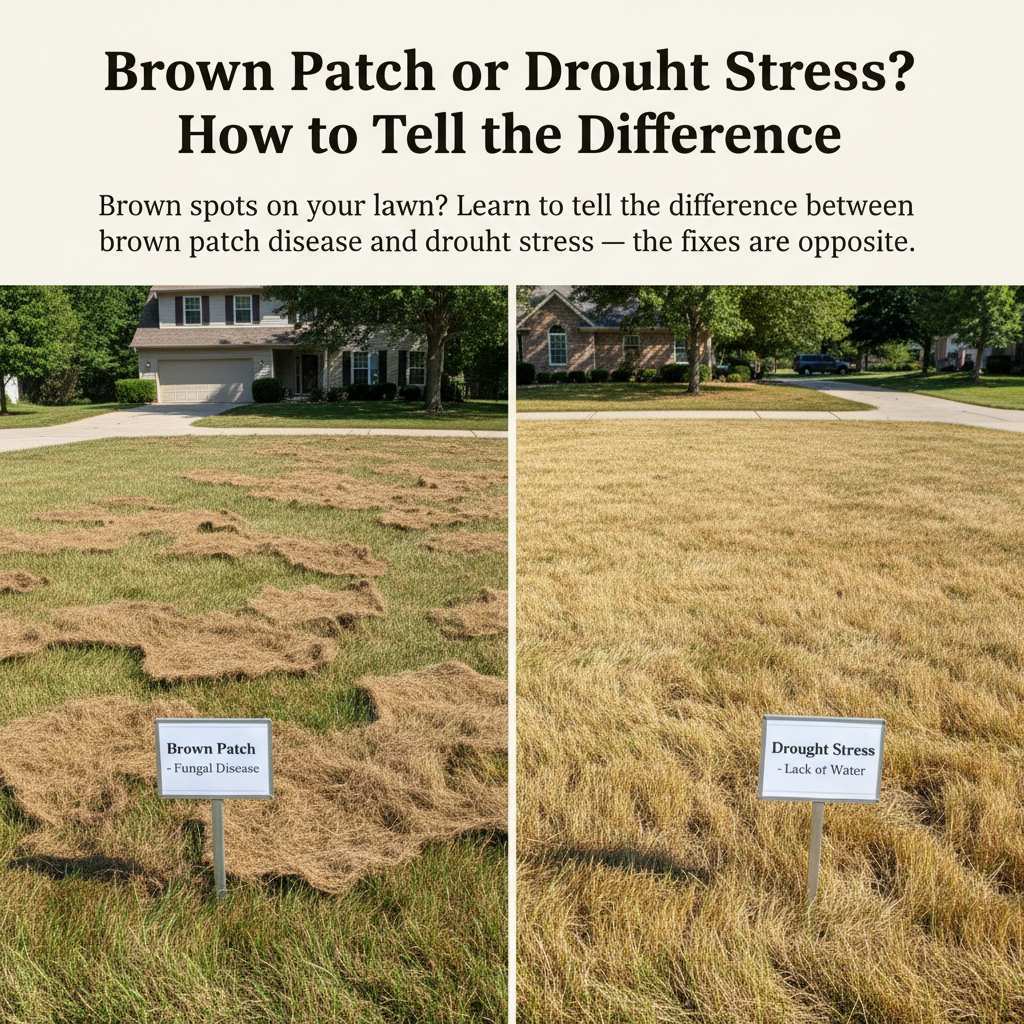
Image source: Bing (Web (fair-use with source credit))
Quick comparison to help you narrow it down:
- Grub damage: irregular patches, spongy feel, sod lifts easily, grubs visible in soil
- Drought stress: uniform browning in dry areas, sod stays firmly rooted, improves with watering
- Fungal disease: defined patterns or rings on grass blades, no loose sod, may spread in humid conditions
- Dog urine: small circular spots with green outer ring, concentrated in pet traffic areas
- Chinch bugs: yellowing in sunny, dry zones first, tiny black-and-white insects visible at soil line
If your sod-lift test comes back clean and you're still seeing brown patches, work through this list before reaching for any treatment. The right fix depends entirely on the right diagnosis.
What the Grubs Themselves Tell You (Species, Size, and Timing)
Not all white grubs are the same, and knowing which species you're dealing with helps you time treatment correctly. The most common lawn-damaging species in North America include Japanese beetle grubs, European chafer grubs, masked chafer grubs, and June beetle grubs. Each has a slightly different life cycle, and that affects when they're most vulnerable to control.
Japanese beetle grubs are among the most widespread. The adults are metallic green and copper, about half an inch long, and they lay eggs in mid to late summer. The grubs hatch and feed aggressively through fall, grow large, then burrow deep into the soil to overwinter.
They return to the root zone in spring for a shorter feeding period before pupating. This species is particularly destructive because the fall feeding window coincides with the time when many homeowners first notice damage.
European chafer grubs follow a similar timeline but tend to be active slightly earlier in the season. The adult beetles, tan-colored and about five-eighths of an inch long, emerge in June and July. Egg laying happens in early summer, so the grubs are already feeding by mid to late July.
In the Northeast and Midwest, European chafers have become one of the most damaging lawn pests over the past two decades.
Masked chafer grubs are smaller than Japanese beetle grubs but can still cause significant damage at high populations. The adults are dull brown beetles, about half an inch long, that fly in early summer. Their grubs follow the standard pattern of fall feeding, winter dormancy, and a brief spring feeding period.
June beetle grubs, sometimes called May beetles, have a longer life cycle. They can spend two to three years in the larval stage before emerging as adults. These grubs are often the largest you'll find, sometimes exceeding an inch in length.
Because of their extended development period, you may find multiple size classes in the same lawn at the same time.
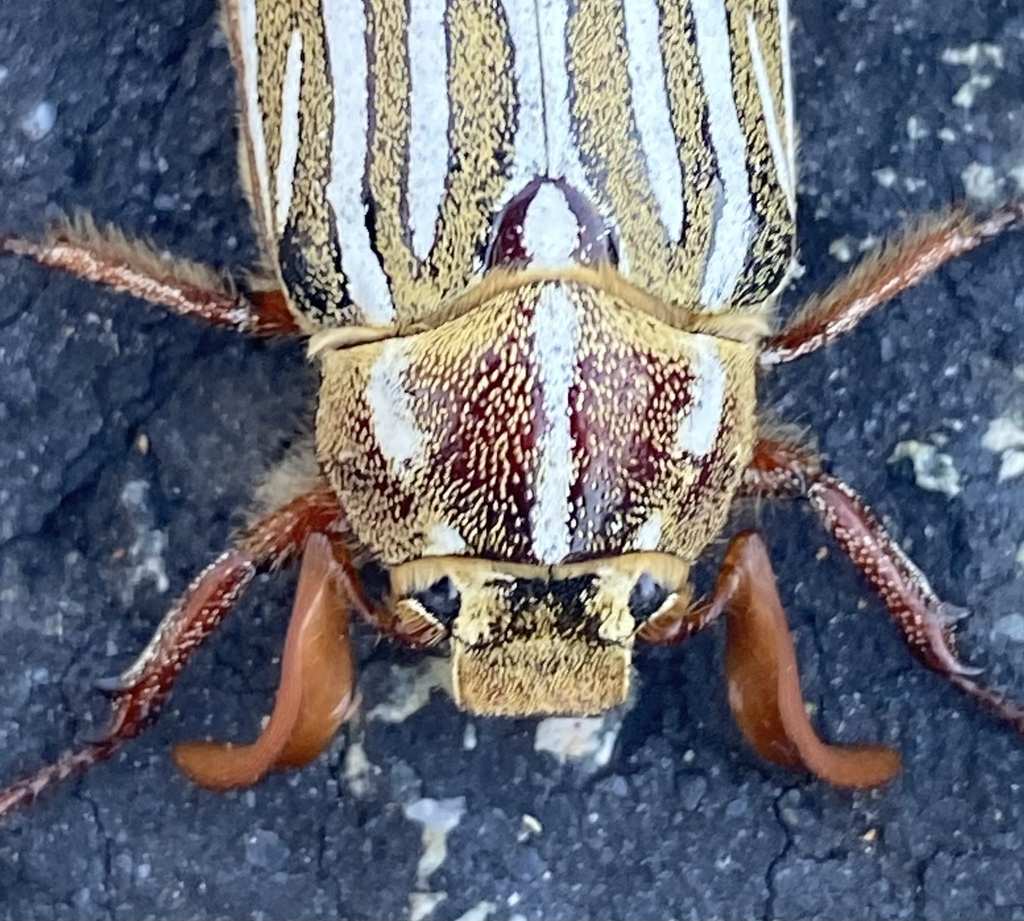
Image source: iNaturalist / Irene
Identifying the exact species requires examining the raster pattern, the arrangement of hairs and spines on the underside of the abdomen near the rear end. This level of detail matters mostly for researchers and pest management professionals. For most homeowners, simply confirming that grubs are present and counting them is enough to make a treatment decision.
What does matter is the size of the grubs when you find them. Small grubs, under about half an inch, are in an early larval stage and much easier to kill with either chemical or biological treatments. Large grubs, three-quarters of an inch or more, are nearing the end of their feeding cycle and harder to control.
If you're finding large grubs in spring, the window for effective treatment has likely already passed for that season. Focus on preventive measures for the following year instead.
Size and timing guide:
- Small grubs (under ½ inch) in late summer: ideal time for curative treatment
- Medium grubs (½ to ¾ inch) in early fall: still treatable, act soon
- Large grubs (¾ inch+) in spring: treatment less effective, plan for preventive approach next year
- Mixed sizes in fall: indicates overlapping generations, treat for the smaller ones
When to Treat — And When You Can Skip It
Timing is everything with grub control. Treat at the wrong moment and you're pouring product into the soil for nothing. The larvae go through stages, and only one of them is vulnerable enough to make treatment worth your money.
The sweet spot for curative treatment runs from late July through September in most temperate regions. That's when the eggs have hatched, the grubs are small, and they're actively feeding near the soil surface. Small grubs haven't built up the resilience that larger larvae develop, and they haven't yet burrowed deep enough to escape contact with applied products.
Preventive treatment follows a different timeline. If your lawn has a history of grub damage, you can apply a preventive insecticide in June to early July, before the adult beetles lay their eggs. The product creates a barrier in the soil that kills grubs as they hatch.
This approach costs more upfront but eliminates the guesswork of trying to time a curative application perfectly.
Spring treatment is usually not worth it. By the time warm weather arrives, most grubs are large and close to pupating. They're harder to kill, and they've already done the bulk of their feeding damage for the season.
If you find large grubs in April or May, skip the treatment and focus on lawn recovery. Overseed the damaged areas in early fall and plan a preventive approach for the following summer.
Decision factors for treatment timing:
- Late July through September: best window for curative treatment when grubs are small
- June through early July: preventive treatment window if you have recurring problems
- October through November: grubs are moving deeper, curative options less effective
- March through May: treatment rarely beneficial, focus on recovery and prevention planning
Choosing the Right Treatment Based on What You Found
Your sod-lift results determine which approach makes sense. Low grub counts in an otherwise healthy lawn don't require any treatment at all. The turf can outgrow minor root feeding as long as the population stays below the damage threshold.
Moderate populations, five to ten grubs per square foot with visible damage, call for a curative insecticide. Products containing trichlorfon or carbaryl are designed to kill existing grub populations quickly. These work best when applied to small, actively watering grubs.
Water the lawn lightly after application to move the product into the root zone where the larvae are feeding.
Heavy infestations, fifteen or more grubs per square foot, usually require immediate treatment followed by a preventive plan for the following season. At that density, the lawn is losing turf fast and secondary damage from animals digging for the grubs can be just as destructive as the feeding itself.
For homeowners who prefer non-chemical options, biological controls can work but require more patience. Beneficial nematodes, specifically Heterorhabditis bacteriophora, are microscopic worms that seek out and kill grubs in the soil. They need to be applied when soil temperatures are above 60°F and the soil must stay moist for at least two weeks after application.
Milky spore disease, Paenibacillus popilliae, targets Japanese beetle grubs specifically and can provide long-term suppression, but it takes two to three years to build up effective levels in the soil.
Treatment options at a glance:
| Situation | Recommended Approach | Expected Timeline |
|---|---|---|
| 0-4 grubs, healthy lawn | No treatment, monitor | Recheck next season |
| 5-9 grubs with damage | Curative insecticide or nematodes | 1-3 weeks for results |
| 10-14 grubs, expanding damage | Curative treatment, then preventive plan | Immediate action, long-term follow-up |
| 15+ grubs, severe damage | Aggressive curative treatment, overseed in fall | Multiple seasons to full recovery |
Common Mistakes People Make When Checking for Grubs
The biggest mistake is treating the lawn without checking at all. People see brown patches, assume grubs, and apply a product. If the real problem is a fungal disease or compacted soil, that application does nothing except introduce unnecessary chemicals into the environment.
Waiting too long to check is the second most common error. Grub damage often doesn't become obvious until late August or September, by which point the larvae are already large. Some homeowners don't notice the problem until they see skunks or raccoons tearing up the lawn.
By then, the grubs have been feeding for weeks and the damage is well underway. Checking at the first sign of irregular browning gives you the widest treatment window.
Testing only in the wrong spots is another frequent pitfall. Grubs cluster in favorable areas, often where the soil stays slightly warmer or moister. If you only test the center of a large dead patch, you might find nothing because the grubs have already moved to the edges.
Test at the perimeter where damaged grass meets healthy turf. That's where active feeding is happening.
Ignoring grass type and lawn health when interpreting counts leads to over-treatment. A dense, well-irrigated lawn of perennial ryegrass handles ten grubs per square foot better than a thin, drought-stressed lawn of tall fescue handles five. Always factor in the overall condition of your turf when deciding whether a grub count warrants action.
Finally, some people overlook the reseeding step. Killing the grubs solves the pest problem, but it doesn't fill in the dead patches. Plan to overseed damaged areas in early fall, ideally at the same time you're monitoring for the next generation of grubs.
Seasonal Timing: Why When You Look Matters as Much as What You Find
Your Beetle grub species follow an annual cycle, and your diagnostic results mean different things depending on the time of year. Checking in March when the grubs are large and inactive tells you a very different story than checking in August when they're small and feeding aggressively.
Adult beetles emerge, mate, and lay eggs in early to midsummer. The eggs hatch within two weeks, and the tiny grubs begin feeding on fine root hairs in late July and August. This is the ideal time to check because the grubs are vulnerable, and catching them early prevents the serious root damage that shows up weeks later.
Through September and into October, the grubs grow rapidly and feed more aggressively. Damage becomes visible as brown patches. This is still a good time for curative treatment, but the window is closing.
By late October in northern regions, the grubs start moving deeper into the soil to escape freezing temperatures. Once they're below the top four inches, surface-applied products won't reach them effectively.
Winter dormancy changes the picture entirely. The grubs are alive but inactive, deep in the soil. Checking during winter is pointless because they won't be in the root zone where you'd sample.
Wait until soil temperatures rise above 50°F in spring, which is when the grubs return to the surface. But by then, they're large and preparing to pupate, so treatment offers limited benefit.
Recommended checking schedule:
- Late July through September: peak diagnostic and treatment window
- October: still productive for checking, treatment effectiveness declining
- November through February: not useful for diagnosis, grubs are dormant and deep
- March through May: grubs present but treatment timing is poor, focus on recovery
- June through July: adult activity period, good time for preventive applications
When to Call in a Pro vs. Handling It Yourself
Most grub problems are manageable for a handy homeowner. The sod-lift test is simple, curative products are widely available, and the treatment process involves basic lawn watering after application. If you've got moderate grub numbers and a straightforward rectangular lawn, there's no reason to pay for professional service.
Some situations justify calling a licensed pesticide applicator. If you're finding heavy infestations across a large property, a pro can apply commercial-grade products that aren't available to homeowners. They also have equipment that distributes the product more evenly, which matters when you're treating several thousand square feet.
Recurring problems year after year suggest something in your landscape is attracting high beetle populations. A professional can assess surrounding vegetation, soil conditions, and irrigation practices to identify contributing factors. Sometimes the fix involves more than just killing grubs.
It might mean adjusting watering schedules, improving soil drainage, or replacing highly susceptible grass varieties.
If you're dealing with a mixed pest problem, grubs plus fungal disease or other insects at the same time, the treatment combinations get complicated. Applying the wrong product sequence can render both treatments ineffective or damage the turf. In those cases, a professional diagnosis saves money in the long run by getting the approach right the first time.
Consider calling a pro when:
- Grub counts exceed fifteen per square foot across large areas
- Damage returns every year despite treatment
- Multiple lawn problems are occurring simultaneously
- You're unsure about product selection or application rates
- Your state or municipality has restrictions on certain active ingredients
Frequently Asked Questions
Can I have grubs even if my lawn looks healthy?
Yes. Low grub populations, fewer than five per square foot in healthy turf, often cause no visible symptoms. You might only discover them when checking a brown patch nearby or when animals start digging.
Routine monitoring catches these populations before they build to damaging levels.
How deep in the soil do grubs live?
Most feeding activity happens in the top two to three inches of soil, right in the root zone. As temperatures drop in fall, grubs burrow deeper, sometimes six to eight inches down, to escape freezing conditions. This is why fall treatments need to happen before the grubs move out of reach.
Will grub damage repair itself?
The grubs will stop feeding once they pupate, but the dead turf won't regenerate on its own. You need to reseed or sod damaged areas. If the root system is only partially damaged and the growing points are intact, the grass can recover with adequate watering and a light fertilizer application.
Are grub treatments safe for pets and children?
Most registered grub control products require keeping people and pets off the treated area until the application has dried, typically 24 to 48 hours. Always read the product label for specific restrictions. Biological options like beneficial nematodes have no re-entry restrictions and are considered safe around people and animals.
Do all white grubs damage lawns?
No. Some scarab beetle larvae feed on decaying organic matter or the roots of ornamental plants rather than turfgrass. Northern masked chafers and European chafers are among the most damaging lawn species.
Black turfgrass ataenius grubs are smaller but can be problematic on golf course fairways and closely mown turf. Correct identification helps you focus treatment on the species that actually threaten your lawn.
How often should I check for grubs?
Once per year during the late summer window is sufficient for most lawns. If you've had grub problems in the past or live in a region with heavy Japanese beetle or European chafer pressure, check twice: once in late July to catch early hatch, and again in September to confirm population levels before they peak.
The previous sections have covered the full diagnostic process and treatment decisions. Here are the remaining sections to wrap things up.
Frequently Asked Questions
Can grubs come back after treatment?
Yes. Grub control products kill the larvae present at the time of application. They don't prevent adult beetles from flying in and laying new eggs.
That's why lawns with recurring problems benefit from preventive programs or biological controls like milky spore that build up in the soil over multiple seasons.
Is it normal to find one or two grubs?
One or two grubs per square foot is completely normal and not a cause for concern. Almost every lawn hosts a small scarab beetle population. Treatment thresholds start around five per square foot in healthy turf, so occasional grubs are just part of a normal backyard ecosystem.
What time of day is best to check for grubs?
Time of day doesn't matter for the sod-lift test. Grubs stay in the soil regardless of sunlight. What matters more is soil moisture.
Checking after a rainfall or light irrigation makes the soil easier to work with and helps you get a clean lift without tearing the sod.
Can I apply grub control at the same time as fertilizer?
Yes, and it's actually a good practice. Applying a fall fertilizer along with a grub treatment addresses both problems at once. The fertilizer helps the turf recover root mass while the insecticide handles the larvae.
Just make sure the products are compatible if you're using a combined application, and follow label rates for both.
Do grub killers hurt earthworms?
Some chemical grub insecticides can affect earthworm populations, particularly carbaryl. If earthworm activity matters to you, consider biological controls like beneficial nematodes. They target grubs specifically and don't harm earthworms, beneficial soil microbes, or other non-target organisms.