For most homeowners, the first real sign of a grub problem isn't seeing the grubs themselves. It's noticing something's off with the turf. Maybe the grass is browning in odd patches, or the ground feels spongy underfoot, or you've woken up to find a raccoon treated your lawn like a buffet.
Figuring out whether grubs are actually the culprit is a step-by-step process, and it starts with knowing what to look for and ruling out the usual suspects.
White grubs are the larval stage of scarab beetles, and they feed on grass roots just below the surface. The tricky part is that their damage looks a lot like other common lawn problems. In our research, the most reliable way to confirm an infestation is a simple physical test: cut a square foot of turf, peel it back, and count what's underneath.
Most turfgrass species can tolerate up to about 5 to 10 grubs per square foot before you need to take action, according to university extension guidelines. Let's walk through exactly how to check.

Image source: Bing (Web (fair-use with source credit))
Quick Answer
You'll know your lawn has grubs if you find C-shaped, white larvae with brown heads in the top few inches of soil. Perform the tug test first. If the grass lifts easily like loose carpet, dig a 1-square-foot sample.
Count the grubs in that sample. More than 5 to 10 per square foot means treatment is warranted. Always rule out drought stress and fungal disease before treating.
What Grub Damage Actually Looks Like (And What Gets Mistaken for It)
Grub damage doesn't show up the same way every time. It depends on your grass type, how many grubs are feeding, and how long they've been at it. The most common sign is irregular brown patches that don't follow a neat circle or pattern.
Unlike a sprinkler miss, these patches tend to expand slowly over weeks.
The turf often feels spongy or loose when you walk on it. That's because the roots have been chewed away and the grass is no longer anchored to the soil. In heavy infestations, you can literally roll the sod back like a carpet.
That's a pretty clear signal something has destroyed the root system.
Animal activity is another big clue. Skunks, raccoons, birds, and armadillos dig into lawns specifically to feed on grubs. If you're seeing scattered holes, torn-up patches, or flipped-back sections of turf, especially overnight, grubs are likely drawing them in.
Moles also tunnel through grub-heavy soil, though voles can cause similar tunneling for other reasons.
Here's where it gets confusing. Drought stress produces brown patches that look almost identical to grub damage. Fungal diseases like brown patch and dollar spot also cause discolored turf.
Dog urine burns create small, concentrated dead spots with a green ring around the edge. Chinch bugs cause damage that mimics grubs but tends to show up in hot, sunny areas first.
The key difference is that grub-damaged turf pulls up easily because the roots are gone. Drought-stressed grass stays firmly rooted even though it's brown. Fungal diseases often show visible fungal growth, lesions on grass blades, or specific patterns like rings or smears.
If the grass resists when you tug it, grubs probably aren't your problem.
The Tug Test: Your First 10-Second Check
Before you grab a shovel, start with the tug test. It's the fastest way to narrow down whether grubs are worth investigating further.
Grab a handful of grass in one of those brown or thinning patches and pull upward firmly. If the turf lifts away from the soil with almost no resistance, like peeling back a rug, that's a strong indicator the roots have been severed. Grubs feed on roots, so when enough of them are present, the grass loses its grip entirely.
If the grass holds firm and you feel resistance, the root system is likely intact. That points toward drought, disease, or some other stressor rather than a grub problem. It's not a perfect test on its own, but it's a useful first filter.
Do this in a few different spots across the lawn. Grub damage is often patchy, so one area might test positive while another doesn't. If multiple spots lift easily, you've got good reason to dig deeper, literally.
One caveat: if the soil is very dry and the grass has gone fully dormant, even healthy turf can sometimes pull up more easily than usual. That's why the tug test works best when combined with an actual soil sample. Think of it as a screening tool, not a final diagnosis.
How to Dig a Sample and Count Grubs the Right Way
If the tug test raises suspicion, it's time to confirm with a physical sample. This is the gold standard for diagnosing a grub infestation, and it takes about five minutes.
Grab a flat shovel or spade. Cut a square roughly 1 foot by 1 foot in a damaged area, going about 2 to 3 inches deep. Pry up the section of sod and fold it back carefully.
What you're looking for are C-shaped, creamy white larvae with brown heads and three pairs of legs near the front of their body. They'll be nestled in the soil right at the base of the root zone.
Count every grub you find in that square foot. Then check at least two or three more spots across the lawn, especially in areas showing different levels of damage. Grubs aren't evenly distributed, so a single sample might not tell the full story.
Here's a quick reference for what your count means:
| Grubs per Square Foot | What It Means |
|---|---|
| 0 to 4 | Usually no treatment needed. Turf can typically outgrow this level of feeding. |
| 5 to 9 | Borderline. Monitor closely. Consider treatment if turf is high-value or already stressed. |
| 10 to 14 | Treatment recommended. Damage is likely visible and will worsen without intervention. |
| 15+ | Heavy infestation. Significant turf loss expected. Treat promptly and plan for repair. |
These thresholds come from university extension research and can vary slightly by grass type. Cool-season grasses like Kentucky bluegrass and tall fescue tend to show damage at lower counts than warm-season varieties like Bermuda or zoysia, which can sometimes tolerate higher populations.
After counting, press the sod back into place and water it. If the roots haven't been completely destroyed, the turf will often re-anchor within a week or two.
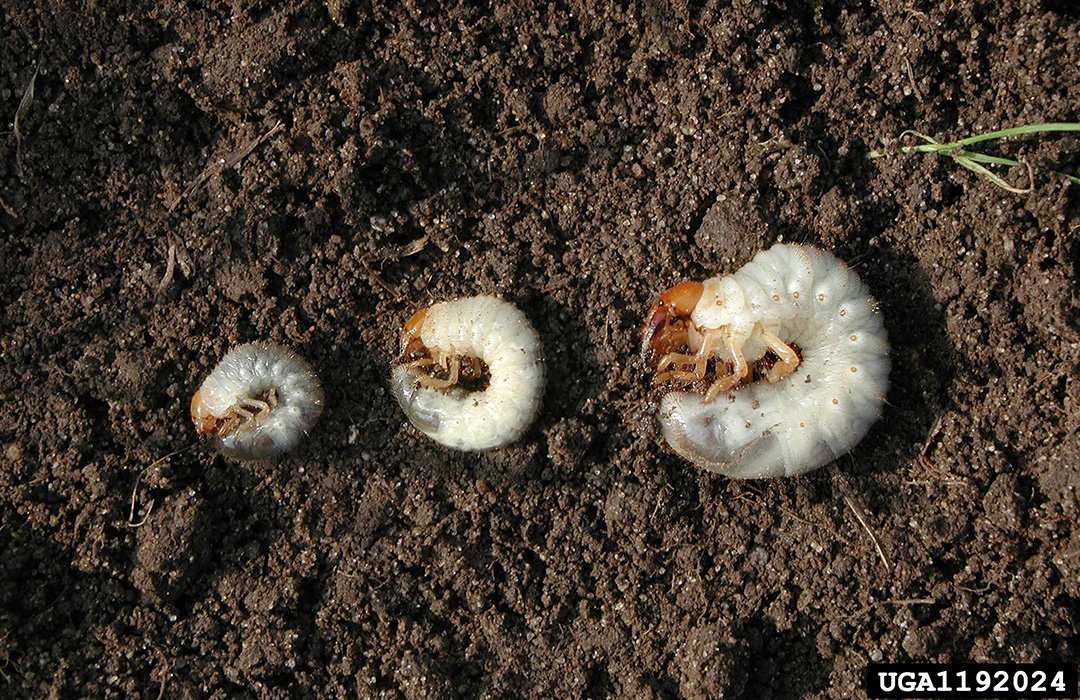
Image source: Bing (Web (fair-use with source credit))
If you're trying to identify the species, look at the raster pattern, the arrangement of tiny hairs on the abdomen tip. Japanese beetle grubs have a distinctive V-shaped pattern. European chafer grubs show a Y-shaped, randomly spaced arrangement.
Species identification isn't always necessary for treatment, but it can help with timing since different beetles lay eggs at slightly different points in summer.
How Many Grubs Is Too Many? Thresholds That Actually Matter
Not every grub in your lawn is a crisis. A small number of larvae is normal in most turf settings, and healthy grass can outgrow light feeding damage. The question is when the population crosses the line from background noise to active threat.
The generally accepted treatment threshold for most cool-season lawns is 5 to 10 grubs per square foot. Below that, the turf's natural growth usually compensates for the root loss. Above it, you'll start seeing visible damage that worsens over time, especially during dry periods when the compromised root system can't pull enough water.
For high-maintenance lawns, golf courses, or sports turf, the threshold drops. Some extension programs recommend treating at just 3 to 5 grubs per square foot for Kentucky bluegrass under intensive management. The standard is lower because the aesthetic and functional expectations are higher.
Warm-season grasses like Bermuda and zoysia are more resilient. They can often handle 10 to 15 grubs per square foot without significant decline, thanks to their aggressive spreading growth habit. St.
Augustine grass is more sensitive and may show damage at lower counts.
Season matters too. A count of 8 grubs per square foot in September is more concerning than the same count in May. Fall is when grubs are actively feeding and growing larger, doing the most damage per larva.
By spring, the grubs are mature and preparing to pupate, so feeding slows down. A spring count might look alarming but cause less actual harm.
If your sample comes back with zero grubs but the turf is still brown and lifting, look for other causes. Sod webworms, fungal root rots, or severe compaction can produce similar symptoms. The absence of grubs in your sample doesn't automatically rule them out entirely, but it should push you toward investigating other possibilities.
What Else Could Be Causing Those Brown Patches?
This is where a lot of homeowners go wrong. They see brown grass, assume grubs, and spend money on treatment that doesn't address the real problem. Before you commit to any grub control, take a few minutes to rule out these common lookalikes.
Drought stress is the number one mimic. Grass that's gone dormant from lack of water turns uniformly brown across large areas, not in irregular patches. The tug test helps here: drought-stressed grass stays firmly rooted.
A deep watering will green it back up within a week if dormancy is the cause.
Fungal diseases like brown patch, dollar spot, and Pythium blight create discolored areas that can resemble grub damage. The difference is in the details. Brown patch often shows a darker "smoke ring" border in the early morning.
Dollar spot produces small, silver-dollar-sized spots. Look closely at individual grass blades for lesions, discoloration patterns, or visible fungal growth.
Chinch bugs feed on grass stems and cause damage that looks like drought but doesn't respond to watering. They're tiny, about 1/6 inch long, and tend to concentrate in hot, sunny areas near driveways or sidewalks. You can check for them by pressing a bottomless coffee can into the soil, filling it with water, and watching for bugs that float to the surface within 10 minutes.
Dog urine creates small dead spots, usually 3 to 6 inches across, with a darker green ring around the edge where the diluted nitrogen acts as fertilizer. The pattern is concentrated in areas where pets regularly go, and the spots are much smaller and more uniform than grub damage.
Sod webworms are caterpillars that chew grass blades rather than roots. Their damage appears as closely cropped, thinning patches, often with small green fecal pellets visible in the thatch. Unlike grubs, webworm damage doesn't cause the turf to lift away from the soil.
Compacted soil and poor drainage can cause thinning and browning, especially in high-traffic areas. If the ground feels hard as concrete and water pools on the surface after rain, compaction is likely the issue. Core aeration usually solves this, not grub control.
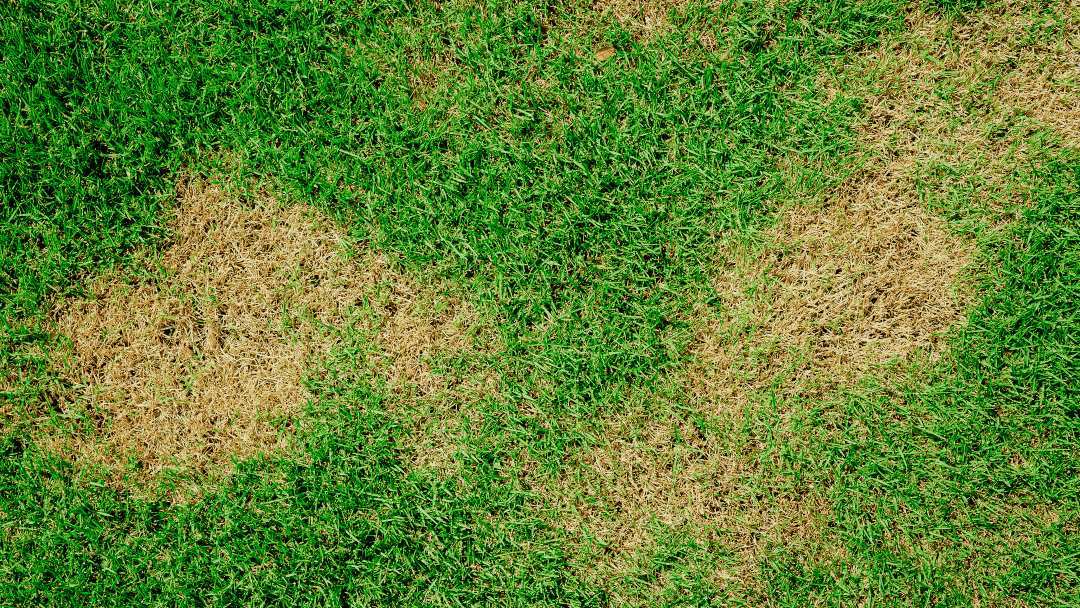
Image source: Bing (Web (fair-use with source credit))
The bottom line: if you haven't physically found grubs in your soil sample, don't treat for them. You'll waste money, introduce unnecessary chemicals into your yard, and still have a brown lawn because the real problem went unaddressed.
Choosing Between Preventive and Curative Treatment
Once you've confirmed grubs are the problem, your next decision depends on timing and what you're trying to accomplish. There are two fundamentally different approaches, and picking the wrong one wastes money and leaves your lawn unprotected.
Preventive treatment stops grubs before they cause damage. You apply it in late spring to early summer, typically June through July, before adult beetles lay their eggs. The product sits in the soil and kills young larvae shortly after they hatch.
This is the most effective strategy for lawns with a history of grub problems. Products containing chlorantraniliprole (the active ingredient in GrubEx) are the go-to preventive option. They're low-toxicity, long-lasting, and won't harm pollinators when applied to turf without flowering weeds.
Curative treatment targets grubs that are already present and feeding. You apply it in late summer to early fall, roughly August through early October, when larvae are small and actively feeding near the surface. This approach makes sense if you discover an existing infestation and need to stop it before winter.
Trichlorfon (Dylox) is the standard curative product because it works fast, killing grubs within days rather than weeks. The tradeoff is a shorter window of effectiveness and a more restricted-use classification in some states.
Here's the critical timing issue. If you apply a preventive product in September, it won't kill the grubs already in your lawn. It's designed to target newly hatched larvae, not established ones.
Conversely, applying a curative product in June does nothing because the grubs from the previous year have already pupated and flown off as beetles. Match the product to the season, or you're just watering expensive granules into the dirt.
For lawns that have never had a grub problem, preventive treatment is usually unnecessary. Save it for situations where you've had recurring infestations or where neighboring properties have documented heavy beetle activity.
Biological Options: Milky Spore, Nematodes, and When They Work
If you'd rather avoid synthetic chemicals, two biological controls are worth understanding. Neither works the way most people expect, so let's set realistic expectations.
Milky spore (Paenibacillus popilliae) is a bacterium that specifically targets Japanese beetle grubs. When larvae ingest it while feeding, they die and release billions of new spores into the soil. The catch is that it takes 2 to 4 years to build up enough concentration in the soil to be effective.
It won't help with an active infestation this season. It also works best in warmer climates, roughly USDA zones 6 and south, where soil temperatures support bacterial activity. If you're dealing with European chafer or other grub species, milky spore won't do much at all.
Beneficial nematodes are microscopic roundworms that seek out and kill grubs from the inside. Heterorhabditis bacteriophora is the species used for grub control. They're a legitimate curative option when applied correctly.
The problem is that they're finicky. They need moist soil, temperatures between 60 and 85°F, and protection from UV light. You mix them with water and spray or sprinkle them onto the lawn in the evening, then water immediately.
If the soil dries out or the nematodes sit in sunlight before application, they die. Aggregate user reviews suggest results are inconsistent, with some homeowners reporting excellent control and others seeing little effect.
Biological options work best as part of a long-term strategy, not as emergency fixes. If you've got 15 grubs per square foot right now, nematodes alone probably won't save your lawn this fall. But for moderate populations or as a follow-up to chemical treatment, they can help reduce numbers over time.
Chemical Treatments: What Works, What Doesn't, and Timing That Makes or Breaks It
Chemical grub control is effective when you match the right product to the right stage of the life cycle. Here's what actually works as of 2026.
Chlorantraniliprole (GrubEx, Acelepryn) is the standard preventive. Apply it in June or July before eggs hatch. It provides season-long control with a single application and has a favorable safety profile for non-target organisms.
It's the product most university extension programs recommend for routine prevention.
Trichlorfon (Dylox) is the go-to curative. Apply it in August or September when grubs are small and feeding near the surface. It kills within 1 to 3 days.
The downside is a short residual window, so timing has to be precise. Some states classify it as restricted-use, meaning you may need a license to purchase it.
Imidacloprid (Merit, older formulations of various brands) was the dominant preventive for years but has fallen out of favor. It's a neonicotinoid, and several states and municipalities have restricted or banned it due to concerns about pollinator exposure and environmental persistence. Check your local regulations before buying any product containing imidacloprid.
What doesn't work: spring applications of preventive products. By the time spring arrives, grubs are large, mature, and nearly done feeding. A preventive product applied in April or May won't affect them.
Save preventive treatments for summer. Also skip home remedies like dish soap soaks or garlic sprays. There's no research supporting their effectiveness against soil-dwelling larvae.
Always water in granular products according to the label. Most need about ¼ to ½ inch of water to move the active ingredient into the root zone where grubs are feeding. Without irrigation or rainfall, the granules just sit on the surface and degrade in sunlight.
Repairing Grub Damage: Overseeding vs. Sod vs. Waiting It Off
Once you've dealt with the grubs, you're left with the aftermath. Dead or thinning turf doesn't recover on its own in most cases. The roots are gone, and without them, the grass can't regenerate.
You need to actively repair the damaged areas.
Overseeding is the most common and cost-effective approach for moderate damage. Rake out the dead grass to expose the soil. Spread grass seed that matches your existing turf variety.
Keep the area consistently moist for 2 to 3 weeks until germination. Fall is the ideal time for overseeding cool-season grasses because soil temperatures are warm enough for germination but air temperatures are cool enough to reduce heat stress. Spring works too, but you'll be competing with weeds.
Sod replacement makes sense for large, heavily damaged areas where you need immediate results. Sod costs significantly more than seed, but it establishes in weeks rather than months. Cut out the dead section, loosen the soil underneath, lay the sod tightly against the surrounding turf, and water daily for the first two weeks.
The downside is cost: sod runs several times more per square foot than seed.
Waiting it off is an option only if the damage is light and your grass has strong spreading ability. Bermuda, zoysia, and Kentucky bluegrass can sometimes fill in small dead patches through lateral growth. But if the roots were completely destroyed, the turf won't come back.
You'll just have bare soil that invites weeds.
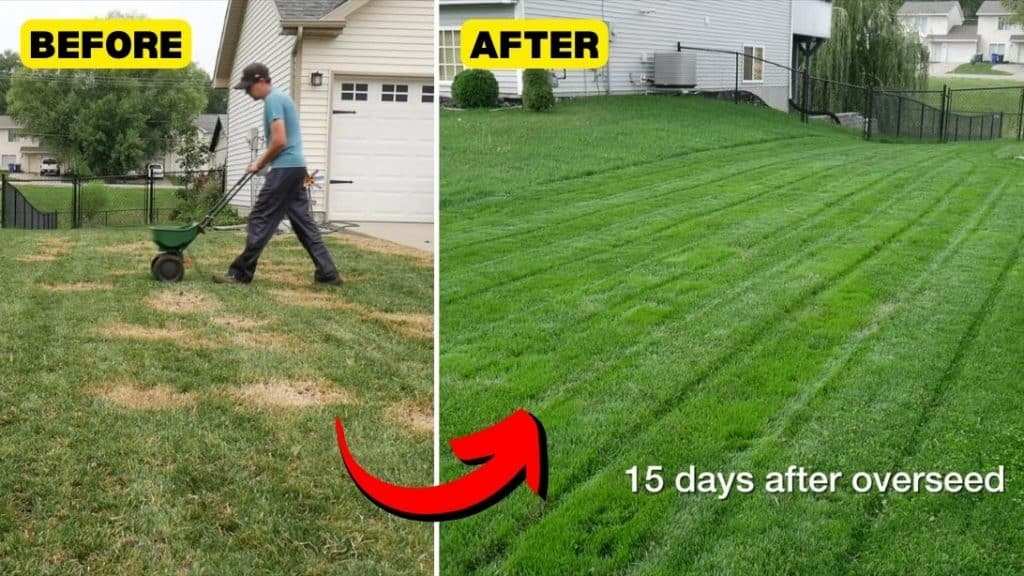
Image source: Bing (Web (fair-use with source credit))
After any repair, apply a starter fertilizer to support new growth. Keep foot traffic off the area until the new grass has been mowed at least 3 or 4 times. And plan a preventive grub treatment for the following summer to stop the cycle from repeating.
When to Call in a Professional
Most grub problems are manageable on your own, but there are situations where a licensed lawn care operator is worth the cost.
Call a professional if your infestation covers more than half the lawn, if you've tried DIY treatment and the grubs came back the following year, or if you're dealing with a species you can't identify. Pros have access to restricted-use products like trichlorfon in states where homeowners can't buy them. They also have calibrated equipment that ensures even coverage, which matters more than most people realize.
Another reason to bring in help is if you're seeing damage but can't find grubs. That could mean the grubs have already pupated and left, or it could mean the damage is from something else entirely. A turf professional can diagnose the issue and recommend the right fix without you guessing.
Get at least two quotes. Grub treatment from a lawn care company typically runs a few hundred dollars for an average-sized yard, depending on your region. Make sure the quote specifies whether it's preventive or curative, what product they're using, and whether follow-up monitoring is included.
Mistakes That Make Grub Problems Worse
The biggest mistake is treating for grubs without confirming they're there. If you haven't done a soil sample and counted larvae, you're guessing. You'll waste money and still have a brown lawn because the real problem went unaddressed.
Another common error is applying preventive products in fall. Chlorantraniliprole won't kill established grubs. It targets newly hatched larvae.
If you apply it in September, you're too late for that season's population.
Overwatering after treatment can also reduce effectiveness. Most granular products need about ¼ to ½ inch of water to move into the root zone. More than that and you're washing the active ingredient below where grubs are feeding.
Finally, don't skip the repair step. Killing the grubs solves the immediate threat, but the dead turf won't recover on its own. Without overseeding or sodding, you're just left with bare soil and a weed problem by spring.
Your Seasonal Grub Action Plan
Here's a simple timeline that keeps you ahead of the life cycle:
- June to July: Apply preventive treatment if your lawn has a history of grub problems. Water it in according to the label.
- August to September: If you suspect an active infestation, do the tug test and dig samples. Apply curative treatment if counts exceed the threshold.
- September to October: Repair damaged areas by overseeding or sodding. Keep new seed consistently moist.
- May: Monitor for animal digging and late-season damage. Don't apply preventive products now, they won't help at this stage.
Stick to this schedule and you'll stay ahead of the beetles instead of reacting after the damage is done.
Frequently Asked Questions
Can I treat for grubs in spring?
Spring treatment is generally not effective. By spring, grubs are mature and nearly done feeding. Preventive products applied now won't affect them.
Save preventive applications for June or July.
How long does it take for grub damage to show up?
Damage typically becomes visible 4 to 6 weeks after larvae begin feeding in late summer. You'll notice it most in September and October when grubs are largest and feeding heavily.
Will grub damage repair itself?
Light damage on aggressive grasses like Bermuda or zoysia may fill in on its own. Heavily damaged areas with destroyed root systems won't recover without overseeding or sodding.
Are grub treatments safe for pets?
Most modern grub products, including chlorantraniliprole, are considered low-toxicity to mammals once watered in and dried. Always follow the label's specific guidance for pet re-entry intervals.
What's the difference between grub damage and fungus?
Grub-damaged turf pulls up easily because roots are gone. Fungal diseases usually show patterns on the grass blades themselves, like lesions, rings, or discoloration, and the turf stays rooted when tugged.