Here's a scenario you've probably run into. You're staring at brown patches in your lawn, pulling back a section of sod, and finding those fat, C-shaped white grubs curled up in the dirt. Then you remember you've got a bottle or bag of Sevin somewhere in the garage.
Does sevin insect killer kill grubs? The answer isn't a simple yes or no. It hinges on which Sevin product you're holding, what time of year it is, and what stage of its life cycle that grub is in.
Carbaryl, the active ingredient in all Sevin products, is a contact and stomach poison insecticide that's been used in home lawn care for decades. But not every product carrying the Sevin name is registered for grub control, and even the right formulation works poorly if you treat at the wrong time of year. Let's break down exactly what you need to know before you spend money on a treatment that might not deliver.

Image source: Wikimedia Commons / Сарапулов (CC BY)
Quick Answer
Yes, certain Sevin products kill grubs, but not all of them are labeled for it.
Sevin Lawn Insect Granules specifically list white grubs on the label. Sevin Ready-To-Spray and Ready-To-Use do not list grubs on their labels.
Timing matters as much as product choice. Treat late July through early September when grubs are small and feeding near the surface.
Carbaryl has a short soil residual. It works as a curative rescue treatment, not a long-term preventative. For lasting prevention, a product like chlorantraniliprole applied in early to mid-summer gives superior results.
What's Actually in Sevin — and Why That Matters for Grubs
Every product under the Sevin brand contains the same active ingredient: carbaryl. Carbaryl belongs to a class of insecticides called organocarbates, sometimes shortened to carbamates. It works by interfering with nerve signal transmission in insects.
When a grub ingests or comes into direct contact with carbaryl-treated soil or plant material, its nervous system overstimulates and it dies.
Here's what makes carbaryl both useful and limited for grub control. It's a contact and stomach poison, meaning it works when grubs eat treated material or physically encounter the chemical. It does not have strong systemic movement through plant the way neonicotinoids like imidacloprid do.
The insecticide stays in the upper soil zone where it's applied. Its soil half-life in typical conditions ranges from roughly 7 to 14 days, depending on microbial activity, moisture, and temperature. That's a relatively short window of protection compared to alternatives like chlorantraniliprole, which can persist in the soil for several months when applied preventatively.
The practical takeaway: carbaryl-based Sevin products work best as curative treatments when grubs are actively feeding and accessible near the soil surface. Don't expect months of control. You're knocking down the current population, not creating a protective barrier for next season.
Which Sevin Products Are Labeled for Grubs (and Which Aren't)
This is where most people get tripped up. "Sevin" is a brand name, not a single formulation. GardenTech manufactures several distinct products under that umbrella, and each one carries its own EPA registration number and label.
The label is the legal document that determines which pests a product can be used against.
Here are the main variants you'll find on store shelves as of 2026:
Sevin Lawn Insect Granules
This is the one you want for grub control. The label specifically lists white grubs among its target pests. It's formulated as a granular product meant to be broadcast over the lawn with a spreader, then watered in to move the active ingredient into the root zone where grubs feed.
The concentration and inert ingredients are designed for soil contact.
Sevin Ready-To-Spray and Ready-To-Use
These are hose-end or pump spray formulations designed for foliar application on ornamental plants, vegetables, and fruit trees. Their labels target above-ground pests like aphids, caterpillars, and beetle adults. Grubs do not appear on these labels.
Spraying your lawn with this product will do almost nothing to grubs living below the soil surface. The insecticide isn't formulated to penetrate thatch and soil effectively.
Sevin Concentrate
This is a liquid you mix with water and apply with a pump sprayer. The label varies by specific product, but Sevin Concentrate formulations are generally registered for above-ground insect control on ornamentals, lawns, and listed edible crops. Some older formulations listed more soil insects, but current labels may not include grubs.
Always check the specific product label before assuming.
The bottom line is straightforward: if the word "grub" doesn't appear on the label of the Sevin product you bought, it's not the right product for this job. You need the Lawn Insect Granules version with grubs listed on the label.
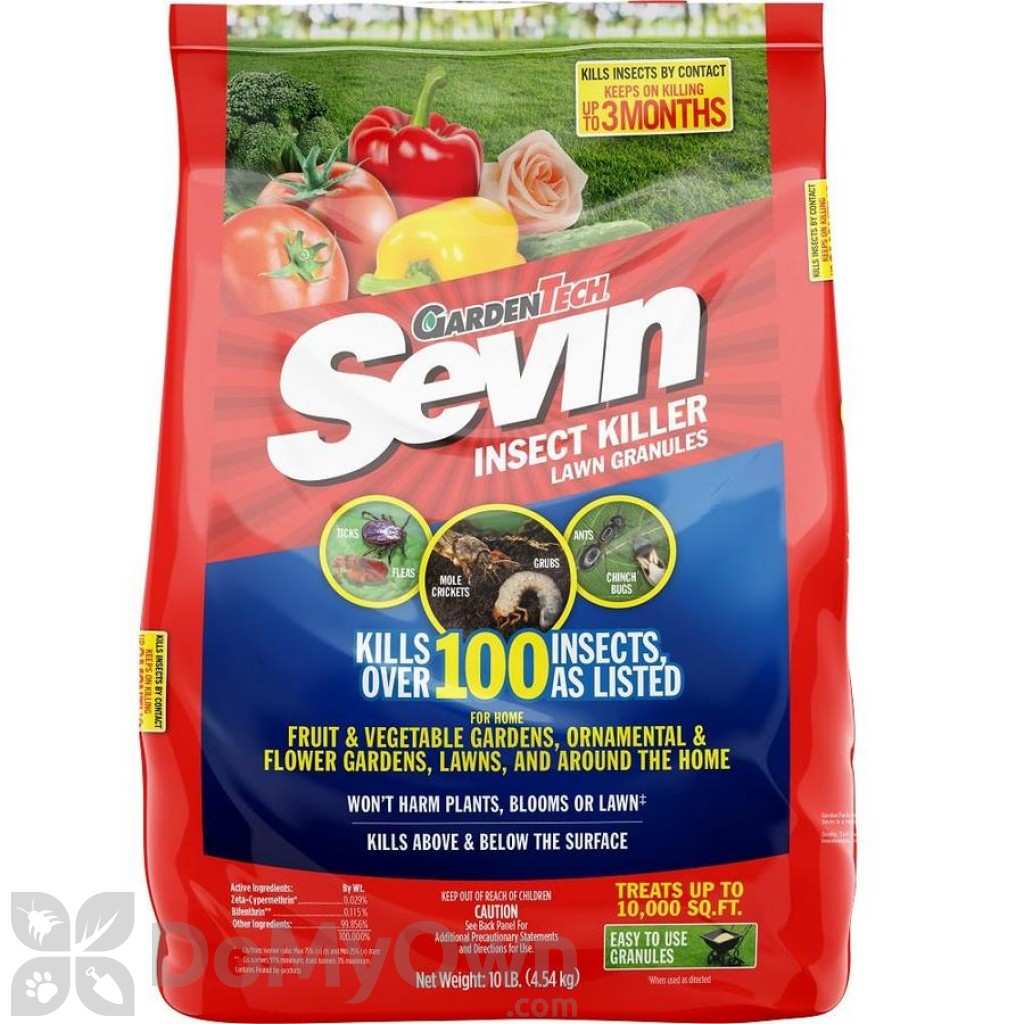
Image source: Bing (Web (fair-use with source credit))
The Grub Life Cycle: Why Timing Makes or Breaks Your Treatment
The single most important factor in whether Sevin works against grubs has nothing to do with the product itself. It's all about when you apply it relative to the grub's life cycle. Understanding this pattern will save you wasted money and frustration.
Late spring through early summer (May to June): Adult beetles like Japanese beetles, European chafers, and June bugs emerge from the soil. They mate, feed on ornamental plants, and females burrow back into turf to lay eggs. Grubs have not hatched yet.
Treating with carbaryl now gives you zero control because there are no grubs present. This is the window to apply a preventative like GrubEx (chlorantraniliprole) if you want to stop the next generation before it starts feeding.
Mid to late summer (late July through August): Eggs hatch into first and second instar grubs, the youngest and smallest larval stages. These tiny grubs are feeding actively close to the soil surface, making them the most vulnerable target for a contact insecticide like carbaryl. This is your prime window for Sevin Lawn Granules as a curative treatment.
Early fall (September to October): Grubs are still feeding but continue growing into third instar stage. They're larger, more resilient, and beginning to move deeper into the soil as temperatures drop. Curative treatments can still work in early September in most regions, but efficacy declines as grubs grow and dive deeper.
Late fall through early spring (November to March): Grubs have moved below the frost line or into deep soil layers to overwinter. They are essentially unreachable by surface-applied insecticides. Treating now is futile.
You'll need to wait until they return to the root zone in spring, then treat during the next summer feeding window.
Key insight from turfgrass research at multiple university extension programs: treating during the young grub stage in late summer gives you the best kill rates. Waiting until you see visible lawn damage in fall often means grubs are already large and harder to control with short-residual products like carbaryl.
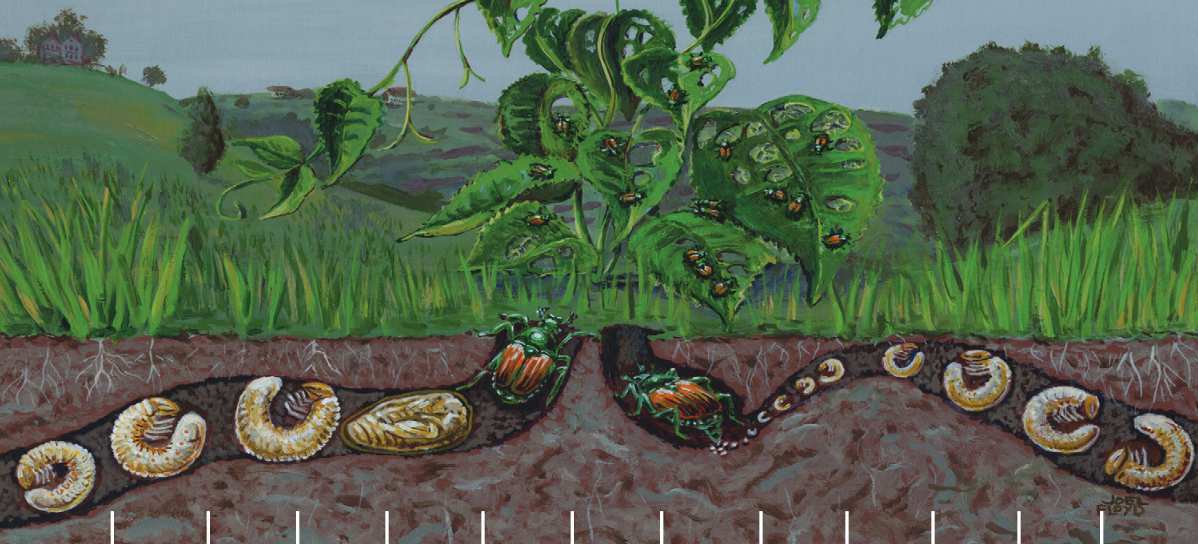
Image source: Wikimedia Commons / Joel Floyd
When to Apply Sevin for Grubs — and When It Won't Work
Now let's match that life cycle to real-world timing in different regions. The specific weeks shift based on your climate zone, but the principles stay constant.
Northern states (Zone 4-5): Peak grub vulnerability typically falls between late July and the end of August. By mid-September, European chafer grubs in particular are already diving deep. If you're a week late with your treatment, you're already losing efficacy.
Mid-Atlantic and Midwest (Zone 5-6): The window extends from late July into early September. Japanese beetle grubs are the dominant species here, and their hatching is tied to adult beetle activity you can actually watch for in July.
Southern states (Zone 7-9): Warm-season grasses and different beetle species shift the timeline. Some regions see two grub generations per year in extreme southern climates. First instar grubs may appear as early as late June.
Northern masked chafers can also be a factor in the transition zone.
When Sevin definitely won't work:
- If you're applying it to grubs that have already burrowed deep for winter dormancy
- If you're using a Sevin spray product instead of the granular formulation
- If you're treating beetle adults flying around your roses (that's a different pest stage entirely)
- If the product you bought doesn't list grubs on the label
- If you're applying during heavy drought when grubs have stopped feeding
When Sevin works well:
- Grubs are small (under half an inch), actively feeding, and within the top 1-2 inches of soil
- You've confirmed grub presence by lawn inspection
- Temperatures are warm enough that grubs are feeding regularly
- You water the product in properly after application
- You're treating within the recommended seasonal window
There's a practical way to use this timing logic. If you noticed adult beetles swarming your yard in June or July, plan to check your lawn for grubs about four to four and a half weeks later. That's when the newest hatchlings will be feeding and most susceptible to carbaryl treatment.
Step-by-Step: How to Apply Sevin Lawn Granules for Grubs
Once you've confirmed you have the right product and the right timing, application technique determines whether the treatment actually reaches the target. Carbaryl granules sitting on top of dry thatch won't kill anything. Here's the process that gives you the best results.
Step 1: Mow the lawn first. Cut your grass to normal height before applying. This removes surface debris and lets granules fall through to the soil more easily. Bag the clippings or rake them lightly so they don't create a barrier.
Step 2: Check thatch depth. If your thatch layer is thicker than half an inch, granules will struggle to reach the soil where grubs live. Rent a dethatcher or power rake if needed. Thick thatch is one of the most common reasons grub treatments fail, regardless of which product you use.
Step 3: Calibrate your spreader. Use a broadcast or drop spreader and set it to the rate specified on the Sevin Lawn Granules label. The typical application rate covers a set number of square feet per pound of product, but always follow the specific label on your bag. Over-applying wastes product and increases environmental risk.
Under-applying leaves gaps in coverage.
Step 4: Apply evenly. Walk at a steady pace and overlap your passes slightly to avoid streaks. Treat the entire lawn, not just the visibly damaged areas. Grubs often spread beyond the brown patches you can see from the sidewalk.
Step 5: Water in thoroughly. This is the step most people skip or do wrong. Apply a quarter to half inch of water after broadcasting granules. This washes the active ingredient off the granule carrier and moves it into the root zone where grubs are feeding.
Don't flood the area. You want penetration, not runoff.
Step 6: Keep pets and kids off the lawn until the surface is dry. Once watered in and dried, the treated area is safe for normal use per label directions. But during the wet application phase, keep everyone off.
Step 7: Wait and assess. Carbaryl works relatively fast as a contact poison. You should see reduced grub activity within 24 to 48 hours. If you're still finding live, active grubs after a week, you may have a heavy infestation that needs a second application.
Check the label for the minimum reapplication interval before treating again.
How to Tell If You Actually Have a Grub Problem
Before you buy any product, confirm that grubs are the real culprit. Brown lawn patches have multiple causes, and treating for grubs when your issue is fungal disease or drought stress wastes time and money.
The tug test: Grab a handful of brown grass and pull. If the sod lifts up easily like a loose carpet, grubs have likely chewed through the roots. Healthy grass, even when brown from drought, still anchors firmly to the soil.
The cut-and-peel method: Use a shovel to cut three sides of a one-foot square of sod in a damaged area. Peel it back and examine the top 2 inches of soil. Count the grubs you find.
Here's the threshold that matters:
| Grubs per sq ft | Action needed |
|---|---|
| 0 to 4 | Usually tolerable. Monitor but don't treat. |
| 5 to 9 | Borderline. Treat if lawn is high-value or stressed. |
| 10 or more | Treat. Damage will likely worsen without intervention. |
Look for secondary signs. Skunks, raccoons, and armadillos digging up your lawn at night are often foraging for grubs. Bird activity on the lawn, especially starlings and grubs, can also indicate a grub population below the surface. These animals cause their own damage, sometimes worse than the grubs themselves.
Rule out other causes. Fungal diseases like brown patch or dollar spot create circular patterns but won't show grubs when you peel back the sod. Drought-stressed grass will feel dry and brittle at the base but roots remain intact. Pet urine damage creates a dark green ring around a dead center, a pattern grubs don't produce.
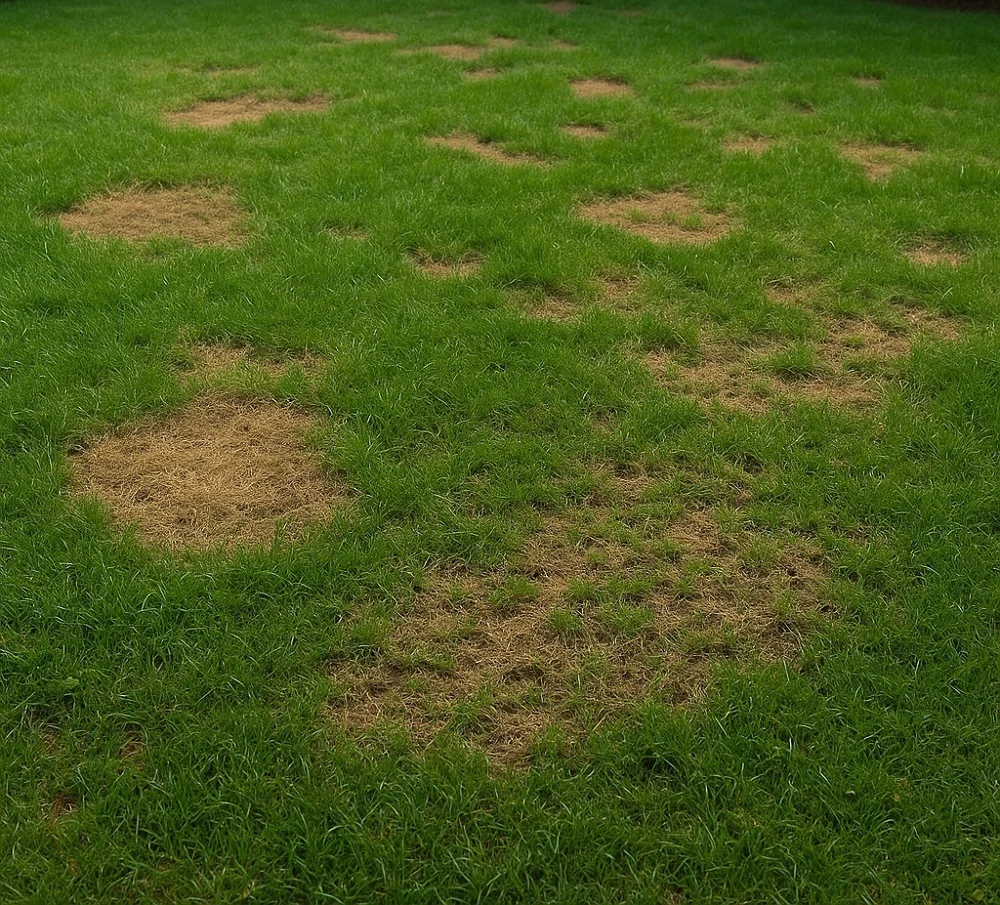
Image source: Bing (Web (fair-use with source credit))
Sevin vs. Other Grub Killers: Which One Fits Your Situation
Sevin isn't the only option, and it's not always the best one. The right choice depends on your timing, your goals, and what you're willing to spend.
Sevin Lawn Granules (carbaryl)
Best for curative treatment when you've already found grubs and need a fast knockdown. It's affordable, widely available, and works quickly on young grubs. The downside is short residual.
You're not getting months of protection. You'll pay roughly $15 to $25 for a bag covering several thousand square feet.
GrubEx (chlorantraniliprole)
Best for preventative control. Apply in early to mid-summer before eggs hatch, and it provides season-long protection. It's more expensive per application, typically $25 to $40 for a similar coverage area, but one treatment often does the job.
This is the go-to recommendation from most university extension services for homeowners who want a set-it-and-forget-it approach.
Dylox (trichlorfon)
Best for late-season curative treatment when grubs are large and other products are losing effectiveness. Dylox works faster than most alternatives on third instar grubs and remains effective into early fall. It's harder to find at retail and usually costs more than Sevin.
Beneficial nematodes (Heterorhabditis bacteriophora)
Best for organic-minded homeowners willing to accept variable results. These microscopic organisms seek out and kill grubs naturally. They require precise soil temperatures above 60°F, adequate moisture, and careful handling.
Success rates vary significantly by application conditions.
Milky spore (Paenibacillus popilliae)
Best for long-term Japanese beetle grub management in warm climates. It's a bacterial disease that specifically targets Japanese beetle larvae. It takes two to three years to establish in the soil but can persist for a decade or more.
It does not work on European chafers or other grub species.
| Product | Type | Best timing | Residual | Cost range |
|---|---|---|---|---|
| Sevin Granules | Curative | Late July to August | 1-2 weeks | $15-25 |
| GrubEx | Preventative | May to early July | 3-4 months | $25-40 |
| Dylox | Curative | August to early October | 1-2 weeks | $30-50 |
| Nematodes | Biological curative | August to September | Variable | $25-50 |
Common Mistakes That Make Sevin "Not Work" on Grubs
When homeowners say "I used Sevin and it didn't work," the product is rarely the actual problem. One of these mistakes is almost always the real culprit.
Using the wrong Sevin product. As covered earlier, the Ready-To-Spray and Ready-To-Use formulations are not labeled for grubs. Spraying your lawn with these products gives you essentially zero soil penetration. You're treating the grass blades, not the root zone.
Treating too late in the season. By October in most regions, grubs have moved below the effective reach of surface-applied carbaryl. The product is sitting in the top inch of soil while grubs are three inches down and heading deeper.
Not watering in after application. Granules need water to release the active ingredient and move it into the soil profile. Dry granules on the surface do nothing. This is probably the single most common application error across all granular lawn insecticides.
Applying during drought. Grubs stop feeding during extended dry periods. They curl up and become inactive. A contact stomach poison only works when grubs are actively ingesting treated material.
If the soil is bone dry, wait for rain or irrigate first, then treat.
Ignoring thatch. A thick thatch layer acts like a sponge, absorbing granules before they reach the soil. If your thatch is over half an inch, dethatch before treating. Otherwise you're feeding your thatch layer, not killing grubs.
Expecting preventative control from a curative product. Carbaryl breaks down in soil within one to two weeks under normal conditions. It does not create a lasting barrier. If you treat in August and new eggs hatch in September, those new grubs won't encounter any residual activity.
That's not a product failure. That's a fundamental difference between curative and preventative chemistry.
Over-applying. More is not better. Exceeding the labeled rate doesn't improve grub kill. It increases runoff risk, environmental contamination, and cost.
Follow the label rate precisely.
Safety, Pets, and Pollinators: What You Need to Know Before Applying
Carbaryl carries a CAUTION signal word on most Sevin products, placing it in EPA Toxicity Category III. That's the lowest acute toxicity rating for pesticide products. But "lower toxicity" doesn't mean "no precautions."
Pets: Keep dogs and cats off the lawn during application and until the treated area is completely dry. Once granules are watered in and the grass has dried, the risk to pets drops dramatically per label directions. Carbaryl is toxic to dogs and cats if ingested in large quantities, so don't let them eat granules directly off the lawn.
Pollinators: Carbaryl is highly toxic to bees. Do not apply Sevin granules to flowering clover, dandelions, or any blooming weeds in your lawn. If your lawn has significant bloom, mow first to remove flowers, then apply.
Apply in early morning or late evening when bees are less active.
Children: Keep kids off the lawn during application and until dry. Once the surface is dry, normal play is fine per label guidance. Wash hands after contact with treated turf.
Water sources: Do not apply near storm drains, wells, ponds, or streams. Carbaryl is toxic to aquatic organisms. Avoid application if heavy rain is forecast within 24 hours, as runoff can carry granules into waterways.
Personal protection: Wear long sleeves, long pants, and chemical-resistant gloves during application. Wash hands thoroughly after handling the product. The label is the legal requirement, not a suggestion.
Read it every time.
Storage: Keep the product in its original container in a cool, dry location out of reach of children and pets. Do not transfer granules to unlabeled containers.
When to Call a Pro Instead of DIY
Most grub problems are manageable on your own. But there are situations where a licensed pesticide applicator is worth the cost.
Call a professional if your infestation covers more than half your lawn. Large-scale treatments require commercial-grade equipment and calibrated application rates that are hard to achieve with a home spreader. Pros also have access to products not available at retail.
Call if you've tried Sevin twice and grubs persist. You may have a species that's less susceptible to carbaryl, or your timing is consistently off. A pro can identify the grub species and adjust the treatment plan accordingly.
Call if you have a water feature on your property. Applying any insecticide near ponds, streams, or drainage systems requires precision that reduces runoff risk. Licensed applicators are trained in buffer zone management.
Call if you're dealing with a mixed pest problem. Grubs plus chinch bugs plus sod webworms in the same season often requires a combination treatment strategy that's beyond a single-product approach.
Professional grub treatments typically run $50 to $100 per application depending on your region and lawn size. Many companies offer seasonal lawn care programs that include grub prevention as part of a broader plan.
Final Decision Guide: Should You Use Sevin for Your Grubs?
Here's a straightforward framework to help you decide.
Use Sevin Lawn Granules if:
- You've confirmed grubs by cutting and peeling back sod
- Grubs are present at 5 or more per square foot
- It's late July through August and grubs are small
- You need a fast, affordable curative treatment
- You're willing to water in properly after application
Skip Sevin and use GrubEx instead if:
- You want preventative control for next season
- You're reading this in May or June before grubs hatch
- You prefer one application over multiple treatments
- You're willing to pay more upfront for longer protection
Skip Sevin and use Dylox instead if:
- It's September or early October and grubs are large
- You've already tried carbaryl without success
- You need a curative option that works later into fall
Skip chemical treatments entirely if:
- You have fewer than 5 grubs per square foot
- Your lawn is otherwise healthy and can tolerate minor root feeding
- You prefer biological options like nematodes or milky spore
- You're willing to accept a longer timeline for control
The honest truth is that Sevin Lawn Granules do kill grubs when used correctly. The product works. But "correctly" means the right product variant, the right timing, proper application, and realistic expectations about residual control.
Get those four things lined up and you'll see results. Get any one of them wrong and you'll think the product failed when the process did.
Frequently Asked Questions
How long does it take for Sevin to kill grubs?
Carbaryl works as a contact and stomach poison, so grubs typically die within 24 to 48 hours of ingesting or encountering treated soil. You may see reduced feeding activity even sooner. If you're still finding active, healthy grubs after a week, the treatment likely missed them due to poor timing, thick thatch, or insufficient watering.
Can I use Sevin on my vegetable garden for grubs?
Sevin Concentrate is labeled for use on certain edible crops, but the specific crop and pre-harvest interval must be listed on the label. Sevin Lawn Granules are formulated for turf, not garden beds. Always check the specific product label for approved uses and waiting periods before harvest.
Is Sevin safe for pets after it dries?
Per label directions, once granules are watered in and the lawn surface is dry, the risk to pets drops significantly. Keep dogs and cats off the lawn during application and until it's completely dry. Don't let pets eat granules directly from the surface.
Will Sevin kill adult Japanese beetles?
Sevin products labeled for ornamental use will kill adult beetles on contact. But controlling adults doesn't solve your grub problem. Adults fly in from surrounding areas, so spraying your yard for beetles provides temporary relief at best.
Targeting grubs in the soil is the more effective long-term strategy.
Can I apply Sevin granules when it's raining?
Don't apply during heavy rain, as runoff carries the product into storm drains and waterways. Light rain after application can actually help water the product in. The ideal scenario is applying during dry conditions, then irrigating afterward with a quarter to half inch of water.
How often can I reapply Sevin for grubs?
Follow the specific reapplication interval on your product label. Most Sevin Lawn Granules labels allow a second application if needed, but there's typically a minimum wait between treatments. Over-applying doesn't improve results and increases environmental risk.