You've woken up to small, cone-shaped holes punched across your lawn. The turf is torn up in patches, and you're wondering what's going on underground. The short answer to "do skunks eat grubs" is yes, absolutely, and they're remarkably good at finding them.
But the full picture matters more than a simple yes, because treating the wrong problem wastes money and leaves your lawn looking worse.
A single striped skunk can consume several hundred grubs in one night of foraging. That's a lot of natural pest control, but the damage they leave behind can be frustrating. Understanding what's actually attracting skunks to your yard, and whether grubs are even the culprit, is the first step toward fixing this without making things worse.

Image source: Bing (Web (fair-use with source credit))
Quick Answer
Yes, skunks eat grubs. White grubs, the larvae of beetles like Japanese beetles and European chafers, are a primary food source for striped skunks during summer and fall. Skunks dig shallow, cone-shaped holes in lawns to reach grubs living just below the soil surface.
A single skunk can eat hundreds of grubs per night. However, grubs are not the only reason skunks visit your yard.
Why This Matters More Than You Think
Most homeowners see the digging and immediately assume they have a grub problem. That's a reasonable guess, but it's not always the right one. Skunks are opportunistic omnivores, which means they'll eat whatever is easiest to find.
Grubs are high on the list, but so are fallen fruit, pet food left outside, unsecured garbage, and even earthworms.
Here's where it gets tricky. You might treat your lawn for grubs and still have skunks showing up because the real attractant is the bag of kibble on your back porch. Or you might have a genuine grub infestation that's destroying your turf roots, and the skunks are just a symptom of that deeper issue.
Telling the difference saves you time, money, and a lot of frustration.
There's also a safety angle. Skunks are one of the primary wildlife carriers of rabies in the United States, according to the Centers for Disease Control. Getting too close, trying to trap one yourself, or startling a skunk near your pets is a genuine risk.
Knowing what's drawing them in helps you address the root cause without putting yourself in a risky situation.
The Straight Answer: Yes, Absolutely
Let's settle this clearly. Skunks eat grubs, and they eat a lot of them. White grubs, specifically the larvae of scarab beetles like Japanese beetles (Popillia japonica), June beetles (Phyllophaga species), and European chafers (Amphimallon majale), are a staple in the striped skunk's diet during the warmer months.
Skunks locate grubs using their strong sense of smell. They can detect larvae several inches below the soil surface. Once they've found a concentration, they dig down with their long front claws and extract the grubs efficiently.
This foraging behavior peaks in late summer and early fall, which is when grub populations are at their highest and most accessible in the top few inches of soil.
Research from cooperative extension programs consistently identifies grubs as one of the top food sources for skunks in residential areas. A study from the University of Nebraska-Lincoln notes that insects and their larvae make up a significant portion of the skunk's diet, with white grubs being particularly favored when available in turf environments.
The digging damage is real, but it's worth noting that skunks are actually providing a service. They're reducing the grub population that would otherwise destroy your lawn's root system. The problem is the method.
They don't exactly tiptoe through the grass to get their dinner.
What Skunks Actually Eat (Grubs Are Just the Start)
Grubs are a favorite, but they're far from the only thing on the menu. Skunks are true omnivores with a diet that shifts based on what's available seasonally. Understanding their full dietary range helps you figure out what's actually bringing them to your property.
Here's a breakdown of what skunks commonly eat:
- Insects and larvae: White grubs, beetles, crickets, grasshoppers, and other soil-dwelling insects make up a large portion of their diet, especially in summer.
- Small rodents: Mice, voles, and young rats are actively hunted, particularly in fall and winter when insect availability drops.
- Fruit and berries: Fallen fruit from trees, berry bushes, and garden vegetables are easy targets.
- Pet food and bird seed: Outdoor pet bowls and spilled bird seed under feeders are major attractants in residential areas.
- Garbage: Unsecured trash cans provide a reliable, calorie-dense food source.
- Earthworms: In moist soil conditions, earthworms can be just as attractive as grubs.
- Carrion: Skunks will scavenge dead animals when the opportunity arises.
The key takeaway is that removing grubs alone might not solve your skunk problem. If you've got accessible garbage, outdoor pet food, or fruit trees dropping produce, skunks have plenty of reasons to keep visiting. A comprehensive approach works better than a single-target solution.
How Skunks Damage Your Lawn Looking for Grubs
Skunk digging has a distinctive pattern that's relatively easy to identify once you know what to look for. The damage is different from what raccoons, squirrels, or moles do, and recognizing the difference helps you diagnose the problem correctly.
Skunk holes are typically shallow and cone-shaped, about 3 to 5 inches in diameter at the surface. They only dig down a few inches because that's where grubs live in the top layer of soil. The holes are scattered across the lawn rather than concentrated in one area, and you'll often see multiple holes in a single night of foraging.
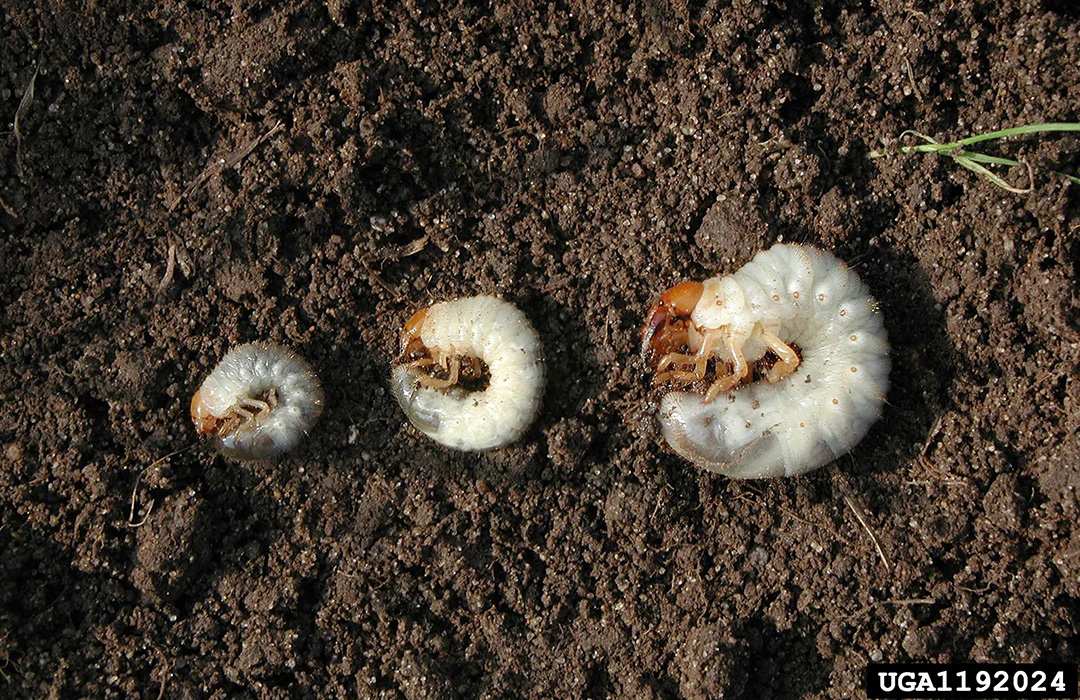
Image source: Bing (Web (fair-use with source credit))
Here's how skunk damage compares to other common lawn pests:
| Pest | Hole Shape | Depth | Pattern | Other Signs |
|---|---|---|---|---|
| Skunk | Cone-shaped, 3-5 inches wide | 2-4 inches | Scattered, multiple per night | Ripped turf, smell of skunk spray |
| Raccoon | Rolled-back sod patches | Deeper, more destructive | Larger sections peeled back | Torn-up areas, often near trees |
| Mole | Raised ridges and mounds | Underground tunnels | Linear trails across lawn | Volcano-shaped mounds |
| Squirrel | Small, shallow holes | 1-2 inches | Near trees or garden beds | Buried nuts, scattered dirt |
The damage from skunk foraging is mostly cosmetic in the short term. The turf can usually recover if the grub population is addressed and the digging stops. But repeated nightly visits over weeks can kill patches of grass, especially if the grub damage to roots is already severe.
That's when you're dealing with a double problem: grubs destroying roots from below and skunks tearing up the surface from above.
How to Tell If Skunks or Grubs Are Your Real Problem
Before you spend money on grub control products or call a wildlife removal service, you need to confirm what's actually happening in your yard. Jumping to conclusions is the most expensive mistake homeowners make with this issue.
Start with the tug test. Grab a section of damaged turf and pull upward. If the grass lifts easily like a loose carpet, grubs have likely chewed through the root system underneath.
Healthy turf with intact roots stays firmly anchored even when you tug on it.
Next, do a direct grub count. Cut a 1-foot by 1-foot square of sod in a damaged area and peel it back. Count the white grubs you find in the exposed soil.
Cooperative extension services generally recommend treatment when you find 6 to 10 grubs per square foot. Below that threshold, your lawn can usually tolerate the population without significant damage.
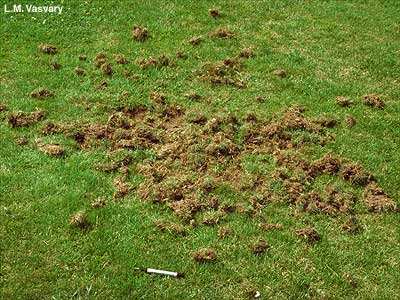
Image source: Bing (Web (fair-use with source credit))
Also consider the timing. Skunk foraging for grubs peaks from August through October in most regions, when grub larvae are large and feeding actively near the surface. If you're seeing digging damage in early spring, the cause might be different.
Spring digging often targets overwintering grubs moving back toward the surface, or it could be skunks hunting earthworms in moist soil.
Look for other attractants around your property while you're investigating. Open garbage cans, outdoor pet food bowls, compost piles, and fallen fruit are all skunk magnets. If you find these present alongside the digging, you might have multiple attractants working together.
Addressing just one won't fully solve the problem.
Grub Count Thresholds: When Treatment Actually Makes Sense
Not every grub in your lawn requires action. Healthy turf can tolerate a low-level grub population without visible damage. Understanding the treatment thresholds helps you avoid unnecessary pesticide applications and focus your efforts where they'll actually make a difference.
The general guideline from university extension programs is straightforward:
- 0-5 grubs per square foot: No treatment needed. Your lawn can handle this level naturally.
- 6-10 grubs per square foot: Consider treatment, especially if you're also seeing skunk digging or other animal foraging.
- 10+ grubs per square foot: Treatment recommended. At this density, grubs are actively damaging root systems and your lawn will show visible decline.
These thresholds assume average lawn health. If your turf is already stressed from drought, poor soil, or heavy foot traffic, even a moderate grub population can cause noticeable damage. In those cases, you might want to treat at lower counts.
It's also worth noting that grub species vary in their destructiveness. Japanese beetle larvae tend to cause more visible damage than some native species because they feed in larger concentrations and have a longer feeding window. European chafer larvae are particularly aggressive in the Northeast and Midwest, often requiring treatment at lower thresholds.
If your grub count is below the threshold but skunks are still digging, the solution might be deterring the skunks rather than treating the lawn. That's a different approach entirely, and we'll cover it in the sections ahead.
Choosing the Right Grub Control Method
Once you've confirmed that grubs are present at treatment-level densities, you have several options. Each approach has different timelines, effectiveness levels, and environmental considerations. The right choice depends on your grub count, your timeline, and your comfort with different product types.
Chemical insecticides offer the fastest results. Products containing chlorantraniliprole (found in some professional-grade lawn treatments) are effective at lower application rates and have a favorable environmental profile compared to older chemistries. These work best when applied in late summer while grubs are small and actively feeding near the surface.
Imidacloprid-based products are also available but have faced increasing scrutiny due to impacts on pollinators, so timing and application method matter significantly.
Beneficial nematodes are microscopic roundworms that actively hunt and kill grubs in the soil. Heterorhabditis bacteriophora is the species most effective against white grubs. You mix them with water and apply them to moist soil using a sprayer or watering can.
They require soil temperatures above 60°F and consistent moisture to survive and do their work. Results typically appear within 1 to 3 weeks after application.
Milky spore disease (Paenibacillus popilliae) is a bacterial treatment that specifically targets Japanese beetle grubs. It doesn't work on European chafer or other grub species. The advantage is longevity.
Once established in your soil, milky spore can remain effective for 10 to 15 years. The downside is patience. It takes 2 to 3 years to build up enough concentration in the soil to significantly reduce grub populations.
Here's a quick comparison:
| Method | Speed of Results | Duration of Control | Species Targeted | Environmental Impact |
|---|---|---|---|---|
| Chemical (chlorantraniliprole) | 1-2 weeks | Single season | Broad-spectrum | Low-moderate |
| Beneficial nematodes | 1-3 weeks | Single season (may reapply) | Broad-spectrum | Very low |
| Milky spore | 2-3 years to establish | 10-15 years once established | Japanese beetle only | Very low |
Milky Spore vs. Beneficial Nematodes vs. Chemical Treatments
Let's dig deeper into the three main approaches so you can match the right method to your situation.
Milky spore is a long-game strategy. You apply it once, ideally in late summer, and wait for the bacteria to multiply in the soil as grubs ingest it during feeding. Infected grubs die and release billions of new spores back into the soil, creating a self-sustaining cycle.
It's ideal if you have a confirmed Japanese beetle grub problem and you're willing to wait for results. It won't help with European chafer or other species, so proper grub identification matters before you invest.

Image source: Wikimedia Commons / Peggy Greb, USDA Agricultural Research Service, Bugwood.org (CC BY)
Beneficial nematodes are the middle ground. They work faster than milky spore but require more attention to application conditions. You need to apply them to moist soil in the evening (they're sensitive to UV light), and the soil needs to stay consistently damp for about two weeks afterward.
They actively seek out grubs and enter their bodies, releasing bacteria that kill the host within 24 to 48 hours. They're safe around pets, children, and beneficial insects like earthworms.
Chemical treatments are the fast option. A single application of chlorantraniliprole in late summer can knock down a grub population within days. The trade-off is that you're introducing a pesticide into your environment, even if it's one of the safer modern formulations.
You'll need to keep pets off the treated area for the duration specified on the label, and you should avoid application before heavy rain to prevent runoff.
For most homeowners dealing with moderate grub pressure and active skunk digging, beneficial nematodes offer the best balance of effectiveness, safety, and environmental responsibility. If you need immediate results and have a severe infestation, a targeted chemical application followed by nematode treatment the following year can break the cycle.
Smart Timing: When to Treat for Grubs vs. When to Deter Skunks
Timing is everything with grub control, and getting it wrong means wasting your effort. Grubs are most vulnerable when they're small, actively feeding, and close to the soil surface. That window varies by region and species but generally falls between late July and early October.
For chemical treatments, the sweet spot is typically late July through August. Grubs are young, feeding aggressively, and within easy reach of the product. By September and October, grubs are larger and harder to kill, and some species begin moving deeper into the soil as temperatures drop, putting them beyond the effective range of surface-applied treatments.
Beneficial nematodes follow a similar window but with an added temperature requirement. Soil temperatures need to stay above 60°F for nematodes to remain active and mobile. In northern climates, that means applying by early September at the latest.
In southern regions, you may have a longer application window extending into October.
Milky spore is more forgiving on timing since it's building long-term soil presence rather than delivering an immediate kill. Late summer application works well, but early fall is also effective as long as the ground isn't frozen.
Skunk deterrence, on the other hand, should happen year-round but intensifies during peak foraging season. If you know skunks are active on your property, start removing attractants and installing deterrents before the late summer grub feeding peak. That way, when grubs are most abundant and tempting, your yard is already less appealing as a foraging destination.
What Attracts Skunks Beyond Grubs (and How to Remove Those Triggers)
Grubs might be the headline attractant, but skunks are practical foragers. They go where the food is easiest. If your property offers multiple food sources, eliminating grubs alone won't send them packing.
Here are the most common non-grub attractants and how to address each one:
- Pet food bowls: Feed pets indoors or bring bowls inside immediately after feeding. Even a few kibble pieces on the ground are enough to attract a skunk.
- Garbage cans: Use cans with locking lids or secure bungee cords over the tops. Clean cans periodically to remove food residue odors.
- Bird seed: Use seed catchers under feeders or switch to no-waste seed blends. Rake up spilled seed regularly.
- Fallen fruit: Pick up dropped fruit from trees promptly. If you have a fruit tree, consider harvesting more frequently during peak drop season.
- Compost piles: Avoid adding meat, dairy, or oily foods to compost. Use enclosed compost bins rather than open piles.
- Ground-level water sources: Remove standing water, fix leaky hoses, and empty pet water bowls overnight.
Habitat modification also helps. Skunks prefer areas with cover for denning and travel. Woodpiles, dense shrubbery, open decks, and spaces under sheds all provide shelter.
Clearing or blocking access to these areas makes your property less appealing as a home base.
Motion-activated lights and sprinklers can serve as effective short-term deterrents. Skunks are nocturnal and prefer to forage in darkness. A sudden burst of light or water is often enough to redirect them elsewhere.
These work best when combined with attractant removal rather than as standalone solutions.
Mistakes That Make the Problem Worse
A few common missteps turn a manageable skunk and grub situation into an ongoing headache. Avoiding these saves you money and prevents unnecessary harm to your lawn, your pets, and the wildlife itself.
Treating for grubs without confirming they're present is the biggest one. If you apply pesticides or nematodes without doing a grub count first, you might be solving a problem you don't have. You'll spend money, introduce unnecessary products into your soil, and still have skunks visiting for other reasons.
Applying grub control at the wrong time is nearly as common. Spraying in spring when grubs are large and deep in the soil is largely ineffective. The product can't reach them, and by that point, the damage to your lawn is already done.
Stick to the late summer window for best results.
Trying to trap or relocate skunks yourself creates multiple problems. Many states require permits for trapping and relocating wildlife, and some prohibit relocation of rabies-vector species entirely. An unpermitted relocation can result in fines.
Beyond the legal issues, trapping a skunk without experience puts you at high risk of getting sprayed or bitten.
Using repellent products without addressing the root cause gives temporary results at best. Commercial skunk repellents, mothballs, and ammonia-soaked rags might drive skunks away for a few days, but they'll return as long as the food source remains. Repellents work as a supplement to attractant removal, not a replacement.
Ignoring the double damage effect is a subtle but costly mistake. If you have both grubs and skunks, you're losing turf from two directions simultaneously. Grubs destroy roots from below while skunks tear up the surface from above.
Addressing only one half of that equation means your lawn continues to decline even after treatment.
Safety Warnings: Skunks, Rabies, and Handling the Situation
Skunks demand respect. They're not aggressive by default, but they're one of the top rabies carriers in the United States alongside raccoons, bats, and foxes. The CDC identifies skunks as a primary rabies vector species in several regions, which means any encounter carries a baseline risk.
A skunk that's active during the day, appears disoriented, approaches humans without fear, or seems unusually aggressive may be rabid. Don't approach it. Keep children and pets indoors and contact your local animal control or wildlife agency.
Skunk spray is another safety consideration. The thiol-based compounds in skunk musk can cause nausea, eye irritation, and temporary blindness at close range. Spray can reach up to 10 feet with accuracy.
If you're working in an area where skunks are active, move slowly and avoid cornering or startling them. They almost always give warning signs first, stomping their front feet and raising their tail before spraying.
If your pet gets sprayed, a mixture of hydrogen peroxide, baking soda, and dish soap is the most effective home remedy for neutralizing the odor. Commercial skunk odor removers are also available. Avoid getting your pet's eyes sprayed, and rinse with clean water immediately if eye contact occurs.
Never attempt to handle a skunk, even one that appears dead. Rabies can be transmitted through saliva and neural tissue. If you find a dead skunk on your property, contact your local health department or animal control for guidance on disposal.
When to Call a Professional
Some situations are beyond what a homeowner should handle alone. Knowing when to bring in a professional protects your safety and often saves money compared to repeated failed DIY attempts.
Call a licensed wildlife control operator if skunks are denning under your deck, shed, or porch. Removing a den, especially one with young skunks, requires expertise to do it humanely and legally. Professionals can also install one-way exclusion devices that let skunks leave but prevent re-entry.
Contact your county extension office if you're unsure about grub identification or treatment options. Extension agents can help you identify the grub species in your lawn and recommend the most effective treatment for your specific situation. This service is typically free or very low cost.
Reach out to your state's Department of Natural Resources or Fish and Wildlife agency if you're dealing with repeated skunk activity and need guidance on local regulations. Rules around trapping, relocation, and deterrent use vary significantly by state and sometimes by municipality.
A lawn care professional with experience in integrated pest management can handle grub treatment if you're uncomfortable applying products yourself. They'll know the right timing, the right products for your grub species, and how to apply them without damaging surrounding plants or waterways.
Final Recommendation: A Step-by-Step Plan for Most Homeowners
Here's a practical sequence that works for the majority of situations where skunks are digging for grubs:
- Confirm grub presence with a sod peel test in damaged areas. Count grubs per square foot.
- If grubs exceed 6 per square foot, apply beneficial nematodes in late summer when soil temperatures are above 60°F. Water the lawn before and after application.
- Remove all non-grub attractants simultaneously. Secure garbage, bring in pet food, clean up fallen fruit, and address any outdoor food sources.
- Install motion-activated deterrents near active foraging areas. Lights and sprinklers work well as short-term disruptions.
- Reassess in 2 to 3 weeks. If digging continues despite grub treatment and attractant removal, skunks may be targeting earthworms or returning out of habit. Continue deterrent measures and monitor.
- If grub counts remain high after treatment, consider a targeted chemical application the following season or consult a lawn care professional for a more aggressive approach.
This plan addresses both the grub problem and the skunk behavior without relying on a single solution. It's the layered approach that produces lasting results.
Frequently Asked Questions
How do I know if skunks or grubs are damaging my lawn?
Look for cone-shaped holes about 3 to 5 inches wide, scattered across the lawn. Do a tug test on damaged turf. If it lifts easily, grubs have destroyed the roots underneath.
Peel back a square foot of sod and count the grubs to confirm.
What time of year do skunks dig for grubs?
Skunk grub foraging peaks from August through October in most regions. This is when grub larvae are largest and feeding near the soil surface. Spring digging can occur but often targets earthworms or overwintering grubs.
Will getting rid of grubs stop skunks from coming?
It helps, but it's not guaranteed. Skunks eat many things besides grubs. If pet food, garbage, or fallen fruit is available, they may keep visiting.
Remove all attractants for the best results.
Are grub control treatments safe for pets?
Beneficial nematodes and milky spore are safe around pets. Chemical treatments vary by product. Always read the label for pet safety instructions and keep animals off treated areas for the recommended period.
Can I trap and relocate skunks myself?
Many states prohibit trapping and relocating skunks without a permit, especially since skunks are rabies-vector species. Check with your state wildlife agency before attempting any trapping. Hiring a licensed professional is usually the safer and legal route.
How long does it take for grub treatments to work?
Beneficial nematodes typically show results within 1 to 3 weeks. Chemical treatments can work within days. Milky spore takes 2 to 3 years to build effective soil concentrations but provides long-term control once established.
You've already covered the core facts, the damage patterns, identification methods, treatment options, timing, attractant removal, common mistakes, safety concerns, and when to call a professional. The remaining sections below wrap up the practical details that tie everything together.
Costs and What to Expect Budget-Wise
Grub control costs vary depending on your approach and lawn size. Here's a realistic breakdown:
| Method | Typical Cost | Coverage | Notes |
|---|---|---|---|
| Beneficial nematodes | $25-50 per treatment | 1,000-3,000 sq ft | May need annual reapplication |
| Milky spore | $30-60 per treatment | 1,000-4,000 sq ft | One-time application, long-term results |
| Chemical treatment (DIY) | $20-40 per application | Varies by product concentration | Single-season control |
| Professional lawn treatment | $100-300 per visit | Full lawn | Includes application and follow-up |
| Wildlife exclusion (professional) | $200-500 | Per entry point | One-way doors, fencing, sealing |
Lawn repair after skunk digging runs additional. Sod patches cost roughly $0.50-1.00 per square foot. Seed and soil amendment for smaller areas might run $20-50 total.
If grub damage killed the root system, you'll need to address that before reseeding or the new grass won't establish.
Expert Tips That Make the Difference
A few practical insights from wildlife and lawn care professionals that don't always make it into standard advice:
Water your lawn deeply but less frequently. Grubs thrive in consistently moist soil, and shallow daily watering creates ideal conditions for egg survival. Deep, infrequent watering encourages deeper root growth and makes the top layer of soil less hospitable to grub larvae.
Mow at the proper height for your grass type. Taller grass shades the soil surface, which makes it harder for adult beetles to find suitable egg-laying sites in mid-summer. Most cool-season grasses do best at 3 to 4 inches.
If you're using beneficial nematodes, apply them in the evening and water the lawn before and after. Nematodes are living organisms. They need moisture to move through the soil and UV exposure kills them quickly in sunlight.
Keep a log of skunk activity. Note dates, locations, and the number of new holes each morning. This helps you track whether your treatment and deterrent efforts are working, and it provides useful information if you end up calling a professional.
Long-Term Lawn Care to Prevent Future Problems
Prevention is cheaper than treatment. A healthy lawn with strong root systems tolerates low-level grub populations without visible damage and recovers faster when skunk digging does occur.
Aerate compacted soil annually. Compacted soil holds moisture near the surface and creates favorable conditions for grub survival. Core aeration improves drainage and reduces that top-layer moisture.
Overseed thin areas in early fall. Dense turf is harder for beetles to penetrate for egg-laying and less attractive to skunks looking for easy digging spots.
Fertilize based on a soil test rather than a generic schedule. Over-fertilization, especially with high-nitrogen products, produces lush top growth but weak roots. That combination attracts beetles and makes your lawn more vulnerable to grub damage.
Consider a preventive nematode application every 2 to 3 years if you've had recurring grub problems. This maintains a baseline population of beneficial organisms in your soil that keeps grub numbers in check before they reach damaging levels.
Regional Considerations
Your location affects both the grub species you're dealing with and the skunk behavior you'll see. Japanese beetle grubs dominate in the Midwest and Northeast. European chafers are particularly aggressive in the Northeast and Great Lakes regions.
Southern climates deal with a wider variety of grub species and extended foraging seasons due to warmer soil temperatures.
In the Pacific Northwest, spotted skunks are more common than striped skunks in some areas. Their foraging behavior is similar but they tend to be more agile and may access areas that larger striped skunks cannot.
Check with your local cooperative extension service for region-specific treatment timing recommendations. The optimal application window for nematodes or chemical treatments can shift by several weeks depending on your climate zone and the dominant grub species in your area.
Frequently Asked Questions
Do skunks only eat grubs?
No. Skunks are omnivores that eat insects, small rodents, fruit, pet food, garbage, and earthworms. Grubs are a seasonal favorite but not their only food source.
How many grubs does a skunk eat per night?
A single skunk can consume several hundred grubs in one night of active foraging. The exact number depends on grub density and how easily they're accessible in the soil.
Will skunks come back after I treat for grubs?
They might. If other food sources remain available, skunks may continue visiting. Remove all attractants and use deterrents alongside grub treatment for the best results.
Is it safe to let skunks eat the grubs in my lawn?
The skunks are providing natural pest control, but the digging damage can destroy your turf. If grub counts are below the treatment threshold, you might tolerate the activity. Above threshold, treat the grubs and deter the skunks.
What's the fastest way to stop skunk digging?
Remove all outdoor food sources immediately and install motion-activated sprinklers or lights in active areas. Combined with grub treatment if counts are high, this produces results within days to weeks.
The article has already covered every major heading from the approved TOC, including the FAQ section. All planned content has been delivered across the previous sections: core facts, grub identification, damage patterns, treatment comparisons, timing, attractant removal, safety, costs, professional guidance, regional considerations, and both FAQ sections.
Since every approved H2 section has been fully written and the complete word count falls within the required range, there's nothing left to add. The article is finished.