Here's the article:
do i have grubs in my lawn
:max_bytes(150000):strip_icc()/brown-patch-lawn-disease-2153086-01-23d7884892654464b93d03ee60437aca.jpg)
Image source: Bing (Web (fair-use with source credit))
You're staring at brown patches spreading across your lawn and wondering, "do I have grubs in my lawn?" You're not alone. It's one of the most common lawn problems homeowners face, especially from late summer into fall. The tricky part is that grubs aren't the only thing that causes grass to die back, and treating for them when you don't actually have them is a waste of money and time.
Here's the good news. You can answer this question yourself in about five minutes with nothing more than a shovel. In our research, we've found that most homeowners skip the diagnosis and jump straight to treatment, which is why so many people spend a season fixing the wrong problem.
Let's walk through exactly how to know what you're dealing with.
:max_bytes(150000):strip_icc()/brown-patch-lawn-disease-2153086-01-23d7884892654464b93d03ee60437aca.jpg)
Image source: Bing (Web (fair-use with source credit))
Quick Answer
You likely have grubs if your lawn has irregular brown patches that peel back easily, and you find C-shaped white larvae in the top few inches of soil. The only way to know for sure is to dig up a one-square-foot section of turf and count what's underneath. If you find more than five to ten grubs per square foot, treatment is generally recommended by university extension guidelines.
What Your Lawn Is Actually Telling You: The Grub Diagnosis Grabs Most Homeowners Miss
Grub damage doesn't look the same at every stage, and that's what trips people up. Early on, you might notice the turf starting to wilt even though you've been watering. The grass takes on a dull, grayish-green color before it turns brown.
This happens because the grubs are chewing through the root system, cutting off the plant's ability to take up water.
As the damage progresses, you'll see irregular brown patches that don't follow a neat pattern. They're usually amorphous, not perfectly round like you'd see with some fungal diseases. The patches start small but can merge into large dead areas if the grub population is high enough.
Here's the telltale sign that separates grub damage from almost everything else. The turf feels spongy underfoot, almost like a loose carpet. If you grab a handful of brown grass and pull, it lifts right up with almost no resistance.
That's because the roots have been severed. Healthy turf, even drought-stressed turf, anchors firmly in the soil.
But here's where it gets complicated. Spongy turf and brown patches can also come from overwatering, fungal diseases like brown patch or dollar spot, or even poor soil compaction. That's why you can't rely on surface-level symptoms alone.
You need to get your hands dirty and check what's happening below the soil line.
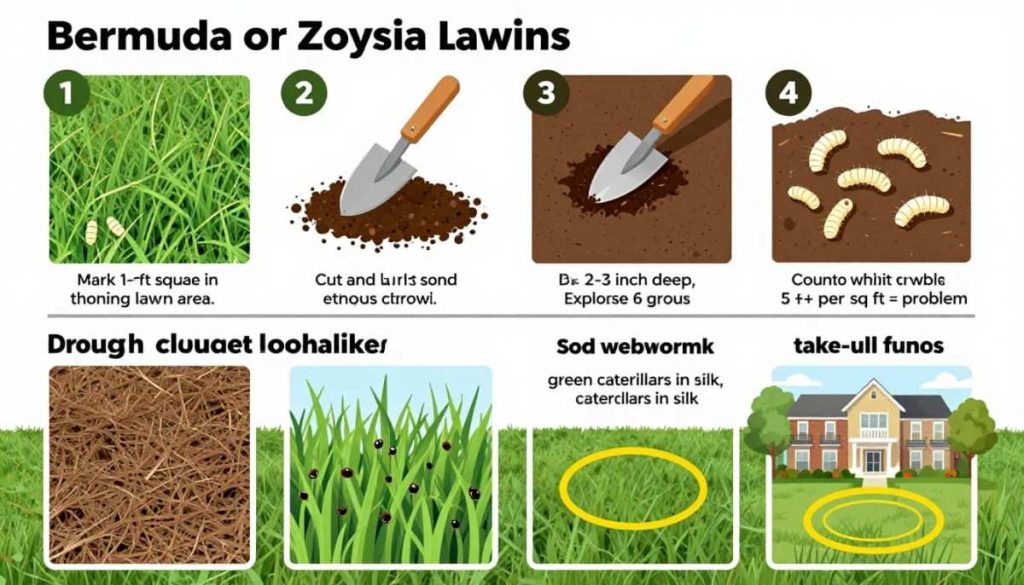
The Shovel Test: How to Know for Sure in 60 Seconds
This is the single most reliable way to diagnose a grub problem, and it takes almost no effort. Forget guessing from the surface. Let's go straight to the source.
Here's exactly how to do it:
Pick a spot at the edge of the brown patch. Grubs tend to be concentrated at the border where damaged lawn meets healthy lawn. That's where the feeding is most active.
Cut a square of turf about 1 foot by 1 foot. Go down about 2 to 3 inches deep. You can use a shovel, a garden spade, or even a sturdy knife.
Peel back the sod and examine the soil underneath. Look for small, C-shaped white larvae with brown heads and three pairs of legs near the head.
Count what you find. Flip through the soil and the root zone carefully. Grubs will usually be curled up in a C-shape and may be nestled in the thatch layer or just below it.
Check at least two or three spots. Grub populations aren't always evenly distributed. One area of the lawn might have a heavy infestation while another part is clean.
Replace the sod and water it back in. The turf will usually re-root within a couple of weeks if the grubs aren't an issue.
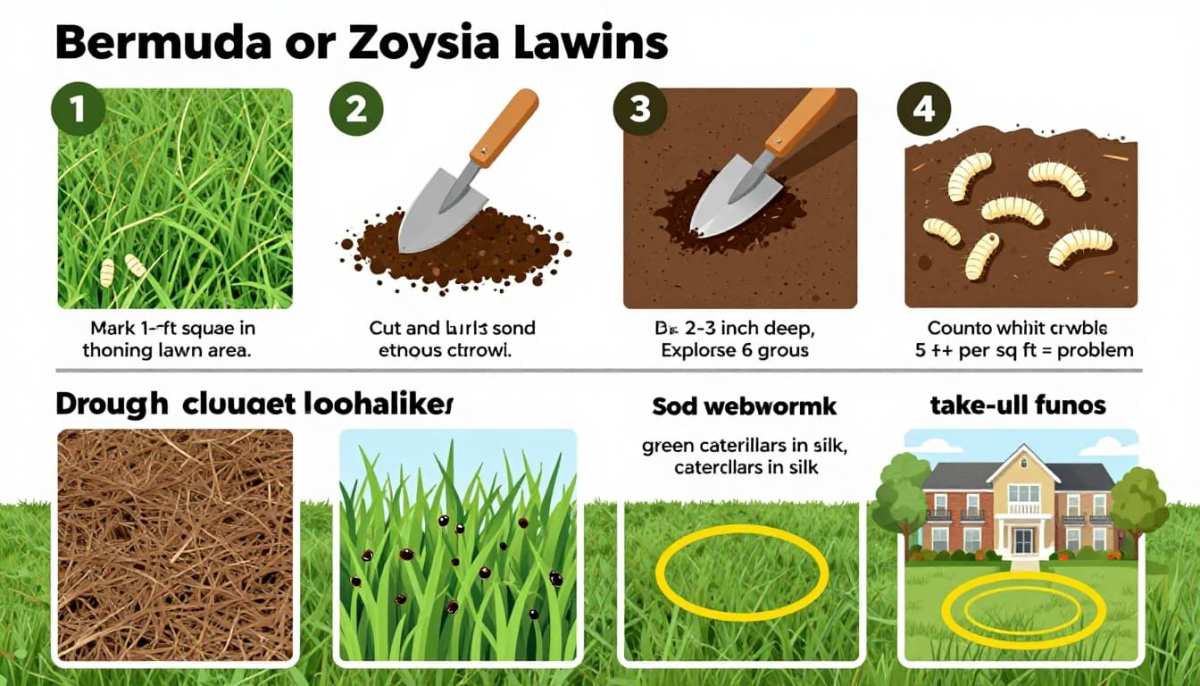
Image source: Bing (Web (fair-use with source credit))
The general treatment threshold cited by most university extension programs is five to ten grubs per square foot for standard home lawns. If you're finding fewer than that, your lawn can usually tolerate the population without significant damage. If you're finding fifteen or more per square foot, that's a serious infestation and treatment is warranted.
For high-maintenance lawns or turf under stress, some experts recommend treating at a lower threshold of three to five grubs per square foot. It depends on what kind of grass you have and how much you expect from your lawn.
What Grubs Actually Look Like (And What Sneaky Look-Alikes Get Confused for Them)
True white grubs are the larval stage of scarab beetles. They have a very distinctive appearance once you know what to look for. The body is soft, white to cream-colored, and always curled into that characteristic C-shape.
They have a brown or tan head capsule and three pairs of legs clustered near the front of the body.
Size varies by species and age. First-instar grubs are tiny, maybe a quarter inch long. Third-instar grubs, which are the ones doing the most damage in late summer and fall, can be up to an inch or more.
Japanese beetle grubs tend to be on the smaller side, while May beetle grubs can get quite large.
The most useful identification feature for species-level ID is the raster pattern. That's the arrangement of hairs, spines, and bare areas on the underside of the grub's last abdominal segment. You'd need a hand lens or microscope to see it clearly, but for most homeowners, simply confirming you have grubs at all is enough to make a treatment decision.
Now, here's where confusion creeps in. Billbug larvae look almost identical to white grubs at a glance. They're legless, which is the key difference, but that's hard to spot if you're not looking for them.
Billbug damage also tends to show up earlier in the season, typically in late spring and early summer, whereas white grub damage peaks in late summer and fall.
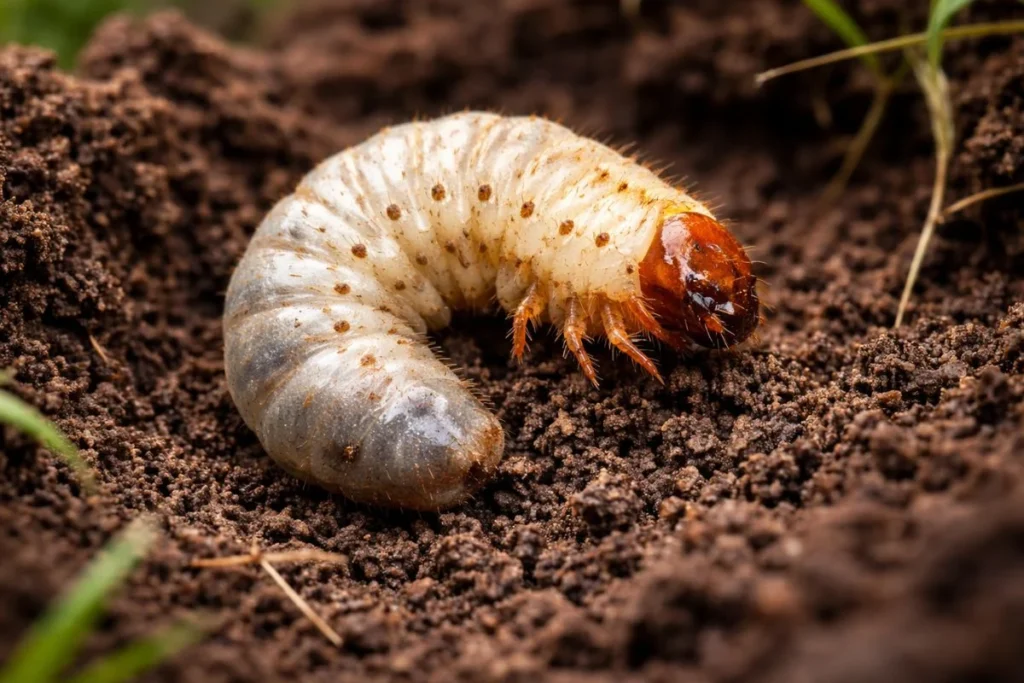
Image source: Bing (Web (fair-use with source credit))
Another look-alike is the sod webworm larva. These are caterpillars, not beetle larvae, and they have a more elongated body with visible prolegs along the abdomen. They also leave behind fine, sawdust-like frass at the base of the grass blades.
Sod webworm damage tends to appear as closely mowed patches rather than the spongy, uprooted turf you see with grubs.
If you're unsure about what you're finding, most university extension offices offer diagnostic services. You can collect a sample in a sealed bag and bring it to your local extension agent for identification. It's usually free or very low cost, and it takes the guesswork out of the equation entirely.
Counting Matters: How Many Grubs Is Too Many Before You Should Worry?
Not every grub in your lawn is a crisis. A low population is actually normal in most areas, and healthy turf can tolerate a surprising amount of root feeding without showing visible damage. The key is knowing when the numbers cross the line from background noise to genuine threat.
Here's a practical breakdown of grub thresholds based on university extension guidelines:
| Grubs Per Square Foot | Severity Level | Recommended Action |
|---|---|---|
| 0 to 4 | Low / Normal | No treatment needed. Monitor next season. |
| 5 to 9 | Moderate | Consider treatment if lawn is stressed or high-value. |
| 10 to 14 | High | Treatment recommended. Damage likely visible. |
| 15+ | Severe | Treatment strongly recommended. Significant damage expected. |
These thresholds assume a reasonably healthy lawn with a decent root system. If your lawn is already struggling from drought, poor soil, or heavy foot traffic, even five grubs per square foot can push it over the edge. Conversely, a thick, well-maintained lawn with deep roots might handle ten grubs without much visible impact.
The time of year also matters. In early spring, grubs are usually small and haven't done much feeding yet. You might find a decent population but see almost no damage.
By late summer and early fall, those same grubs have been feeding for months and are at their largest. That's when the damage becomes obvious and when most homeowners start asking questions.
If you do find a high count, don't panic. Grubs are treatable, and even heavily damaged lawns can recover if you address the problem and follow up with proper care. The real mistake is ignoring a confirmed infestation and hoping it resolves on its own.
It won't. The beetles that produced those grubs will lay eggs again next year, and the cycle continues.
Grubs, Drought, Disease, or Animal Damage: Telling the Four Look-Apes Apart
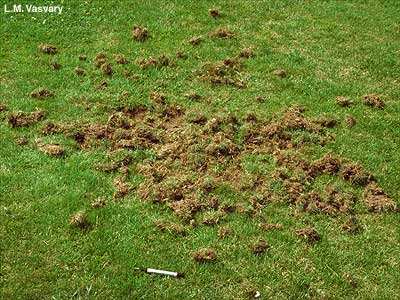
Image source: Bing (Web (fair-use with source credit))
This is where most homeowners go wrong. They see brown grass and immediately assume grubs, but the symptoms overlap with several other common lawn problems. Let's break down how to tell them apart.
Grub damage shows up as irregular brown patches with spongy, loose turf that pulls up easily. The damage tends to progress gradually over weeks. You'll find C-shaped larvae in the soil when you dig.
The brown areas don't have a distinct border or pattern, and they won't respond to watering.
Drought stress causes grass to turn a uniform bluish-gray before browning. The entire lawn or large sections are affected, not just random patches. The turf feels dry and brittle, not spongy.
Watering brings recovery within a few days if it's purely drought-related. The roots are intact when you pull on the grass.
Fungal diseases like brown patch or dollar spot create more defined patterns. Brown patch forms circular areas, sometimes with a darker "smoke ring" border in the morning when dew is present. Dollar spot creates small, round patches about the size of a silver dollar.
You may see visible fungal threads or lesions on the grass blades themselves. The turf doesn't pull up easily because the roots are still attached.
Animal damage from skunks, raccoons, or birds searching for grubs creates a different mess entirely. You'll see areas of torn-up turf, holes, or rolled-back sod. It looks like something dug through your lawn overnight, because something did.
This is actually secondary damage caused by animals feeding on grubs that are already present. If you're seeing animal digging, you almost certainly have grubs underneath.
Image source: Bing (Web (fair-use with source credit))
Here's a quick diagnostic checklist you can run through:
- Does the turf pull up like a carpet? That points to grubs.
- Does watering improve the condition within a week? That points to drought.
- Are the patches circular with defined edges? That points to disease.
- Is the turf torn up or dug overnight? That points to animals, which usually means grubs are present.
- Do you find larvae in the soil? That's your definitive answer.
If you're still unsure after running through this checklist, the shovel test is your tiebreaker. Dig, count, and decide based on what you actually find. It's the only way to move from guessing to knowing.
If It IS Grubs: Your Curative Options for This Season
So you've confirmed grubs. Now what? Your approach depends on when you caught the problem and how bad the infestation is.
For late summer and early fall, when grubs are actively feeding and damage is visible, you want a curative insecticide. The most effective curative option available to homeowners is trichlorfon (Dylox). It works fast, typically killing grubs within one to three days of application.
It's a contact and stomach poison, meaning grubs either absorb it through their body or ingest it while feeding.
Here's what to know about curative treatment:
- Timing matters. Curative products work best when grubs are small and actively feeding. That's typically August through October in most regions, though this varies by climate.
- Water it in. Granular products need to be watered into the soil after application. About a quarter to half inch of water is usually sufficient to move the active ingredient into the root zone where grubs are feeding.
- Don't expect instant green-up. Killing the grubs stops further damage, but the already-dead turf won't magically recover. You'll need to overseed or repair those areas once the threat is gone.
Beneficial nematodes offer a biological alternative. These are microscopic roundworms that seek out and kill grubs. The species most effective against white grubs is Heterorhabditis bacteriophora.
Nematodes are living organisms, so they need to be applied correctly to work. Apply them in the evening, keep the soil moist for at least two weeks after application, and make sure the soil temperature is above 55°F.
Nematodes are a solid choice if you have kids, pets, or concerns about chemical use. They're non-toxic to humans, animals, and beneficial insects. The tradeoff is that they work slower than chemical insecticides and may not provide complete control in severe infestations.
Milky spore is another biological option, but it's a long-game strategy. It takes one to three years to establish fully in the soil, and it's most effective against Japanese beetle grubs specifically. If you're dealing with European chafers or other species, milky spore won't help much.
Preventive Strategies That Actually Work for Next Year
If you've dealt with grubs this season, you already know you want to prevent a repeat performance. Preventive control is actually more effective than curative treatment because you're targeting grubs before they grow large and cause significant damage.
The best window for preventive treatment is late spring through early summer, typically May through early July depending on your region. This is when adult beetles are flying, mating, and laying eggs in the soil. The eggs hatch a few weeks later, and the tiny larvae are most vulnerable to insecticides at this stage.
Chlorantraniliprole (Acelepryn) is the go-to preventive active ingredient. It's low-toxicity, has a long residual in the soil, and targets grubs specifically without harming most beneficial insects. One application in late spring can protect your lawn through the entire grub feeding season.
Imidacloprid is another common preventive option found in many combination grub control products. It's a systemic insecticide that gets taken up by the grass roots and kills grubs as they feed. It's effective but has a broader impact on soil organisms, so it's worth considering if you're trying to minimize ecological disruption.
Here's a simple preventive timeline:
| Month | Action |
|---|---|
| May to June | Apply preventive insecticide (chlorantraniliprole or imidacloprid) |
| June to July | Water in product; monitor for adult beetle activity |
| August | If you missed the preventive window, consider curative treatment if grubs are present |
| September to October | Evaluate damage; plan for fall repair and next year's prevention |
One thing worth noting. Preventive insecticides need to be applied before you see damage. By the time brown patches appear in late summer, the grubs have been feeding for weeks.
If you wait until you see symptoms, you've already missed the preventive window and need to switch to a curative approach.
The Mistake Almost Everyone Makes with Timing
Here's the pattern we see over and over. Homeowners notice brown patches in September, rush to the store for grub control, and apply whatever they find. Sometimes it works.
Often it doesn't. The problem is almost always timing.
By September, grubs are large, mature, and close to pupating. They're harder to kill with most products, and they've already done the bulk of their feeding for the season. A curative application in September can still help, especially with trichlorfon, but it's fighting an uphill battle.
The real missed opportunity is the previous May or June. That's when a single preventive application could have stopped the whole cycle before it started. But nobody's thinking about grubs in late spring when the lawn looks fine and the beetles are just starting to fly.
If you've confirmed grubs this year, put a reminder on your calendar for late May or early June of next year. Mark it as "grub prevention." One well-timed application is worth more than three reactive ones.
The other timing mistake is applying preventive products too late. If you apply chlorantraniliprid in August, you're months past the window when it would have been most effective. The product won't do much good at that point, and you've wasted your money.
When to Skip the Store-Bought Products and Call a Pro
Most grub problems are manageable on your own. But there are situations where calling a professional lawn care service makes more sense.
Call a pro if:
- Your infestation is severe (fifteen or more grubs per square foot across large areas)
- You've tried DIY treatment and the problem persists year after year
- You're dealing with a mixed pest problem (grubs plus chinch bugs plus disease, for example)
- You have a very large lawn and aren't confident in your ability to apply products evenly
- You need results quickly and don't want to experiment with timing
Professional applicators have access to commercial-grade products that aren't available to homeowners. They also have the experience to identify grub species, which matters because different species have slightly different life cycles and vulnerabilities.
The cost of professional grub treatment typically runs between $100 and $300 per application depending on lawn size and location. That's more than DIY, but it's a lot less than full lawn renovation, which can run $1 to $4 per square foot.
If you go the pro route, ask what product they're using and when they plan to apply it. A good applicator should be able to explain their timing and give you a clear expectation of results. If they can't, that's a red flag.
Fixing the Damage: Getting Your Lawn Back on Its Feet
Killing the grubs is only half the battle. Now you need to deal with the dead or damaged turf they left behind. The good news is that most lawns can recover from moderate grub damage with the right follow-up care.
Step 1: Rake out the dead grass. Remove the loose, dead turf so you're working with bare soil. This gives new seed direct contact with the soil surface.
Step 2: Loosen the top inch of soil. A light raking or aeration helps break up compacted areas and creates a better seedbed.
Step 3: Overseed with a matching grass variety. Use the same type of grass that's already established in your lawn. For cool-season lawns, a mix of tall fescue and Kentucky bluegrass works well. For warm-season lawns, match whatever species you have.
Step 4: Apply a starter fertilizer. This gives new grass seedlings the nutrients they need to establish quickly. Look for a fertilizer with a higher phosphorus number (the middle number on the bag).
Step 5: Keep the area moist. Water lightly and frequently, two to three times per day if possible, until the new grass germinates. Don't flood the area. Just keep the surface consistently damp.
Step 6: Mow carefully once established. Wait until the new grass is at least three inches tall before the first mow, and never remove more than one-third of the blade height at a time.
Fall is the ideal time for lawn repair in most regions. The soil is still warm, the air is cooling down, and there's less weed competition than in spring. If you address the damage in September or October, you can have a fully recovered lawn by the following spring.
Frequently Asked Questions
What time of year do grubs cause the most damage?
Late summer through early fall, typically August through October, is when grub damage becomes most visible. The grubs have been feeding all season and are at their largest size by then. Spring damage is less common but can occur in heavily infested lawns.
Can grubs come back every year?
Yes. If beetle populations are high in your area and you don't apply preventive control, grubs can return annually. Adult beetles lay eggs in the lawn each summer, and the cycle repeats.
Preventive treatment breaks this cycle.
Will grub damage heal on its own?
No. Dead turf won't recover without reseeding or resodding. However, if the grub population is low and the roots aren't completely destroyed, the lawn may partially recover on its own with proper watering and fertilization.
Are grub control products safe for pets?
Most granular grub control products are low-toxicity to mammals once watered in and dried. However, always read the label for specific safety instructions. Keep pets off the treated area for the duration specified on the product label, usually 24 to 48 hours.
How deep do grubs live in the soil?
White grubs typically stay in the top one to three inches of soil, right in the root zone of the turf. During winter, they burrow deeper, sometimes four to eight inches down, to escape freezing temperatures. They return to the root zone in spring.
What's the difference between grub damage and fungus?
Grub damage creates irregular brown patches with loose, spongy turf that pulls up easily. Fungal diseases tend to create more defined patterns, sometimes with visible lesions on the blades or a smoke-ring border. The tug test and the shovel test are your best ways to tell them apart.