You've been staring at your cucumber vines for weeks. They're covered in bright yellow blooms, the leaves look healthy, and you're feeling good about the season. Then it hits you: not a single cucumber is forming.
If you've ever wondered why do my cucumber plants only have male flowers, you're not alone. It's one of the most common frustrations home gardeners run into, and the good news is it's almost always fixable once you understand what's going on.
Cucumber plants (Cucumis sativus) produce separate male and female flowers on the same vine in most standard varieties. Male flowers show up first and in greater numbers, which is completely normal early in the season. But when female flowers never appear, or show up way too late, something in your growing conditions is off.
Let's walk through exactly why this happens and what you can do about it, step by step.
Image source: Pixabay / Oldiefan (Pixabay Content License)
Quick Answer
Cucumber plants produce only male flowers when the plant is young, stressed, or exposed to high temperatures. Most monoecious varieties bloom male-first as a normal growth pattern. Female flowers typically appear 1 to 3 weeks after the first male blooms.
Excess nitrogen, heat above 86°F (30°C), and low light can all delay or suppress female flower development.
How Cucumber Flower Sex Actually Works
Before you can fix the problem, it helps to understand how cucumber flowering actually works. Most garden cucumber varieties are monoecious, meaning they produce both male and female flowers on the same plant. They're just separate blooms, not combined into one.
Male flowers are the ones you'll see first. They grow on thin, slender stems and their only job is to produce pollen. Female flowers are the ones that actually become cucumbers.
You can spot them by the tiny, immature fruit (called an ovary) sitting right behind the base of the flower. It looks like a miniature cucumber before the bloom even opens.
Here's the key thing. The plant controls which flowers it produces based on several environmental and genetic factors. Temperature, day length, plant age, nutrient balance, and even the specific variety you planted all play a role.
Research published in horticultural journals has shown that ethylene and gibberellic acid levels inside the plant directly influence whether a given node produces a male or female flower.
There are also gynoecious varieties bred to produce almost exclusively female flowers. These are popular with commercial growers because they set fruit faster. If you planted one of these and are seeing only male flowers, something has stressed the plant enough to override its genetics.
That's a clue worth paying attention to.
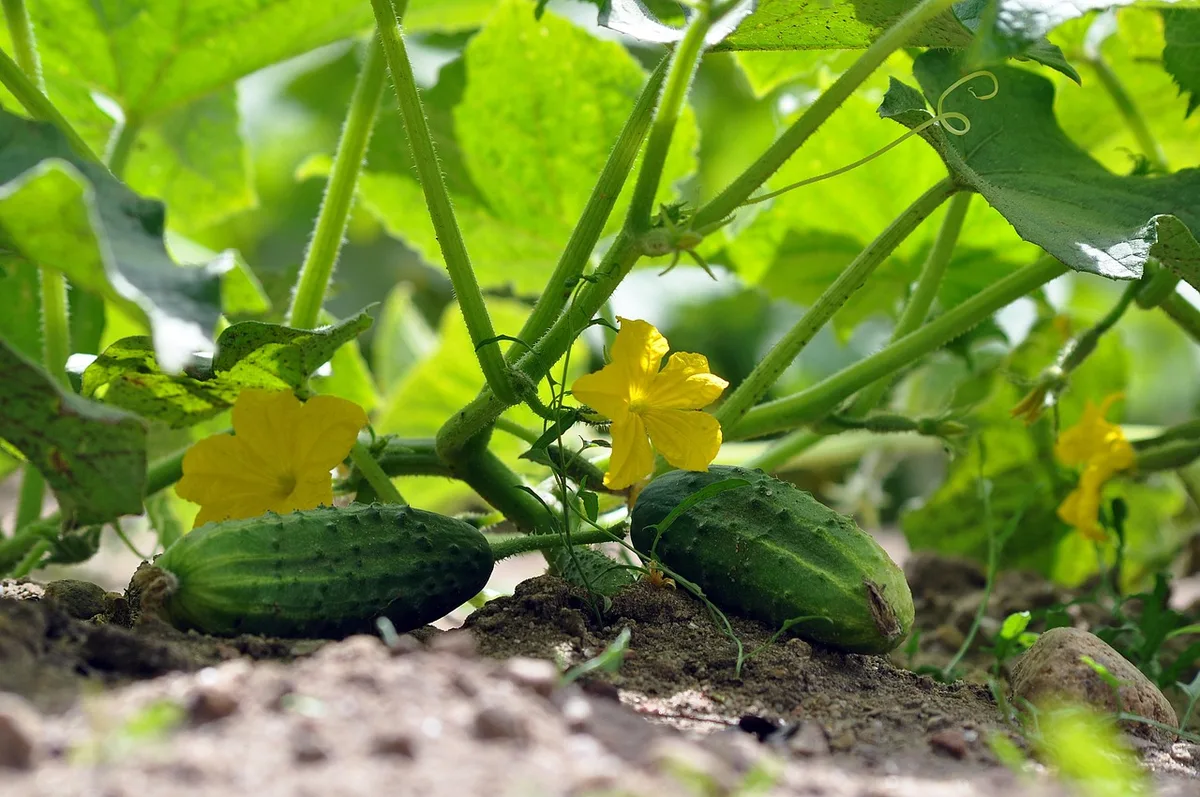
Image source: Pixabay / artellliii72 (Pixabay Content License)
Reason #1: Your Plant Is Still Too Young
This is the most common reason and the easiest one to fix. You just need to wait.
Cucumber plants follow a predictable flowering sequence. Male flowers almost always appear first, sometimes by a margin of 1 to 3 weeks before any female flowers show up. On a young vine, the plant is putting its energy into establishing a strong root system and growing foliage.
Fruiting comes second.
Most monoecious cucumber varieties start producing their first male flowers around 35 to 50 days after seeding. Female flowers typically begin appearing at nodes 5 through 10, while male flowers may have already been blooming at nodes 1 through 4. If your plant is on the younger side and you're seeing plenty of healthy male blooms, the female flowers are probably right around the corner.
What to look for:
- Count the nodes up the main stem. If female flowers haven't appeared past node 8, other factors may be at play.
- Check overall vine length. A cucumber vine under 2 feet tall is still in early growth.
- Look for tiny ovaries forming at new nodes. That's your signal the plant is transitioning.
Patience is genuinely the right move here. Resist the urge to over-fertilize or over-water trying to "speed things up." That usually backfires.
Reason #2: High Temperatures Are Suppressing Female Flowers
If you're growing cucumbers through a heatwave, temperature is very likely your culprit. Sustained air temperatures above 86°F (30°C) directly suppress female flower formation in most cucumber varieties. Soil temperatures above 85°F (29°C) make it worse.
Here's what's happening inside the plant. Heat stress shifts the hormonal balance toward gibberellic acid production, which promotes male flower development. At the same time, ethylene synthesis, which encourages female flower formation, gets dialed down.
The result is a vine covered in male blooms with almost no females in sight.
This is especially common for gardeners in the Southern US, the Mediterranean, or anywhere experiencing unusually hot summers. As of 2026, shifting climate patterns have made mid-summer heat stress a more frequent issue even in traditionally cooler growing zones.
Signs heat is the problem:
- Daytime highs consistently above 86°F (30°C) for more than 5 days
- Female flowers were appearing, then stopped during a heat wave
- The plant looks otherwise healthy but fruit set has stalled
- Flowers may be dropping off without setting fruit
What you can do:
- Use shade cloth (30 to 40% shade rating) during the hottest part of the day
- Mulch heavily around the base to keep soil temperatures down
- Water deeply in the early morning to cool the root zone
- Consider planting heat-tolerant varieties next season
Image source: Pixabay / Kathas_Fotos (Pixabay Content License)
Reason #3: Too Much Nitrogen Is Pushing Vine Growth Over Fruiting
If your cucumber plant looks like a jungle, huge dark green leaves, thick stems, rapid vine growth, but almost no fruit, you've probably overdone the nitrogen. This is an incredibly common mistake because nitrogen is the nutrient most heavily marketed on fertilizer bags, and vigorous leafy growth feels like success. It's not, at least not for fruit production.
Nitrogen drives vegetative growth. When there's an abundance of it relative to phosphorus and potassium, the plant has no biological reason to reproduce. It just keeps growing vines and leaves.
Female flower production gets delayed or reduced because the plant isn't receiving the hormonal signals that trigger the reproductive stage.
University extension services consistently flag nitrogen imbalance as a leading cause of poor fruit set in cucurbits. The ideal approach is to use a balanced or slightly phosphorus-heavy fertilizer once flowering begins. Look for something with a ratio where the first number (nitrogen) is equal to or lower than the second and third numbers, like 5-10-10 or 3-4-6.
How to tell nitrogen is the issue:
- Leaves are unusually dark green and large
- Vine growth is extremely fast and lush
- You've been fertilizing regularly with a high-nitrogen product
- Other plants nearby (like tomatoes or peppers) are also showing excessive leaf growth
What to do now:
- Stop applying nitrogen-heavy fertilizers immediately
- Switch to a bloom-focused or balanced formula
- If you've heavily over-fertilized, flush the soil with deep watering to leach excess nutrients
- Wait 1 to 2 weeks and monitor new flower development at the nodes
Reason #4: Your Variety Is Naturally Male-Heavy Early On
Not all cucumber varieties behave the same way when it comes to flowering. Some are just programmed to produce a ton of male flowers before the females show up, and that's not a problem. It's genetics.
Standard monoecious varieties, the kind most home gardeners plant, typically follow a pattern where the first several nodes produce only male flowers. The first female flower might not appear until node 5, 6, or even higher. Hybrid varieties and gynoecious types have been bred to flip that ratio, producing female flowers earlier and more frequently.
If you planted an open-pollinated heirloom or a standard slicing variety, a male-heavy early bloom cycle is completely expected.
Here's a quick breakdown of how the main variety types differ:
| Variety Type | Male Flowers Early | Female Flowers Early | Best For |
|---|---|---|---|
| Monoecious (standard) | Heavy | Delayed (node 5+) | General home gardening |
| Gynoecious | Minimal | Very early (node 2-4) | High-yield production |
| Parthenocarpic | Varies | Early, no pollination needed | Greenhouse or indoor growing |
If you're growing a standard variety and seeing only male flowers in the first few weeks, check the seed packet or catalog description. It may simply tell you the plant's natural pattern. Gynoecious varieties, on the other hand, should be producing female flowers almost from the start.
If a gynoecious plant is putting out mostly males, that's a stress response and you should revisit the temperature and nutrient factors covered earlier.
Reason #5: Low Light or Short Days Are Delaying Female Flowers
Cucumbers are sensitive to photoperiod, meaning the amount of daylight they receive directly influences flower sex expression. Shorter days and lower light intensity tend to favor female flower development, while very long days with intense light can push the plant toward more male flowers.
This matters more than most gardeners realize. If you planted cucumbers in a spot that gets less than 6 hours of direct sunlight, or if nearby structures and trees are casting shade during critical parts of the day, the plant may struggle to trigger female flowering. Container gardeners on balconies or patios often run into this issue without knowing it.
Research from university extension programs shows that cucumber plants receiving 8 or more hours of direct sunlight produce a more balanced male-to-female flower ratio compared to those in partial shade. The plant needs sufficient light energy to support the resource-intensive process of fruit development, and when light is limited, it defaults to the less costly male flower production.
What to check:
- Track how many hours of direct sun your cucumber bed actually gets
- Look for shading from fences, buildings, or taller neighboring plants
- South-facing locations in the Northern Hemisphere get the most consistent light
What to do:
- Relocate containers to the brightest available spot
- Prune nearby vegetation that's casting shade
- Reflective mulch (like silver plastic mulch) can bounce additional light onto lower foliage
- For next season, choose the sunniest bed on your property for cucumbers
Reason #6: Plant Stress From Water, Soil, or Root Problems
Cucumber plants are surprisingly sensitive to root zone stress, and when they're struggling below the surface, flower sex expression is one of the first things to change. Inconsistent watering, compacted soil, root-bound containers, and poor drainage can all push a plant toward producing mostly male flowers.
Here's the logic from the plant's perspective. When conditions are stressful, the plant prioritizes survival over reproduction. Male flowers are cheaper to produce.
They don't require the energy investment of developing fruit. So a stressed plant will hold off on female flowers until it feels stable enough to support fruit development.
Under-watering is the most common trigger. Cucumbers have shallow root systems and need consistent moisture. If the soil dries out completely between waterings, the plant experiences drought stress even if it perks up again after you water.
Over-watering is just as bad. Waterlogged roots can't take up oxygen properly, which leads to root rot and a similar stress response.
Signs your plant is stressed below the surface:
- Wilting during the hottest part of the day, even with adequate soil moisture
- Yellowing lower leaves
- Stunted vine growth
- Soil that's either bone dry or soggy an inch below the surface
- Roots circling the bottom of a container (root-bound)
How to fix it:
- Water deeply and consistently, aiming for 1 to 1.5 inches per week
- Mulch 2 to 3 inches deep to regulate soil moisture and temperature
- Make sure containers have drainage holes and are at least 5 gallons per plant
- Loosen compacted garden soil with compost before planting
- Avoid cultivating near the roots, as cucumbers have fragile, shallow root systems
How to Diagnose Which Cause Applies to Your Plants
Now that you know the six main reasons, the real question is figuring out which one is actually affecting your garden. The best way to do this is to work through them systematically, eliminating causes based on your specific situation.
Start with the simplest explanations first. Check your plant's age and node count. If the vine is under 3 feet long and female flowers haven't appeared past node 5, the plant may just be immature.
Give it another week or two.
Next, look at your recent weather. Have daytime highs been above 86°F (30°C) for an extended period? If so, heat stress is the likely driver.
Check your fertilizer history too. If you've been feeding a high-nitrogen product, that's a strong suspect.
Then evaluate your growing conditions. Measure actual sunlight hours at the plant's location. Dig a small hole near the root zone to check soil moisture and structure.
Look at the seed packet to confirm your variety type.
Quick diagnostic checklist:
- Plant under 35 days from seed: likely too young
- Heat wave in progress: likely temperature stress
- Lush, dark green growth with no fruit: likely nitrogen excess
- Less than 6 hours of direct sun: likely light deficiency
- Wilting or yellowing leaves: likely water or root stress
- Gynoecious variety producing only males: likely environmental stress overriding genetics
In many cases, more than one factor is contributing. A plant that's both heat-stressed and over-fertilized will have a much more pronounced male-only flowering pattern than one dealing with just a single issue. Address all the factors you can control and the plant will usually correct itself within 2 to 3 weeks.
What to Do Right Now to Encourage Female Flowers
Once you've identified the likely cause, here are the immediate actions that can help shift your plant toward female flower production.
Adjust your watering schedule. Water deeply once or twice per week rather than light daily sprinklings. The goal is consistent moisture about 4 to 6 inches deep. Mulch heavily to reduce evaporation.
Switch your fertilizer. Stop any high-nitrogen product. Move to a balanced or phosphorus-rich formula. Something like a 5-10-10 applied at half strength every 2 weeks is a solid choice once flowering has started.
Manage heat exposure. If temperatures are above 86°F (30%), set up temporary shade cloth during peak afternoon hours. Water the base of the plant in the morning to cool the root zone.
Improve light exposure. Trim back anything casting shade on your cucumbers. Move containers to the brightest location you have.
Be patient with young plants. If your vine is still early in its growth cycle, female flowers may simply need more time. Avoid the temptation to over-correct with extra fertilizer or water.
Consider hand pollination later. Once female flowers do appear, you can hand-pollinate to maximize fruit set. Use a small brush or pick a male flower, peel back the petals, and dab the pollen directly onto the stigma inside the female flower. Do this in the morning when flowers are freshly open.
Most cucumber plants will self-correct within 2 to 3 weeks once the stressor is removed. If you've addressed all the factors above and still see no female flowers after that window, it may be time to consider replanting with a different variety better suited to your conditions.
Image source: Pixabay / PublicDomainPictures (Pixabay Content License)
Variety Selection: Choosing Cucumbers That Produce More Female Flowers
If you've battled male-heavy flowering for more than one season, the smartest long-term fix is choosing a variety bred for higher female flower production. Gynoecious hybrids are the go-to option here. They've been specifically developed to produce predominantly female flowers from early growth stages, which means faster fruit set and higher yields per plant.
Popular gynoecious varieties include 'Diva', 'Sweet Success', and 'Genuity'. These are widely available from major seed suppliers and perform well in both garden beds and containers. Parthenocarpic varieties are another strong choice, especially if you're growing in a greenhouse or an area with limited pollinator activity.
They set fruit without pollination at all, so even a shortage of male flowers won't hurt your harvest.
For gardeners in hot climates, look for heat-tolerant varieties like 'Marketmore 76' or 'Straight 8'. These handle temperature stress better and are less likely to suppress female flowering during summer spikes. Always check the seed packet or catalog description for terms like "gynoecious," "female-dominant," or "parthenocarpic" to know what you're getting before you plant.
Common Mistakes That Make the Problem Worse
A few well-intentioned habits actually push cucumber plants further toward male-only flowering. The biggest one is over-fertilizing with nitrogen, which we covered earlier, but there are others worth calling out.
Pruning too aggressively is a common error. Some gardeners pinch back vines to encourage branching, but excessive pruning stresses the plant and can delay female flower production. Cucumbers don't need heavy pruning the way tomatoes do.
Just remove dead or diseased foliage and let the vine do its thing.
Applying fertilizer too frequently is another trap. More is not better with cucumbers. A single side-dressing of compost at planting and one balanced fertilizer application at flowering is usually enough for the whole season.
Overfeeding keeps the plant in vegetative mode and away from fruiting.
Ignoring pollinator health matters too. Even when female flowers appear, poor pollination means fruit won't develop. That can look like the plant is still only making males.
Avoid using broad-spectrum insecticides near blooming cucumbers. Plant flowers like marigolds or alyssum nearby to attract bees.
When to Wait It Out vs. When to Take Action
Not every male-heavy flowering situation needs intervention. If your plant is under 35 days old and growing vigorously, patience is the right call. Female flowers will likely appear on their own within 1 to 3 weeks.
Take action immediately if you see heat stress symptoms, over-fertilization signs, or root zone problems. These won't self-correct without a change on your part. The longer the plant stays stressed, the more growing season you lose.
If you've addressed all environmental factors and 3 to 4 weeks pass with zero female flowers, consider whether the variety itself is the issue. In that case, starting a second round of seeds with a gynoecious variety can salvage the season, especially in regions with long growing windows.
FAQs
How long does it take for female cucumber flowers to appear?
In most monoecious varieties, female flowers appear 1 to 3 weeks after the first male blooms. This typically falls between 35 and 55 days from seeding, depending on the variety and growing conditions.
Can a cucumber plant have only male flowers permanently?
It's rare but possible if the plant is a male-dominant hybrid or if chronic stress prevents female flower development. In most cases, female flowers will appear once conditions improve.
Should I remove male cucumber flowers to encourage female ones?
No. Removing male flowers won't trigger female flower production. It will only reduce pollination once females do appear.
Leave all flowers on the plant.
Do gynoecious cucumbers need male flowers to fruit?
Most gynoecious hybrids still need some pollen, which is why seed companies often include a pollinator variety in the seed mix. Parthenocarpic varieties are the exception and set fruit without any pollination at all.
Will female flowers appear after a heat wave breaks?
Yes, in most cases. Once daytime temperatures drop below 86°F (30°C) consistently, the plant's hormonal balance shifts back toward female flower production. Expect to see new female blooms within 1 to 2 weeks of improved conditions.
Final Checklist: Getting Your Cucumbers to Actually Fruit
Here's a quick recap of the steps to shift your cucumber plants from male-only flowering to actual fruit production.
- Confirm your variety type and its expected flowering pattern
- Check plant age and node count to rule out immaturity
- Evaluate recent temperatures for heat stress
- Review your fertilizer history and switch to a balanced formula if needed
- Measure actual sunlight hours at the plant's location
- Assess soil moisture and root zone health
- Apply mulch to regulate temperature and moisture
- Be patient for 2 to 3 weeks after making corrections
- Consider replanting with a gynoecious or parthenocarpic variety if the season allows
Most cucumber plants will respond to corrected conditions within a few weeks. The key is identifying which factor is actually at play in your garden rather than guessing. Once female flowers show up and get pollinated, you'll be picking cucumbers before you know it.