The first time you spot a patch of your lawn that lifts up like a loose rug, you've already got a grub problem. Dead brown sections that peel back with a gentle tug, spongy ground underfoot, and skunks or raccoons digging holes at night, that's the classic grub damage scene. Knowing when to treat for grubs isn't just about picking a date off a calendar.
It's about reading your lawn, understanding the grub life cycle, and matching the right product to the right window. Get the timing wrong, and you're just throwing money at dead dirt.
University extension research across the Midwest and Northeast consistently shows that the treatment window splits into two distinct phases: preventive application (aimed at eggs and newly hatched larvae) during late spring through mid-summer, and curative application (aimed at large, actively feeding grubs) in late summer through early fall. As of 2026, soil temperature remains the most reliable trigger for timing, not the calendar date alone. Let's walk through exactly how this works so you treat when it actually matters.
Quick Answer
Treat for grubs preventively between mid-June and mid-July. Target eggs and young larvae before they cause damage. Treat curatively from mid-August through September if you already see dead patches.
Confirm you have at least five to ten grubs per square foot before using any product. Always water in the treatment immediately with half an inch of water.
The Real Problem: Why Your Lawn Gets That Dead, Spongy Look
Grubs are the larval stage of beetles, Japanese beetles, masked chafers, European chafers, and June beetles being the most common culprits. They live in the soil and feed on grass roots. A small population (under five per square foot) usually doesn't cause visible damage.
But when numbers climb past that threshold, the root system gets chewed up so badly that the turf can't take up water or nutrients.
You'll notice it first as wilting that doesn't bounce back after watering. Then the grass turns brown in irregular patches. The big giveaway: grab a handful of grass near the edge of a dead spot and pull.
If it peels away from the soil like a cheap toupee, you've got grubs. Birds, skunks, and raccoons make it worse by digging up the lawn to eat the juicy larvae underneath.
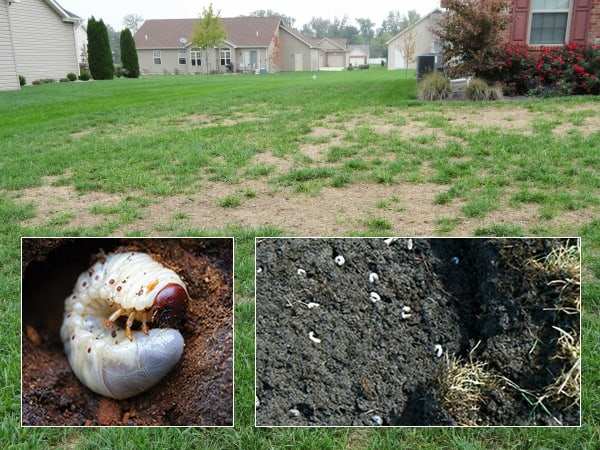
One important distinction: not every brown patch means grubs. Drought stress, fungal disease, and chinch bugs cause similar symptoms. That's why we always recommend doing a physical check before buying any treatment.
More on that in a minute.
How Grubs Actually Work (And Why Timing Matters More Than the Chemical)
The grub life cycle is the single most important thing to understand for correct timing. It dictates everything, which product works, when to apply it, and whether you'll see results.
The Four Life Stages
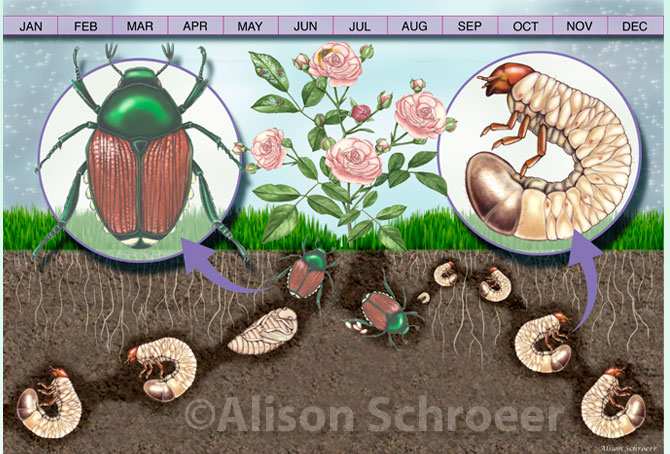
Adult beetles emerge from the soil in early summer (typically June through July). They mate, lay eggs in the soil, and die. The eggs hatch into tiny first-instar larvae within two weeks.
These are the stage you want to target preventively. The larvae grow through three instars (molting stages), getting bigger and hungrier with each one.
By late summer, they're in their third instar, large, white, C-shaped grubs with brown heads and six visible legs. This is the stage that causes real damage. They feed aggressively until soil temperatures drop below 50°F, then burrow deeper to overwinter.
In spring, they move back up, feed briefly, and pupate into adult beetles.
Why the Chemical Doesn't Matter If the Timing Is Wrong
Here's the part that trips most people up. Preventive insecticides (chlorantraniliprole, imidacloprid, thiamethoxam) work by lingering in the soil and killing newly hatched grubs. They're effective only if you apply them before or right when eggs hatch.
Apply them in August after grubs are already large, and you've wasted your money, those products simply don't kill big larvae well.
Curative insecticides (trichlorfon) kill large grubs on contact. But they break down quickly in sunlight and soil. Apply them in June and they'll be gone by the time the grubs arrive.
Each product has a narrow window of effectiveness. The calendar doesn't matter; the grub's life stage does.
Decision Tree: Preventive vs. Curative Treatment
This is where we translate the life cycle into a practical decision. Your situation determines which branch to follow.
Branch 1: Preventive — You're Planning Ahead (Late Spring to Mid-Summer)
Best for: Anyone who had grubs the previous year, lives in a grub-heavy region, or wants peace of mind. Preventive treatment is the most effective approach per manufacturer specifications, with a single application often providing season-long control.
When to apply: Mid-June through mid-July. The exact window varies by region, but soil temperature at a 2-inch depth should be consistently above 60°F. This typically aligns with when adult beetles are actively flying and laying eggs.
What to use: A preventive product containing chlorantraniliprole or imidacloprid. These are applied as granules or liquid, then watered in with at least 0.5 inches of water within 24 hours.
How it works: The chemical binds to organic matter in the soil and creates a root-zone barrier. When eggs hatch and tiny grubs start feeding, they ingest the chemical and die before reaching damaging size.
Pros:
- One application usually covers the whole season
- Stops damage before it starts
- More effective than curative options
Cons:
- Must be applied before you see any damage
- Requires planning and calendar awareness
- Not effective against existing large grubs
Branch 2: Curative — You Already Have Damage (Late Summer to Early Fall)
Best for: Homeowners who missed the preventive window, just discovered damage, or only treat when they see a problem.
When to apply: Mid-August through September. This is when grubs are in their third instar, feeding aggressively near the surface. Apply as soon as you confirm five or more grubs per square foot.
What to use: A curative product containing trichlorfon (sold under brand names like Dylox). These are fast-acting but short-lived in the soil.
How it works: Trichlorfon is a contact poison. Grubs absorb it through their skin as they move through treated soil. They die within 24 to 72 hours.
Pros:
- Fast results, you see dead grubs within days
- Works on existing infestations
- Lower upfront cost (you only treat when needed)
Cons:
- Must be applied during a narrow window
- Only lasts 7 to 14 days in soil
- Higher chance of missing the window and losing the season
Branch 3: The Borderline — It's August and You're Not Sure
If you're in early August and haven't treated, stop and do a digging test first. If you find fewer than five grubs per square foot, consider waiting. Make a note that you'll need to plan for preventive treatment next year.
If you find more than five, apply curative immediately. The window closes fast. By October, grubs will have burrowed deep into the soil for winter, and surface treatments won't reach them.
Step-by-Step: How to Check If You Actually Have Grubs
Before you buy a single bag of anything, confirm grubs are the problem. Here's the method that university extension services recommend.
What You Need
- A square-edged shovel or spade
- A tape measure
- A trowel or garden fork
- A spray bottle of water (optional, for dust control)
The Process
- Pick a suspect area. Edge of a dead patch where green meets brown is ideal. Avoid the center of a dead zone, grubs may have already moved on or died there.
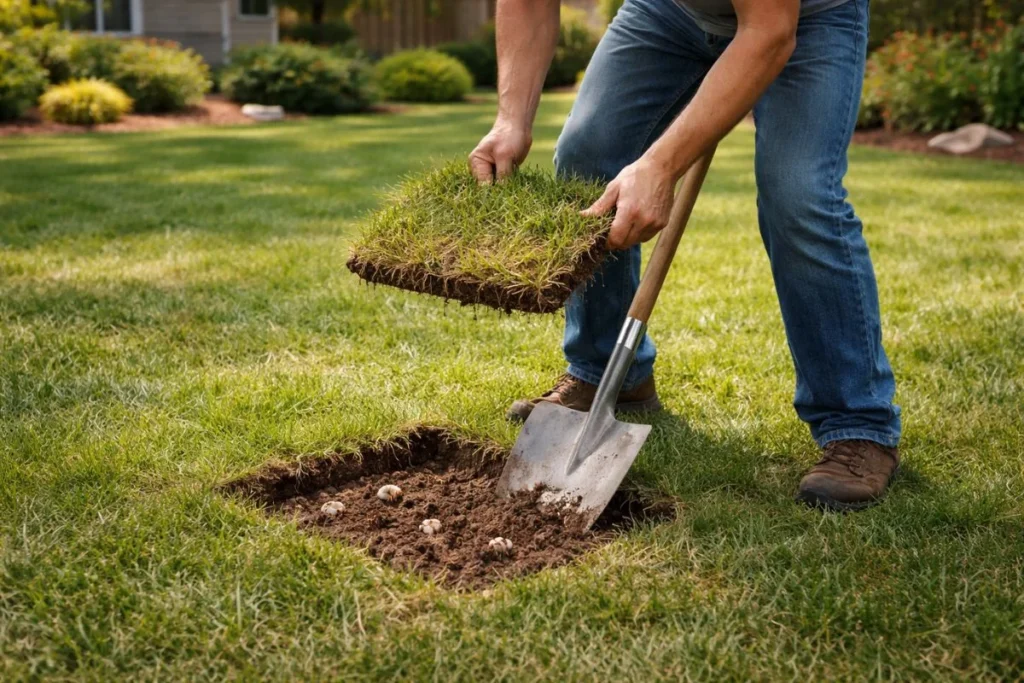
- Cut a one-foot square. Push the shovel straight down about 4 inches deep on all four sides of the square. Pry up the turf and fold it back like opening a book.
- Count the grubs. Sift through the top 3 inches of soil with your fingers or the trowel. Count every white grub you find. Ignore other insects.
- Replace the turf. Press it back down gently and water it. Roots will re-establish if the damage isn't too severe.
What Your Count Means
| Grubs per square foot | What to do |
|---|---|
| 0 to 4 | No treatment needed. The lawn can handle this population. |
| 5 to 9 | Treatment recommended if your lawn is stressed or you've had issues before. |
| 10 or more | Treat immediately. Damage is happening and will get worse. |
Check at least three spots across your lawn. Grubs aren't always evenly distributed. If the average across your sample spots exceeds five per square foot, it's time to act.
The Exact Numbers You Need to Know Before You Treat
Timing isn't guesswork. These are the specific thresholds and measurements that matter.
Soil Temperature
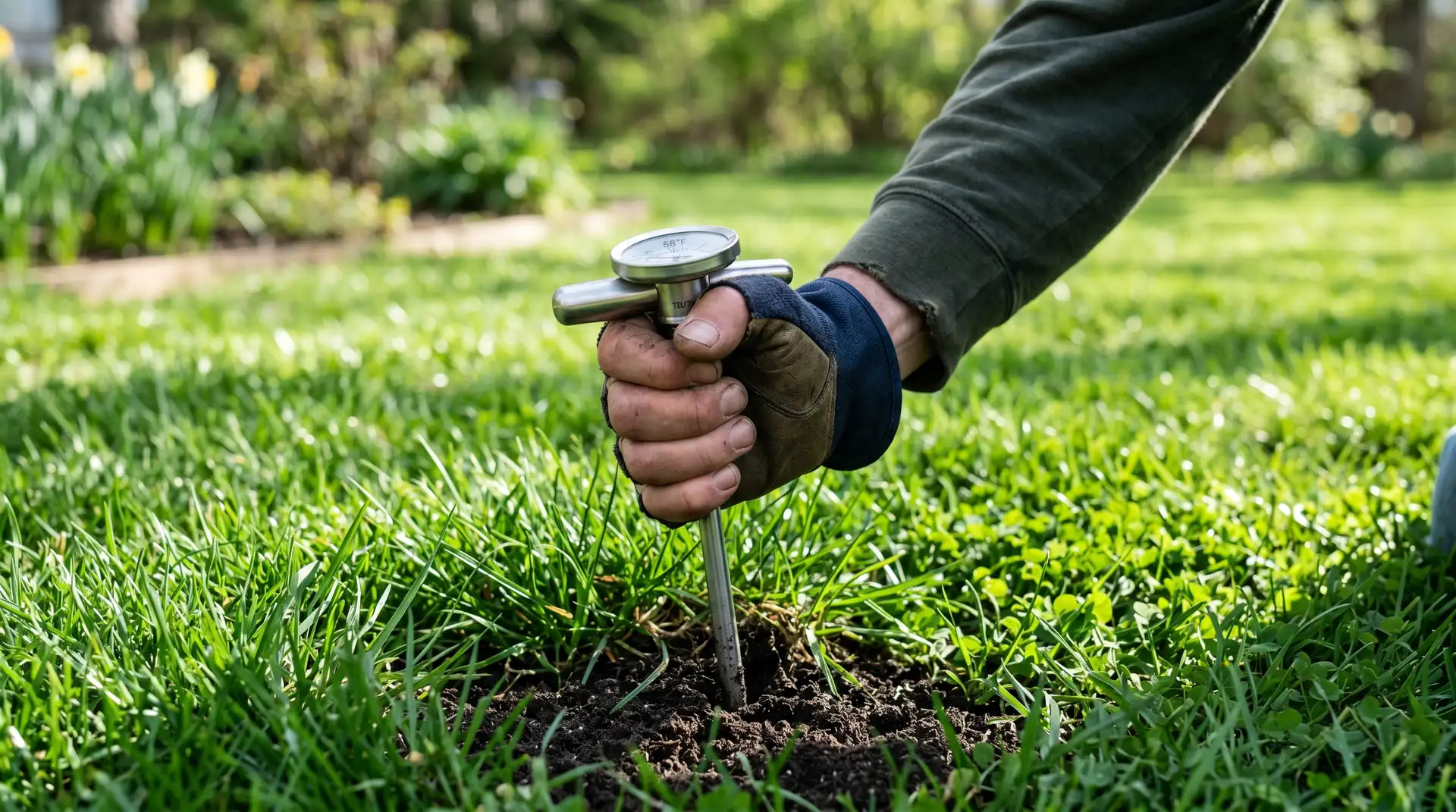
Soil temperature at a 2-inch depth is the most reliable indicator of grub activity. A standard soil thermometer costs under $10 and saves you from treating too early or too late.
- Preventive window opens: Soil temperature consistently above 60°F (typically mid-June in most of the northern US)
- Peak egg hatch: Soil temperature between 65°F and 75°F
- Curative window opens: Soil temperature still above 60°F (mid-August through September)
- Grubs move deep for winter: Soil temperature drops below 50°F (typically October)
Watering Requirements
Every grub treatment must be watered into the soil to reach the root zone where grubs live. Preventive products need 0.5 inches of water within 24 hours of application. Curative products need 0.5 inches immediately, they break down in sunlight, so getting them into the soil fast is critical.
Use a tuna can or rain gauge to measure your sprinkler output. Running the sprinkler for 15 minutes doesn't mean you've delivered half an inch. Calibrate first, then water.
Product Persistence (How Long It Lasts)
| Product type | Active ingredient | Soil life | Best application timing |
|---|---|---|---|
| Preventive | Chlorantraniliprole | 60 to 90 days | Mid-June to mid-July |
| Preventive | Imidacloprid | 50 to 70 days | Mid-June to early July |
| Preventive | Thiamethoxam | 40 to 60 days | Late June to mid-July |
| Curative | Trichlorfon | 7 to 14 days | Mid-August to September |
These numbers come from product labels and university extension trials. Applying outside these windows reduces effectiveness significantly.
Mistakes That Wreck Your Treatment (And Waste Your Money)
Even experienced lawn owners make these errors. They're easy to avoid once you know what they are.
Timing the Wrong Product
Applying a preventive product in late August is the most common mistake. The product sits in the soil, slowly breaking down, while large grubs feed right underneath it. You see no results, blame the product, and try something else.
The product wasn't the problem. The timing was.
Skimping on Water
Grub treatments need water to reach the root zone. Apply granules to dry soil and leave them there, and they sit on the surface breaking down in sunlight. You lose effectiveness and potentially harm surface insects and birds that eat the granules.
Water immediately and thoroughly.
Treating Without Confirming Grubs Exist
A surprising number of people treat their entire lawn for grubs every year without ever checking. That's unnecessary chemical exposure and wasted money. Many brown patches are caused by drought, fungus, or other pests.
Do the digging test first.
Ignoring the Resistance Problem
Using the same preventive product year after year can lead to resistance. University research has documented reduced susceptibility to neonicotinoids (imidacloprid, thiamethoxam) in some grub populations. Rotate between chemical classes (chlorantraniliprole one year, imidacloprid the next) or alternate with biological controls to keep products effective.
Overlooking Your Spreader Calibration
Broadcast spreaders aren't all calibrated the same. Using the wrong setting delivers too little or too much product. Check your spreader's manual for the specific setting recommended for granular grub control.
Then do a quick calibration test on a hard surface using a small amount of product to verify the output. It takes five minutes and prevents patchy coverage.
Biological Options: Nematodes and Milky Spore – When They Actually Work
Not everyone wants to use synthetic insecticides. Biological controls offer an alternative, but they come with stricter timing and handling requirements.
Beneficial Nematodes
Nematodes are microscopic roundworms that parasitize and kill grubs. The species Heterorhabditis bacteriophora is the most effective for grub control.
When to apply: Late August through September, when grubs are actively feeding. Soil temperature must be above 55°F for nematodes to be active. Apply in the evening to protect them from UV light, which kills them quickly.
How to apply: Mix with water and apply using a hose-end sprayer or watering can. Keep the solution agitated. Water the lawn before and after application to help nematodes move through the soil.
Pros:
- Safe for pets, kids, and beneficial insects
- No chemical resistance concerns
- Can establish a population that persists for multiple seasons
Cons:
- Narrow handling window (refrigerate until use, apply immediately)
- Requires moist soil for several days after application
- Less effective against very high grub populations (over 10 per square foot)

Milky Spore
Milky spore is a bacterium (Paenibacillus popilliae) that infects and kills Japanese beetle grubs. It's specific to that species, so it won't help with masked chafers or European chafers.
When to apply: Spring or fall, when grubs are actively feeding in the root zone. Soil temperature above 60°F is ideal.
How it works: Grubs ingest the spores while feeding. The spores multiply inside the grub, turning its body milky white. Dead grubs release millions of new spores into the soil.
Pros:
- Single application can provide control for 10 to 15 years
- Completely natural and safe
- Works best in neighborhoods where many properties participate
Cons:
- Only affects Japanese beetles
- Takes 1 to 3 years to build up to effective levels
- Not effective for immediate damage control
Which Biological Option Is Right for You?
| Situation | Best biological option |
|---|---|
| You have Japanese beetles specifically | Milky spore (long-term) |
| You have mixed grub species | Nematodes (broad-spectrum) |
| You need results this season | Nematodes (apply in late summer) |
| You're planning long-term prevention | Milky spore (apply annually for 2 to 3 years) |
| Your main concern is chemical use | Nematodes (fast-acting, safe) |
Safety First: Pets, Kids, Bees, and Runoff
Grub treatments, especially synthetic insecticides, come with real safety considerations. Respecting them protects your family and the environment.
Keep Children and Pets Off the Lawn
Most product labels specify a re-entry interval. For granular products that are watered in, the standard is to keep people and pets off the lawn until the product has been watered in and the grass is dry. This typically takes 4 to 6 hours after watering.
Curative products with trichlorfon sometimes carry longer restrictions. Always read the label.
Protect Bees and Pollinators
Neonicotinoid insecticides (imidacloprid, thiamethoxam) are systemic and can be harmful to bees. The risk is highest when bees forage on flowering weeds in the lawn. Before applying, mow off any clover, dandelions, or other blooms.
Apply in the evening when bees are less active. Chlorantraniliprole has a much lower toxicity to bees and is the safer choice if pollinators are a concern.
Prevent Runoff
Never apply grub treatment before heavy rain. The product can wash off your lawn into storm drains, ditches, or waterways. Check the forecast.
Apply when no significant rain is expected for 24 to 48 hours. If rain arrives sooner than expected and you see runoff, consider it a loss and don't reapply, just plan better next time.
Health Precautions for the Applicator
Wear gloves, long sleeves, and closed-toe shoes when handling any granular product. Wash hands thoroughly after application. Don't eat, drink, or smoke while handling pesticides.
These aren't just suggestions, they're standard safe practices recommended by the EPA and every extension service.
Regional Timing Cheat Sheet: When to Treat by Where You Live
General timing windows shift depending on your climate zone. Here's a rough guide based on typical seasons in 2026.
Northern US and Canada (Cool-Season Grass)
- Preventive window: June 15 to July 15
- Curative window: August 15 to September 15
- Soil temperature cue: Preventive when soil temps hit 60°F at 2 inches; curative while temps stay above 55°F
Southern US (Warm-Season Grass)
- Preventive window: Late May to late June (earlier due to warmer springs)
- Curative window: July through August (grubs develop faster in warm soil)
- Note: Southern lawns often face different grub species (June beetles) with staggered life cycles. Check local extension resources for species-specific timing.
Pacific Northwest
- Preventive window: Late June to late July (cooler springs delay emergence)
- Curative window: September through early October (milder falls extend the window)
- Note: Higher rainfall means soil moisture stays high, which can benefit biological controls like nematodes.
Transition Zone (Mid-Atlantic, Upper South)
- Preventive window: June 1 to July 1
- Curative window: August 1 to September 15
- Note: Soil temperatures fluctuate more here. Rely on thermometer readings over calendar dates.
What to Do If You Overseed in the Same Season
Overseeding and grub treatment don't always play nice together. The timing conflict is real, but manageable.
Preventive Treatment and Overseeding
Apply preventive grub treatment at the standard window (mid-June to mid-July). Overseed in late August or early September, which is the ideal time for cool-season grass seeding anyway. The preventive product will have degraded enough by then to not interfere with seedling root development.
Wait at least 4 to 6 weeks between the grub application and overseeding.
Curative Treatment and Overseeding
This is trickier. Curative products (trichlorfon) are short-lived, but overseeding immediately after treatment can still stress young seedlings. Apply the curative treatment in August.
Wait 3 to 4 weeks, then overseed. The treatment will have broken down, and soil temperatures will still be warm enough for grass seed germination.
The Order of Operations
- Apply grub treatment at the correct window.
- Water in thoroughly.
- Wait the appropriate interval (4 to 6 weeks for preventive, 3 to 4 weeks for curative).
- Prepare the seedbed and overseed.
- Water regularly for seed germination.
Trying to do both at the same time wastes your seed investment. The products aren't directly toxic to grass seed, but the chemical environment in the soil can slow root development and reduce germination rates. Keep them separate.
The Verdict: Your 3-Question Decision Guide for This Season
Let's boil everything down to three questions you answer right now for your lawn.
Question 1: Do you have damage or a history of grub problems?
- Yes → Go to Question 2
- No → Do a digging test. If under 5 grubs per square foot, skip treatment. Focus on general lawn care instead.
Question 2: What month is it?
- June or July → Go with preventive treatment
- August or early September → Go with curative treatment
- April, May, or October → Wait. You're outside the effective window. Mark your calendar for the next appropriate window.
Question 3: How many grubs per square foot?
- 0 to 4 → No treatment needed. Monitor through the season.
- 5 to 9 → Treat with preventive (if in window) or curative (if in window). Consider biological options if you prefer non-chemical methods.
- 10+ → Treat immediately with curative if within window. If outside the window, plan to treat preventively next season and accept some cosmetic damage this year.
That's the whole framework. It's not complicated once you separate preventive from curative and match the timing to the grub's life stage rather than hoping a calendar date works. Doing it right means healthier roots, greener grass, and far fewer of those annoying animal holes next spring.
Frequently Asked Questions
What happens if I apply grub treatment too early?
Applying preventive treatment too early (June 1 in most regions) means the chemical may break down before eggs hatch. You'll need a second application later in the season, which doubles the cost. Applying curative treatment too early (June or July) kills very few grubs because the product degrades before grubs reach damaging size.
Can I treat for grubs in the spring?
Spring is the least effective time for grub treatment. Grubs that overwintered in the soil are already large and feeding. They pupate into adult beetles within weeks, so any curative treatment you apply has a very short window to work.
Preventive products applied in spring will have degraded long before summer eggs hatch. Focus on preventive treatment in June instead.
How long does it take for grub treatment to work?
Curative products (trichlorfon) show visible results within 24 to 72 hours. Dead grubs may appear on the soil surface or in thatch. Preventive products work slowly over 7 to 14 days as newly hatched grubs ingest the chemical.
You won't see dead grubs with preventive products because the grubs die underground when they're still very small.
Do I need to treat for grubs every year?
No. Only treat when a digging test confirms five or more grubs per square foot. Some years you'll have zero grubs.
Some years you'll have a heavy infestation. Routine annual treatment without testing wastes money, increases pesticide resistance, and harms beneficial soil organisms.
Will grub treatment kill earthworms?
Some synthetic insecticides, particularly neonicotinoids, can reduce earthworm populations in the treated area. Chlorantraniliprole has lower earthworm toxicity. Biological controls like nematodes do not harm earthworms.
If earthworm health is a priority, choose chlorantraniliprole or nematodes.
Can I use the same product for prevention and cure?
No single product does both well. Preventive products (chlorantraniliprole, imidacloprid) are designed for long soil persistence and target young grubs. Curative products (trichlorfon) are designed for fast knockdown of large grubs.
Using a preventive product as a curative will fail. Using a curative product as a preventive means you'll need to reapply several times through the season.