Figuring out when to apply grub killer is the difference between a quick fix and a lawn that keeps dying no matter what you spray. The timing isn't a single date on the calendar. It depends entirely on what stage the grubs are in, what species you're dealing with, and whether you're trying to prevent damage or stop it that's already happening.
Get the timing right and one application does the job. Get it wrong and you've wasted money, time, and a weekend. The general rule is preventive treatments go down in early to mid summer before eggs hatch, while curative treatments work best in late summer and early fall when grubs are small and feeding aggressively near the surface.
But the specifics matter, and that's what we're going to walk through.

Image source: Bing (Web (fair-use with source credit))
Quick Answer
Apply preventive grub killer in June or July, before beetle eggs hatch. Apply curative grub killer in August or September when young grubs are small and actively feeding near the soil surface. The exact week depends on your region and the grub species present.
If you're seeing brown patches right now, you need a curative product, not a preventive one.
Is It Even Grubs? Confirming the Problem Before You Treat
Before you grab any product, make sure grubs are actually the problem. Brown patches in a lawn come from a lot of things: drought stress, fungal disease, dog urine, compacted soil, or even a broken sprinkler head. Grub damage has a specific look and feel that's worth confirming.
Here's the tug test. Grab a handful of the brown grass at the edge of the damaged area and pull. If the turf lifts up like a loose carpet, grubs have chewed through the roots underneath.
Healthy grass, even when it's drought-stressed, stays anchored. That spongy, roll-back feel is the classic giveaway.
If the tug test is positive, dig a small square about 1 foot by 1 foot and 2 to 3 inches deep at the border between dead and healthy grass. Flip it over and count what you find. White grubs are C-shaped, cream-colored, with a brown head and six legs near the front.
They range from a quarter inch to over an inch long depending on the species and age.
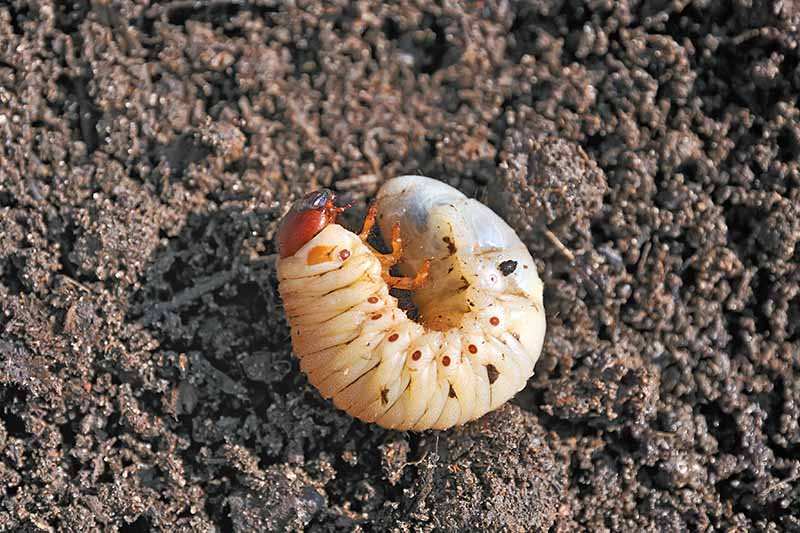
Image source: Bing (Web (fair-use with source credit))
The damage threshold matters. For cool-season grasses like Kentucky bluegrass, perennial ryegrass, and tall fescue, treatment is generally warranted when you find 6 to 10 grubs per square foot. Warm-season grasses like Bermuda, zoysia, and St.
Augustine are more sensitive, so the threshold drops to around 3 to 5 grubs per square foot. Below those numbers, your lawn can usually outgrow the damage with proper watering and fertilization.
Don't skip this step. Plenty of people spray grub killer for patches caused by something entirely different, and the product does nothing because there were never enough grubs to justify treatment in the first place.
The One Timing Rule That Changes Everything: Preventive vs. Curative
This is where most people go wrong. They buy the right product but apply it at the wrong time, and then wonder why it didn't work. The entire timing question comes down to one distinction: are you trying to prevent grubs or kill grubs that are already there?
Preventive grub killers contain active ingredients like imidacloprid or chlorantraniliprole. They work by creating a treated zone in the soil that kills grubs shortly after they hatch and start feeding. These need to be in place before the eggs hatch, which means applying them in early to mid summer.
The product needs time to move into the root zone where the tiny larvae will encounter it.
Curative grub killers contain active ingredients like trichlorfon (Dylox) or carbaryl (Sevin). They kill existing grubs on contact or through ingestion, and they work fast. Dylox, for example, can kill grubs within 24 to 72 hours.
These go down when grubs are present and actively feeding, which is typically August through October in most regions.
Here's the critical part. If you apply a preventive product in September when you're already seeing damage, it's too late. The grubs are too large and too deep for a preventive to work.
Conversely, if you apply a curative product in June before any eggs have hatched, there's nothing there to kill, and the product breaks down before the grubs ever show up.
| Feature | Preventive Grub Killer | Curative Grub Killer |
|---|---|---|
| Active ingredients | Imidacloprid, chlorantraniliprole, halofenozide | Trichlorfon (Dylox), carbaryl (Sevin) |
| Best application window | June to July | August to October |
| Target grub stage | Newly hatched larvae | Small to medium larvae |
| Speed of action | Gradual, as grubs feed | Fast, 24 hours to 3 days |
| Residual protection | 2 to 4 months | Short-term, single event |
| Best for | Stopping damage before it starts | Rescuing already-damaged lawns |
How to Read the Grub Life Cycle Clock for Your Region
Grubs aren't active year-round at the surface. They follow a predictable cycle driven by soil temperature, and understanding that cycle is what lets you time your application correctly.
Adult beetles emerge from the ground in late spring to early summer, depending on your region. Japanese beetles typically peak in late June through July across the Northeast and Midwest. European chafers fly a bit earlier, often in June.
May beetles (June bugs) have a longer flight period that can stretch from May through August.
After mating, female beetles burrow back into the turf and lay eggs in the soil. Those eggs hatch within about 2 to 3 weeks. The tiny larvae start feeding on grass roots in late July and August.
This is the stage where they're most vulnerable to curative treatments because they're small, close to the surface, and actively eating.
As fall progresses and soil temperatures drop below about 50°F, grubs burrow deeper into the soil to overwinter. They're much harder to reach with any product at that point. In spring, they move back toward the surface to feed briefly before pupating and emerging as adults, but spring feeding damage is usually less severe than fall feeding in most regions.

Image source: Bing (Web (fair-use with source credit))
Your local extension service is the best resource for pinpointing beetle flight and egg hatch timing in your specific area. Many university extension programs track degree-day models and publish regional pest activity calendars that take the guesswork out of timing.
Step 1: Diagnose Your Situation (Right Type, Right Stage, Right Damage)
Once you've confirmed grubs are present, you need to figure out three things before choosing a product or a date: what species you're dealing with, how big the grubs are, and how much damage has already occurred.
Species identification matters because different beetles have slightly different timing. Japanese beetle grubs are the most common lawn pest across the Northeast and Midwest. European chafers are heavy in the Great Lakes region and parts of New England.
Masked chafers show up across a wide swath of the eastern and central US. Billbug larvae look similar but are legless, which is an easy way to tell them apart. If you're not sure what you're looking at, your county extension office can usually identify a grub from a clear photo.
Grub size tells you what stage you're dealing with. Grubs under about half an inch long are young and actively feeding near the surface. This is the sweet spot for curative treatments. Grubs over an inch long are mature, harder to kill, and may already be preparing to burrow deep for winter.
If you're finding large grubs in October or November, a curative treatment may still help, but you should also plan a preventive application the following summer to break the cycle.
Damage assessment determines urgency. If you've got scattered brown patches that pass the tug test and 8 to 12 grubs per square foot, you need to act quickly with a curative product. If you've got a history of grub problems in your neighborhood but your lawn still looks healthy, a preventive application this summer is the smarter play.
Here's a simple decision framework:
- It's June or July, no visible damage, but you had grubs last year. Apply a preventive product now.
- It's August or September, brown patches are showing, tug test is positive. Apply a curative product immediately.
- It's October or November, grubs are large, lawn is damaged. Apply a curative product if grubs are still near the surface, but plan to follow up with a preventive next summer.
- It's spring, damage from last fall is visible. Repair the dead patches with seed or sod. Apply a preventive in early summer to protect against the next generation.
Step 2: Match Your Timing to the Product That Actually Works Now
You've diagnosed the situation. Now you need to pick the right product for the right week. This is where the rubber meets the road, and getting it right means the difference between a controlled problem and a recurring nightmare.
If you're in the preventive window (June to July): Look for products containing chlorantraniliprole (found in GrubEx) or imidacloprid (found in Merit and various store-brand formulations). Chlorantraniliprole has become the go-to preventive because it's effective at low application rates and has a favorable environmental profile compared to older neonicotinoids. Apply it in late June or early July in most northern and mid-Atlantic states.
In the Southeast, where beetle flight starts earlier, you may need to apply in late May or early June. Water it in thoroughly after application so the active ingredient moves into the root zone where newly hatched grubs will encounter it.
If you're in the curative window (August to October): Reach for trichlorfon (Dylox) or carbaryl (Sevin). Dylox is the most widely recommended curative because it kills fast and works on larger grubs that preventive products can't touch. It's a contact and stomach poison, so grubs don't need to eat treated grass for it to work.
They just need to move through the treated soil. Apply Dylox when grubs are actively feeding near the surface, which is typically August through mid-October in most regions. Water it in with about a quarter inch of irrigation right after application.
If you're past mid-October and grubs are still showing up: Check your soil temperature. If it's still above 50°F at a 3-inch depth, a curative application can still work. If soil temps have dropped below that threshold, grubs have likely already moved too deep.
Hold off, mark your calendar for a preventive application next June, and focus on repairing the damage in spring.
A few products on the market combine both modes of action or claim season-long control. Read the label carefully. A product that says "prevents grubs" is not going to rescue a lawn that's already being eaten alive.
Match the label claim to your actual situation.
One more thing worth mentioning. Some homeowners try to use milky spore (Paenibacillus popilliae) or beneficial nematodes (Heterorhabditis bacteriophora) as alternatives. Milky spore only targets Japanese beetle grubs, takes 2 to 4 years to establish in the soil, and won't help you this season.
Nematodes can work as a curative treatment if applied correctly in late summer when soil temperatures are warm and moisture is adequate, but they require more careful handling and precise conditions to be effective. They're a valid option for organic-minded homeowners, but they're not a drop-in replacement for chemical insecticides when you need reliable control.
What to Do If You Missed the Preventive Window
It happens. Life gets busy, you didn't notice the beetles flying in June, and now it's August with brown patches spreading across the yard. The good news is you're not out of options.
You just need to switch from prevention mode to rescue mode.
The first thing to do is confirm grubs are still active near the surface. Dig a small test hole at the edge of a damaged area, about 2 to 3 inches deep. If you find small, C-shaped larvae, you're in the curative window and a product like Dylox (trichlorfon) will do the job.
Apply it as soon as possible. Every week you wait, those grubs get bigger and harder to kill.
If you're finding grubs but they're already over an inch long and it's late September or October, check your soil temperature. Grab a probe thermometer and push it 3 inches into the soil. If you're reading above 50°F, grubs are still feeding near the surface and a curative treatment can still knock them back.
If it's below 50°F, they've likely started their descent into deeper soil for winter. In that case, mark your calendar for a preventive application next June and focus on lawn repair in spring.
One common mistake at this stage is reaching for a preventive product because it's what's on the shelf at the hardware store. Imidacloprid and chlorantraniliprole won't touch large, established grubs. You need a curative active ingredient.
Read the label before you buy. If it says "prevents grubs" or "season-long control," put it back and look for one that says "kills grubs on contact" or lists trichlorfon or carbaryl as the active ingredient.
The Decision Flowchart: Which Product, Which Week, Why
Let's put this all together into a straightforward decision path. Answer these questions in order and you'll land on the right product at the right time.
Question 1: What month is it?
- May to June: You're in the preventive window. If you had grubs last year or your neighbors are reporting beetle activity, apply a preventive product containing chlorantraniliprole or imidacloprid. Water it in well.
- July to August: You're at the transition point. If you haven't applied a preventive yet and you're in a high-pressure grub area, you can still get a preventive down in early July. By late August, switch to a curative if you're finding small grubs.
- September to October: You're in the curative window. Apply trichlorfon (Dylox) or carbaryl (Sevin) if grubs are present and soil temps are above 50°F.
- November or later: Hold off on treatment. Plan a preventive for next summer and repair damage in spring.
Question 2: Are you seeing damage right now?
- No damage, no grubs found: If you're in the preventive window and had problems before, apply a preventive. If you've never had grub issues, you can probably skip treatment this year.
- Damage present, grubs confirmed: Apply a curative immediately. Don't wait for a "better" time. Active feeding means active damage.
- Damage present, no grubs found: Something else is causing the problem. Check for fungal disease, drought stress, or irrigation issues before treating.
Question 3: What's your grass type?
- Cool-season grasses (bluegrass, fescue, ryegrass): These tolerate moderate grub feeding. Threshold for treatment is around 6 to 10 grubs per square foot.
- Warm-season grasses (Bermuda, zoysia, St. Augustine, centipede): These are more sensitive. Treat at 3 to 5 grubs per square foot. Timing may be earlier in the South, with preventive applications sometimes needed in May.
Season-by-Season Breakdown: Spring, Summer, Fall
Spring (March to May): This is repair season, not treatment season. Grubs that survived the winter may feed briefly, but they're preparing to pupate and aren't worth targeting. Focus on overseeding dead patches, fertilizing, and getting your lawn healthy.
If you had significant grub damage last fall, plan your preventive application for early summer. This is also a good time to call your local extension office and ask about beetle activity predictions for your area.
Summer (June to August): This is your preventive window. Adult beetles are flying, mating, and laying eggs. Apply a preventive product in June or early July in northern and mid-Atlantic states.
In the Southeast, you may need to apply in late May. Water the product in thoroughly with at least a quarter inch of irrigation. If you missed the preventive window and are finding small grubs in late August, a curative application can still save your lawn.
Fall (September to November): This is curative territory. Grubs are feeding aggressively and causing visible damage. Apply a curative product like Dylox as soon as you confirm grubs are present.
September is ideal because grubs are still small and near the surface. By late October, check soil temperatures before treating. Once November arrives in northern climates, it's usually too late for effective chemical control.
Focus on cleanup and planning for next year.
Timing Mistakes That Waste Your Money
The number one mistake is applying a preventive product too late. People see brown patches in August, buy a product with imidacloprid, put it down, and wonder why the lawn keeps dying. That product was designed to kill tiny larvae, not inch-long monsters.
By August, you need a curative.
The second mistake is applying a curative product too early. If you put Dylox down in June before any eggs have hatched, there's nothing in the soil to kill. The product degrades over a few weeks, and by the time grubs actually appear in August, it's gone.
You've spent money for zero results.
The third mistake is not watering in the product. Granular grub killers need water to move the active ingredient into the soil where grubs live. If you spread granules on a dry lawn and don't water, most of the product sits on the surface and breaks down in sunlight.
You need about a quarter to half inch of water within 24 hours of application. A sprinkler works better than relying on rainfall you can't control.
The fourth mistake is treating when grubs have already gone deep for winter. If it's late October in Ohio and your soil temperature is 45°F, those grubs are already 6 inches down. No product will reach them effectively at that depth.
You're better off waiting until next summer and breaking the cycle with a preventive.
The fifth mistake is confusing grub damage with other problems. Drought-stressed grass, fungal patches like brown patch or dollar spot, and even dog urine spots can look similar from a distance. Always do the tug test and dig before you treat.
If you don't find grubs, you don't need grub killer.
How to Water In and Make the Treatment Actually Stick
You've picked the right product for the right week. Now you need to apply it correctly, and watering is the step most people get wrong.
For granular products, use a broadcast or drop spreader to distribute the granules evenly across the lawn. Check the bag for the correct spreader setting. Overlapping passes leave streaks of over-treated lawn, and gaps leave untreated zones where grubs survive.
Walk at a steady pace and shut off the spreader at turns to avoid piling up product in one spot.

Image source: Bing (Web (fair-use with source credit))
After spreading, water the lawn with about a quarter to half inch of irrigation. This moves the active ingredient off the granules and into the top inch or two of soil where grubs are feeding. You can measure this by placing a shallow tuna can on the lawn while you run the sprinkler.
When it's got a quarter inch of water in it, you're done.
Don't apply right before a heavy rainstorm. A light rain is fine, but a downpour can wash granules off the lawn and into storm drains. That's wasted product and a water quality concern.
If rain is in the forecast, apply when you can control the watering yourself.
For liquid products, use a hose-end sprayer or pump sprayer calibrated to the rate on the label. Spray evenly, then water in lightly. Liquid formulations can work faster than granular ones because the active ingredient is already in solution, but they still need that initial watering to move into the root zone.
Keep pets and children off the treated area until the product has been watered in and the grass is dry. This is usually a matter of a few hours, but check the specific product label for its recommendation. Most modern grub killers are low-toxicity to mammals once they've been watered into the soil, but the dry granules on the surface can be irritating if tracked into the house or ingested.
When DIY Isn't Enough: Knowing When to Call a Pro
Most grub problems are manageable with a trip to the hardware store and a Saturday afternoon. But there are situations where calling a licensed lawn care professional is the smarter move.
If you've got a large property, say over half an acre, and widespread damage across multiple areas, a professional applicator can cover the ground faster and more evenly than most homeowners. They also have access to commercial-grade products and equipment that aren't available on retail shelves.
If you've applied a curative product correctly and you're still finding live grubs two weeks later, something's off. A pro can reassess the situation, check for misidentified species, or determine if you're dealing with a resistant population. They can also evaluate whether secondary issues like fungal disease are compounding the damage.
If you're in a high-pressure area with recurring annual infestations, a professional preventive program takes the guesswork out of timing. Many lawn care companies offer season-long grub control as part of their service, with applications timed to local pest activity data.
Real Scenarios: What to Do Based on What You're Seeing Right Now
Scenario 1: It's July 10, your lawn looks fine, but your neighbor had grubs last year. Apply a preventive product containing chlorantraniliprole this week. Water it in well. You're protecting against eggs that are likely being laid right now.
Scenario 2: It's August 20, you've got brown patches, and the tug test is positive with 8 grubs per square foot. Apply Dylox immediately. Water it in with a quarter inch of irrigation. Check for dead grubs in 3 to 5 days.
Plan to overseed the damaged areas in September or early October.
Scenario 3: It's October 5, you're finding large grubs, and soil temperature is 55°F. You still have time for a curative application. Apply Dylox now while grubs are still near the surface. They'll start moving deeper within a few weeks as temperatures drop.
Scenario 4: It's April, and you're seeing the damage from last fall. Don't treat. The grubs are pupating and chemical control won't help. Aerate the damaged areas, overseed with an appropriate grass variety, and fertilize.
Plan a preventive application for June.
Frequently Asked Questions
Can I apply grub killer and fertilizer at the same time?
Yes, in most cases. Many homeowners combine a preventive grub control application with their summer fertilizer. Just make sure both products are compatible and follow the label directions for each.
Water everything in together after application.
How long after applying grub killer can I let my pets back on the lawn?
Most product labels recommend keeping pets off the treated area until the product has been watered in and the grass is completely dry. This is typically 2 to 4 hours. Check the specific label on your product for its recommendation.
Will grub killer kill earthworms?
Some broad-spectrum insecticides can harm earthworm populations. Products containing carbaryl are more likely to affect earthworms than those with chlorantraniliprole or trichlorfon. If earthworm health is a priority, choose a grub-specific product rather than a broad-spectrum insecticide.
Do I need to treat my entire lawn or just the damaged areas?
Treat the entire lawn, not just the visible damage. Grubs often spread beyond the areas where damage is obvious, and untreated sections become reservoirs for next year's infestation. A full-lawn application gives you complete protection.
Can I apply grub killer in the rain?
Don't apply granular products before heavy rain, as runoff can carry the product off your lawn. A light rain after application is actually helpful for watering in the product. If rain is forecast, apply when you can control the irrigation yourself.
How do I know if the treatment worked?
Check the treated area 5 to 7 days after application. Dig in the same spots where you found grubs before. Dead grubs will often appear shriveled or discolored.
If you're still finding active, healthy grubs after two weeks, you may need a second application or a different product.