

Image source: Bing (Web (fair-use with source credit))
Figuring out when to apply grub control in Iowa isn't as simple as circling a date on the calendar. The right timing depends on what product you're using, what grub species you're dealing with, and what life stage those grubs are in right now. Get it right and you'll protect your lawn all season.
Get it wrong and you've wasted money on a product that never had a chance to work.
Here's the thing most people miss: Iowa's mix of cool-season turf, variable spring temperatures, and multiple grub species means there's no single "apply by" date that works for everyone. What we can do is walk through the decision process step by step so you can nail the timing for your specific situation. As of 2026, the core recommendations from Iowa State University Extension haven't changed much, but product options have expanded, giving you more flexibility than ever.
Quick Answer
Apply preventive grub control in Iowa between late May and late June. Apply curative treatments from late July through September. Your exact timing depends on the product you choose and soil temperatures at four inches deep.
Always scout your lawn before treating.
Why Timing Is Everything with Grub Control
What happens when you apply too early
If you put down a preventive product weeks before eggs hatch, the active ingredient may start breaking down before grubs ever encounter it. Most preventive insecticides have a soil half-life measured in weeks, not months. Imidacloprid lasts longer than most, but even it won't sit dormant in your soil for three months waiting for grubs to show up.
You'd be throwing money into the ground, literally.
What happens when you apply too late
This is the more common and more costly mistake. Once grubs reach the third instar stage (L3), they're large, tough, and feeding aggressively. Preventive products like imidacloprid and chlorantraniliprole barely touch them at that point.
You'd need a curative product like trichlorfon, and even that works best on smaller grubs. By the time you see brown patches in August, the damage is already done and you're playing catch-up.
The Iowa-specific challenge: variable springs and multiple grub species
Iowa springs don't warm up on a predictable schedule. A warm March in Des Moines can push soil temperatures to 50°F two weeks earlier than a cold April in Mason City. On top of that, you might have Japanese beetles, June bugs, European chafers, and masked chafers all laying eggs in your yard at slightly different times.
That's why relying on a fixed calendar date is risky. You need to watch soil temperatures and adult beetle activity, not just the calendar.
Know What You're Dealing With: Grub Species and Life Stages in Iowa
The main grub species in Iowa lawns
Not all grubs are created equal. The species you're dealing with affects when they hatch, how fast they grow, and which products work best. Here are the big four in Iowa:
- Japanese beetles, The most notorious. Adults emerge mid-June through July, eggs hatch about two weeks later, and grubs feed through fall.
- European chafers, Common in central Iowa. Adults fly in June, and grubs hatch earlier than Japanese beetles in many cases.
- Northern and southern masked chafers, Adults fly in July. Grubs are often the first to cause visible damage in late summer.
- June bugs (Phyllophaga species), Widespread across rural Iowa. Multiple species with slightly different timing, but most hatch from late June through August.
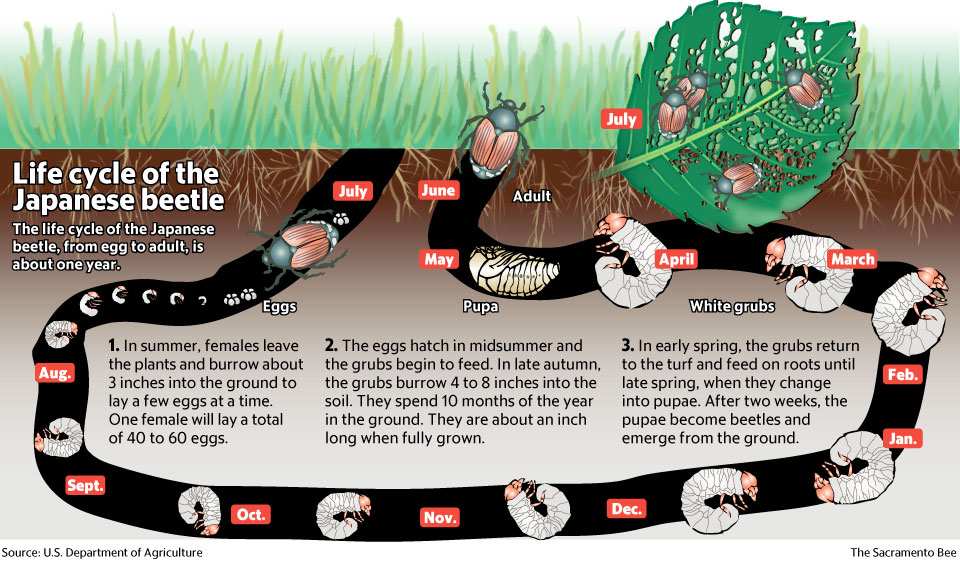
Image source: Bing (Web (fair-use with source credit))
Why life stage determines everything
Grubs go through three larval stages called instars. The first instar (L1) is tiny, maybe an eighth of an inch long, and extremely vulnerable to insecticides. By the third instar (L3), they can be over an inch long and have a much thicker cuticle that resists chemical penetration.
This is why preventive products target eggs and L1 grubs, while curative products need to hit L2 or early L3 to be effective.
Here's a quick breakdown:
| Life Stage | Size | Vulnerability | Best Product Type |
|---|---|---|---|
| Egg | Microscopic | Not feeding yet | Preventive (IGRs like halofenozide) |
| 1st instar (L1) | 1/8–1/4 inch | Highest | Preventive insecticides |
| 2nd instar (L2) | 1/4–3/4 inch | Moderate | Preventive or curative |
| 3rd instar (L3) | 3/4–1+ inch | Low | Curative only (trichlorfon, carbaryl) |
How to scout your lawn and count grubs
Before you buy anything, cut a one-square-foot section of sod in a damaged area. Peel it back and count the grubs you find in the soil underneath. Do this in three or four spots across your lawn.
Here's what the numbers tell you:
- 0, 5 grubs per square foot, Usually no treatment needed. Your turf can handle it.
- 6, 10 grubs per square foot, Borderline. Consider treatment if your lawn is already stressed by drought or heat.
- 10, 15+ grubs per square foot, Treat. You're looking at real damage without intervention.
Scouting in late July or early August gives you the clearest picture of what you're dealing with heading into fall.
The Decision Tree: Preventive vs. Curative — Which Path Do You Take?
This is the fork in the road. Your choice here determines your entire timeline.
Path 1: You're going preventive (stopping next year's damage)
Choose this path if you had grub damage last year, you found more than 10 grubs per square foot in your scouting, or you just want to protect a lawn you've invested in. Preventive products work on eggs and newly hatched grubs. They won't kill the big grubs already in your lawn right now.
When to apply: Late May through late June in most of Iowa. Southern Iowa counties can start in early May if soil temperatures are consistently hitting 50°F at four inches deep. Northern Iowa may not be ready until early June.
Products to consider:
- Chlorantraniliprole (GrubEx1, Acelepryn), Long residual, low toxicity to non-target organisms
- Imidacloprid (Merit, GrubEx), Proven track record, full-season control
- Halofenozide (Mach 2), Insect growth regulator, must be ingested before molting
Path 2: You're going curative (dealing with grubs right now)
Choose this path if you're already seeing damage, you scouted and found large grubs, or it's mid-summer and you missed the preventive window. Curative products work fast but don't last long. You're putting out a fire, not installing a fireproof door.
When to apply: Late July through September, when grubs are actively feeding in the root zone. The earlier in this window, the better your results.
Products to consider:
- Trichlorfon (Dylox, GrubEx2), Fast-acting, works on L2 and L3 grubs
- Carbaryl (Sevin), Moderate residual, also handles surface-feeding insects
Path 3: You're using biological controls (nematodes, Bt)
Choose this path if you want to avoid synthetic chemicals, you have pets and kids playing on the lawn, or you're managing an organic property. Biologicals require more precise timing and handling but are safe for pollinators, earthworms, and wildlife.
When to apply:
- Beneficial nematodes (Heterorhabditis bacteriophora): Late August through early October, when soil is warm and moist
- Bt galleriae (grubGONE!): Late July through September, applied to moist soil in the evening
- Milky spore (Paenibacillus popilliae): Anytime the ground isn't frozen, but it's a long-term strategy, not a quick fix
Timing by Product: When to Apply What in Iowa
Now let's get specific. Here's a full breakdown of when to apply each major product category in Iowa, based on manufacturer specifications and Iowa State University Extension guidance.
Preventive products: imidacloprid, chlorantraniliprole, halofenozide
These all need to be in the soil before or right as eggs hatch. The grubs have to ingest or encounter the product while they're still tiny.
| Product | Active Ingredient | Iowa Application Window | Target Stage | Water-In Required? |
|---|---|---|---|---|
| GrubEx1 | Chlorantraniliprole | Late May – late June | Eggs, L1 | Yes, 1/4–1/2 inch |
| GrubEx (original) | Imidacloprid | Late May – early July | Eggs, L1, early L2 | Yes, 1/4–1/2 inch |
| Mach 2 | Halofenozide | Late May – mid-June | Eggs, L1 | Yes, follow label |
The key with all three is getting them watered in within 24 hours of application. The active ingredient needs to move into the root zone where grubs feed. If you apply granules and leave them sitting on the surface, most of the product never reaches the target.
Curative products: trichlorfon, carbaryl
These are your rescue treatments. They work on grubs that are already feeding and growing. Speed matters here because the longer you wait, the bigger the grubs get and the harder they are to kill.
| Product | Active Ingredient | Iowa Application Window | Target Stage | Water-In Required? |
|---|---|---|---|---|
| Dylox / GrubEx2 | Trichlorfon | Late July – September | L2, early L3 | Yes, immediately |
| Sevin | Carbaryl | Late July – September | L2, L3 | Yes, follow label |
Trichlorfon is the go-to curative because it's fast-acting. You can see results within a few days. But it breaks down quickly in the soil, so timing has to be precise.
Carbaryl lasts a bit longer but isn't quite as effective on larger grubs.
Biological options: beneficial nematodes, Bt galleriae, milky spore
These require more care in handling and application but offer a chemical-free approach.
| Product | Active Ingredient | Iowa Application Window | Target Stage | Special Notes |
|---|---|---|---|---|
| NemaSeek | Heterorhabditis bacteriophora | Late August – early October | L1, L2 | Keep soil moist; apply in evening |
| grubGONE! | Bt galleriae | Late July – September | L1, L2 | Must be ingested; apply to moist soil |
| Milky spore | Paenibacillus popilliae | Any non-frozen time | L3 (Japanese beetle only) | Takes 2–3 years to establish; long-term only |
Beneficial nematodes are living organisms. If you buy them, check the expiration date, keep them refrigerated until application, and apply them in the evening. UV light kills them fast.
Bt galleriae works similarly to Bt for caterpillars but targets grubs specifically. Milky spore is a long-term play. It won't help this year, but if you have a persistent Japanese beetle problem, it can reduce populations over several seasons.
Using Soil Temperature and Beetle Activity to Fine-Tune Your Timing
Soil temperature thresholds that trigger egg hatch
Soil temperature is the single most reliable indicator for grub egg hatch in Iowa. When the soil at four inches deep hits 50°F consistently, eggs start hatching for most species. Peak hatch usually occurs between 60°F and 70°F.
Once soil temps climb above 75°F, grubs start moving deeper into the soil profile, making them harder to reach with surface-applied products.
You don't need fancy equipment. A basic soil thermometer pushed four inches into the ground gives you what you need. Take readings in the morning for consistency.
Check a few spots in your yard since shaded areas warm up slower than full-sun areas.

Image source: Bing (Web (fair-use with source credit))
Here's a rough timeline for Iowa based on historical soil temperature data:
| Soil Temperature (4-inch depth) | What's Happening | Action to Take |
|---|---|---|
| Below 50°F | Eggs not hatching yet | Wait. Don't apply preventive yet. |
| 50–55°F | Egg hatch beginning | Apply preventive products now. |
| 55–65°F | Peak egg hatch, L1 grubs active | Ideal window for preventive application. |
| 65–75°F | L1 and L2 grubs feeding | Last chance for preventive. Curative window opening. |
| Above 75°F | Grubs moving deeper | Switch to curative products if needed. |
Tracking adult beetle flight in Iowa
Adult beetles are your early warning system. When you start seeing Japanese beetles or June bugs flying around your porch lights or feeding on your roses, eggs are going into the ground about two weeks later. That's your cue to get preventive products down if you haven't already.
In southern Iowa, Japanese beetle flight typically starts in mid-June. In northern Iowa, it's closer to late June or early July. European chafers tend to fly about a week earlier than Japanese beetles.
Masked chafers fly in July. If you're seeing adult beetles in your yard, your application window is now.
Degree-day models: the more precise approach
For those who want to get really precise, degree-day models track accumulated heat units over time. Japanese beetle egg hatch in Iowa correlates with approximately 1,050 degree-days using a base temperature of 50°F, measured from when adults first emerge. You can find degree-day accumulation data through Iowa State University Extension and some weather services.
The advantage of degree-day tracking is that it accounts for those weird Iowa springs where March is warm and April is cold. A calendar can't do that. Degree-days can.
The downside is it requires checking data regularly and doing a bit of math. For most homeowners, watching soil temps and beetle activity is close enough.
Common Mistakes That Waste Your Time and Money
Applying preventive products to large, established grubs
This is the number one mistake we see. Someone buys GrubEx in August because they see brown patches in their lawn. They put it down and wonder why it doesn't work.
The product was designed to kill tiny L1 grubs, not inch-long L3 grubs that are already tearing through the root system. If you're past mid-July and seeing damage, you need a curative product, not a preventive one.
Skipping the water-in step
Granular grub control products need water to move the active ingredient into the soil where grubs live. If you apply granules and leave them sitting on the surface, UV light breaks them down and they never reach the target zone. Water in with a quarter-inch to half-inch of irrigation within 24 hours of application.
Don't wait for rain. You might wait too long.
Treating without scouting first
Not every brown patch in an Iowa lawn is grub damage. Fungal diseases, drought stress, dog urine spots, and fertilizer burn can all look similar. If you treat for grubs without confirming they're there, you're spending money on a problem you don't have.
Cut that square foot of sod. Peel it back. Count the grubs.
Then decide.

Image source: Bing (Web (fair-use with source credit))
Confusing grub damage with other lawn problems
Grub damage has a telltale sign: the sod lifts up like a loose carpet because the roots have been chewed through. If you can't peel the brown grass up easily, it's probably something else. Grubs also cause irregular patches, not the uniform circles you'd see with a fungal disease.
And skunk or raccoon digging in your lawn at night is a secondary sign. They're after the grubs, but the grubs caused the problem first.
Applying before a heavy rain event
If your weather forecast calls for two inches of rain in the next 24 hours, hold off on your application. Heavy rain can wash granular products off slopes and into storm drains. That's wasted product and unnecessary chemical loading in Iowa's waterways.
Check the forecast. Apply when you have a calm weather window ahead.
Expecting curative products to prevent next year's damage
Trichlorfon and carbaryl break down in the soil within a few weeks. They kill the grubs that are there now, but they won't protect your lawn next spring. If you use a curative product this fall and had a serious grub problem, plan to apply a preventive product the following late spring.
Otherwise you'll be right back in the same spot next year.
Costs, Products, and What to Expect
Product comparison: what works when
Here's a side-by-side look at the main grub control options available to Iowa homeowners:
| Product | Type | Active Ingredient | Best Timing (Iowa) | Avg. Cost per 5,000 sq ft | Residual |
|---|---|---|---|---|---|
| GrubEx1 | Preventive | Chlorantraniliprole | Late May – late June | $25–$40 | Full season |
| GrubEx (original) | Preventive | Imidacloprid | Late May – early July | $20–$35 | Full season |
| Dylox / GrubEx2 | Curative | Trichlorfon | Late July – Sept | $30–$50 | 2–4 weeks |
| Sevin | Curative | Carbaryl | Late July – Sept | $15–$30 | 2–3 weeks |
| NemaSeek | Biological | Beneficial nematodes | Late Aug – early Oct | $30–$60 | 2–4 weeks |
| grubGONE! | Biological | Bt galleriae | Late July – Sept | $35–$55 | 1–2 weeks |
DIY vs. professional application costs in Iowa
If you're doing it yourself, expect to spend between $15 and $60 per application depending on the product and lawn size. Most granular products cover 5,000 to 10,000 square feet per bag. A typical Iowa lawn of 5,000 square feet runs about $25 to $40 for a preventive application using a store-bought product.
Professional lawn care services in Iowa typically charge $50 to $100 per application for an average-sized lawn. The premium gets you proper product selection, calibrated application, and someone who knows what they're looking for. If you've had repeated grub problems and aren't sure what you're dealing with, a professional assessment can pay for itself.
How long each product lasts and when to reevaluate
Preventive products like chlorantraniliprole and imidacloprid are designed to last the full growing season. One application in late spring should carry you through fall. Curative products are short-lived.
If you apply trichlorfon in August, scout again two to three weeks later. If you're still finding live grubs, a second application may be needed.
For biological options, expect shorter residuals. Nematodes need to find their host within a few weeks or they die off. Bt galleriae breaks down in sunlight and needs repeat applications in some cases.
These products work, but they demand more attention and follow-up.
Iowa-Specific Factors That Shift Your Timing
Northern Iowa vs. southern Iowa: the 1–2 week gap
Iowa spans roughly two USDA hardiness zones and about four degrees of latitude. That matters for grub timing. Southern Iowa counties like Lee, Des Moines, and Appanoose typically see soil temperatures hit 50°F one to two weeks earlier than northern counties like Kossuth, Dickinson, and Allamakee.
If you live near the Minnesota border, don't be surprised if your neighbors to the south are treating grubs while you're still waiting for things to warm up.
This also means adult beetle flight starts earlier in the south. Japanese beetles in Keokuk might be flying in early June while they're just showing up in Algona in late June. Adjust your calendar accordingly.
Cool-season turf and grub damage thresholds
Most Iowa lawns are cool-season grasses: Kentucky bluegrass, tall fescue, and perennial ryegrass. These species have different tolerances for grub feeding. Kentucky bluegrass tends to show damage faster because it spreads by rhizomes and relies on a healthy root system.
Tall fescue, with its deeper roots and bunch-type growth, can tolerate a few more grubs before browning out.
The general threshold for cool-season turf is around 10 grubs per square foot before treatment is recommended. If your lawn is well-watered and well-fertilized, it can handle a bit more stress. If it's already struggling with drought or heat, even five or six grubs per square foot can cause visible damage.
Where to find local guidance and soil temperature data
Iowa State University Extension and Outreach is your best resource for region-specific grub management guidance. Their horticulture publications and county extension offices provide updated recommendations each season. The Iowa Department of Agriculture and Land Stewardship handles pesticide applicator licensing and regulations if you're a professional or just want to know what's legal to apply.
For soil temperature data, check local weather stations and agricultural reporting services. Many Iowa State University research farms publish soil temperature readings online. Your local extension office can also point you to the nearest monitoring station.
Don't guess when you can measure.
Your Step-by-Step Action Plan for This Season
Step 1: Assess last year's damage and current grub presence
Think back to last summer. Did you have brown patches that peeled up like loose carpet? Did skunks or raccoons tear up your lawn at night?
If yes, you're at high risk for this year. Scout your lawn in late July by cutting one-square-foot sections in suspect areas. Count the grubs you find.
More than 10 per square foot means treat.
Step 2: Choose your product based on timing and life stage
If you're reading this in May or June and you had grubs last year, go preventive. Chlorantraniliprole or imidacloprid are your best bets. If it's already August and you're seeing damage, grab a curative product like trichlorfon.
If you want to avoid synthetic chemicals entirely, beneficial nematodes applied in late August or early October can work, but they require careful handling and moist soil.
Step 3: Apply at the right window and water in properly
Apply your preventive product between late May and late June for most of Iowa. Put it down before soil temperatures hit 60°F consistently. Use a spreader for even coverage.
Water in with a quarter-inch to half-inch of irrigation within 24 hours. Don't skip this step. The product needs to reach the root zone where grubs feed.
Step 4: Evaluate and plan ahead for next year
Two to three weeks after application, scout again. For curative products, you should see a significant reduction in live grub counts. If you're still finding plenty of healthy grubs, a second application may be needed.
If you used a preventive this spring, make a note to do it again next year at the same time. Consistency is what keeps grub populations under control long-term.
Frequently Asked Questions
Can I apply grub control in the fall instead of spring?
You can apply curative products in fall, but preventive products applied in fall are generally too late to be effective. By October in Iowa, most grubs have already burrowed deep into the soil to overwinter. They're not feeding and not ingesting preventive insecticides.
If you missed the spring preventive window, your best bet is to use a curative product on active grubs or wait until next late spring.
Do I need to treat every year?
Not necessarily. If you scout and find fewer than five grubs per square foot, you can probably skip treatment. Lawns that are well-maintained with proper watering and fertilization can tolerate low grub populations without visible damage.
If you've had chronic problems for multiple years, an annual preventive application is the most reliable approach.
Will grub control hurt my pets or the bees?
Most modern grub control products are low-toxicity to mammals once watered in. Keep pets off the treated lawn until it's completely dry. For bees, the main concern is neonicotinoid products like imidacloprid if applied to flowering clover or weeds in your lawn.
Mow off any blooms before application and you'll minimize the risk. Chlorantraniliprole has lower toxicity to bees compared to older neonicotinoid options.
What if I already see damage? Is it too late?
It's not too late for this year, but you've missed the preventive window. Switch to a curative product like trichlorfon and apply it as soon as possible. Water it in well.
You won't reverse the damage that's already done, but you can stop it from getting worse. Plan to apply a preventive next late spring to break the cycle.
Can I combine grub control with fertilizer?
Many lawn care products combine grub control with fertilizer, and that's fine as long as the timing works for both. The key is making sure the grub control active ingredient gets watered in properly. Read the label carefully.
Some combination products have specific watering instructions that differ from standalone grub control products.
How do I know if I have grubs vs. a fungal disease?
Grub damage lifts up easily because the roots are gone. Fungal diseases typically don't loosen the sod. Grub damage appears as irregular brown patches that expand over time.
Fungal diseases often have distinct patterns like circles or spots on the blades. When in doubt, cut a small section and check for grubs in the soil.