Every year, thousands of homeowners spend money on grub control at the wrong time and wonder why their lawn still ends up torn apart. The truth is that timing isn't just one piece of the puzzle. It's the whole puzzle.
If you're asking when should you apply grub control, the answer depends on what's actually happening under your grass right now, not what the calendar says.
Here's the thing most people miss. Grub products aren't one-size-fits-all, and the window for effective treatment is narrower than you'd think. Research from university extension programs consistently shows that preventive insecticides need to be in the soil before eggs hatch, while curative products only work when grubs are small and actively feeding.
Get the timing wrong by even a few weeks, and you've basically watered your lawn with expensive placebo.

Image source: Wikimedia Commons / Сарапулов (CC BY)
Quick Answer
Apply preventive grub control in early to mid-summer, typically June through July in most regions. This puts the product in place before beetle eggs hatch. If you're using a curative approach, late August through September is your window.
Always match your timing to the specific grub species in your area. Soil temperature and local beetle activity matter more than any fixed calendar date.
Why Grub Timing Is the Make-or-Break Factor
Grubs aren't just sitting in your soil waiting for you to show up with a product. They're following a biological clock that's been running for thousands of years. Adult beetles emerge, mate, lay eggs, and those eggs hatch on a schedule driven by soil temperature and daylight.
Your job is to interrupt that cycle at exactly the right moment.
Image source: Wikimedia Commons / Сарапулов (CC BY)
When you apply too early, the active ingredient starts breaking down before the grubs even appear. Most preventive insecticides have a residual window of 8 to 12 weeks. Apply in May for a beetle that doesn't lay eggs until late July, and you've got bare soil by the time larvae show up.
That's money in the ground doing absolutely nothing.
Apply too late, and you're dealing with large, mature grubs that most over-the-counter products can't touch. By September in many regions, third-instar grubs have built up enough body mass that curative insecticides struggle to deliver a lethal dose. They're also starting to burrow deeper into the soil for winter, putting them out of reach entirely.
The cost of bad timing isn't just wasted product. It's the lawn damage that happens while you wait for a "better time" that never comes. A heavy grub population can destroy root systems in weeks, leaving you with brown patches that peel back like loose carpet.
Then you're looking at reseeding or sodding, which costs ten times what a properly timed application would have.
How the Grub Life Cycle Dictates Your Timing
Understanding the grub life cycle is the single most important thing you can do to get your timing right. Every species follows the same basic pattern, but the calendar shifts depending on where you live and which beetles are active in your area.
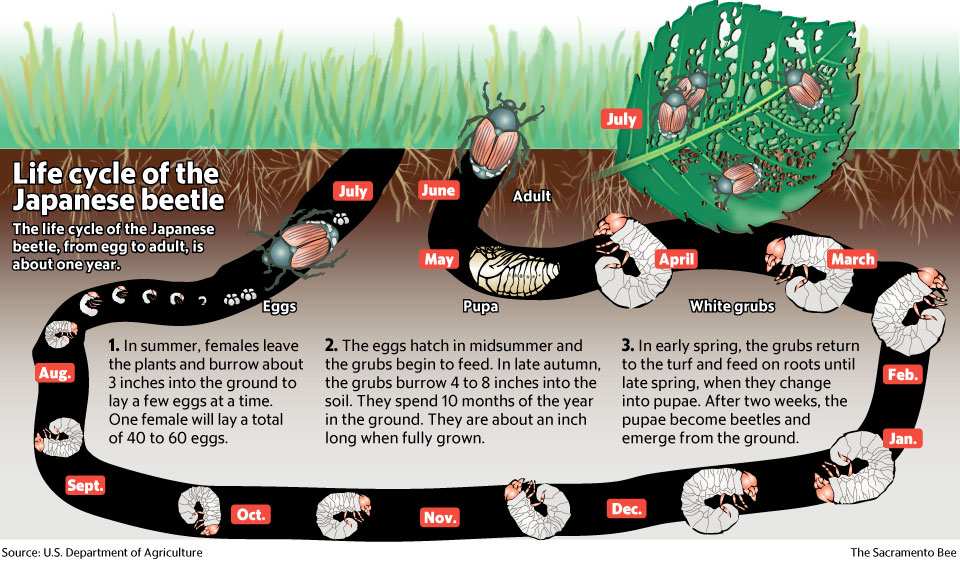
Image source: Bing (Web (fair-use with source credit))
Here's how it works. Adult beetles emerge from the soil in late spring or early summer. Japanese beetles typically show up in June across the Midwest and Northeast.
European chafers can appear as early as mid-May in some northern states. Masked chafers in the South often fly in July.
After emerging, adults feed on trees and shrubs for a few weeks. Then they mate and females burrow back into the soil to lay eggs. This egg-laying period is your trigger point.
It's when you need preventive product already in place or going down immediately.
Eggs hatch within 10 to 21 days depending on soil temperature. The tiny first-instar grubs that emerge are the most vulnerable stage. They're small, they're near the surface, and they're feeding aggressively on fine root hairs.
This is the sweet spot for curative products if you missed the preventive window.
As summer progresses, grubs molt into second and third instars. They get bigger, they eat more, and they move deeper into the soil profile. By fall, third-instar grubs can be over an inch long and sitting 4 to 6 inches down.
At that point, even the best curative insecticide has trouble reaching them effectively.
The cycle completes when grubs burrow deep for winter and pupate the following spring. Adults emerge, and it starts all over again. Your treatment timing needs to target either the egg-laying period for prevention or the early larval stage for cure.
Preventive vs. Curative: Choosing the Right Approach
This is where most people get confused, and it's the decision that determines your entire timing strategy. Preventive and curative grub controls aren't interchangeable. They use different active ingredients, work through different mechanisms, and have completely different application windows.
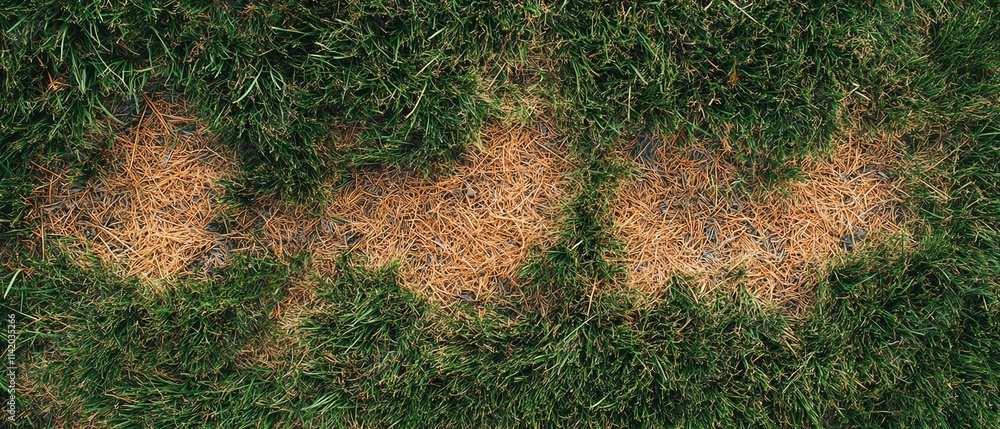
Image source: Bing (Web (fair-use with source credit)
Preventive grub control is your insurance policy. You apply it before grubs are a problem, and it creates a protective zone in the soil that kills larvae as they hatch and start feeding. The most common active ingredients here are imidacloprid, clothianidin, and chlorantraniliprole.
These are systemic, meaning plant roots absorb them and grubs ingest them while feeding.
The timing window for preventive products is early to mid-summer. You want the active ingredient established in the root zone before beetle flight peaks. For most of the country, that means June through early July.
In the upper Midwest dealing with European chafer, late May to mid-June can be the right call.
Curative grub control is your emergency response. You use it when you've already found grubs in your lawn or when you missed the preventive window and beetles have already laid eggs. The go-to active ingredients here are trichlorfon and carbaryl.
These work on contact and through ingestion, delivering a faster kill than preventive products.
The curative window is late summer to early fall. You're targeting those small, newly hatched grubs before they grow too large. In most regions, that's late August through September.
Once soil temperatures drop and grubs start their downward migration for winter, curative products lose effectiveness fast.
Here's a simple breakdown of when each approach makes sense:
| Factor | Preventive | Curative |
|---|---|---|
| Best application window | June to early July | Late August to September |
| Active ingredients | Imidacloprid, clothianidin, chlorantraniliprole | Trichlorfon, carbaryl |
| Speed of kill | Slow (works as grubs feed) | Fast (24 to 72 hours) |
| Grub size at application | Not yet hatched | Small, first to second instar |
| Best for | Known grub history, high-risk areas | Active infestation, missed prevention |
| Residual protection | 8 to 12 weeks | Short, single-season |
The mistake people make is buying a preventive product in September when they see damage. That product won't work because it's designed to be in the soil before eggs hatch, not to kill existing grubs. Always match your product type to your timing and situation.
The Decision Tree: Which Timing Window Fits Your Lawn
Let's cut through the guesswork. Your situation determines your timing, not a generic recommendation. Walk through these scenarios and find yours.
Scenario 1: You're Starting Fresh (No Active Grubs)
If you've never had grub damage and you're being proactive, preventive is your play. Apply a product containing imidacloprid or chlorantraniliprole in June or early July. This gives the active ingredient time to move into the root zone before beetle flight peaks in your area.
Water it in thoroughly after application. Granular products need about a quarter inch of irrigation to move the active ingredient into the soil where roots can absorb it. Without that watering step, the product sits on the surface and degrades in sunlight.
Scenario 2: You Found Grubs This Spring
Finding grubs in April or May doesn't mean you need to panic. Those are overwintered grubs that have been in the soil since last fall. They're large, they're deep, and most products won't touch them effectively at this stage.
Your move here is to mark your calendar for preventive application in early summer. Those grubs will pupate and emerge as adults soon. The adults will lay eggs, and that's when your preventive product needs to be ready.
Don't waste money trying to kill big spring grubs. Focus on breaking the cycle for the next generation.
Scenario 3: You're Dealing With Heavy Animal Digging
Skunks and raccoons tearing up your lawn at night is a classic sign of a heavy grub infestation. They're digging to feed on the larvae, and by the time animals show up, you've already got a significant population.
This is a curative situation. Apply trichlorfon or carbaryl as soon as possible. These products work fast, usually within 24 to 72 hours.
You want to knock down the population before animals cause more structural damage to the turf than the grubs themselves.
Follow up with a preventive application the following June to stop the cycle from repeating. One curative treatment fixes the immediate problem, but without prevention, you'll be back in the same spot next year.
Scenario 4: You Had Damage Last Year
If you dealt with grub damage last season, assume eggs are in the soil waiting to hatch. Beetles return to the same areas to lay eggs, especially if the soil conditions and turf type are favorable to them.
Go preventive this year. Apply in early to mid-summer before adult beetles finish their egg-laying cycle. If you're in a region with multiple beetle species that fly at different times, consider a product with a longer residual window or plan for a second application timed to the later-flying species.
The key insight here is that past damage is the single best predictor of future problems. If you've had grubs once, you're in a high-risk category and should treat preventively every year until you've broken the cycle.
Regional Timing Differences You Can't Ignore
The "June through July" preventive window I mentioned earlier works well as a baseline, but your actual timing needs to account for your region and the specific beetle species in your area. What works in Ohio will fail in Georgia. What works for Japanese beetle won't line up for European chafer.
Let's break it down by region. In the Northeast and upper Midwest, European chafer is the dominant pest in many areas. These beetles fly and lay eggs earlier than Japanese beetles, sometimes peaking in mid-June.
That shifts your preventive window earlier, often to late May or early July. If you wait until July for preventive application in these areas, you've already missed the egg-laying peak.
Japanese beetle territory covers much of the eastern half of the country. Their adult flight typically peaks in July, so preventive application through mid-July works well here. University extension services in states like Pennsylvania, Ohio, and Indiana consistently recommend early to mid-July as the sweet spot.
The Southeast faces different challenges. Masked chafers and Japanese beetles overlap, and the warm soil accelerates egg development. Preventive application might need to go down as early as May in parts of Georgia, Alabama, and the Carolinas.
Warm-season grasses like bermudagrass and zoysiagrass also tend to show damage faster because their root systems are shallower and more vulnerable during peak summer heat.
Out West, European crane fly is the primary grub problem in the Pacific Northwest. Their life cycle shifts everything later. Adult flies emerge in late summer, so preventive application timing differs significantly from beetle-driven regions.
If you're in Oregon or Washington, your grub control calendar looks completely different than someone in New Jersey.
The best single thing you can do is call your local cooperative extension office. They track beetle flight data in real time and can tell you exactly when adults are active in your county. That local intelligence beats any national timing chart.
What Happens If You Apply at the Wrong Time
Bad timing doesn't just waste product. It can actually make your problem worse by giving you false confidence while grubs continue feeding unchecked.
Here's what happens with early application. If you put down preventive insecticide in April or May, the active ingredient starts degrading through microbial breakdown and UV exposure. By the time eggs hatch in July, residual levels may be too low to deliver a lethal dose.
You think you're protected. You're not. Grubs feed all summer, and you don't see damage until August or September.
Late application has its own problems. If you're using a preventive product in September, eggs have already hatched and grubs are growing. Preventive insecticides work by being present in the root zone as tiny grubs begin feeding.
They're not designed to kill established larvae. You've spent money on the wrong tool for the job.
Then there's the curative timing mistake. Apply curative insecticide too late in fall, and grubs have already migrated below the treatment zone. You get partial kill at best, leaving enough survivors to cause damage next spring.
Those survivors also contribute to the next generation's egg-laying population, making your long-term problem worse.
The cost adds up fast. A typical lawn treatment costs $30 to $60 in product for a DIY application, or $100 to $300 for professional service. Apply at the wrong time, and you'll likely need a reseed or repair job on top of that.
Lawn renovation can run $500 to $2,000 depending on the damaged area. That's real money lost to a timing error.
How to Confirm Grubs Are Actually Your Problem
Before you apply anything, make sure grubs are your actual issue. Brown patches in a lawn can come from drought stress, fungal disease, dog urine, or compacted soil. Grub damage has specific signs that set it apart.
Start with the tug test. Grab a handful of brown grass and pull. If it lifts easily like loose carpet with no root attachment, that's classic grub damage.
Healthy turf, even when drought-stressed, resists pulling because roots are still anchored.
Next, check the perimeter. Grub damage typically starts at the edges of a lawn where beetles prefer to lay eggs, especially along sunny south-facing slopes. If your damage is concentrated in shady interior areas, grubs are less likely the culprit.
Get down and look at the soil. Cut a one-foot-square section of turf about 2 inches deep and peel it back. Count the grubs you find in that square foot.
The general threshold is 10 to 15 grubs per square foot before treatment is recommended. Below that, most healthy lawns can outgrow the damage.
Also check for secondary signs. Skunk and raccoon activity at night is a strong indicator. These animals dig small cone-shaped holes in lawns to feed on grubs.
Crows and starlings patrolling your yard pecking at the ground can also signal a grub population worth addressing.
Product Types and Their Specific Timing Windows
Not all grub control products share the same application window. The active ingredient determines when and how you apply, and mixing these up is one of the most common mistakes homeowners make.
Imidacloprid-based products are the most widely available preventive option. Apply these in early to mid-summer, roughly June through July. They need time to be taken up by roots before eggs hatch.
Water them in within 24 hours of application.
Chlorantraniliprole-based products offer similar preventive protection but with a wider application window. Some formulations can be applied as early as May and still provide season-long control. This makes them a good choice for regions with early beetle activity or if you want a more forgiving timeline.
Clothianidin-based products work similarly to imidacloprid but with a slightly different chemical structure. Timing is comparable, June through July for preventive use.
Trichlorfon-based products are your fast-acting curative option. Apply these when grubs are small and actively feeding, typically late August to September. They deliver a quick kill but offer minimal residual protection.
Carbaryl-based products serve as both a preventive and curative depending on timing. Applied in early summer, they work preventively. Applied in late summer, they work curatively.
This versatility makes them useful if you're unsure of your grub situation.
Biological options like milky spore disease and beneficial nematodes have their own timing requirements. Milky spore takes multiple years to establish and works best when soil temperatures are consistently above 70°F. Nematodes need moist soil and should be applied in late summer when grubs are near the surface.
Step-by-Step: Applying Grub Control the Right Way
Getting the product in the ground correctly matters as much as timing. Poor application technique can ruin even a perfectly timed treatment.
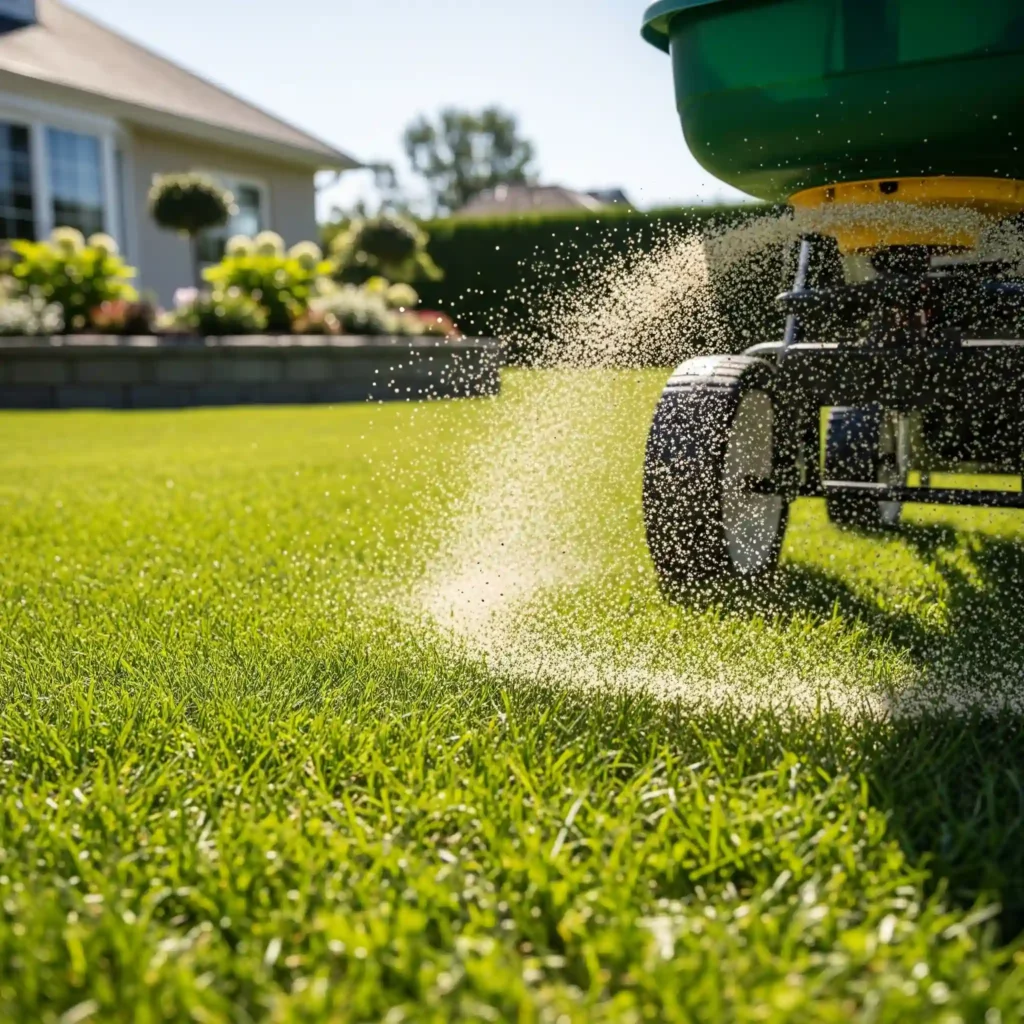
Image source: Bing (Web (fair-use with source credit))
Step 1: Mow your lawn a day or two before application. You want grass short enough for granules to reach the soil surface. Tall grass catches granules and prevents them from reaching the root zone where they're needed.
Step 2: Calibrate your spreader. Read the product label for the correct application rate for your lawn size. Most granular products recommend 2 to 3 pounds per 1,000 square feet.
Too little and you get spotty coverage. Too much and you're wasting product and potentially harming beneficial insects.
Step 3: Apply granular product in two passes. Go north-south on your first pass, then east-west on your second. This cross-hatch pattern gives more even coverage than a single pass.
Step 4: Water thoroughly after application. Aim for at least a quarter inch of irrigation to move granules off grass blades and into the soil. Without this step, active ingredients sit on the surface and degrade in sunlight.
Step 5: Keep foot traffic off the lawn for 24 hours after application and watering. You want the product to settle into the soil without disturbance.
Step 6: Mark your calendar. Note the product used, application date, and area covered. This record helps you evaluate effectiveness and plan next year's treatment.
For liquid formulations, the process is similar. Mix according to label directions, apply with a hose-end or pump sprayer, and water in after application. Liquid products can be faster to apply but require more precise mixing to ensure proper concentration.
Common Mistakes That Waste Your Money
Even with good timing, several application errors can tank your results. The most common one is skipping the water-in step. Granular products need moisture to dissolve and move into the root zone.
Without irrigation, those granules sit on the surface and degrade in sunlight within days.
Another frequent mistake is applying to dry, compacted soil. Hard, packed soil prevents the active ingredient from moving down to where grubs feed. If your lawn hasn't had rain and you can't water, wait until conditions improve.
Applying to drought-stressed turf also reduces uptake since roots aren't actively growing.
Using the wrong spreader setting causes uneven coverage. Too light and you get patchy protection. Too heavy and you're over-applying, which wastes product and increases environmental impact.
Always calibrate your spreader before starting, even if you used the same product last year.
Some people apply grub control at the same time they fertilize, thinking it's efficient. This can work with compatible products, but always check labels. Certain combinations can cause phytotoxicity or reduce effectiveness of one or both products.
When to Call a Professional Instead
DIY grub control works for most residential lawns, but there are situations where professional help makes sense. If you're dealing with a large property over half an acre, professional application ensures even coverage that's hard to achieve with a consumer spreader.
Severe infestations with 20 or more grubs per square foot may need commercial-grade products not available to homeowners. Professionals also have access to application equipment that places product more precisely in the root zone.
If you've tried DIY treatment for two consecutive years and still see damage, something's off with your timing, product choice, or application technique. A licensed lawn care operator can assess the situation and adjust your approach.
FAQs About Grub Control Timing
Can I apply grub control in spring?
Spring application of preventive products is generally too early. The active ingredient degrades before summer egg hatch. Spring is better spent identifying whether you have a grub problem and planning your summer treatment.
How long does grub control take to work?
Preventive products work gradually as grubs ingest treated roots. Curative products like trichlorfon deliver a faster kill, typically within 24 to 72 hours. Full population reduction may take one to two weeks depending on grub size and product used.
Is fall too late for grub control?
Fall is too late for preventive products but still viable for curative treatment if grubs are small and near the surface. Once soil temperatures drop below 50°F and grubs migrate deep, most products lose effectiveness.
Do I need to treat every year?
If you've had grub damage in the past two years, annual preventive treatment is recommended. Beetles return to the same areas to lay eggs, and populations can rebuild quickly. After three consecutive years of successful prevention, you can reassess based on monitoring.
Can I apply grub control and weed control at the same time?
Some combination products exist, but always verify compatibility on the label. If using separate products, apply them at least a week apart to avoid overwhelming the turf or creating chemical interactions that reduce effectiveness.