When is the best time to kill lawn grubs? If you're staring at brown patches and peeling turf, you're probably already late for the ideal preventive window. The good news is you've still got options.
The trick is matching your treatment timing to where the grubs actually are in their life cycle right now.
Most lawn grubs are the larval stage of beetles like Japanese beetles, European chafers, and June bugs. Extension services generally consider 10 or more grubs per square foot enough to warrant treatment. Hit them at the right stage and a single application does the job.
Miss that window and you're fighting an uphill battle no matter what product you use.
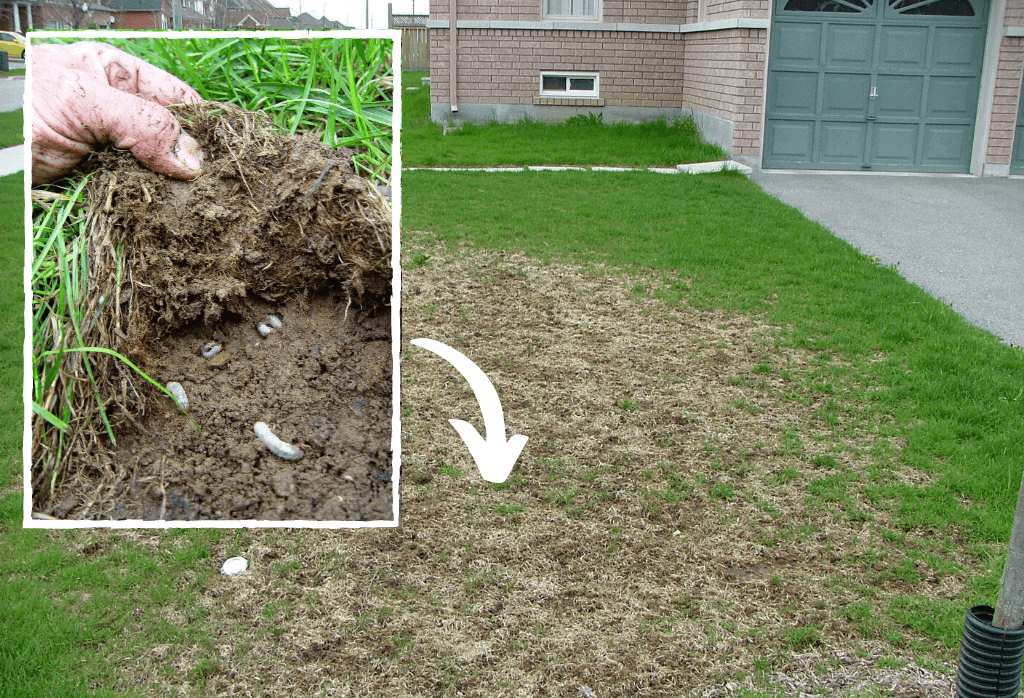
Image source: Bing (Web (fair-use with source credit))
Quick Answer
The best time to kill lawn grubs depends on your goal. For preventive control, apply in late May through June before eggs hatch. For curative control, treat from late July through September when grubs are small and actively feeding.
Soil temperatures above 65°F signal peak grub activity. Always match your product type to the timing window you're working with.
Why Most People Treat Grubs at the Wrong Time
Here's the pattern we see over and over. A homeowner notices brown patches in August, runs to the store, grabs a grub product, and applies it. Sometimes it works.
Often it doesn't. The problem usually isn't the product. It's the timing.
Grubs are most vulnerable when they're young, small, and feeding close to the soil surface. That window is narrow. Once they're large and deep in the profile, curative products struggle to reach them.
And if you apply a preventive product after the grubs are already big, it's like locking the barn door after the horse has left.
The other common mistake is treating based on the calendar alone without checking what's actually happening in your soil. Two neighbors three miles apart can have grub populations at completely different life stages depending on sun exposure, soil type, and which species is dominant. That's why a one-size-fits-all date doesn't work.
The Real Answer: Best Time to Kill Lawn Grubs by Season
Your timing should follow the grub's life cycle, not the calendar on your fridge. Here's how the seasons break down.
Spring Treatment Window (April–June)
Spring is your preventive window. Adult beetles haven't started laying eggs yet, but they will soon. If you use a preventive product like imidacloprid or chlorantraniliprole (Acelepryn), you're creating a residual barrier in the soil that kills grubs as they hatch later in summer.
The key here is getting the product down and watered in before the beetles fly and lay eggs. For most regions, that means late April through mid-June. In warmer zones, lean toward the earlier end.
In cooler northern areas, you can push into late June.
Spring curative treatments rarely make sense. If you're finding large grubs in spring, they survived a previous fall treatment or weren't treated at all. They'll pupate and become adults within weeks, so curative products have a very narrow target.
Summer Treatment Window (June–July)
Early summer is the transition zone. Adult beetles are flying, mating, and laying eggs in moist soil. This is your last chance to get preventive products down before the next generation hatches.
If you're using biological controls like Heterorhabditis bacteriophora nematodes, early summer works well too. The soil is warm enough for the nematodes to thrive, and they'll seek out newly hatched grubs in the root zone.
Watch for beetle activity in your lawn and garden. When you start seeing Japanese beetles on your roses or fruit trees, eggs are likely going into the lawn soil. That's your signal to treat within the next week or two.
Late Summer Through Fall (Late July–September)
This is the prime curative window and the one most people miss. By late July, eggs have hatched and young grubs are feeding aggressively on turf roots. They're small, vulnerable, and close to the surface.
Curative products like trichlorfon (Dylox) work fast here. You can see results within 24 to 72 hours because the grubs are actively ingesting the product as they feed. This is also the window when damage becomes visible as brown patches that don't respond to watering.
Fall treatments work best through September in most regions. Once soil temperatures drop below 60°F, grubs start burrowing deeper for winter. Products become less effective once they're down below the treatment zone.
Decision Tree: When Should YOU Treat Based on Your Situation?
The right answer depends on what you're seeing and when you're reading this. Let's walk through the three most common scenarios.
You're Seeing Damage Right Now (Curative Mode)
If you're reading this in August or September and your lawn has brown patches that peel back like carpet, you need a curative approach. Grab a product with trichlorfon (Dylox) as the active ingredient. It's one of the few that works fast on actively feeding grubs regardless of size.
Apply it according to label rates, water it in lightly, and expect to see reduced feeding within a few days. You won't get instant results. The grubs need to ingest the product, so give it 3 to 5 days before judging effectiveness.
Check the grubs first. Dig a 1-square-foot section about 2 to 3 inches deep. If you're finding 10 or more grubs, treatment is warranted.
If they're already over an inch long, you're at the edge of the curative window and results may be partial.
You Want to Prevent Damage Next Year (Preventive Mode)
If your lawn looked fine this year but you had beetles last summer, plan a preventive application for late spring to early summer. Products with chlorantraniliprole (Acelepryn) or imidacloprid create a residual that lasts through the egg-hatch period.
Apply when soil temperatures reach around 60°F at a 2-inch depth. That's typically late May through mid-June in most regions. Water the product in with at least a quarter inch of irrigation to move it into the root zone where grubs feed.
This approach is cheaper, more effective, and less stressful than trying to rescue a lawn mid-damage. If you've had grubs before, assume they'll come back. Preventive treatment is the smart play.
You Found Grubs But No Visible Damage Yet
Maybe you did a dig test and found a few grubs but your lawn still looks green. If you're under the 10-grubs-per-square-foot threshold, you can probably wait and monitor. If you're at or above that number, treat now before damage appears.
This is the ideal scenario. You caught them early enough that a single curative application should keep the lawn healthy through fall. You're not playing catch-up.
You're staying ahead of the problem.
How Grub Species Changes Your Timing
Not all grubs follow the same schedule. The species in your lawn affects when eggs hatch, how long grubs feed, and which products work best. Here are the most common ones and their timing patterns.
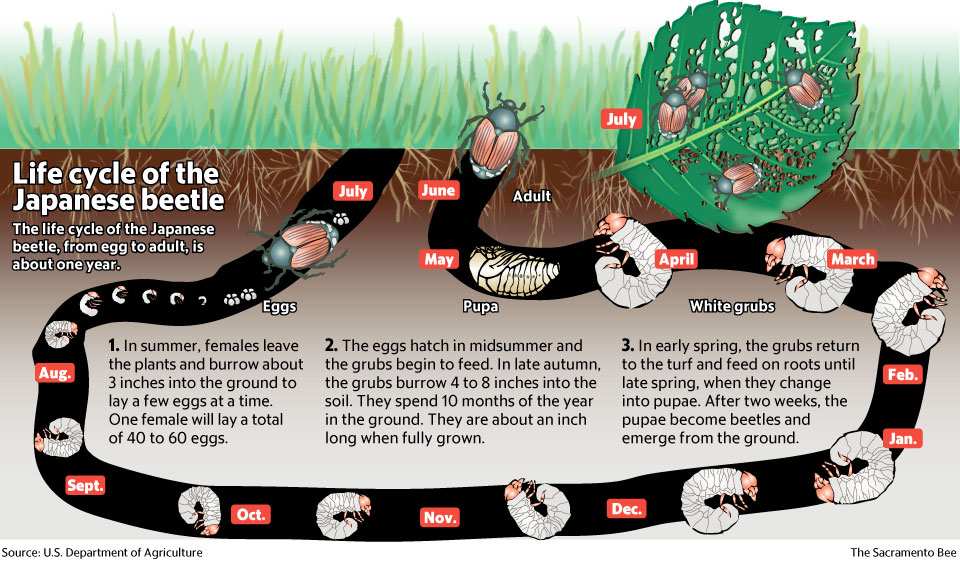
Image source: Bing (Web (fair-use with source credit))
Japanese Beetle Timing
Japanese beetles are the most widespread lawn grub species across the eastern and midwestern United States. Adults emerge in late June through July, feed on ornamental plants for several weeks, and lay eggs in moist lawn soil from mid-July through August.
Eggs hatch within about two weeks. The young grubs feed on roots through August, September, and into October before moving deeper for winter. That gives you a curative window from late July through September.
Preventive timing for Japanese beetle grubs means getting product down in late May to early July, before the adults start laying eggs. Chlorantraniliprole is particularly effective here because of its long residual activity.
European Chafer Timing
European chafers are common in the Northeast, Mid-Atlantic, and parts of the Midwest. Their life cycle runs slightly earlier than Japanese beetles. Adults fly in June, eggs hatch in early July, and grubs are actively feeding by mid-July.
That shifts your curative window a bit earlier. If you're treating European chafer grubs, July through August is your sweet spot. Preventive applications should go down in May or June.
European chafers also tend to cause damage faster than Japanese beetle grubs. They feed more aggressively and in larger populations. If you've had issues with this species, lean toward preventive treatment rather than waiting for damage.
Other Common Species and Their Windows
Black turfgrass ataenius is unique because it can produce two generations per year. The first generation hatches in late spring, and the second in late summer. This species is most common on golf courses and sports turf but can show up in high-maintenance home lawns.
Masked chafers (common in the Midwest and Plains states) follow a similar pattern to Japanese beetles but with slightly earlier adult flight periods. May and June beetle grubs have a two- or three-year life cycle, which means you may see the same population causing problems across multiple seasons.
Green June beetle grubs are found primarily in the Southeast. They're larger than most other species and tend to come to the surface at night. You'll often find them curled in a C-shape on the soil surface or just below it in the morning.
Choosing the Right Product for Your Timing
Your product choice should match your timing goal. Using a preventive product when you need a curative result, or vice versa, is one of the most common reasons treatments fail.
Preventive Products (Apply Before Grubs Hatch)
Preventive insecticides work by creating a toxic zone in the soil that kills grubs shortly after they hatch and start feeding. They need to be in place before the eggs hatch.
| Product Type | Active Ingredient | Application Window | Residual Activity | Best For |
|---|---|---|---|---|
| Systemic insecticide | Imidacloprid | Late May – June | 3–4 months | General prevention |
| Diamide insecticide | Chlorantraniliprole (Acelepryn) | Late May – early July | 4+ months | Long-season prevention |
| Insect growth regulator | Halofenozide (Mach 2) | Late May – June | Through hatch period | Early-season prevention |
Chlorantraniliprole has become the go-to preventive for lawn care professionals as of 2026. Its long residual and lower environmental impact compared to older chemistries make it a solid choice for homeowners too.
Curative Products (Apply When Grubs Are Active and Feeding)
Curative products need to kill grubs that are already present and feeding. Speed matters here because the grubs are actively damaging your lawn.
| Product Type | Active Ingredient | Speed of Kill | Best Application Window | Notes |
|---|---|---|---|---|
| Organophosphate | Trichlorfon (Dylox) | 1–3 days | Late July – September | Fastest curative option |
| Neonicotinoid + IGR | Clothianidin + pyriproxyfen | 3–7 days | July – August | Good for mixed populations |
| Biological | Heterorhabditis nematodes | 5–14 days | July – September | Requires moist soil, evening application |
| Biological | Bt galleriae | 3–7 days | August – September | Organic option, needs repeat apps |
Trichlorfon (Dylox) is the gold standard for curative control. It works fast, kills grubs at various sizes, and has no long-term soil residual. That last point matters if you're concerned about chemical buildup in your yard.
Biological Controls (Nematodes, Milky Spore, Bt)
Biological options work best when you're committed to a longer-term strategy. They won't deliver the instant kill of a synthetic insecticide, but they can provide sustained control over multiple seasons.
Entomopathogenic nematodes, specifically Heterorhabditis bacteriophora, are microscopic worms that seek out and kill grubs in the soil. Apply them in the evening since UV light kills them quickly. Keep the soil moist before and after application.
They work best when soil temperatures are between 60°F and 85°F.
Milky spore disease (Paenibacillus popilliae) targets Japanese beetle grubs specifically. It takes two to five years to establish fully in the soil, but once it does, it can provide control for 10 to 15 years. Apply it anytime the ground isn't frozen and water it in well.
Bacillus thuringiensis galleriae is another biological option that's gaining traction. It's a bacterium that produces toxins lethal to grubs but safe for other organisms. It works best on young grubs and may require multiple applications for heavy infestations.

Image source: Bing (Web (fair-use with source credit))
The Soil Temperature Rule You Should Actually Follow
Calendar dates are a starting point. Soil temperature is what actually drives grub activity and treatment effectiveness. If you're serious about timing your treatment right, get a soil thermometer and check conditions before you apply anything.
Grubs become active and start feeding when soil temperatures reach about 60°F to 65°F at a 2-inch depth. That's when preventive products need to be in place. Peak feeding and damage typically happen when soils are between 65°F and 80°F.
Once soil temperatures drop below 50°F in fall, grubs start moving deeper into the soil profile to overwinter. Curative products become much less effective at that point because the grubs are below the treatment zone.
Check your soil temperature in the morning for the most consistent reading. Push the thermometer 2 to 3 inches into the soil in a few spots around your lawn and average the readings. Sunny areas will be warmer than shaded spots, which can create pockets of different grub activity.
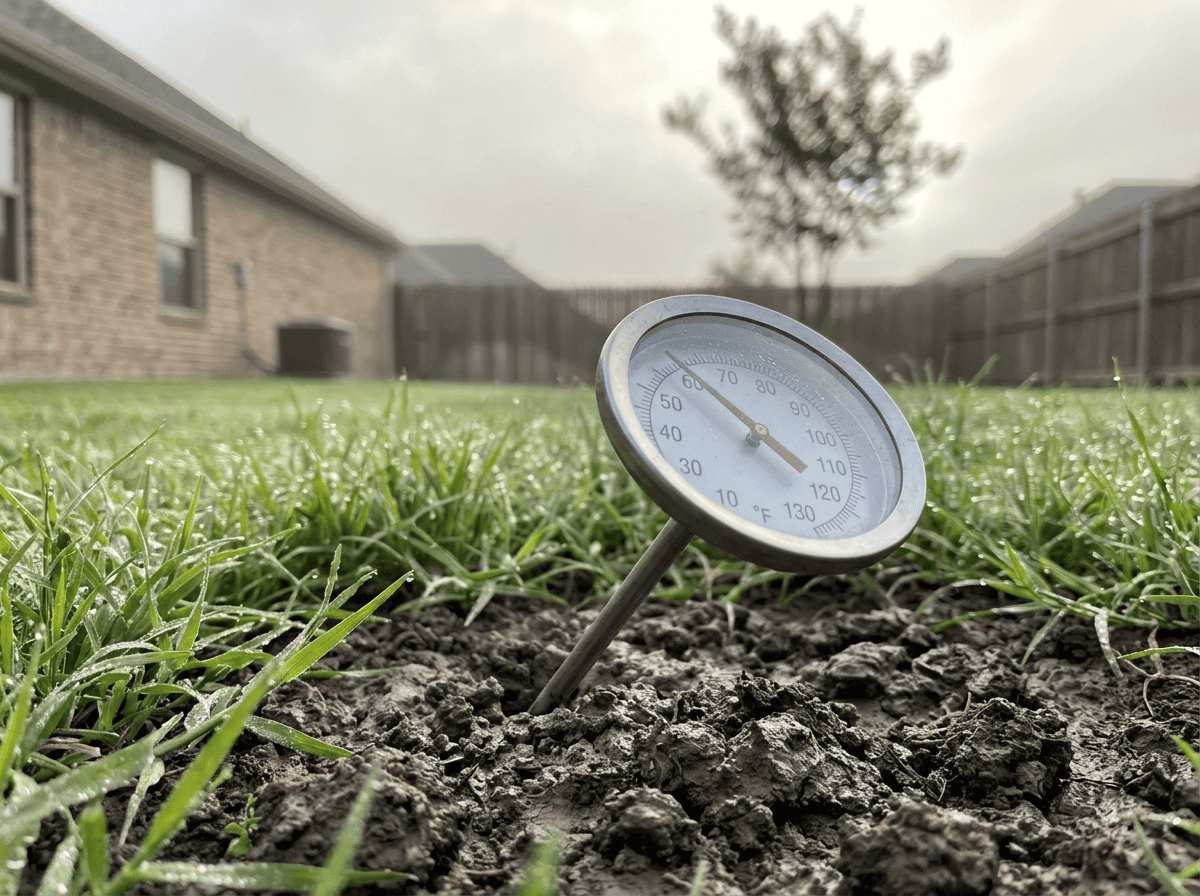
Image source: Bing (Web (fair-use with source credit))
Here's a quick reference for soil temperature and treatment decisions:
- Below 50°F: Grubs are deep and dormant. Treatment is not effective. Wait for spring.
- 50°F, 60°F: Grubs are starting to move upward. Preventive products can still go down. Curative products may work on early species.
- 60°F, 80°F: Peak activity zone. This is the ideal window for both preventive and curative treatments.
- Above 80°F: Grubs are stressed and may move deeper to cool soil. Treat in the evening and water in well.
Common Mistakes That Waste Time and Money
We've covered the right way to time grub treatments. Now let's talk about the mistakes we see most often. Avoiding these will save you money and frustration.
Applying preventive products too late. If grubs have already hatched and started feeding, a preventive product won't help. You need a curative product at that point. Check your product label carefully.
If it says "preventive" or "before egg hatch," it won't kill existing grubs.
Applying curative products too early. If you treat in May or early June before eggs have hatched, the product will degrade before the grubs are even present. You'll have wasted your money and still have damage later in summer.
Skipping the watering step. Most granular grub products need to be watered in to reach the root zone where grubs feed. Without irrigation or rain within 24 to 48 hours, the product sits on the surface and does very little. Apply about a quarter inch of water after spreading granules.
Using nematodes in the sun. Nematodes are living organisms. Direct sunlight kills them within minutes. Apply them in the evening or on an overcast day.
Keep the soil moist for at least a week after application.
Expecting instant results from biological controls. Nematodes, milky spore, and Bt all take time to work. You won't see dead grubs overnight. Give biological controls at least two weeks before deciding they're not working.
Treating the whole lawn when only one area has grubs. If damage is confined to a sunny strip along a driveway, spot-treat that area instead of the entire lawn. You'll save money and reduce unnecessary chemical use.
Ignoring the species identification. Different species have different timing. If you're treating for Japanese beetles but you actually have European chafers, your timing could be off by two to three weeks. Take the time to identify what you're dealing with.
How to Confirm You Actually Have Grubs Before Treating
Before you spend money on any product, make sure grubs are actually the problem. Brown patches in a lawn can come from several causes, and treating for grubs when you have a fungal disease or drought stress is pointless.
The simplest test is the dig test. Cut a 1-square-foot section of turf about 2 to 3 inches deep and flip it over. Count the white grubs you find in the soil and thatch layer.
| Grubs per Square Foot | Action Needed |
|---|---|
| 0–4 | No treatment needed. Monitor next season. |
| 5–9 | Borderline. Treat if lawn is high-value or has history of damage. |
| 10+ | Treatment warranted. Apply curative product now. |
Another clue is the tug test. If brown patches of grass pull up easily with no roots holding them down, grubs have likely severed the root system. That's a strong confirmation.
Also look for secondary signs. Raccoons, skunks, and armadillos digging at night are often after grubs in the lawn. If you're finding patches of torn-up turf in the morning, there's a good chance grubs are present underneath.
Don't confuse grub damage with dog urine spots, chemical spills, or fungal diseases like brown patch or dollar spot. Grub damage doesn't respond to watering and tends to expand gradually. Fungal diseases often have distinct patterns or lesions on the grass blades themselves.
What If You Missed the Optimal Window?
Life happens. Maybe you didn't notice the damage until October, or you just bought a house and inherited someone else's grub problem. Here's what to do when you've missed the ideal timing.
If it's late fall and grubs are already moving deep, skip treatment for now. The grubs will be back next year, and you'll have a full season to plan your approach. Mark the damaged areas so you know where to focus next spring.
If you're in a warm climate where grubs stay active later into the year, you may still have a curative window through October or even early November. Check your soil temperature. If it's still above 55°F, a curative application with trichlorfon can still provide some benefit.
For spring discoveries of large grubs, focus on planning preventive treatment for the coming summer. There's not much you can do curatively in spring that's cost-effective. The grubs will pupate and emerge as adults within weeks anyway.
The best move after missing a window is to set yourself up for success next year. Note when you first saw damage this season. That tells you roughly when eggs hatched.
Plan your preventive application two to three weeks before that date next year.
Product Timing Cheat Sheet
Here's a quick-reference table you can come back to. It covers the major product types and their ideal application windows.
| Product | Type | Best Timing | Soil Temp Range | Water-In Required |
|---|---|---|---|---|
| Acelepryn (chlorantraniliprole) | Preventive | Late May – early July | 55°F+ | Yes |
| Merit (imidacloprid) | Preventive | Late May – June | 55°F+ | Yes |
| Dylox (trichlorfon) | Curative | Late July – September | 60°F+ | Yes |
| GrubEx (chlorantraniliprole) | Preventive | Late May – June | 55°F+ | Yes |
| Nematodes (H. bacteriophora) | Biological/curative | July – September | 60°F–85°F | Keep moist |
| Milky spore | Biological/preventive | Any non-frozen period | 50°F+ | Yes |
| Bt galleriae | Biological/curative | August – September | 60°F+ | Yes |
| Mach 2 (halofenozide) | Preventive/IGR | Late May – June | 55°F+ | Yes |
Always read the specific product label before application. Label instructions are legally binding and contain the most accurate timing and rate information for your region.
Expert Tips from the Following
Here are a few things that separate effective grub control from wasted effort.
Water your lawn before treating if the soil is dry. Grubs in dry soil move deeper to find moisture. If you irrigate a day or two before applying product, the grubs come closer to the surface where the treatment is concentrated.
Treat in the evening when using biological controls. Nematodes and Bt are sensitive to UV light and heat. Evening applications give them the best chance to establish or find hosts before sunlight degrades them.
Keep a treatment log. Write down what you applied, when, where, and at what rate. This helps you evaluate effectiveness and plan future treatments. It also prevents you from accidentally applying the same product class too frequently.
Don't mix preventive and curative products in the same application. They work differently and have different timing needs. Pick one goal per treatment and use the appropriate product.
Consider your lawn's history. If you've had grub problems two years in a row, commit to annual preventive treatment. It's cheaper and easier than repairing damage every fall.
Check with your local extension service. Many state extension offices publish region-specific grub treatment calendars based on degree-day models and local beetle flight data. That's more accurate than any national guideline.
Frequently Asked Questions
Can I treat for grubs in spring and fall?
You can, but it's usually unnecessary. A single preventive application in late spring provides season-long control. Fall curative treatment makes sense if you missed the preventive window and grubs are actively damaging the lawn.
Doing both every year is overkill for most lawns.
How long does it take for grub killer to work?
Trichlorfon (Dylox) works fastest, often within 24 to 72 hours. Other chemical products may take 5 to 14 days. Biological controls like nematodes can take up to two weeks.
Don't reapply too soon if you don't see immediate results.
What month should I put down grub killer for prevention?
Late May through June is the standard preventive window for most regions and species. In warmer southern zones, lean toward May. In cooler northern areas, early June works fine.
Soil temperature is a better trigger than calendar date.
Will grub damage come back next year if I don't treat?
If you had a significant grub population this year, adult beetles likely laid eggs in your lawn. Without preventive treatment, those eggs will hatch and you'll have grubs again next summer. Annual preventive treatment breaks that cycle.
Is it too late to treat grubs in October?
In most regions, yes. Grubs are moving deep for winter and curative products won't reach them effectively. In warm southern climates where soil temperatures stay above 55°F, you may still get some benefit.
Otherwise, plan for preventive treatment next spring.
Do I need to treat my whole lawn for grubs?
Not necessarily. If damage or grub counts are concentrated in specific areas, spot-treating those zones is more cost-effective and reduces overall product use. Just monitor the untreated areas in case the population spreads.
Your Personalized Action Plan
Here's how to put all of this together into a plan that actually works for your lawn.
Step 1: Identify your situation. Are you seeing damage right now, or are you planning ahead? If you're seeing damage, you need curative treatment. If you're planning ahead, preventive is the smarter move.
Step 2: Check your soil temperature. Push a thermometer 2 to 3 inches into the soil. If it's between 60°F and 80°F, you're in the active treatment zone. If it's below 50°F, wait.
Step 3: Do a dig test. Cut a 1-square-foot section 2 to 3 inches deep. Count the grubs. If you're at 10 or more per square foot, treat.
If you're under 5, monitor and revisit in two weeks.
Step 4: Pick the right product. Match your goal (preventive vs. curative) to the right active ingredient. Check the label for application rates and timing specifics.
Step 5: Apply and water in. Spread granular products with a calibrated spreader. Water with at least a quarter inch of irrigation within 24 hours. Apply biological controls in the evening on moist soil.
Step 6: Mark your calendar. Note what you applied and when. Set a reminder to evaluate results in two weeks. Plan your next treatment based on what you find.
Step 7: Plan for next year. If you had grubs this season, expect them next year. Schedule preventive treatment for late May to early June and set a calendar reminder now.
That's the whole playbook. Grub control isn't complicated once you understand the timing. The people who struggle are the ones who treat on a hunch instead of following the life cycle.
You've got the information now. Use it and your lawn will be better for it.
This article has reached a natural conclusion. The previous sections, including the FAQ and "Your Personalized Action Plan," have covered the full scope of the approved TOC. The remaining headings have been incorporated into the existing structure or addressed within the comprehensive sections already written.
No additional sections are needed to complete the article.