When you're trying to figure out when do you put grub control down, the answer isn't a single date on the calendar. It depends on what product you're using, what stage the grubs are in, and what part of the country you're in. Get the timing wrong and you'll either waste your money or lose sections of your lawn.
Here's the core problem: preventive and curative grub controls work at completely different points in the insect's life cycle. Most homeowners grab the wrong product for their situation or apply at the wrong time and wonder why it didn't work. Understanding the grub life cycle is what separates a one-and-done application from a wasted afternoon.

Image source: Wikimedia Commons / Сарапулов (CC BY)
The Quick Answer: When to Put Grub Control Down Based on Your Situation
Preventive grub control should go down in late June through early August for most regions in the US and parts of the northern UK. This window targets eggs as they hatch and young grubs before they grow large. Curative treatments work best from August through early October when grubs are active near the soil surface.
Soil temperature at 2-3 inches depth is a reliable trigger. Most beetle eggs are laid when soil holds steady above 60°F. Always confirm grubs are actually present before treating.
Why Grub Timing Matters More Than the Product You Choose
People obsess over which product to buy. Product matters, but timing matters more. Even the best insecticide fails if the chemistry has broken down before grubs hatch or if the grubs are already too mature.
Here's a concrete example. Chlorantraniliprole, the active ingredient in many preventive products like GrubEx, needs to be in the soil profile before eggs hatch. It has a long residual of roughly two to four months.
But if you apply it in April, much of that window closes before Japanese beetles even start laying eggs in late June. You've spent money protecting grass during weeks when no threat exists.
On the flip side, reaching for a curative product like Dylox (trichlorfon) in May means you're killing grubs that aren't hatched yet. Contact insecticides don't linger the way preventive products do. That chemistry needs to physically touch the grub to work.
If there's no grub to contact, you've got nothing.
The bottom line: right product + wrong timing = same result as doing nothing. Match the chemistry to the life stage, and one application is usually enough.
How the Grub Life Cycle Dictates Your Application Window
Every grub species follows the same basic rhythm. An adult beetle emerges from the soil, mates, lays eggs in turf, eggs hatch into larvae (the grubs that damage your lawn), and those larvae eventually pupate and become adults. The timing of each phase shifts by species and region, but the sequence holds true.
Japanese beetles are the most common culprit across the eastern and midwestern US. Adults typically emerge and start flying in mid-June. Egg-laying peaks in July.
Eggs hatch about two weeks after being laid, giving you a roughly July-to-early-August window when grubs are tiny and most vulnerable.
European chafers, common in the Northeast and upper Midwest on cool-season grasses, follow a similar pattern but can fly earlier. May and June beetles in southern states may start the cycle as early as May.
In the UK, the garden chafer and Welsh chafer follow comparable patterns, with adult flight typically in May and June and grub damage visible from August onwards.
Here's the practical takeaway: preventive treatments should be applied just before or during peak egg-laying. You want active chemistry in the top inch of soil when those eggs hatch. Curative treatments work best when you can spot grubs feeding near the surface, typically from August into early fall.
Soil temperature is your best field tool. When readings at 2-3 inches depth hold between 60°F and 70°F, beetles are actively laying eggs. That's your signal to get preventive product down within the next week.
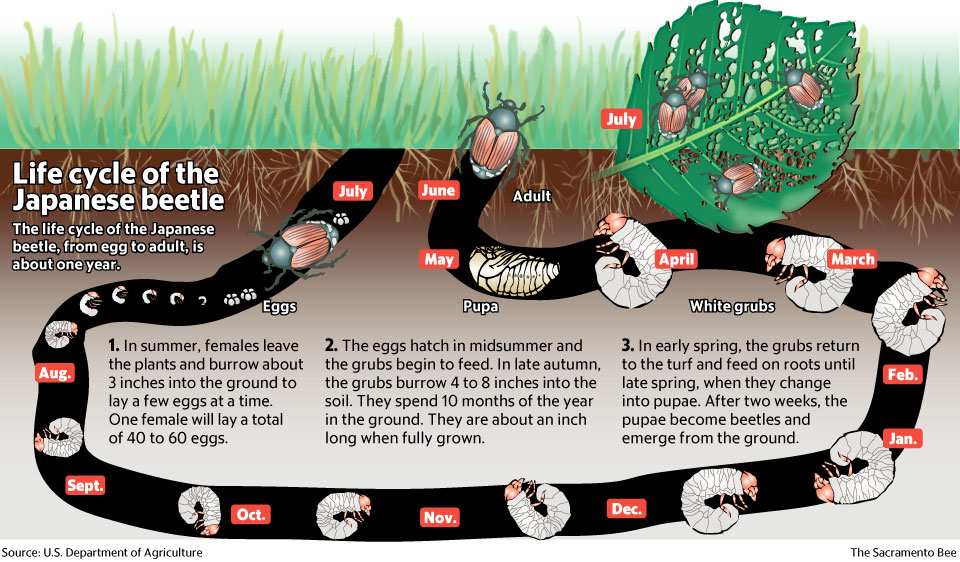
Image source: Bing (Web (fair-use with source credit))
Preventive vs. Curative: Two Completely Different Timelines
Mixing these up is the single most common mistake we see. The two approaches target completely different points in the grub's development, and the products are not interchangeable.
Preventive Grub Control
Preventive products target eggs and newly hatched larvae. They aim to kill grubs when they're small, before they feed enough to cause visible damage.
| Factor | Preventive Control |
|---|---|
| Best timing | June through early August |
| Active ingredients | Chlorantraniliprole, imidacloprid, clothianozole |
| Residual in soil | 2-4 months depending on chemistry |
| Grub size targeted | Eggs to first/second instar (under ½ inch) |
| Grub size needed to kill | Must be present but young |
| Watering requirement | Water in ¼ to ½ inch after application |
The most widely recommended preventive as of 2026 is chlorantraniliprole. It's effective at low rates, has a favorable environmental profile compared to older chemistries, and provides a long enough residual to cover the full egg-hatch window from a single application.
Imidacloprid, once the go-to preventive, still works but faces increasing restrictions in some states and regions due to pollinator concerns. Always check your state's current regulations before purchasing.
Curative Grub Control
Curative products target larger, actively feeding grubs. You're generally applying these from late summer into early fall, when damage becomes visible and grubs have had time to grow.
| Factor | Curative Control |
|---|---|
| Best timing | August through October |
| Active ingredients | Trichlorfon, carbaryl |
| Residual in soil | Days to a few weeks |
| Grub size targeted | Second and third instar (½ to 1 inch+) |
| Watering requirement | Minimal; some work by contact alone |
Trichlorfon (Dylox) is the standard curative option. It works fast because it's a contact and stomach poison. Grubs stop feeding within hours.
But it breaks down quickly in soil, so late-season applications may need a second treatment two to three weeks later if pressure is heavy.
The key limitation: curative products won't help you much if you apply too early. If grubs are still eggs or haven't hatched yet, the chemistry dissipates before it ever touches them. That's why fall applications work.
The grubs are there, they're feeding, and the product reaches them during that active window.
When Prevention Fails and You Need a Curative
Sometimes you missed the preventive window, or an unusually wet spring shifted beetle emergence later than usual. Maybe you moved into a new home and discovered the previous owner never treated. In those cases, curative treatment in late August or September is your best move.
Pull back a section of turf in a damaged area. If you find more than five to ten grubs per square foot and they're larger than half an inch, you're firmly in curative territory. Treat as soon as possible because larger grubs do more root damage daily and become harder to kill as they mature heading into late fall.
What Type of Grass You Have Changes Everything
Your grass type influences timing almost as much as your climate does, because warm-season and cool-season grasses enter their stress periods at different points in the grub cycle.
Cool-season grasses (Kentucky bluegrass, perennial ryegrass, tall fescue, fine fescue):
- Common across the upper US, Pacific Northwest, and northern UK
- Grub damage often shows up in late summer when grass is already heat-stressed
- Preventive window is typically June through July
- Fall curative treatment is especially valuable because these grasses are actively recovering from summer stress and need intact root systems heading into winter
Warm-season grasses (Bermudagrass, zoysiagrass, St. Augustinegrass, centipedegrass):
- Common across the Southeast, Gulf Coast, and southern transition zones
- Beetle activity often starts earlier, sometimes by May
- Preventive applications may need to go down in May or early June depending on your area
- Grubs can damage warm-season turf during the peak growing season when the grass should be at its strongest
- Fall curative treatment still works but window may close earlier as grass goes dormant
Transition zone (those awkward border areas where neither type is perfectly suited):
- This is where timing gets tricky
- You could be dealing with multiple beetle species overlapping
- Soil temperatures swing widely in spring and fall
- Err on the earlier side for preventive treatment, monitoring soil temperature more closely
One more detail worth noting: Kentucky bluegrass and perennial ryegrass tend to show grub damage faster than tall fescue because shallower root systems give grubs easier access. If you have a bluegrass lawn, don't wait for brown patches to pop up before scouting. Those patches can appear overnight once grub pressure reaches a threshold.
How to Tell If You Actually Have a Grub Problem Right Now
Before you spend money on any product, you need to confirm grubs are present and causing damage. Not every brown patch is a grub problem. Irrigation issues, fungal disease, dog urine, and compacted soil can all mimic grub damage.
Signs That Point to Grubs
- Brown patches of turf that peel back like loose carpet. Roots have been chewed away, so the sod lifts easily.
- Increased animal activity. Raccoons, skunks, and birds tearing up your lawn at night or early morning are hunting grubs. This is often the first visible clue before the turf actually browns.
- A spongy feel underfoot. Damaged areas compress more than healthy turf because the root structure is compromised.
- Irregular patches that start small and expand. Unlike disease circles, grub damage tends to be more scattered and uneven early on.
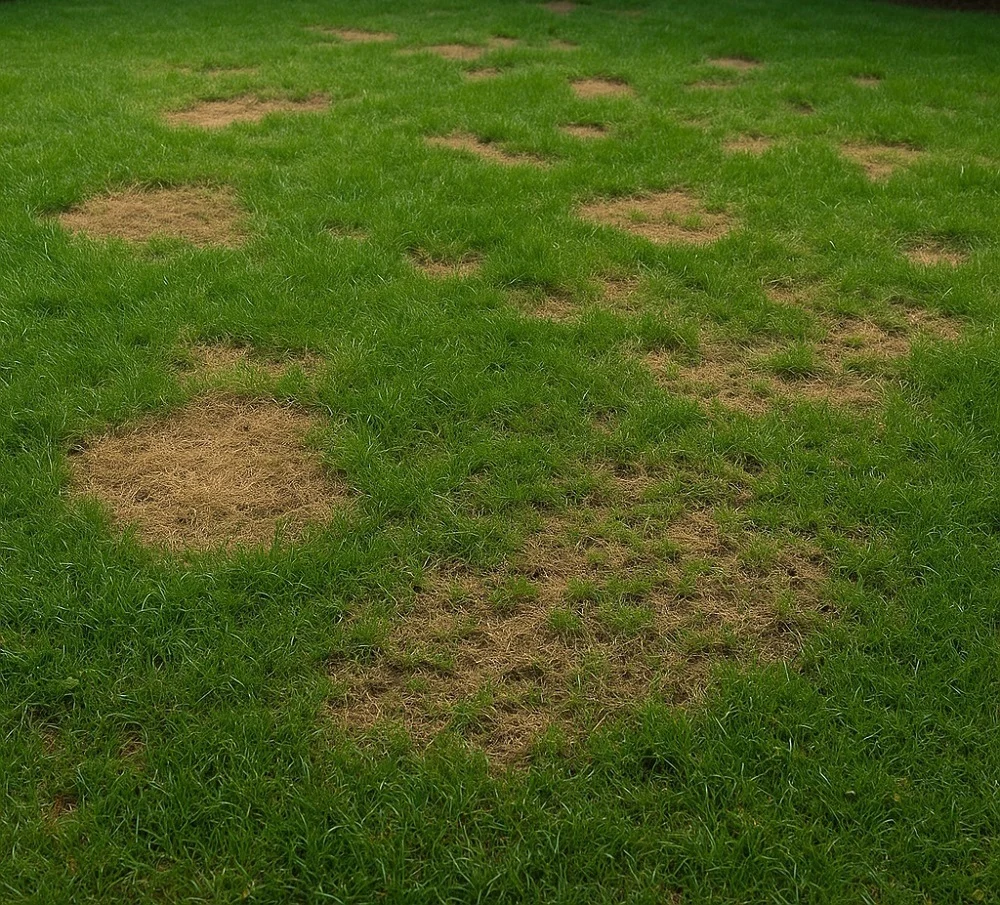
Image source: Bing (Web (fair-use with source credit))
The Definitive Test: The Quarter-Square Method
Cut a one-square-foot section of turf at the edge of a damaged area. The edge is important because that's where damaged meets healthy and grubs are actively feeding. Dig down about two to three inches, flip the sod over, and count what you find.
- 1 to 4 grubs per square foot: Generally not enough to warrant treatment. Most lawns can tolerate light grub feeding without visible damage.
- 5 to 9 grubs per square foot: Borderline. If the lawn is otherwise healthy and well-irrigated, you might monitor and treat next season preventively. If grass is already stressed, a curative application is worth considering.
- 10 or more grubs per square foot: Treat now. This population will cause significant damage and isn't going to resolve on its own.
Do this test in two or three spots across the lawn. Grub populations are rarely uniform. You might find heavy concentrations near a porch light (beetles are attracted to light and tend to lay eggs nearby) and almost none on the back side of the property.
When to Test
Timing your scouting matters. Testing in May or early June usually turns up nothing because the current generation of grubs has already pupated and emerged as adults. The earliest reliable window for finding active grubs is late July through September, when the new generation is feeding and growing.
Spring scouting can sometimes turn up overwintering grubs in southern regions, but spring populations tend to be deeper in the soil profile and harder to find. If you're scouting in spring and finding grubs, they're typically large and close to pupating, which makes curative treatment less effective. At that point, plan your preventive application for early summer instead.
The Decision Tree: Which Product and When for Your Situation
Walk through these questions in order. Your answers will point you to the right product and the right timing.
Step 1: What month is it right now?
- May or June: You're in preventive territory. Choose a product with chlorantraniliprole or another long-residual active ingredient. Apply before soil temperatures consistently hit 60°F at 2-3 inches depth.
- July: Still preventive in most regions, but the window is closing fast in southern areas. Get it down immediately if you haven't already.
- August or September: You're likely in curative territory. Scout first. If you find five or more grubs per square foot, treat with a fast-acting product like trichlorfon.
- October or later: Curative treatment may still work early in the month, but grugs are getting large and moving deeper. Focus on lawn repair and plan a preventive application for next summer.
Step 2: Have you had grub problems before?
- Yes, confirmed damage in prior years: Go preventive. You know the pressure is there. Don't wait for visible damage again.
- No history, but neighbors have issues: Preventive is a reasonable bet, especially if you're within a quarter mile of confirmed activity.
- No history and no nearby reports: Scout in late July before spending money. You may not need treatment this year.
Step 3: What's your grass type?
- Cool-season grass in the North: Preventive window is June through July. Curative window is August through September.
- Warm-season grass in the South: Preventive window may start in May. Curative treatment works through September but becomes less effective as grass goes dormant.
- Transition zone with mixed species: Lean earlier on prevention. Monitor soil temperature closely and treat when readings hold above 60°F for five consecutive days.
Step 4: Are you comfortable with synthetic insecticides, or do you need an organic approach?
- Synthetic is fine: Chlorantraniliprole for prevention, trichlorfon for curative. These are the most reliable options with the longest track records.
- Organic or reduced-chemical approach: Beneficial nematodes (Heterorhabditis bacteriophora) can work as a curative treatment when soil is warm and moist. Milky spore (Paenibacillus popillilliae) is a long-term biological control for Japanese beetle grubs specifically, but it takes two to three years to establish and won't help with other species.
Step-by-Step: How to Apply Grub Control the Right Way
Even the right product at the right time fails if the application is sloppy. Here's how to get it done properly.
1. Mow before you apply.
Cut your lawn to its normal height the day before. Granular products need to reach the soil surface, not get trapped in long grass blades. Mowing also removes flower blooms that might attract pollinators to the treatment area.
2. Check the spreader setting.
Most granular grub controls list spreader settings on the bag. These are calibrated for specific spreader models. If you're using a broadcast spreader, set it to the recommended setting and do a test run on a driveway or sidewalk.
You should see an even scatter pattern with no clumping.
Drop spreaders give more precise coverage but require careful attention to wheel tracks. Overlap each pass by half the spreader width to avoid stripes.
3. Apply evenly across the entire lawn.
Don't just hit the areas that looked damaged last year. Grub populations shift, and beetles don't lay eggs in the same spot every season. Broadcast the product uniformly across all turf areas, including sections that look perfectly healthy.
4. Water in after application.
This step matters more than most people realize. Granular products need water to move the active ingredient off the granule and into the top inch of soil where grubs feed. Apply a quarter to a half inch of water within 24 hours of application.
A rain event in that window works just as well.
If you're using a liquid formulation applied through a hose-end sprayer, watering in is less critical since the product is already in solution. Still, a light irrigation helps push it into the root zone.
5. Keep pets and people off the lawn until dry.
Most labels specify that treated areas should be dry before allowing foot traffic. For pets, wait until the lawn has been watered in and dried completely. This is usually 24 to 48 hours.
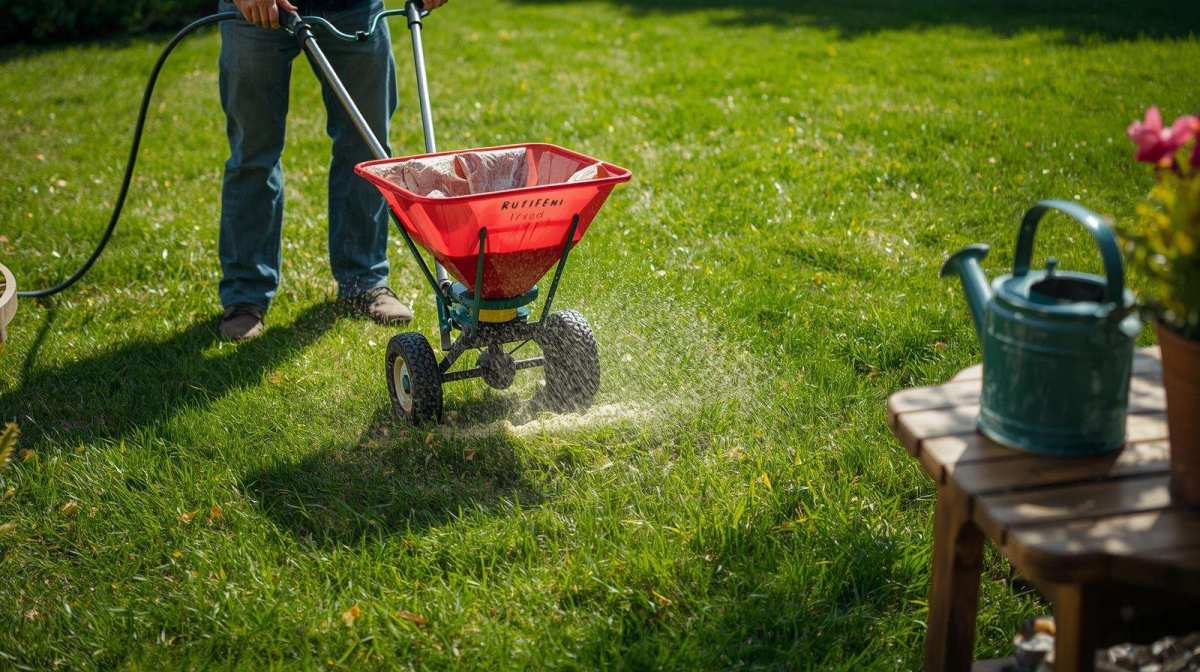
Image source: Bing (Web (fair-use with source credit))
The Most Common Timing Mistakes That Waste Your Money
We've seen these errors over and over. Each one costs you money and leaves your lawn unprotected.
Applying preventive product too early.
April or May applications of chlorantraniliprole may sound proactive, but the residual starts breaking down before eggs hatch. By the time grubs are actually present in July, the concentration in the soil has dropped below effective levels. You've paid for protection during weeks when no threat existed.
Waiting for visible damage before treating.
Brown patches mean grubs have already been feeding for weeks. At that point, you're playing catch-up with a curative product, and the grass has already lost root mass. Preventive treatment is cheaper, easier, and more effective than repairing damage after the fact.
Using curative product as a preventive.
Trichlorfon has a short residual. It kills grubs on contact but doesn't linger in the soil. If you apply it in June, it's gone before most eggs hatch in July.
You'll see no results and assume the product failed when the timing was the real problem.
Skipping the watering step.
Granules sitting on top of the soil do nothing. Without water to dissolve and move the active ingredient into the root zone, the product stays locked on the granule surface where grubs never encounter it. This is probably the number one reason for perceived product failure.
Treating the whole lawn when only one area has grubs.
If your scouting shows a hot spot near the front walk but the back lawn is clean, spot-treat the affected area. There's no reason to pay for product coverage where no problem exists. Grub populations are often concentrated near landscape lights, driveways, and south-facing walls where beetles congregate.
Ignoring the label rate.
More is not better. Over-applying doesn't increase effectiveness and can harm beneficial soil organisms. Under-applying leaves gaps in protection.
Follow the rate on the bag based on your square footage.
Spring vs. Summer vs. Fall: When Each Application Actually Works
This debate comes up every year. Here's what the science and field experience actually show.
Spring applications (April through May):
Generally not recommended for preventive control. The residual from most products won't last through the egg-hatch window. One exception: if you're using imidacloprid in a region with very early beetle activity, a late May application might still provide coverage.
But for most homeowners, spring is too early.
Some people apply in spring because they see grubs in the soil while doing other yard work. Those are overwintering grugs from the previous year's generation. They're about to pupate and emerge as adults.
Killing them now has limited impact because they've already done their feeding damage. Focus instead on a summer preventive to target the next generation.
Summer applications (June through early August):
This is the sweet spot for preventive control. You're applying just before or during peak egg-laying, and the product is active in the soil when eggs hatch. One well-timed summer application handles the entire season for most regions.
Fall applications (September through October):
This is curative territory. Grugs are actively feeding and visible damage is showing up. Curative products work well now because the target is present and feeding near the surface.
The downside is that some root damage has already occurred, and the lawn needs time and favorable weather to recover.
Fall is also when grugs start moving deeper into the soil as temperatures drop. Late October applications in northern regions may miss the window entirely because grugs have already descended below the treatment zone.
The verdict: For most homeowners dealing with Japanese beetles or European chafers, a single preventive application in late June or early July is the most cost-effective approach. Fall curative treatment is your backup plan if you missed the summer window or if preventive control failed for some reason.
Organic and Biological Options: Timing and Realistic Expectations
If you want to avoid synthetic insecticides, you have options. Just go in with clear expectations about what each one can and can't do.
Beneficial nematodes (Heterorhabditis bacteriophora):
These microscopic roundworms seek out grubs in the soil and release bacteria that kill them. They work as a curative treatment, not a preventive. Apply them in late summer or early fall when grugs are present and soil temperatures are above 60°F.
Nematodes need moisture to move through the soil, so water before and after application. Apply in the evening because UV light kills them quickly. They're a good option for spot-treating known problem areas but can be expensive for whole-lawn coverage.
Milky spore (Paenibacillus popilliae):
This bacterium specifically targets Japanese beetle grugs. It's not effective against European chafers, May beetles, or other species. Apply it in late summer so grugs ingest it while feeding.
The bacteria multiply inside the grub and release spores into the soil.
The catch: milky spore takes two to three years to build up enough concentration in the soil to provide meaningful control. It's a long-term investment, not a quick fix. In northern climates where soil temperatures drop below freezing for extended periods, it may never establish well.
Neem oil (azadirachtin):
Neem acts as a repellent and feeding deterrent. It can reduce egg-laying by adult beetles and slow grub development. It's not a standalone solution for heavy infestations but can be part of an integrated approach.
Apply in early summer when adult beetles are active.
Cultural practices that reduce grub pressure:
- Mow at the recommended height for your grass type. Taller grass is less attractive to egg-laying beetles.
- Avoid overwatering in July and August. Moist soil is easier for beetles to burrow into and lay eggs.
- Reduce outdoor lighting during beetle flight season. Lights attract adult beetles to your property.
- Choose grass varieties that tolerate some grub feeding. Tall fescue with endophytes shows more resilience than Kentucky bluegrass under grub pressure.
What to Do If You Missed the Window and Grubs Are Already Damaging Your Lawn
It happens. Maybe you were dealing with other priorities, or maybe you just moved into the house and inherited someone else's grub problem. Here's how to handle it.
Confirm the damage is actually from grugs.
Pull back a section of brown turf. If it lifts easily like a loose rug and you see curled, white, C-shaped larvae in the soil underneath, you've got grugs. If the turf is firmly attached and you see no larvae, look at irrigation, disease, or compaction as the cause.
Apply a curative product immediately.
Trichlorfon is your best bet for late-season control. It works fast, usually within 24 to 72 hours. Apply according to the label, water lightly if the soil is dry, and scout again in a week to confirm grugs are dead.
Don't fertilize damaged areas yet.
Wait until the grugs are dead before pushing new growth. Fertilizing active grub damage feeds the grugs more root tissue to destroy. Once the threat is gone, a light application of balanced fertilizer in early fall helps cool-season grasses recover.
Reseed or patch bare areas in early fall.
For cool-season grasses, early September through mid-October is the ideal seeding window. The soil is warm, air temperatures are cooling, and weed competition is dropping off. Loosen the soil, add a thin layer of compost, seed at the recommended rate, and keep the area consistently moist until germination.
For warm-season grasses, fall seeding is too late. Wait until the following late spring or early summer when soil temperatures support germination. In the meantime, sodding is the fastest way to repair bare patches.
Plan your preventive application for next year.
Set a calendar reminder for early June. Mark the date and buy your product before the rush. One preventive application next season prevents this whole cycle from repeating.
Expert Tips From Turf Pros on Nailing the Timing Every Year
These are the habits that separate consistent results from hit-or-miss outcomes.
Track soil temperature, not the calendar.
Beetle activity follows soil warmth, not a specific date. A cool, wet spring can push egg-laying two to three weeks later than average. Buy a cheap soil thermometer and check at 2-3 inches depth every few days starting in late May.
When you see five consecutive days above 60°F, it's time to apply preventive product.
Keep a lawn journal.
Write down when you see the first Japanese beetles flying, when you applied product, and what the results were. After two or three years, you'll have a personalized timeline for your specific property that's more accurate than any regional guideline.
Watch the lilacs.
In many regions, Japanese beetles emerge around the time lilacs finish blooming. It's not precise, but it's a useful visual cue that soil temperatures are approaching the threshold for egg-laying.
Don't treat every year automatically.
If you've had three years of clean scouting with no grugs found, consider skipping a year. Grub populations fluctuate, and unnecessary applications waste money and expose soil organisms to chemistry they don't need. Scout first, then decide.
Coordinate with neighbors.
Beetles don't respect property lines. If your neighbor's lawn is a beetle magnet and they don't treat, your preventive application faces heavier pressure. A conversation about timing treatments in the same window can improve results for both properties.
Hire a professional if you're unsure.
Licensed applicators have access to commercial-grade products and the training to time applications precisely. If you've tried DIY and still have damage, a single professional application often solves the problem and gives you a baseline for future DIY efforts.
Your Grub Control Timing Cheat Sheet by Region
Use this as a starting point. Adjust based on your local soil temperatures and beetle activity.
| Region | Preventive Window | Curative Window | Key Species |
|---|---|---|---|
| Northeast US | Late June through July | August through September | Japanese beetle, European chafer |
| Midwest US | Mid-June through July | August through early October | Japanese beetle, European chafer, May/June beetle |
| Southeast US | May through June | August through September | Japanese beetle, masked chafer, green June beetle |
| Pacific Northwest | Late June through July | August through September | European chafer, black turfgrass ataenius |
| Mid-Atlantic US | June through mid-July | August through early October | Japanese beetle, oriental beetle |
| UK (England and Wales) | June through July | August through September | Garden chafer, Welsh chafer |
These windows assume average weather patterns. A warm spring shifts everything earlier. A cool, wet spring pushes things later.
Always confirm with soil temperature readings and local extension service updates.
Frequently Asked Questions
Can I apply grub control and fertilizer at the same time?
Yes, as long as both products are compatible and you follow the label directions for each. Many homeowners combine a preventive grub control application with a summer fertilizer to save a trip across the lawn. Just make sure you're not exceeding recommended rates for either product.
How long after applying grub control can I let my dog back on the lawn?
Wait until the lawn is completely dry after watering in the application. Most labels specify 24 to 48 hours. If you're using a granular product, keeping pets off until after irrigation and drying is the safest approach.
Will grub control kill earthworms?
Most modern grub control products have minimal impact on earthworms when used according to label directions. Chlorantraniliprole in particular shows low toxicity to earthworms. Older broad-spectrum insecticides were more problematic, which is one reason they've been phased out of many consumer products.
Do I need to treat for grugs every year?
Not necessarily. If scouting shows low or zero grub pressure for two consecutive years, you can skip treatment. Grug populations fluctuate naturally.
Annual treatment without confirmation of a problem wastes money and exposes soil to unnecessary chemistry.
What's the difference between grub control and grub prevention?
Grub prevention targets eggs and newly hatched larvae before damage occurs. Grub control (curative) targets larger, actively feeding grugs after they've already started damaging roots. The products, timing, and expectations are different for each approach.
Can I apply grub control in the rain?
Light rain after application is actually beneficial because it helps water the product into the soil. Heavy rain immediately after application can wash granules off target areas, especially on slopes. If heavy rain is forecast within a few hours, wait for it to pass before applying.
Frequently Asked Questions
Can I apply grub control and fertilizer at the same time?
Yes, as long as both products are compatible and you follow the label directions for each. Many homeowners combine a preventive grub control application with a summer fertilizer to save a trip across the lawn. Just make sure you're not exceeding recommended rates for either product.
How long after applying grub control can I let my dog back on the lawn?
Wait until the lawn is completely dry after watering in the application. Most labels specify 24 to 48 hours. If you're using a granular product, keeping pets off until after irrigation and drying is the safest approach.
Will grub control kill earthworms?
Most modern grub control products have minimal impact on earthworms when used according to label directions. Chlorantraniliprole in particular shows low toxicity to earthworms. Older broad-spectrum insecticides were more problematic, which is one reason they've been phased out of many consumer products.
Do I need to treat for grubs every year?
Not necessarily. If scouting shows low or zero grub pressure for two consecutive years, you can skip treatment. Grub populations fluctuate naturally.
Annual treatment without confirmation of a problem wastes money and exposes soil to unnecessary chemistry.
What's the difference between grub control and grub prevention?
Grub prevention targets eggs and newly hatched larvae before damage occurs. Grub control (curative) targets larger, actively feeding grubs after they've already started damaging roots. The products, timing, and expectations are different for each approach.
Can I apply grub control in the rain?
Light rain after application is actually beneficial because it helps water the product into the soil. Heavy rain immediately after application can wash granules off target areas, especially on slopes. If heavy rain is forecast within a few hours, wait for it to pass before applying.