Image source: Bing (Web (fair-use with source credit))
When Do You Actually Need to Treat for Grubs?
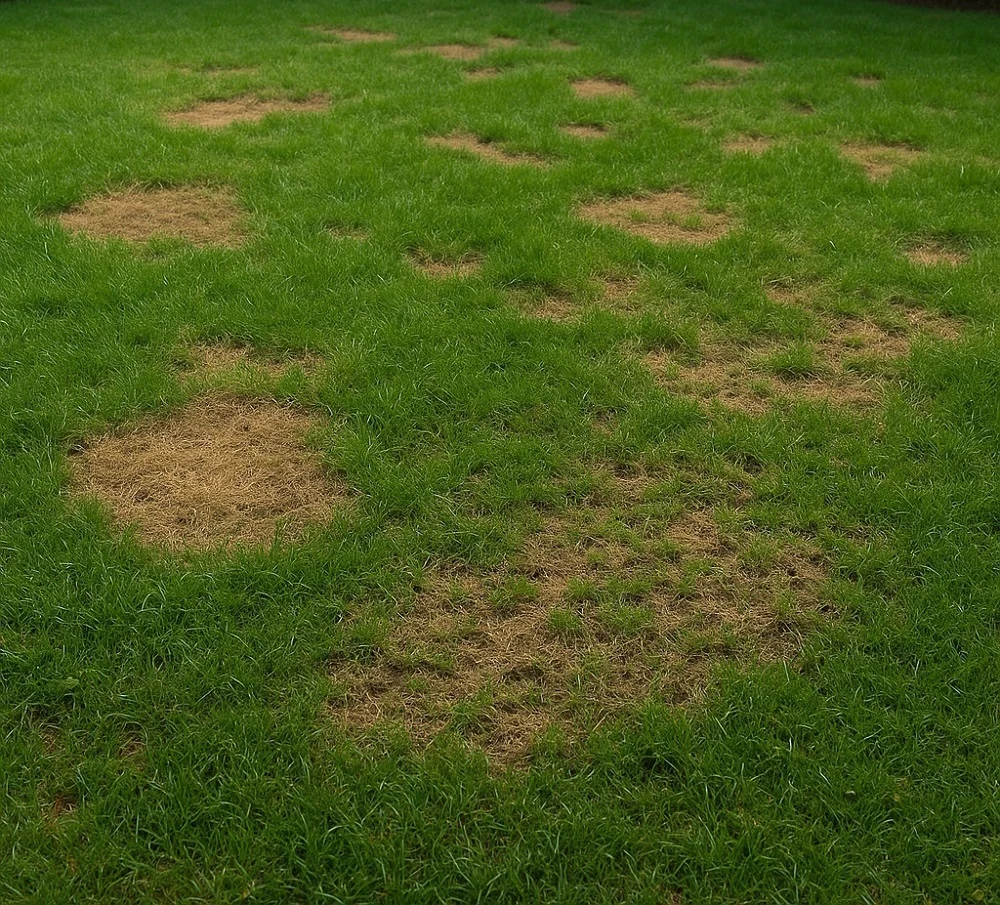
If you've noticed brown patches in your lawn that peel back like loose carpet, you're probably wondering when do you treat for grubs. The honest answer depends on what's actually happening under your grass right now, not a date on the calendar. Most homeowners either treat too late, treat when they don't need to, or grab the wrong product for their situation.
Here's the thing. Grub damage can look a lot like drought stress, fungal disease, or even dog urine burns. Before you spend a dime on treatment, you need to confirm you actually have a problem worth solving.
Research from university extension programs consistently shows that most lawns can tolerate up to 5 grubs per square foot without any visible damage, especially if the turf is otherwise healthy and well-watered.
Quick Answer
Treat preventively in mid to late June, before eggs hatch. Treat curatively in late August through October when young grubs are actively feeding near the surface. Confirm grub counts first.
Skip treatment if you find fewer than 6 grubs per square foot in cool-season turf. Timing depends on your region and the grub species present.
How to Confirm You Have Grubs Before Wasting Time and Money
Don't treat based on brown patches alone. That's the single most expensive mistake homeowners make with grub control. Brown grass has a dozen possible causes, and dumping insecticide on a fungal problem won't help anything.
The confirmation process is straightforward. Cut a 1-foot square of turf in a damaged area, about 2 inches deep. Peel it back like a flap and examine the soil underneath.
Count every grub you see in that square foot. Then push the sod back down and water it. The turf will re-root if the roots are still intact.
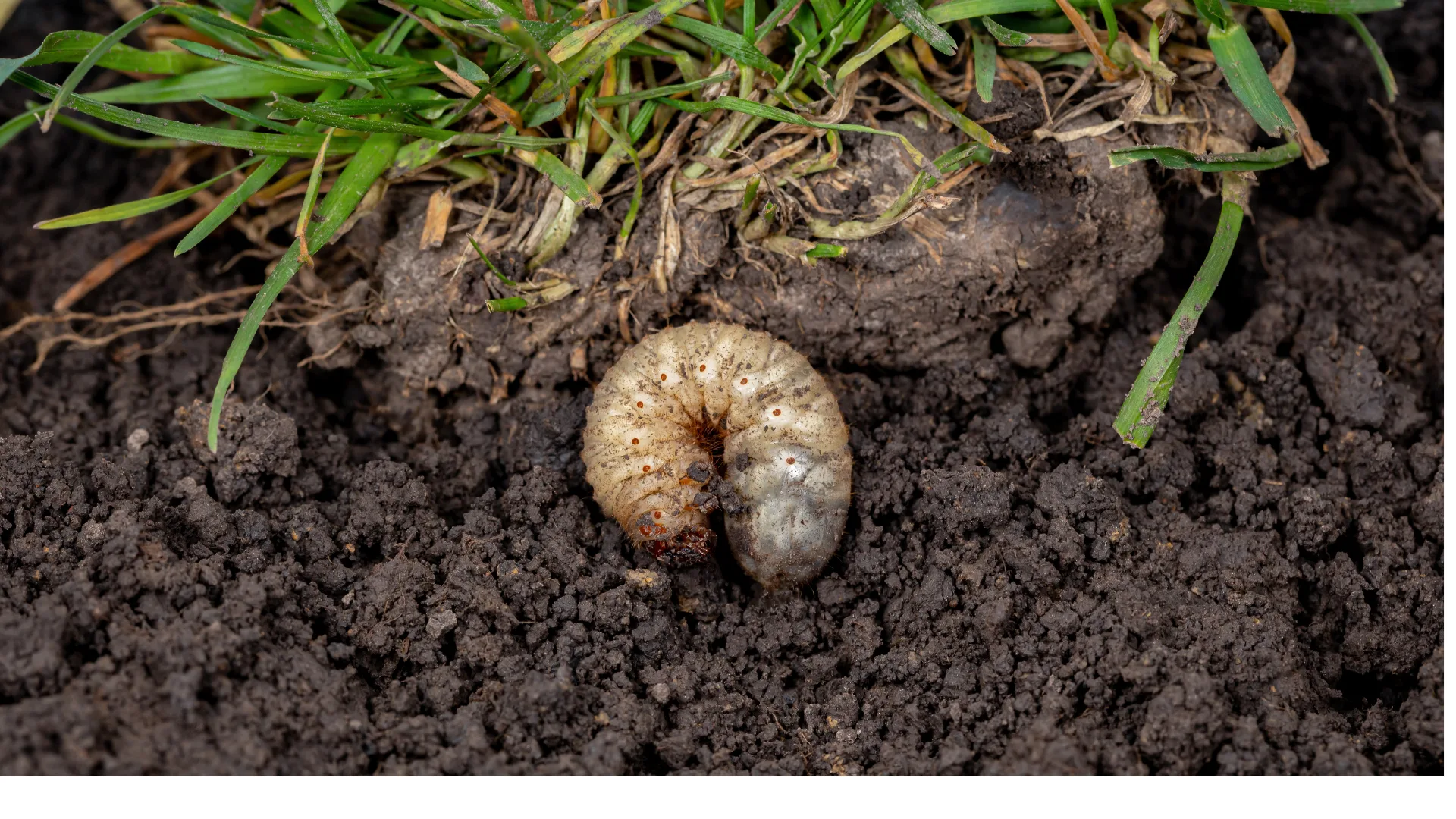
Image source: Bing (Web (fair-use with source credit))
You're looking for C-shaped, creamy-white larvae with brown heads and six legs near the head. They range from a quarter inch to over an inch long depending on the species and how mature they are. Japanese beetle grubs are the most common culprit across the Midwest and Northeast, but European chafers, May beetles, and masked chafers all cause similar damage in different regions.
Check multiple spots. Grubs often cluster in sunny, south-facing slopes or near sidewalks and driveways where the soil warms up faster. If you find them concentrated in one area but not another, you can spot-treat instead of blanketing the whole yard.
Grub Count Thresholds: The Number That Decides Everything
Not every grub in your lawn warrants treatment. Turfgrass is surprisingly resilient when it's otherwise healthy. The threshold for action varies based on your grass type and how well your lawn is maintained.
Here's a practical breakdown:
| Grub Count per Sq Ft | Cool-Season Turf (Fescue, Bluegrass, Ryegrass) | Warm-Season Turf (Bermuda, Zoysia, St. Augustine) |
|---|---|---|
| 0–5 grubs | No treatment needed | No treatment needed |
| 6–10 grubs | Monitor closely; treat if lawn is stressed or irrigated | Usually tolerable with good maintenance |
| 10+ grubs | Treat now | Treat now |
| Any count + animal digging | Treat regardless of count | Treat regardless of count |
Irrigated lawns actually attract more egg-laying beetles because female beetles prefer moist soil for laying eggs. If you water regularly, you're more likely to cross the treatment threshold than a lawn that goes dormant in summer heat.
Animal activity is a separate signal entirely. If skunks, raccoons, or armadillos are tearing up your lawn at night, they're after grubs. The secondary damage from digging often destroys more turf than the grubs themselves.
In that case, treat even if your square-foot count seems borderline.
The Grub Life Cycle and Why Timing Changes Everything
Understanding the grub life cycle is the key to getting timing right. Every common lawn grub species follows roughly the same pattern, though the exact weeks shift by region.
Adult beetles emerge in early summer, mate, and lay eggs in moist soil. Japanese beetles typically fly and lay eggs from late June through July across the Midwest and Northeast. European chafers start a bit earlier, often in June.
The eggs hatch within about two weeks.
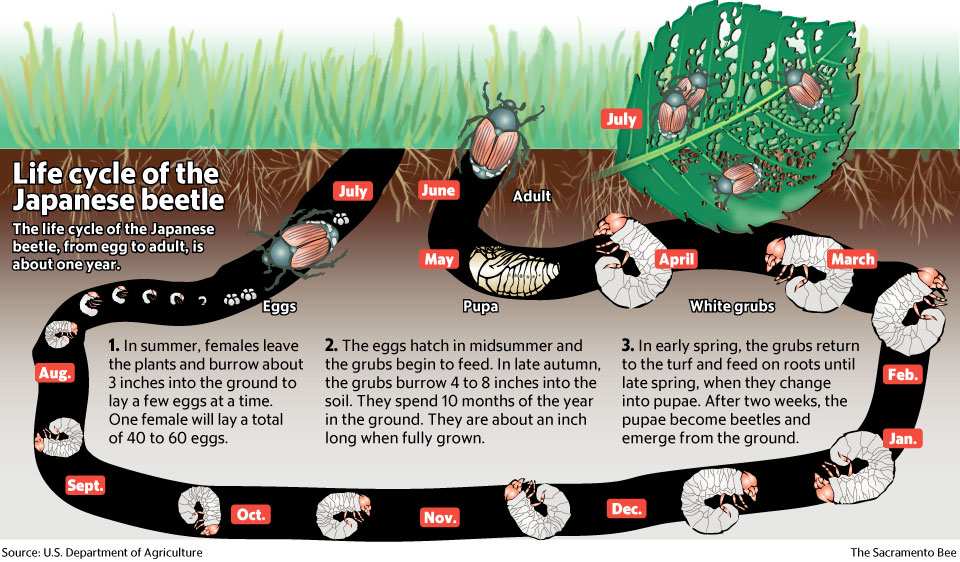
Image source: Bing (Web (fair-use with source credit))
The newly hatched larvae are tiny first-instar grubs. They feed on grass roots near the surface through late summer and into fall. As temperatures drop, they burrow deeper into the soil to overwinter.
In spring, they return to the root zone for a brief feeding period before pupating and emerging as adults.
This cycle creates two distinct treatment windows. The preventive window targets eggs and newly hatched larvae before they cause damage. The curative window targets active-feeding grubs after you've confirmed they're present and causing harm.
The products, timing, and expectations are completely different for each approach.
Preventive Treatment: Your Best Shot at Control
If you've had grub problems before, or if your neighborhood has a history of Japanese beetle activity, preventive treatment is your most reliable strategy. It's easier, more effective, and often cheaper than trying to kill established grubs after the damage is done.
Preventive products contain active ingredients like chlorantraniliprole or imidacloprid. These work by targeting eggs and very young larvae before they develop into root-destroying machines. Chlorantraniliprole, found in products like Scotts GrubEx1, has become the go-to preventive because it's highly effective at low application rates and has a favorable environmental profile compared to older chemistries.
The application window for preventive grub control is mid to late June through early July in most northern and mid-Atlantic states. You want the product in the soil and active before adult beetles finish laying eggs. In the Deep South, this window shifts earlier, often into May.
Here's the critical detail most people miss. You need to water in granular preventive products with about half an inch of irrigation or rainfall within a few days of application. The active ingredient has to move down into the root zone where eggs are hatching.
If you apply granules and they sit on the surface for two weeks in dry weather, you've wasted your money.
Preventive treatments typically provide season-long control from a single application. That's a big advantage over curative products, which may require precise timing and sometimes a second application. The tradeoff is that you're applying insecticide based on probability rather than confirmed presence.
For lawns with a history of grub issues, that tradeoff is usually worth it.
Curative Treatment: When You're Already Seeing Damage
Curative treatment is your move when grubs are already present, actively feeding, and causing visible harm. This is reactive rather than proactive, and the timing window is narrower and less forgiving.
The best curative window runs from late August through October in most northern regions. You want to hit grubs when they're young, small, and feeding aggressively near the soil surface. First and second instar grubs are far easier to kill than mature third instars that have built up size and resilience.
Curative products rely on active ingredients like trichlorfon or carbaryl. These work on contact and through ingestion, killing existing grubs within days rather than weeks. Trichlorfon, in particular, is known for its fast knockdown of active-feeding larvae.
The downside is that these products have shorter soil residuals. They won't protect your lawn for the entire season the way a preventive will.
Here's where people get into trouble. If you wait until you see large, mature grubs in October or November, curative products become significantly less effective. Those big grubs are preparing to burrow deep for winter.
They're feeding less, moving less, and harder to reach with surface-applied insecticide. You'll get partial control at best, and the surviving grubs will emerge as beetles next summer to start the cycle again.
If you're reading this in spring and seeing damage, the grubs you're finding are nearly mature. A curative application in early spring can still knock down some larvae before they pupate, but it's the least efficient timing. You're better off planning a preventive application for the following June.
The Exact Application Window by Season and Region
Grub species and climate vary enough that a single calendar date doesn't work everywhere. Here's a practical regional breakdown based on university extension data and beetle flight patterns across the US.
| Region | Preventive Application | Curative Application | Primary Species |
|---|---|---|---|
| Northeast (NY, PA, New England) | Mid-June to early July | Late August to mid-October | Japanese beetle, European chafer |
| Midwest (OH, IL, MI, IN) | Mid-June to early July | Late August to mid-October | Japanese beetle, European chafer |
| Mid-Atlantic (VA, MD, DE) | Late May to late June | Mid-August to late October | Japanese beetle, masked chafer |
| Southeast (NC, GA, AL) | Late April to late May | August to September | Japanese beetle, oriental beetle |
| Southern Plains (TX, OK) | Late April to May | August to October | May/June beetles, masked chafer |
| Pacific Northwest (WA, OR) | Late June to July | September to October | European chafer, black turfgrass ataenius |
These windows track adult beetle flight and egg-laying activity. If you're unsure when beetles are active in your area, your local university extension office publishes annual pest monitoring reports with specific flight dates. That's the most reliable local data you can get.
One more factor matters. Soil temperature drives egg development. Eggs hatch faster in warm soil, so a hot July compresses the window.
A cool, wet spring can delay beetle emergence and push everything back by a week or two. Watch the weather, not just the calendar.
Preventive vs. Curative Products: Which One Fits Your Situation
Choosing between preventive and curative grub control comes down to your specific circumstances. Neither is universally better. They solve different problems at different times.
Go preventive if:
- You've had grub damage in the past two years
- Your neighborhood has active Japanese beetle populations
- You maintain an irrigated lawn that attracts egg-laying females
- You want season-long protection from a single application
- You're treating a large area where spot-treatment isn't practical
Go curative if:
- You've confirmed active grub counts above threshold right now
- You're seeing fresh damage in late summer or fall
- Animals are digging in your lawn
- You missed the preventive window and need to act fast
- You're dealing with a small, localized outbreak
Some homeowners use both strategies in the same year. They apply a preventive in June for baseline protection, then spot-treat with a curative product in September if they find hotspots. That layered approach works well for properties with recurring problems.
Cost-wise, preventive products tend to run slightly more per application, but you're only applying once. Curative products may require a second application if the first doesn't achieve full control. Factor in your time and labor, not just the product price.
How to Apply Grub Control the Right Way
Application technique matters as much as product choice. Even the best insecticide fails if it doesn't reach the target zone where grubs are feeding.
Start by mowing your lawn a day or two before application. You want the grass short enough that granules reach the soil surface rather than getting trapped in tall blades. Remove any clippings as well.
Use a broadcast spreader for large areas or a drop spreader for smaller lawns and precise edges. Calibrate your spreader according to the product label. Over-applying wastes product and increases environmental risk.
Under-applying leaves gaps in coverage where grubs survive.
Apply the granules evenly across the entire treatment area. Overlap your passes slightly to avoid streaks. Many products recommend applying in a cross pattern, one pass north-south and a second pass east-west, for uniform coverage.
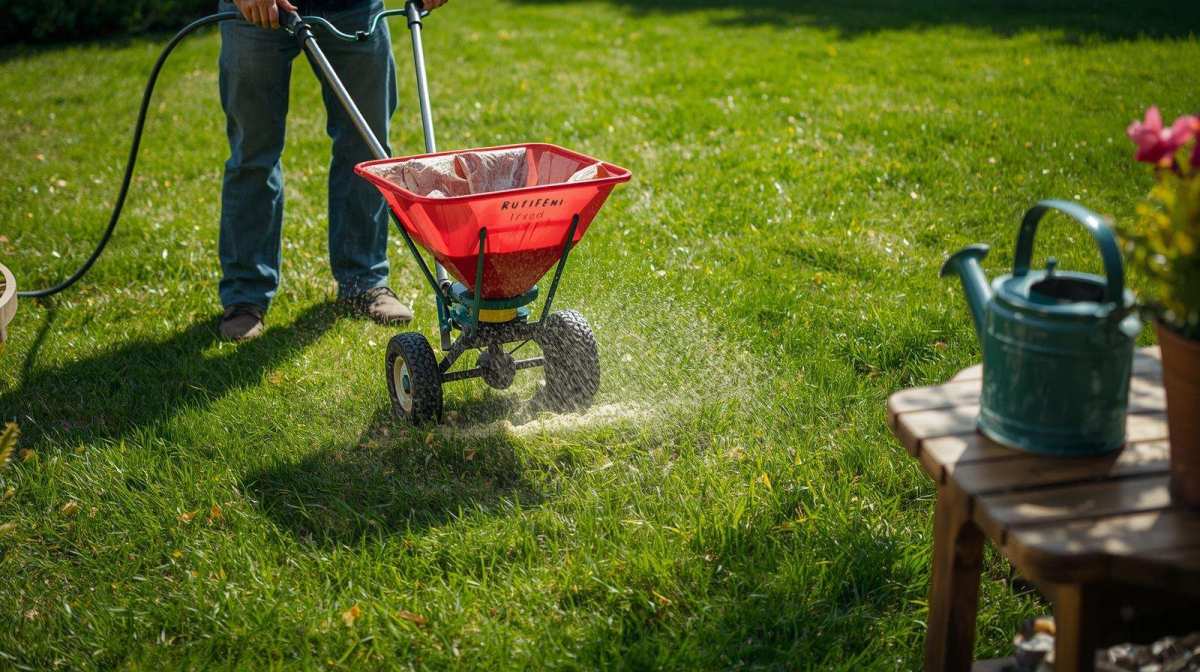
Image source: Bing (Web (fair-use with source credit))
Water in the application within 24 to 48 hours. This is non-negotiable for granular products. You need about half an inch of water to dissolve the granules and carry the active ingredient into the top inch of soil where grubs feed.
If rain isn't in the forecast, run your sprinklers.
Keep people and pets off the treated area until the granules have been watered in and the surface is dry. This isn't about toxicity panic. It's about keeping the product where you put it instead of tracking it into the house on shoes and paws.
Common Mistakes That Make Grub Treatment Fail
Even when homeowners pick the right product and the right timing, execution errors can ruin the treatment. Here are the ones we see most often.
Applying preventive products too early. If you put down a preventive in April, the residual will degrade before eggs hatch in July. You'll have no active ingredient left when you need it most. Stick to the June window.
Applying curative products too late. By November in northern states, grubs have burrowed below the treatment zone. The insecticide sits in the top inch of soil while the grubs are four inches down, comfortable and unreachable.
Skipping the watering step. Granules that sit on the surface don't work. They need moisture to release the active ingredient and move into the root zone. Dry granules are wasted granules.
Confusing grub damage with other problems. Fungal diseases, drought stress, compacted soil, and nutrient deficiencies all cause brown patches. If you treat for grubs when the real issue is something else, you've spent money and time for nothing. Always confirm with the sod-flotation test first.
Using the same product every year. While resistance isn't as widespread with grub insecticides as with some other pesticides, rotating between different active ingredient classes is good practice. Alternate between chlorantraniliprole and a neonicotinoid-based product if you're treating preventively on a regular schedule.
Ignoring the thatch layer. Heavy thatch, more than half an inch thick, acts as a barrier that prevents granules from reaching the soil. If your lawn has significant thatch, core-aerate before applying grub control. The aeration holes give the product a direct path to the root zone.
Organic and Low-Toxicity Alternatives Worth Considering
You don't have to reach for synthetic insecticides to manage grubs. Two organic approaches have solid research behind them, though each comes with tradeoffs you should understand.
Beneficial nematodes are microscopic roundworms that seek out and kill grubs from the inside. Heterorhabditis bacteriophora is the species most commonly used for grub control. You mix them with water and spray or sprinkle them onto the lawn in late summer when grubs are active near the surface. They work best in moist soil with temperatures between 60 and 85 degrees Fahrenheit.
The main drawback is shelf life. Nematodes are living organisms. They need to be stored properly and applied quickly after purchase.
Milky spore disease is caused by the bacterium Paenibacillus popilliae. It specifically targets Japanese beetle grubs and can persist in the soil for 10 to 15 years once established. The catch is patience.
Milky spore takes two to three years to build up enough concentration in the soil to provide meaningful control. It's a long-term investment, not a quick fix.
Both options are safe around children, pets, and pollinators. That's their biggest advantage over conventional insecticides. If you're managing a small lawn and can tolerate a gradual approach, they're worth considering.
When to Skip Treatment Entirely
Sometimes the best decision is to do nothing. If your sod test comes back with fewer than 5 grubs per square foot and your lawn is otherwise healthy, treatment isn't justified. You'd be spending money and adding chemicals to the environment for a problem that isn't actually a problem.
Lawns with deep, vigorous root systems can handle a surprising amount of root feeding without showing visible stress. Deep watering and proper fertilization help turf outgrow minor grub feeding. If you're mowing at the right height and fertilizing on schedule, your lawn has more resilience than you might think.
Also consider that a small grub population feeds birds and other beneficial wildlife. Robins, starlings, and ground beetles all prey on grubs. A complete elimination approach disrupts that food chain for no real benefit.
Final Decision Guide: Should You Treat Right Now?
Here's a straightforward way to make your call. Walk through these questions in order.
What month is it? If it's June or early July, you're in the preventive window. If it's August through October, it's curative season. If it's November through May, hold off and plan for the right window.
Did you confirm grubs are present? Cut a square foot of sod and count. If you're under 5 per square foot in cool-season turf, skip treatment. If you're over 10, proceed.
Between 5 and 10, consider your lawn's overall health and whether animals are digging.
Did you have damage last year? If yes, preventive treatment this June is your most reliable bet. If this is your first time dealing with grubs, confirm the problem before treating.
Are you comfortable with synthetic insecticides? If not, look into beneficial nematodes for curative situations or milky spore for long-term Japanese beetle management. Both require more patience but avoid conventional chemistry.
The bottom line is simple. Confirm the problem, match your timing to the product type, and apply correctly. Most grub control failures come down to one of those three steps getting skipped.
Frequently Asked Questions
Can I apply grub control and fertilizer at the same time?
Yes, as long as both products are compatible and applied at their recommended rates. Many homeowners combine a preventive grub control application with a summer fertilizer feeding. Just water everything in together after application.
How long does grub control take to work?
Preventive products start working as eggs hatch, usually within a week of watering in. Curative products like trichlorfon can kill active grubs within 24 to 72 hours under good conditions.
Will grub damage come back on its own?
If you don't treat, surviving grubs will mature, pupate, and emerge as adult beetles that lay eggs the following summer. The cycle repeats. One year of damage often leads to worse damage the next year without intervention.
Is it too late to treat grubs in September?
Not at all. September is prime curative treatment time in most regions. Grubs are still small, actively feeding, and close to the soil surface.
You're actually in a better position than someone trying to treat in November.
Do I need to treat my entire lawn?
Not necessarily. If grubs are concentrated in one area, spot-treating that zone can be effective and saves money. Just make sure to check multiple areas.
Grubs often cluster near sidewalks, driveways, and sunny slopes.
Can overwatering make grub problems worse?
Yes. Female beetles prefer moist soil for egg-laying. Over-irrigated lawns attract more egg deposition and provide better conditions for egg survival.
Water deeply but infrequently rather than light daily watering.