If you've ever dug into your lawn and found a pale, squirming creature curled up in the soil, you're probably wondering what does grub worms look like and whether you should be worried. The short answer is that most "grubs" people find are actually the larvae of scarab beetles, and they share a handful of telltale features that make them fairly easy to recognize once you know what to look for.
The tricky part is that several different soil-dwelling larvae get lumped under the word "grub," and not all of them are the same pest. Getting the identification right matters because a Japanese beetle grub and a billbug larva require completely different control strategies. In our research, we've found that misidentification is the single biggest reason people waste money on the wrong treatment or apply it at the wrong time of year.
Quick Answer
White grubs are C-shaped larvae with soft, off-white bodies and brown head capsules. They have six small legs near their head end. Most species range from 8 mm to 50 mm long depending on their age.
The underside of their last body segment, called the raster pattern, is the most reliable way to tell species apart.
What Grubs Look Like: The Visual Breakdown
When most people picture a grub, they're thinking of a scarab beetle larva. These are the classic "white grubs" that turf professionals deal with across much of the United States and Europe. The body is soft, plump, and usually a creamy off-white color.
The head is a distinct brown or tan, slightly hardened capsule that looks darker than the rest of the body.
The body curves into a C-shape, which is the posture most grubs hold when you pull them out of the soil. This C-curve is one of the first visual clues you're dealing with a scarab larva rather than something else. The body itself is segmented and slightly translucent in younger specimens, and you can sometimes see the dark line of the digestive tract running through the middle.
Size varies quite a bit. A freshly hatched first-instar grub might be barely 8 mm long, while a mature third-instar Japanese beetle grub reaches about 25 mm. The green june beetle grub is the heavyweight of the group, growing up to 50 mm, which is noticeably larger than most other species you'll encounter in a lawn.

Image source: iNaturalist / Irene
One thing that surprises people is that grubs do have legs. Scarab grubs have three pairs of legs clustered near the head end, and they're usually visible if you look closely. This is actually one of the key features that separates them from look-alike larvae, which we'll get into shortly.
The Key Features That Separate One Grub From Another
Not all white grubs are the same species, and telling them apart comes down to a few specific physical traits. The most reliable one is the raster pattern, which we'll cover in detail in its own section. But there are other features worth checking first.
Body color and tone. Most scarab grubs are cream or off-white, but some species lean slightly gray or yellowish. The green june beetle grub, for example, can appear more translucent and pale. Billbug larvae, which are often mistaken for grubs, tend to be more yellowish-white.
Head capsule color and shape. The head is brown in most scarab species, but the shade can vary from light tan to dark reddish-brown. Billbug larvae have a darker, more rounded head that looks distinctly weevil-like as they mature.
Legs or no legs. This is the big one. Scarab grubs have six legs. Billbug larvae and weevil grubs have no true legs at all.
If you're holding a white larva and you can't find any legs, you're probably not looking at a scarab grub.
Body shape and thickness. Scarab grubs are plump and cylindrical. Wireworms, which people sometimes confuse with grubs, are much flatter, harder-bodied, and more elongated. Leatherjackets (crane fly larvae) are legless, gray-brown, and have a tougher, almost leathery skin texture.
Size at maturity. Japanese beetle grubs top out around 25 mm. European chafers are similar. Masked chafers tend to be slightly smaller.
Green june beetle grubs are the outliers at up to 50 mm, so if you find something unusually large, that's your first clue.
Scarab Grubs vs. Billbug Larvae vs. Leatherjackets: Telling Them Apart
This is where most people get tripped up, and honestly, it's where misidentification causes the most real-world damage. Three different larvae get called "grubs" by homeowners, but they're from completely different insect families and they need different approaches.
Scarab grubs (Japanese beetle, European chafer, masked chafer, May/June beetle) have six legs, a brown head capsule, a C-shaped body, and a soft, plump profile. They feed on turfgrass roots and are the most common target of grub control products.
Billbug larvae (Sphenophorus spp.) look similar at first glance. They're legless, which is the giveaway. They're also more yellowish, and as they mature, the head takes on a distinct weevil-like shape.
Billbugs are a bigger problem in certain warm-season grasses like zoysia and bermudagrass, and the standard grub control timing doesn't always line up with their life cycle.
Leatherjackets (crane fly larvae) are the odd ones out. They're legless, grayish-brown, and have a tough, almost leathery skin. They don't curl into the same tight C-shape as scarab grubs.
In the UK and Pacific Northwest, leatherjackets are actually more common than scarab grubs as a turf pest, so regional context matters a lot here.
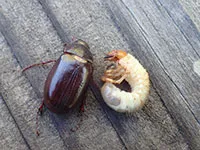
Image source: Bing (Web (fair-use with source credit))
The practical difference is this. If you treat for Japanese beetle grubs in late July but you actually have billbugs, you've probably missed the window. Billbug damage often shows up earlier in the season, and the larvae are already too large by the time standard grub products would be applied.
Knowing which one you're dealing with changes everything about your timing and product choice.
How to Examine a Grub You've Dug Up
Once you've got a grub in hand, here's how to work through the identification process step by step.
Step 1: Place it on a flat, light-colored surface. A white plate or a piece of paper works well. You need to see the body clearly, and a dark background makes it harder to pick up on color differences.
Step 2: Check for legs. Look near the head end. If you see three pairs of small legs, you're dealing with a scarab grub. If there are no legs at all, set it aside as a possible billbug, weevil grub, or leatherjacket.
Step 3: Note the body color and shape. Is it creamy white and C-shaped? That points to scarab. Is it yellowish and slightly straighter?
Think billbug. Is it gray-brown and leathery? That's a leatherjacket.
Step 4: Look at the head. A brown, hardened head capsule is typical of scarab grubs. A darker, more rounded head suggests billbug.
Step 5: Flip it over and examine the underside of the last abdominal segment. This is where the raster pattern lives, and it's the gold standard for species-level identification. We'll walk through exactly what to look for in the next section.
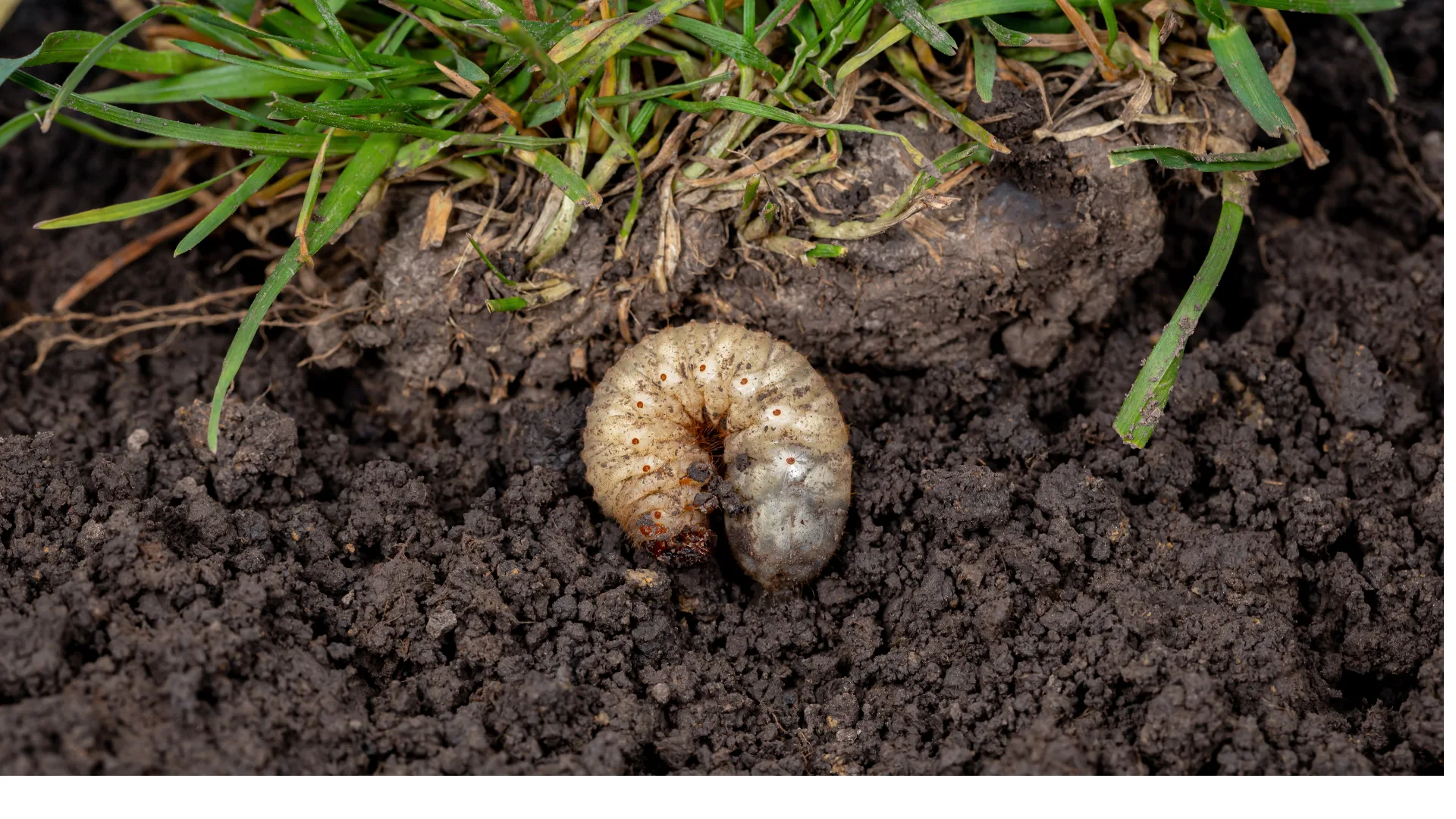
Image source: Bing (Web (fair-use with source credit))
A hand lens or magnifying glass makes a real difference here. The raster pattern details are small, and trying to identify them with the naked eye alone leads to a lot of guesswork. If you don't have a magnifier, a phone camera with macro mode can work in a pinch.
The Raster Pattern: Your Most Reliable ID Tool
The raster is the area on the underside of the grub's last body segment, just above the anus. It's covered in a pattern of hairs, spines, and bare spots, and the arrangement is different for each species. This is the feature entomologists use to confirm identification, and it's the single most reliable way to tell one grub species from another.
Here's what to look for in the most common species:
| Species | Raster Pattern Description |
|---|---|
| Japanese beetle (Popillia japonica) | Two distinct rows of spines forming a narrow V-shape |
| European chafer (Amphimallon majale) | Two rows of spines forming a wide, open Y-shape or transverse line |
| Masked chafer (Cyclocephala spp.) | Scattered spines with no distinct pattern, often a single row |
| May/June beetle (Phyllophaga spp.) | Three rows of spines, sometimes described as a "chevron" pattern |
| Black turfgrass ataenius | Two parallel rows of spines, closely spaced |
| Green june beetle (Cotinis nitica) | Two rows of spines that converge at the base, forming a narrow V |
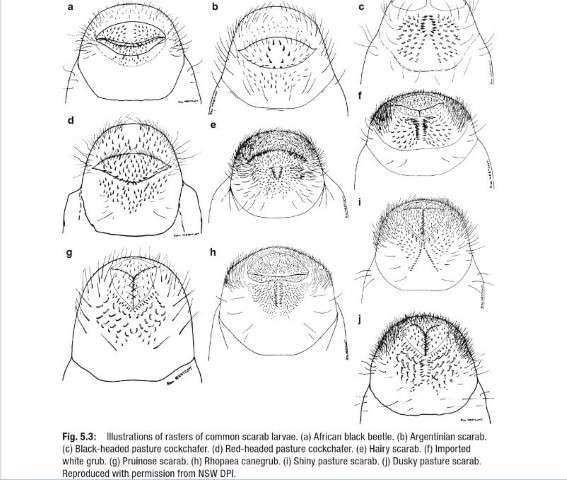
Image source: Bing (Web (fair-use with source credit))
The pattern can be subtle, and the spines are tiny. A magnifying glass at 10x magnification makes this much easier. If you're serious about getting the ID right, this is the step that separates a confident identification from a guess.
One practical note: the raster pattern is easiest to see on third-instar grubs, which are the largest and most mature. First and second instars have less developed patterns, so if you're sampling early in the season and finding very small grubs, you may need to let them grow a bit or send a sample to your local extension service for confirmation.
Common Mistakes People Make When Identifying Grubs
The biggest mistake is assuming every white larva in the soil is the same thing. Billbugs, leatherjackets, and wireworms all get called "grubs" by homeowners, and treating them all the same way leads to wasted money and poor results.
Another common error is identifying grubs based only on body color. Color can vary with age, diet, and soil conditions, so it's not a reliable standalone feature. Two grubs of the same species can look slightly different depending on what they've been feeding on.
People also tend to skip the leg check. If you don't confirm whether the larva has legs, you're missing the single fastest way to rule out billbugs and weevils. It takes five seconds and saves you from a completely wrong treatment plan.
Timing trips people up too. Grubs are easiest to find and identify in late summer and early fall, when they're actively feeding near the surface. By the time lawn damage is visible in spring, many grubs have already pupated and turned into beetles.
If you're trying to identify grubs from damage alone without actually finding the larvae, you're working with incomplete information.
Finally, a lot of people don't check multiple spots in the lawn. Grub populations are often patchy. Finding one grub in a single plug doesn't tell you much.
Extension services generally recommend sampling at least four to six areas across the lawn to get a realistic picture of what's down there.
What to Do Once You Know What You're Dealing With
Once you've confirmed the species, the next steps depend on what you found and how many grubs are present.
If you have scarab grubs at or above the treatment threshold (generally 6 to 10 grubs per 0.1 square meter, though this varies by region and grass type), you've got two timing options. Preventive products containing imidacloprid or chlorantraniliprole are applied in early to mid-summer, before eggs hatch. Curative products containing trichlorfon or carbaryl work on small, actively feeding grubs in late summer and early fall.
The key is matching the product to the grub's life stage.
If you have billbugs, the timing shifts. Billbug larvae are most vulnerable in late spring to early summer, which is earlier than the standard grub treatment window. Products containing chlorantraniliprole or certain pyrethroids are commonly used, but the application timing is different from scarab grub programs.
If you have leatherjackets, biological control with entomopathogenic nematodes (Steinernema species) can be effective in the UK and Pacific Northwest. Chemical options are more limited in some regions, so check with your local extension for current recommendations.
If grub numbers are below threshold, you might not need to do anything at all. A few grubs per square foot is normal in most lawns and won't cause visible damage. Over-treating can kill beneficial soil organisms and create resistance issues down the line.
When to Call in an Expert or Send a Sample to Extension
If you've gone through the identification steps and you're still not sure what you're looking at, your county cooperative extension service is the best resource. Most extension offices will identify grub samples for free or a small fee, and they can tell you the species, the current life stage, and the recommended treatment window for your area.
This is especially worth doing if you're dealing with a large lawn, a golf course, or a sod farm where the economic stakes are higher. A wrong identification on a 2-acre property can cost significantly more than the same mistake on a backyard.
You should also reach out to extension if you're finding grubs but no corresponding lawn damage, or if you're seeing damage but can't find any grubs. Both situations can point to something other than a standard grub problem, and an expert can help you rule out fungal disease, nematode damage, or other issues that mimic grub injury.
Quick Reference: Grub Species Comparison Chart
| Feature | Japanese Beetle Grub | European Chafer Grub | Masked Chafer Grub | Green June Beetle Grub | Billbug Larva |
|---|---|---|---|---|---|
| Body shape | C-shaped, plump | C-shaped, plump | C-shaped, plump | C-shaped, very large | Slightly curved, cylindrical |
| Body color | Creamy white | Creamy white | Creamy white | Pale, translucent | Yellowish white |
| Head capsule | Brown | Brown | Brown | Brown | Dark brown, rounded |
| Legs | 6 (3 pairs) | 6 (3 pairs) | 6 (3 pairs) | 6 (3 pairs) | None |
| Mature length | ~25 mm | ~25 mm | ~20 mm | ~50 mm | ~10 mm |
| Raster pattern | V-shaped spine rows | Y-shaped spine rows | Scattered, no clear pattern | Narrow V, converging | N/A (no true raster) |
| Peak activity | Late Aug to Oct | Late Aug to Oct | July to Sept | Late summer | Late spring to early summer |
Frequently Asked Questions
How can I tell if the white thing in my soil is a grub or something else?
Check for legs first. Scarab grubs have six legs near the head. If it's legless, you're likely looking at a billbug larva, leatherjacket, or weevil grub.
Body shape and the C-curve posture are your next clues.
Do all grubs look the same?
No. While most scarab grubs share a similar C-shaped, white-bodied appearance, the species differ in size, raster pattern, and subtle color variations. Billbugs and leatherjackets look different enough that a close examination will separate them.
What time of year is best for identifying grubs?
Late summer through early fall, roughly August to October in most regions, is the prime window. Grubs are actively feeding near the surface and are large enough to examine. Spring sampling works too, but grubs may have already pupated.
How many grubs in my lawn is considered a problem?
The general economic threshold is 6 to 10 grubs per 0.1 square meter. Below that, most healthy lawns can tolerate the feeding without visible damage. Above that, treatment is usually warranted.
Can I identify grubs from lawn damage alone?
Not reliably. Brown, spongy turf that pulls up easily is a classic sign of grub feeding, but fungal diseases, drought stress, and nematode damage can look similar. You need to actually find and examine the grubs to confirm the cause.
What to Do Once You Know What You're Dealing With
Once you've confirmed the species, the next steps depend on what you found and how many grubs are present.
If you have scarab grubs at or above the treatment threshold (generally 6 to 10 grubs per 0.1 square meter, though this varies by region and grass type), you've got two timing options. Preventive products containing imidacloprid or chlorantraniprole are applied in early to mid-summer, before eggs hatch. Curative products work on small, actively feeding grubs in late summer and early fall.
If you have billbugs, the timing shifts earlier. Billbug larvae are most vulnerable in late spring to early summer. Standard grub control programs often miss this window entirely, which is why correct identification matters so much.
If you have leatherjackets, biological control with entomopathogenic nematodes (Steinernema species) can be effective in the UK and Pacific Northwest. Chemical options are more limited in some regions, so check with your local extension for current recommendations.
If grub numbers are below threshold, you might not need to do anything. A few grubs per square foot is normal in most lawns and won't cause visible damage. Over-treating kills beneficial soil organisms and creates resistance issues over time.
When to Call in an Expert or Send a Sample to Extension
If you've gone through the identification steps and you're still not sure what you're looking at, your county cooperative extension service is the best resource. Most extension offices will identify grub samples for free or a small fee. They can tell you the species, the current life stage, and the recommended treatment window for your area.
This is especially worth doing if you're dealing with a large property, a golf course, or a sod farm where the economic stakes are higher. A wrong identification on a 2-acre lawn can cost significantly more than the same mistake on a backyard.
You should also reach out to extension if you're finding grubs but no corresponding lawn damage, or if you're seeing damage but can't find any grubs. Both situations can point to something other than a standard grub problem.
Quick Reference: Grub Species Comparison Chart
| Feature | Japanese Beetle | European Chafer | Masked Chafer | Green June Beetle | Billbug Larva |
|---|---|---|---|---|---|
| Body shape | C-shaped, plump | C-shaped, plump | C-shaped, plump | C-shaped, very large | Slightly curved |
| Body color | Creamy white | Creamy white | Creamy white | Pale, translucent | Yellowish white |
| Head capsule | Brown | Brown | Brown | Brown | Dark brown, rounded |
| Legs | 6 (3 pairs) | 6 (3 pairs) | 6 (3 pairs) | 6 (3 pairs) | None |
| Mature length | ~25 mm | ~25 mm | ~20 mm | ~50 mm | ~10 mm |
Frequently Asked Questions
How can I tell if the white thing in my soil is a grub or something else?
Check for legs first. Scarab grubs have six legs near the head. If it's legless, you're likely looking at a billbug larva, leatherjacket, or weevil grub.
Body shape and the C-curve posture are your next clues.
Do all grubs look the same?
No. While most scarab grubs share a similar C-shaped, white-bodied appearance, species differ in size, raster pattern, and subtle color variations. Billbugs and leatherjackets look different enough that a close examination will separate them.
What time of year is best for identifying grubs?
Late summer through early fall is the prime window in most regions. Grubs are actively feeding near the surface and are large enough to examine. Spring sampling works too, but many grubs have already pupated.
How many grubs in my lawn is considered a problem?
The general threshold is 6 to 10 grubs per 0.1 square meter. Below that, most healthy lawns tolerate the feeding without visible damage. Above that, treatment is usually warranted.
Can I identify grubs from lawn damage alone?
Not reliably. Brown, spongy turf that pulls up easily is a classic sign of grub feeding, but fungal diseases and drought stress can look similar. You need to actually find and examine the grubs to confirm the cause.
Common Mistakes People Make When Identifying Grubs
Misidentifying billbugs as white grubs is the most common error we've seen. People see a pale larva in the soil and assume it's the same pest their neighbor treated for last year. Applying a product at the wrong time of year because you misidentified the species wastes money and rarely solves the problem.
Another mistake is relying on body color alone. Grub color shifts with age, diet, and soil moisture. Two larvae of the same species can look noticeably different depending on what they've been feeding on.
Leg count and body posture are far more reliable tells.
People also tend to skip examining multiple areas of the lawn. Grub populations cluster. Finding three grubs in one plug and none in four others tells a very different story than finding three grubs in every plug across the property.
What to Do Once You Know What You're Dealing With
Correct identification unlocks the right treatment timing and product choice. Scarab grubs have two treatment paths depending on when you catch them. Preventive applications target newly hatched grubs in mid-summer.
Curative applications work on small, actively feeding grubs in late summer and early fall.
Billbug control requires a different schedule entirely. The larvae are most vulnerable in late spring, well before most grub programs begin. Missing this window means the larvae are already inside the plant stem where sprays can't reach them effectively.
Always follow product label directions carefully. Application rates, watering requirements, and re-entry intervals vary by product. Overwatering after application can move the product below the root zone where grubs are feeding.
When to Call in an Expert or Send a Sample to Extension
Your county extension office offers grub identification as a free or low-cost service in most states. Send a sample in a sealed container with a note about where you found it and what kind of damage you're seeing. They can confirm the species and give you timing recommendations specific to your region.
This step pays off most when you're dealing with a large property or when the larvae you've found don't match any of the common descriptions perfectly. Some scarab species look very similar, and extension entomologists have the reference collections to tell them apart.
Quick Reference: Grub Species Comparison Chart
| Feature | Japanese Beetle | European Chafer | Masked Chafer | Billbug Larva |
|---|---|---|---|---|
| Body color | Creamy white | Creamy white | Creamy white | Yellowish white |
| Legs present | Yes (6) | Yes (6) | Yes (6) | No |
| Mature length | ~25 mm | ~25 mm | ~20 mm | ~10 mm |
| Raster pattern | V-shaped | Y-shaped | Scattered | N/A |
| Best treatment window | Late summer | Late summer | Mid to late summer | Late spring |
Frequently Asked Questions
How can I tell a grub from other white larvae?
Check for six legs near the head and a brown head capsule. No legs means it's likely a billbug, weevil grub, or leatherjacket. The C-shaped posture points to scarab species.
Why does species identification matter?
Treatment timing differs between species. A product applied in August works for Japanese beetle grubs but may miss billbug larvae entirely. Correct species ID saves money and gets better results.
How do I send a sample to extension?
Collect five to ten larvae in a sealed plastic bag or container. Include your address, the location where you found them lawn or garden, and a description of any visible damage. Ship or deliver early in the week so the sample doesn't sit in a hot mailbox over the weekend.
Can grubs come back after treatment?
Yes. Products kill the larvae present at application time but don't prevent future beetles from laying eggs. Monitoring the following season and re-sampling is the best way to catch a new infestation early before visible damage appears.