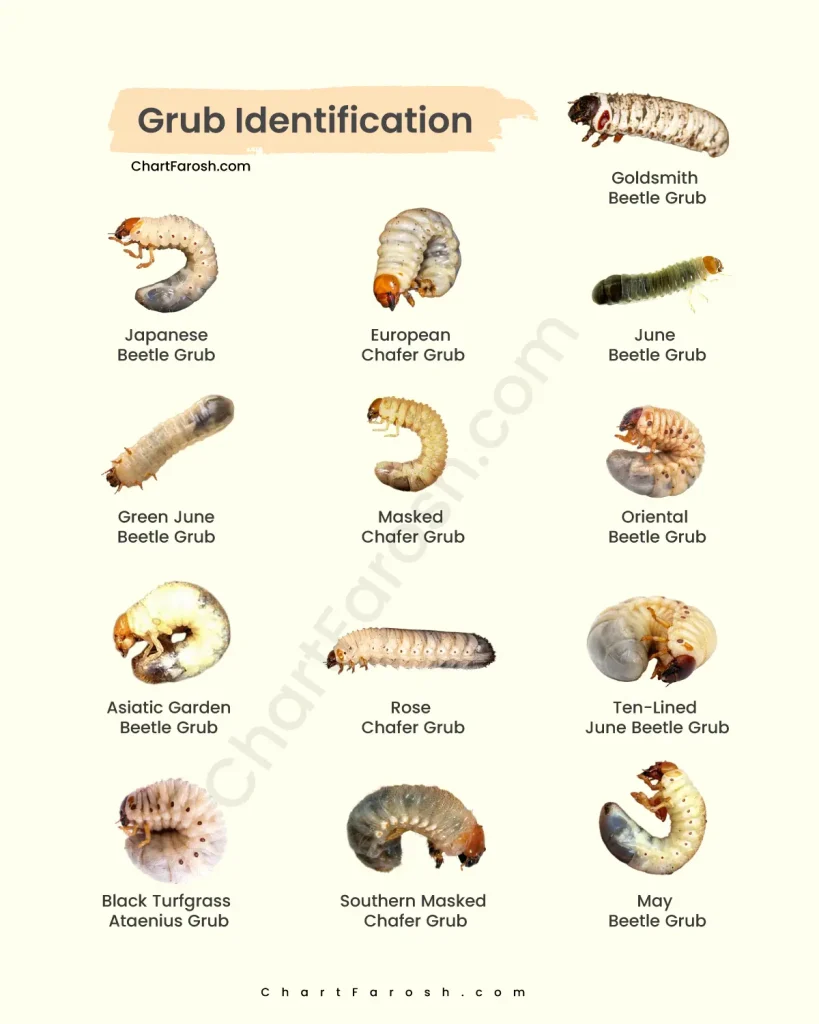
Pulling up a patch of dead, brown turf and seeing tiny curled creatures in the soil can be unsettling. You're not alone, and you're asking the right question. What does a lawn grub look like is one of the most important things to know before you reach for any treatment.
Getting the ID right saves you time, money, and unnecessary chemicals.
Grubs are the larval stage of scarab beetles, and multiple species cause damage across most of the United States. Extension services typically consider 5 to 10 grubs per square foot the treatment threshold for cool-season lawns. Let's walk through exactly what to look for so you can tell grubs apart from everything else living in your soil.
Quick Answer
A lawn grub is a creamy white or grayish C-shaped larva with a tan or brown head and three pairs of legs near its head. Most species range from ¼ inch to 1½ inches long when fully grown. The tip of its abdomen often appears darker because you're seeing gut contents through its skin.
Turn it over and you'll find a specific bristle pattern called a raster, which distinguishes one species from another.
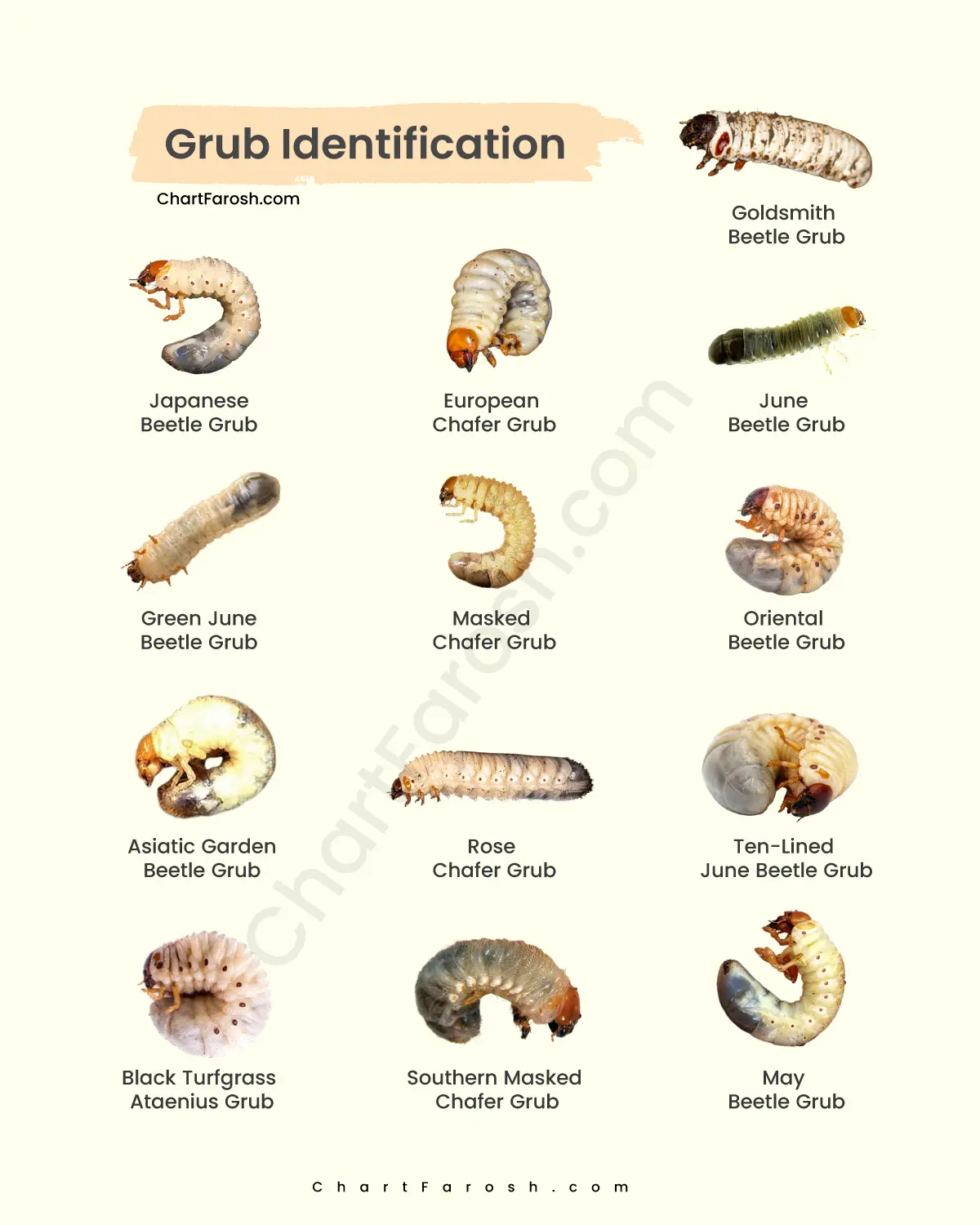
Image source: Bing (Web (fair-use with source credit))
Why Seeing the Difference Matters
Misidentification is the biggest mistake homeowners make with lawn grubs. You might treat a lawn that doesn't actually have a pest problem, or worse, you might miss a real infestation because you assumed the damage was drought stress.
Brown patches from grub feeding can look almost identical to fungal disease or dog urine spots. The only reliable way to know what's going on is to dig, find the larvae, and confirm what they are. Once you've done that, you can check your count against the treatment threshold that matches your grass type and region.
Beneficial insects live in the same soil zone. Ground beetle larvae, for example, are predators that actually help your lawn. If you can't tell the difference, you risk killing the organisms that are working in your favor.
The Key Visual Features of White Grubs
Every white grub shares a set of physical traits. Learn these and you'll be able to pick a grub out of a handful of dirt with confidence.
Body shape and posture. Grubs hold their body in a characteristic C-shape. If you place one on a flat surface, it won't stretch out straight. That curl is your first visual clue and the feature most people recognize immediately.
Color. The body is creamy white to pale gray, sometimes with a faint yellowish tint. The head capsule is tan, amber, or reddish brown depending on the species. The rear end often looks darker (brownish or gray) because you can see through the skin.
Legs. Grubs have three pairs of legs attached to the thorax, right behind the head. They're small but visible with the naked eye or a basic magnifier. If the larva you're looking at has no legs, it's not a grub.
Size. First-instar grubs (freshly hatched) are tiny, around ¼ inch. Third-instar grubs (mature larvae before pupation) reach ¾ inch to over 1½ inches depending on the species. Japanese beetle grubs top out around 1 inch.
European chafer grubs can get slightly larger.
Texture. The body is soft, plump, and slightly translucent. You can feel the firmness when you pick one up, almost like a small, wet grain of rice with legs.
Here's a quick rundown of the most common features to check:
| Feature | What to Look For |
|---|---|
| Body shape | Pronounced C-curve |
| Body color | Creamy white to pale gray |
| Head capsule | Tan, amber, or reddish brown |
| Legs | Three pairs near the head |
| Posterior tip | Often darker (visible gut contents) |
| Size range | ¼ inch to 1½ inches |
Telling Grub Species Apart: Japanese Beetle vs. European Chafer vs. June Bug
Not all grubs are the same species, and the differences matter for treatment timing. The two most important distinguishing features are head color and the raster pattern (the arrangement of hairs and spines on the underside of the abdomen tip).
Japanese beetle grubs (Popillia japonica) have a brownish-tan head and a V-shaped or two-row raster pattern. They're the most talked-about species in the eastern half of the country, and the adults are the metallic green-and-copper beetles that show up in midsummer.
European chafer grubs (Amphimallon majale) also have a tan head, but their raster pattern forms a Y-shaped opening or a more chaotic, open arrangement. They're especially destructive in the Northeast and Great Lakes regions.
June bug grubs, also called May beetles (Phyllophaga species), tend to be larger than either of the others. Their head capsule is a warm reddish-brown, and their raster pattern shows two distinct, roughly parallel rows of spines.
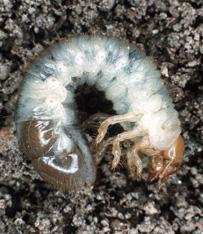
Image source: Wikimedia Commons / USDA
Here's a side-by-side comparison of the three most commonly misidentified species:
| Species | Head Color | Typical Size | Raster Pattern | Primary Region |
|---|---|---|---|---|
| Japanese beetle grub | Tan to brown | ~1 inch | V-shaped or paired rows | Eastern & midwestern US |
| European chafer grub | Tan | ~1 inch | Y-shaped opening, more open | Northeast & Great Lakes |
| June bug / May beetle grub | Reddish brown | Up to 1½ inches | Two roughly parallel rows | Widespread across US |
If you're trying to tell species apart and don't have a magnifying lens or microscope handy, at least note the head color and approximate size. Take a clear photo and send it to your local extension office. They can confirm the species, which tells you when the larvae will be at their most vulnerable stage for treatment.
What People Mistake for Grubs
Several other organisms live in the top few inches of soil and get flagged as grubs by worried homeowners. Here's what you're actually looking at in the most common cases.
Earthworms. These are segmented, legless, and longer than any grub. Earthworms are beneficial. Never treat for them.
Millipedes. Many legs, a harder body, and a round (not flattened) cross-section. They feed on decaying organic matter, not living roots. Not a threat to your lawn.
Ground beetle larvae. These are elongated, fast-moving, and often dark-colored with prominent jaws. They're predators that eat actual pests. Leave them alone.
Billbug larvae. These can cause damage that looks similar to grub feeding, but billbug larvae are legless and have a smooth, creamy-white body. That lack of legs is the easiest way to separate them from true grubs.
Sod webworms. These don't live in the soil at all. They're caterpillars that feed above ground on grass blades at night. If you're finding larvae in the root zone, webworms aren't your problem.
The one visual check that settles most debates: count the legs. True grubs have three pairs. If you see a pair of legs per body segment, you're looking at something else entirely.
The Raster Pattern: The Best Way to Confirm You're Looking at a Grub
Flip a confirmed grub onto its back and look at the last abdominal segment. You'll see a cluster of tiny bristles, spines, and sometimes two small anal slits. That arrangement is called the raster pattern, and it's the single most reliable way to distinguish grub species from one another.
With a 10x hand lens or a phone camera in macro mode, you can actually see the shape these bristles make. Japanese beetle grubs show a distinctive V-shaped or paired row pattern. European chafer grubs reveal a more open, Y-shaped arrangement.
June bug species display two roughly parallel rows of spines.
Hosting these larvae on a white surface under good light helps enormously. The contrast makes the bristle field pop against the paler skin. Without this close-up view, many species look nearly identical at a glance.
State extension services often publish illustrated raster charts you can download for free. Having one next to you while you inspect your sample takes the guesswork out of species identification.
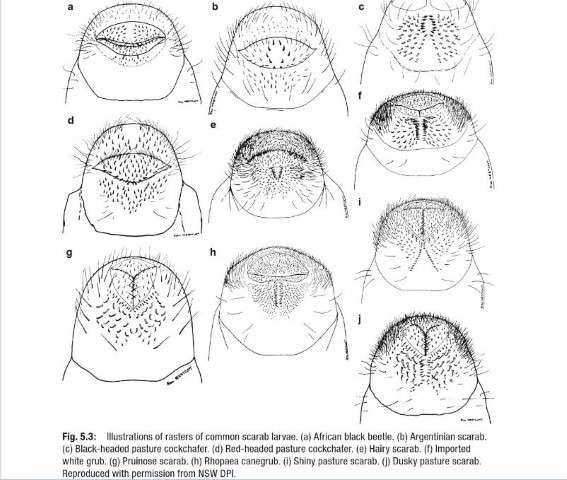
Image source: Bing (Web (fair-use with source credit))
How to Dig for and Photograph Grubs in Your Lawn
Finding grubs requires a short dig in the right spot, not a full lawn renovation. You don't need special tools, just a flat shovel or a sturdy knife and a piece of cardboard to lay the soil on.
Start where the brown patch meets healthy green grass. Grubs tend to feed along these transition zones, not always in the dead center of the damage.
Cut three sides of a 1-foot square about 2 to 3 inches deep. Peel back the sod like a flap. Sift through the soil with your fingers or a trowel.
Count every grub you find in that square.
Replace the flap and water it back down. The turf should re-root within a week or two.
Repeat this process in three or four different spots around the lawn. Average your counts to get a reliable picture of infestation severity.
For photographs, place grubs on a clean white paper or plate. Use your phone's macro setting if available. Snap one from directly above and one flipped to show the underside tip.
That two-angle approach is what entomologists request for identification help.
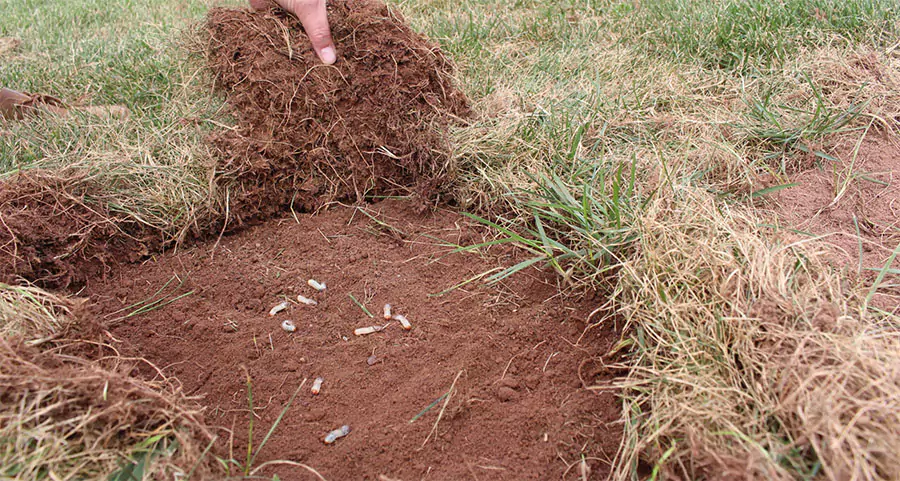
Image source: Bing (Web (fair-use with source credit))
Here's a step-by-step summary you can follow in the field:
- Locate the edge of a brown patch or area showing wilting despite adequate soil moisture.
- Cut a 1-square-foot section at least 2 to 3 inches deep on three sides.
- Peel back the turf carefully so you can replace it intact.
- Sift through the entire depth of exposed soil, counting every grub you find.
- Replace the turf flap and press it down firmly.
- Water the area immediately to encourage the roots to reconnect.
- Sample three to four spots across the lawn to calculate your average count per square foot.
Grub or Not? A Visual ID Cheat Sheet
Sometimes you just need a quick yes-or-no check before getting into species-level detail. Run through this short checklist.
Almost certainly a grub if:
- Body held in a tight C-curve
- Creamy white to gray body with a darker rear end
- Brown or tan head capsule
- Three pairs of legs near the head
- Found in the top 2 to 4 inches of soil during late summer or early fall
Probably not a grub if:
- The body is fully straight or elongated
- Legs run along the entire body length (millipede)
- No legs at all (billbug larva or cutworm)
- Body is clearly segmented with visible rings (earthworm)
- Found on grass blades above ground, not in soil (webworm or armyworm)
When in doubt, a close photo sent to your state extension service gets you a definitive answer within a couple of business days in most regions. This free service is one of the most underused resources available to homeowners.
When to Treat and When You Don't Need To
Finding a couple of grubs in your lawn doesn't automatically mean you should reach for a pesticide. Healthy turf with deep roots can tolerate a surprising amount of feeding pressure.
For cool-season grasses like Kentucky bluegrass, tall fescue, and perennial ryegrass, extension programs commonly use a threshold of 5 to 10 grubs per square foot. Below that range, a well-watered and properly fertilized lawn will usually outgrow the damage.
Warm-season grasses such as Bermudagrass and zoysiagrass are more sensitive. Treatment thresholds can be as low as 3 to 5 grubs per square foot for these species.
Timing matters just as much as the count. Curative treatments work best when grubs are small and actively feeding, typically from mid-August through October in most regions. By the time you see extensive brown patches in spring, the grubs have already done much of their feeding and are preparing to pupate.
Late-season treatment the previous fall would have been far more effective.
If your count is well below threshold, consider beneficial Heterorhabditis bacteriophora nematodes as a low-impact option. These microscopic roundworms seek out and kill grubs in the soil without harming earthworms or other non-target organisms. They need moist soil and moderate temperatures to work well, so follow application timing carefully.
Regional Differences in Grub Types and When They're Active
Your location determines which grub species you're most likely dealing with and when they'll be visible near the surface.
The Japanese beetle grub dominates across much of the eastern and midwestern United States as of 2026. Its range continues to expand westward, though quarantine efforts have slowed movement into some western states.
European chafers are a primary concern in the Northeast, particularly in New York, Ohio, Michigan, and parts of New England. They thrive in sandy and loamy soils and often show up in lawns that have been recently established.
June bug species (genus Phyllophaga) are the most widespread grubs in North America. They're likely what you'll find anywhere from the Great Plains to the Southeast, and their feeding period tends to extend slightly later into the fall in warmer climates.
In the South and Southwest, the black turfgrass ataenius (Ataenius spretulus) and the Asiatic garden beetle (Maladera castanea) are more commonly encountered. These species are slightly smaller than the others discussed in this article, and their damage can appear earlier in the summer, sometimes as early as June or July.
Seasonal patterns follow a predictable rhythm across most of the country:
| Season | Grub Stage | Recommended Action |
|---|---|---|
| Spring (April–May) | Large, mature grubs nearing pupation | Count threshold exceeded? Dig and assess. Curative option still possible. |
| Early Summer (June–July) | Pupation and beetle emergence | Monitor adult beetle activity on plants. Plan preventive strategy for next year. |
| Mid to Late Summer (August–September) | Newly hatched, tiny grubs beginning to feed | Peak window for preventive or early curative treatment. |
| Fall (October–November) | Active feeding, growing rapidly | Curative treatment still viable. Late-season counts guide winter planning. |
Contact your state cooperative extension office for region-specific treatment recommendations and product guidance. They base their advice on local pest pressure data and current EPA-registered product availability.
Frequently Asked Questions
What does a healthy crabgrass grub look like compared to a turf-damaging grub?
Grasshopper grubs aren't a thing, people sometimes mean green June beetle grubs. These are larger than most turf grubs, with a pale brownish body that tunnels rather than sitting still. Most lawn-damaging grubs are scarab beetle larvae with the characteristic C-shape.
How small can grubs be when they first hatch?
Newly hatched first-instar grubs are roughly the size of a grain of rice, about ¼ inch long. They're almost translucent at this stage and difficult to spot without close inspection. Numbers are highest in mid to late August when eggs laid by summer beetles begin hatching.
Can I identify grubs just by looking at lawn damage above ground?
Above-ground symptoms like spongy turf, easy pulling, and brown patches suggest grub activity. You cannot confirm the species without digging and examining specimens. Many conditions cause similar-looking damage, so digging is the only reliable step.
Do grubs ever come above the soil surface at night?
True grubs stay underground in the root zone. What people sometimes see on grass blades at night are sod webworm cutworms or armyworm caterpillars, which are altogether different pests. Grubs don't climb onto grass.
Will all grubs turn into Japanese beetles eventually?
No. Grubs are the larvae of various scarab beetle species. Japanese beetles, European chafers, June bugs, Oriental beetles, and masked chafers all produce grubs that look similar but develop into different adult beetles.
The species is determined at the egg stage.
Is it safe to touch grubs with bare hands?
Grub larvae don't bite, sting, or carry diseases that transfer to humans through casual contact. Washing hands afterward is good practice, simply because any soil organism can harbor bacteria. Take the same basic hygiene approach you'd take after normal garden work.
When you've done your counts, checked your timing, and still can't confidently ID the species in your soil, your local extension service remains the best next step. Many offices accept photo submissions through email or online portals and can give you a species confirmation within a few business days. Getting that confirmation before applying any grub control product is worth the wait.
Treatment windows are short, but so is the window to make the right call on whether you even need to treat at all.