Finding mysterious brown patches in your lawn is unsettling, especially when the damage appears almost overnight during summer. You probably wondered "what do grubs in lawn look like" after pulling back dead sod and spotted tiny curled creatures in the soil. Grub identification matters more than most homeowners realize because the wrong treatment wastes money and leaves your grass vulnerable to permanent damage.
Early detection makes treatment straightforward and affordable. Most university extension services report that preventive grub control costs roughly a third of repairing dead turf, which makes knowing what you're looking at worth the five minutes of inspection time.
Quick Answer
Lawn grubs are C-shaped larvae with creamy white or grayish-brown bodies, brown head capsules, and three pairs of legs near the head. They range from one-quarter inch when newly hatched to over one inch at full maturity, depending on the species. Japanese beetle grubs, European chafer grubs, and June bug grubs are the three most common species damaging residential lawns across the United States.
The raster pattern, a cluster of spines on the underside of the tail end, is the most reliable feature for identifying which species you have.

Why Grub Identification Actually Matters for Your Lawn
People often dump expensive pesticides on their lawn without confirming grubs are actually the problem. That mistake wastes money, pollutes groundwater, and can kill beneficial insects living in your soil. Knowing exactly what you're dealing with helps you pick the right product, apply it at the right time, and skip treatment altogether if your grub count stays below the damage threshold.
Proper identification also separates true grub damage from drought stress, fungal disease, chinch bug feeding, and dog urine spots, all of which create similar-looking brown patches but require completely different fixes. Getting this wrong means you treat for grubs while the real killer goes unchecked, and your lawn keeps dying.
What Grubs Look Like: The Visual Breakdown
Before you can fix the problem, you need to recognize what you're actually dealing with under that dead patch of sod. Grubs share a handful of universal physical traits across species, but the fine details separate harmless larvae from the ones chewing through your turf roots.
The Universal C-Shape and Body Basics
Almost every grub you dig up curls into a distinct C-shape when disturbed or handled. This body posture is the single most recognizable feature across all scarab beetle larvae. The body itself is thick, segmented, and slightly translucent, especially in newly hatched individuals.
You can often see a darkened streak running down the center of the body, which is the digestive tract filled with soil and root material. The skin feels firm and smooth, not slimy or soft. Fully grown grubs are plump and roughly the diameter of a pencil.
Head Capsule, Legs, and Body Color
The head is the most rigid part of the grub and differs noticeably from the rest of the body. Japanese beetle, European chafer, and June bug grubs all sport distinctly brown or reddish-brown head capsules. The capsule is slightly harder and shinier than the creamy white body behind it.
Three pairs of short, jointed legs sit just behind the head. These legs help the grub move through the upper soil layer, though they look stubby compared to beetle larvae that live in compost. The body itself ranges from bright white in young larvae to a grayish-cream color as they mature and fill with soil particles.
The Raster Pattern: Your Secret Weapon for Species ID
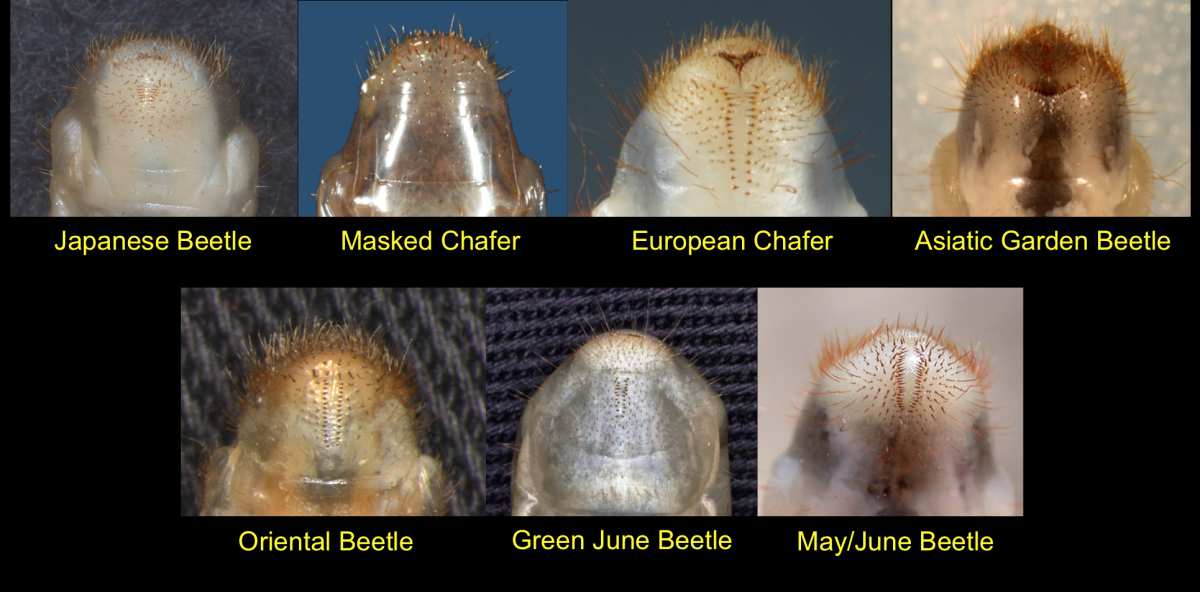
This is where most homeowners get stuck, and honestly, where even experienced DIYers miss the mark. The raster pattern is a small cluster of spines, hairs, and bare patches on the underside of the grub's last abdominal segment. You need a cheap 10x hand lens or your phone's macro camera to see it clearly.
Japanese beetle grubs display two distinct rows of spines arranged in a V-formation. European chafer grubs show an irregular Y-shaped or random-looking spine pattern. June bug grubs have a single straight transverse row of spines.
Purdue University Extension and Rutgers both publish side-by-side raster diagrams that are worth bookmarking if you're dealing with a serious infestation.
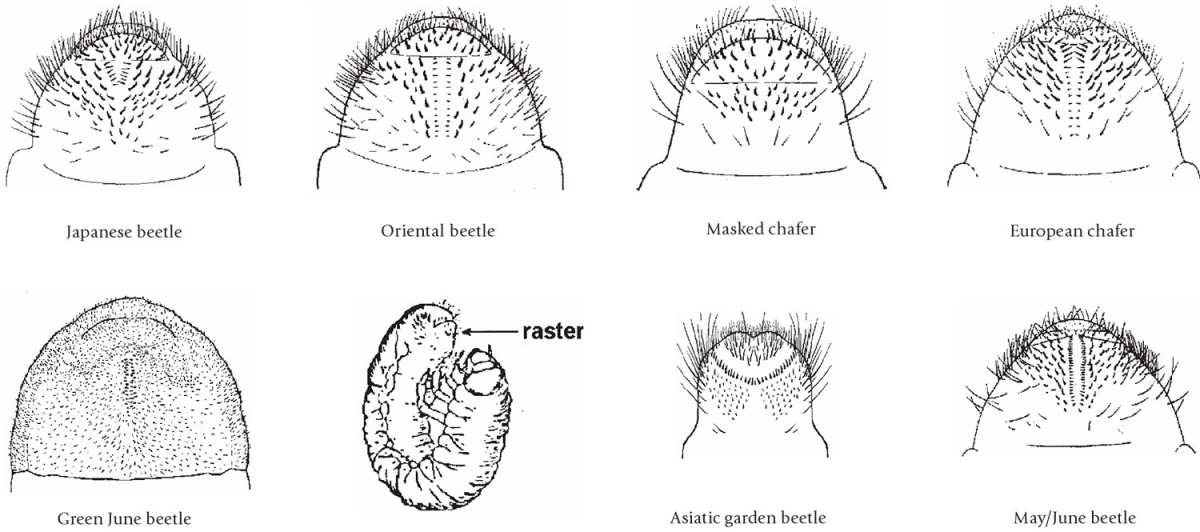
Without checking the raster, you're guessing at species. That matters because Japanese beetle grubs feed later into autumn and require different timing than European chafer populations, which can start damaging roots in early spring.
The Most Common Lawn Grub Species and How to Tell Them Apart
Not all grubs are created equal, and the species living in your lawn determines when they'll cause the most harm and how you should respond. These four species account for the vast majority of residential grub complaints in North America.
Japanese Beetle Grubs
Japanese beetle grubs are the most common lawn pest east of the Mississippi River. They grow to about one inch long when fully mature and have a creamy white body with a yellowish-brown head capsule. The V-shaped raster pattern on the tail end is the definitive identifier.
They hatch in mid-July and begin feeding on turf roots immediately, causing the worst damage from August through October. Adults emerge the following June to restart the cycle.
European Chafer Grubs
European chafer grubs look superficially similar to Japanese beetle grubs but grow a bit smaller, maxing out around three-quarters of an inch. The key difference is the raster pattern, which forms a more chaotic Y-shape or open fan arrangement rather than the neat V. They are especially common across New England, Upstate New York, and the northern Midwest.
European chafer adults swarm in June, and the grubs start causing visible damage earlier in the season than Japanese beetle larvae.
June Bug Grubs
June bug grubs, sometimes called May beetle grubs, are the largest of the common lawn species. They can reach one and a half inches long after maturing through three years of larval development. The body color is bright white with a dark tan head, and the transverse row of spines across the tail section forms a single straight line rather than the paired V-shape.
Their extended life cycle means they're present in the soil far longer before adulthood, and established populations cause slow, cumulative root damage over multiple seasons.
Black Turfgrass Ataenius Grubs
These small grubs are easy to overlook because they rarely exceed one-quarter inch at maturity. They favor golf course putting greens and highly maintained lawns in the Northeast and Mid-Atlantic. The body is creamy white with a brown head, but the tiny size leads many people to mistake the damage for drought stress.
They complete two to three generations per year, which means populations can build rapidly under favorable conditions. Correct identification prevents unnecessary broad-spectrum pesticide applications.
Billbug Larvae
Billbug larvae are the imposters of the grub world. They lack the three pairs of legs that all true white grubs display. Instead, they look like small, yellowish-white worms curled in the leaf sheath and crown of grass plants.
Damage from billbugs appears as small dead spots with hollowed-out stems, not the large-scale root destruction grubs cause. People frequently misidentify billbug larvae as young grubs and treat with products that simply don't work on weevils. A quick look under magnification confirms the absence of legs, saving you a wasted trip to the garden center.
What Grub Damage Looks Like vs. Other Lawn Problems
The first sign of grubs is rarely the grubs themselves. You'll notice the symptoms on your turf before you ever see a single curled larva. Knowing how grub damage compares to other common lawn problems saves you from treating the wrong issue.
The Tug Test: Confirming Grubs Are the Culprit
The tug test is the easiest way to confirm grub activity before you even start digging. Grab a handful of brown or thinning grass and pull upward with moderate force. If the sod lifts away from the soil like a loose carpet, grubs have severed the root system underneath.
Healthy turf with intact roots resists your tug and stays firmly anchored. Drought-strained grass may look brown but still holds tight because the roots are alive. This single test eliminates half the guesswork right away.
Grub Damage vs. Drought, Disease, and Other Pests
Grub damage often follows an irregular, spreading pattern across the lawn. The affected area will feel spongy underfoot before the grass actually turns brown. Drought stress typically appears during extended dry spells and recovers quickly after rain or irrigation.
Fungal diseases like brown patch or dollar spot present with distinct lesions on individual grass blades, something grubs never cause. Chinch bugs suck sap from grass stems and create damage that looks similar but occurs in hot, sunny areas and follows a more uniform pattern. Sod webworm damage shows up as closely cropped brown patches, not the rolling-back carpet texture that grub damage produces.

Dog urine spots feature a bright green outer ring surrounding a dead center, a pattern no turf pest reproduces. Fungal issues respond to improved drainage and fungicide application, while grub damage requires entirely different treatment directed at the soil-dwelling larvae you can't see without checking.
When and Where to Look for Grubs in Your Lawn
Timing your inspection correctly makes the difference between catching a manageable problem and discovering a full-blown infestation after the damage is done. Grubs move through the soil profile as temperatures change, so knowing when to dig saves you from checking at the wrong depth.
Best Time of Year to Check
Late July through September is the prime window for grub inspection across most of the United States. That's when newly hatched larvae are actively feeding in the top two inches of soil, right where turf roots are densest. Spring inspections can work for overwintering species like European chafer, but the grubs are deeper in the soil and harder to find.
Fall damage often shows up in August and September, which means the larvae have been feeding for weeks before you notice the brown patches. Checking in late July gives you a head start on treatment before the worst feeding period begins.
How to Cut and Inspect a Turf Sample
Grab a sharp spade and cut a one-foot-square section of turf at the edge of a damaged area, where dead grass meets healthy grass. Peel back the sod like you're opening a flap and examine the root zone directly. Count every grub you see in that square foot of soil.
Flip the sod back into place when you're done and water it thoroughly, so the turf re-establishes within a week. Sample at least three or four spots across the lawn because grub populations cluster unevenly. A single clean square doesn't tell you the full story.
How Many Grubs Are Too Many? Treatment Thresholds
Finding a few grubs doesn't automatically mean you need to treat. Healthy turf can tolerate a low population without showing visible damage. The general treatment threshold for cool-season grasses like Kentucky bluegrass, fescue, and perennial ryegrass is five to ten grubs per square foot.
Warm-season grasses such as Bermuda and zoysia can sometimes handle slightly higher counts due to their aggressive root regeneration. If you're finding fewer than five per square foot across your samples, beneficial organisms like birds, parasitic wasps, and soil-dwelling fungi are probably keeping the population in check. Going above ten per square foot almost guarantees visible damage by late summer, and treatment becomes the smart financial move compared to reseeding dead patches.
What to Do Once You've Identified Grubs in Your Lawn
Your treatment path depends on the species, the time of year, and how many grubs you're dealing with. Matching the right product to the right situation is where most people either save their lawn or waste money.
Preventive treatments work best when applied in June or early July, before eggs hatch. Products containing chlorantraniliprole fall into this category and need to be watered into the soil to reach the root zone. Curative treatments target grubs that are already feeding and should go down in late August or September when larvae are small and vulnerable.
Trichlorfon and carbaryl are common curative options, though some states restrict their use, so check your local regulations before purchasing. Biological controls like milky spore (Paenibacillus popilliae) specifically target Japanese beetle grubs and take two to three years to build effective soil populations. Beneficial nematodes (Heterorhabditis bacteriophora) offer another biological option that works on multiple grub species when applied to moist soil in late summer.
| Treatment Type | Timing | Best For | Examples |
|---|---|---|---|
| Preventive | June to early July | High-risk lawns with prior infestations | Chlorantraniliprole |
| Curative | Late August to September | Active infestations above threshold | Trichlorfon, carbaryl |
| Biological | Late summer, repeat annually | Long-term suppression, eco-conscious lawns | Milky spore, beneficial nematodes |
Always read the product label completely before application. The label specifies the exact rate per square foot, watering requirements, and safety precautions for children and pets. Over-applying doesn't kill more grubs, it just wastes product and increases chemical runoff into storm drains.
Mistakes People Make When Identifying and Treating Grubs
The most common mistake is treating for grubs without confirming they're actually present. Brown patches have dozens of causes, and dumping pesticide on a fungal problem does nothing except delay the real fix. Another frequent error is applying preventive products too late in the season.
Once grubs are large and actively feeding in September, preventive chemistry won't touch them. You need a curative product at that point, not a preventive one.
People also tend to under-sample their lawn. Checking one spot and finding zero grubs doesn't mean the rest of the yard is clean. Grubs cluster near landscape lights, foundations, and moist areas, so sampling only the center of the lawn misses hotspots entirely.
Skipping the raster pattern check is another missed opportunity. Without confirming the species, you might apply milky spore for a Japanese beetle problem when you actually have European chafer grubs, which milky spore doesn't control effectively.
Overwatering after treatment is a surprisingly common error. These products need about one-quarter inch of water to move into the root zone, not a deep soaking that pushes the chemistry past where grubs are feeding. Finally, ignoring the damage threshold leads to unnecessary applications.
A healthy lawn with three grubs per square foot doesn't need intervention, and letting natural predators do their job keeps your soil ecosystem balanced.
Quick-Reference Grub Identification Chart
Keep this chart handy when you're standing in the garden with a grub in your hand and no idea what you're looking at. The visual differences are subtle, but these key markers will point you in the right direction.
| Species | Size at Maturity | Head Color | Raster Pattern | Peak Damage Period |
|---|---|---|---|---|
| Japanese beetle | Up to 1 inch | Yellowish-brown | V-shaped paired rows | August to October |
| European chafer | ¾ inch | Light brown | Y-shaped or open fan | July to September |
| June bug (May beetle) | 1 to 1½ inches | Dark tan | Single transverse row | August to October (multi-year) |
| Black turfgrass ataenius | ¼ inch | Brown | Sparse, hard to see | June to August |
| Billbug larva | ½ inch | Brown | No true raster, legless | July to September |
If you're still unsure after checking these features, snap a close-up photo with your phone and contact your local cooperative extension office. Most county extensions offer free pest identification and can confirm the species within a day or two.
Frequently Asked Questions
What time of year are grubs most active in lawns?
Grubs are most active from late July through October across most regions. Newly hatched larvae begin feeding on turf roots immediately after egg hatch in mid-summer, and damage becomes visible by August. Some species like European chafer start feeding earlier in spring, but the heaviest root damage occurs in late summer and early fall.
Can my lawn recover from grub damage on its own?
Yes, if the damage is caught early and grub populations drop below the threshold. Lightly affected turf often recovers with adequate watering and fertilization in September and October. Severely damaged areas where roots are completely severed will not recover and require reseeding or sodding the following spring.
Are all white grubs bad for my lawn?
No. Some beetle larvae are harmless decomposers that break down organic matter in the soil. The problematic species are Japanese beetle, European chafer, June bug, and black turfgrass ataenius.
Proper identification prevents unnecessary treatment of beneficial or neutral larvae living in your soil.
How deep in the soil do grubs live?
Most lawn grubs feed in the top one to three inches of soil, right in the root zone of turfgrass. During winter, they burrow deeper, sometimes six to eight inches down, to escape freezing temperatures. This is why spring inspections are harder, the larvae are below the active root layer and harder to find.
Do grub treatments harm earthworms and beneficial insects?
Some chemical grub control products can affect non-target soil organisms. Chlorantraniliprole has relatively low toxicity to earthworms compared to older chemistries. Biological options like beneficial nematodes and milky spore are highly specific to target grubs and pose minimal risk to earthworms, pollinators, and other beneficial insects.
What attracts grubs to my lawn in the first place?
Adult beetles are drawn to moist, well-irrigated lawns with thick organic matter in the soil. Landscape lighting also attracts night-flying beetles like Japanese beetles and June bugs, which then lay eggs in nearby turf. Reducing outdoor lighting during beetle flight season in June and July can lower egg-laying activity near your home.