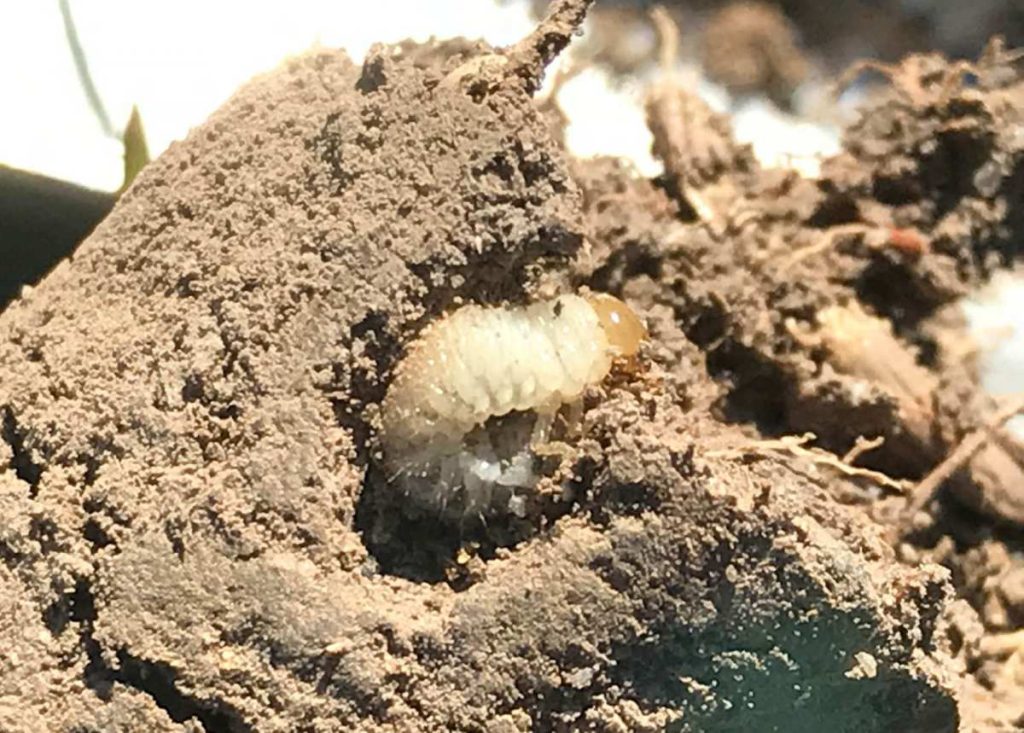
If you've ever dug into your lawn and wondered what those tiny, pearly specks in the soil actually were, you're not alone. Figuring out what grub eggs look like is trickier than most people expect, because they're small, buried, and easy to mistake for all sorts of other things. Getting a clear picture of what you're looking at can save you from treating your lawn at the wrong time or missing a problem entirely.
Grub eggs are the starting point for the white grubs that chew through grass roots and leave brown patches across your yard. A single female Japanese beetle can lay 40 to 60 eggs over her lifetime, usually buried a few inches down in moist soil during summer. Once you know what to look for, spotting them early gives you a real advantage.
Quick Answer
Grub eggs are small, oval, and pearly white. They measure about 1.5 to 2 millimeters across, roughly the size of a pinhead or sesame seed. Fresh eggs have a smooth, slightly glossy surface.
They turn yellowish or tan as they near hatching. You'll find them buried 2 to 4 inches deep in moist soil.
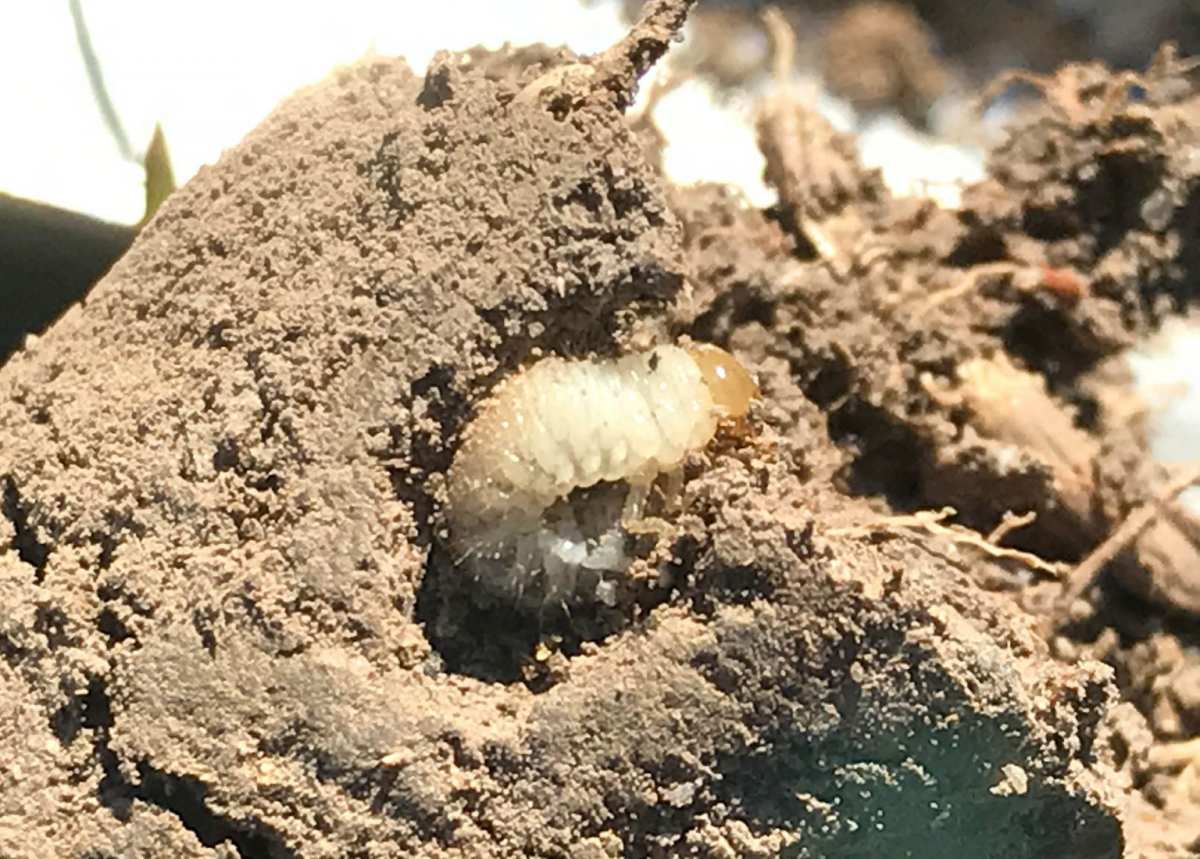
Image source: Bing (Web (fair-use with source credit))
Why Grub Eggs Are So Hard to Spot (And Why It Matters)
Grub eggs don't sit on the surface waiting to be found. Female scarab beetles, including Japanese beetles, European chafers, and May beetles, dig down into the soil to deposit their eggs. This keeps them protected from predators, weather, and most casual inspections.
The eggs themselves are tiny. At 1.5 to 2 millimeters, they're easy to miss even when you're looking right at them. Their pearly white color blends with light-colored soil, sand, and decomposed organic matter.
If your lawn has a layer of thatch or loose topsoil, the eggs practically disappear.
Here's why this matters for your lawn. Grub eggs hatch in about 10 to 14 days under warm, moist conditions. Once they hatch, the larvae start feeding on grass roots almost immediately.
By the time you see brown patches on the surface, the damage has already been happening underground for weeks. Catching the eggs before they hatch lets you time preventive treatments properly, which is far more effective than trying to kill established grubs later.
The window for finding eggs is relatively narrow. Most turf-dwelling scarab beetles lay eggs between mid-June and early August, depending on your region and species. In warmer southern climates, egg-laying can start as early as May.
In northern areas, it may not begin until July. Missing this window means you're dealing with larvae instead of eggs, and the treatment approach changes completely.
What Grub Eggs Actually Look Like Up Close
Getting a close look at grub eggs reveals details that matter for identification. Freshly laid eggs are pearly white with a smooth, slightly translucent surface. They're oval, not perfectly round, with a gentle elongation that becomes more obvious under magnification.
The surface has a subtle gloss to it, almost like a tiny bead. This sheen fades as the egg ages and the shell dries slightly. Within a few days, the color shifts from bright white to a cream or pale yellow tone.
Right before hatching, you might notice the egg looking slightly darker or more opaque as the developing larva becomes visible inside.
Size varies slightly by species, but most common turf grub eggs fall within a similar range:
| Species | Egg Color (Fresh) | Egg Color (Aging) | Approximate Size |
|---|---|---|---|
| Japanese beetle | Pearly white | Cream to pale yellow | 1.5–1.8 mm |
| European chafer | White | Yellowish tan | 1.8–2.0 mm |
| May/June beetle | White | Cream | 2.0–2.2 mm |
| Masked chafer | White | Pale yellow | 1.4–1.6 mm |
| Black turfgrass ataenius | White | Tan | 1.0–1.3 mm |
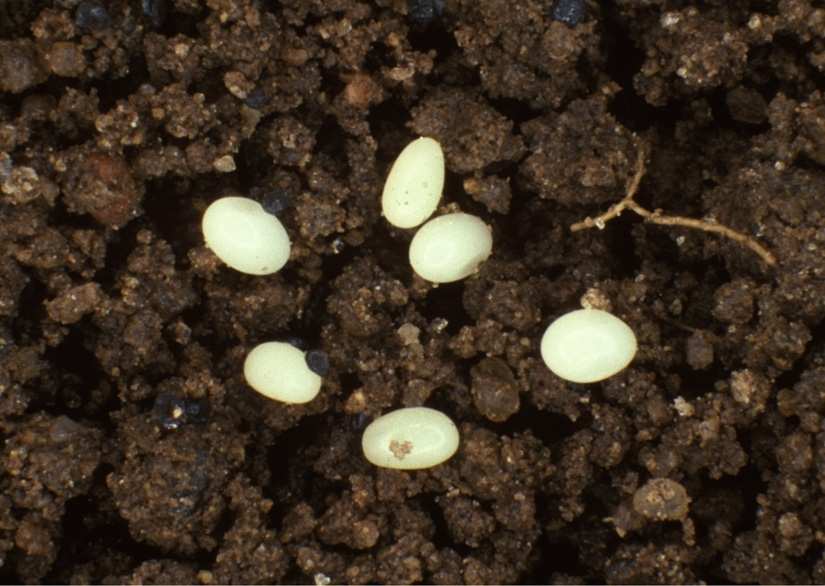
Image source: Bing (Web (fair-use with source credit))
The shell itself is soft and pliable, not hard like a bird egg. If you were to gently press one with a fingertip, it would yield slightly. This softness is actually a useful identification clue, because many look-alike objects in soil, such as fertilizer granules or perlite, feel rigid by comparison.
One thing that surprises people is that grub eggs aren't laid in neat clusters or rows. Female beetles scatter them loosely through the soil as they move. You might find three or four within a small area, then nothing for several inches.
This scattered pattern is different from how many other insects lay their eggs, and it's one reason why a thorough inspection matters.
How to Tell Grub Eggs Apart from Look-Alikes in Your Soil
Your soil contains plenty of small, white, oval objects that aren't grub eggs. Knowing the differences saves you from false alarms and missed problems.
Fertilizer granules are probably the most common source of confusion. Many lawn fertilizers come in small, round, white or pale pellets. They're usually more uniform in size and shape than grub eggs, and they tend to sit near the soil surface rather than buried a few inches down.
Fertilizer granules also feel hard and granular, while grub eggs are smooth and slightly soft.
Perlite and vermiculite are soil amendments that look like small white specks. They're lightweight, rigid, and often mixed into potting soil or garden beds. If you've recently amended your soil, these are likely what you're seeing.
They don't have the oval shape or pearly sheen of grub eggs.
Slug eggs are another frequent mix-up. Slug eggs are translucent, gelatinous, and usually found in clusters of 10 to 50. They look like tiny jelly balls, not solid pearly ovals.
You'll typically find them under logs, stones, or dense vegetation rather than buried in open lawn soil.
Earthworm cocoons are small, lemon-shaped, and amber or yellowish-brown. They're smaller than most grub eggs and have a distinct pointed end. If you're finding these in your soil, that's actually a good sign, because earthworms indicate healthy soil biology.
Ant eggs are tiny, white, and rice-grain shaped, but they're almost always found inside ant nests, not scattered through open lawn soil. If you're seeing them on the surface, they're probably being moved by worker ants.
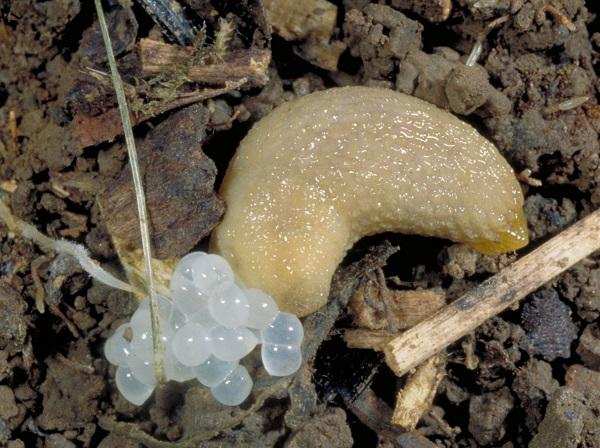
Image source: Bing (Web (fair-use with source credit))
The key identifiers for grub eggs come down to a few things. Look for the pearly white color with a slight gloss. Check for the oval, slightly elongated shape.
Note the size, around 1.5 to 2 millimeters. Feel for a soft, pliable surface rather than something hard. And consider the location, buried a few inches down in moist soil during summer months.
If you're still unsure, a simple hand lens or magnifying glass makes a big difference. At 10x magnification, the smooth surface and subtle translucency of a fresh grub egg become obvious. Most look-alikes reveal their true nature under magnification too, whether it's the crystalline structure of a fertilizer granule or the gelatinous texture of slug eggs.
Where and When Beetles Lay Their Eggs in Your Lawn
Understanding the timing and placement of grub eggs helps you know when and where to look. Female scarab beetles are selective about where they lay, and their preferences directly affect which parts of your lawn are most at risk.
Timing by species and region:
Most turf-dwelling scarab beetles lay eggs in summer, but the exact window shifts by species and climate. Japanese beetles typically begin laying in late June across the Midwest and Northeast, peaking in July. European chafers start slightly earlier, often in mid-June.
May beetles follow a similar schedule. In the southern United States, all of these timelines shift earlier by two to four weeks.
Soil temperature plays a big role. Females prefer to lay eggs when soil temperatures at a 2-inch depth are between 65 and 85 degrees Fahrenheit. If spring is unusually cool, egg-laying gets delayed.
A hot, dry summer can also suppress activity, because females need moist soil to dig and deposit eggs successfully.
Where in the lawn to look:
Female beetles favor areas with moist, well-drained soil. They tend to avoid compacted, dry, or waterlogged spots. In research from university extension programs, the highest egg concentrations are often found in lawns with moderate irrigation and full to partial sun exposure.
South-facing slopes and areas near pavement often warm up faster in spring, which can attract early egg-laying activity. Low spots that collect moisture without staying soggy are also prime targets. If your lawn has irrigation, the areas closest to sprinkler heads often see the most beetle activity simply because the soil stays consistently moist.
Depth in the soil:
Most species deposit eggs between 2 and 4 inches below the surface. This depth keeps the eggs in the root zone where larvae will find food immediately after hatching, while protecting them from surface disturbances like mowing and foot traffic. Some species, particularly the black turfgrass ataenius, may lay eggs slightly shallower, around 1 to 2 inches down.
What attracts beetles to your lawn:
Adult scarab beetles feed on trees, shrubs, and garden plants before mating and laying eggs. Japanese beetles are particularly attracted to linden trees, roses, grapes, and fruit trees. European chafers are less picky about their adult food sources.
If you've noticed heavy beetle activity on nearby plants in early summer, your lawn is more likely to have eggs.
Well-watered, healthy lawns with thick turf are actually more attractive to egg-laying females than stressed or thin lawns. The moisture and root density create ideal conditions for egg survival and larval development. This is one of those frustrating situations where doing everything right for your grass also makes it more appealing to pests.
How to Inspect Your Lawn for Grub Eggs Step by Step
Finding grub eggs takes a deliberate approach. You won't spot them by walking across your lawn. You need to get your hands in the soil and look carefully.
What you'll need:
- A flat spade or shovel
- A piece of white paper or a light-colored tray
- A hand lens or magnifying glass (10x works well)
- A ruler or measuring tape
- Gloves if you prefer them
Step 1: Choose your timing.
Inspect in late June through early August when egg-laying is most active. Pick a day when the soil is moist but not waterlogged. If it hasn't rained recently, water the area lightly the evening before and inspect the next morning.
Step 2: Select your inspection sites.
Focus on areas where you've seen adult beetle activity or where the lawn gets consistent moisture. South-facing areas, spots near trees that beetles feed on, and well-irrigated sections are good starting points. If you've had grub damage in previous years, check those areas first.
Step 3: Cut a small test section.
Use your spade to cut a square of turf about 6 inches across and 4 inches deep. Lift the section carefully and place it on a tarp or piece of cardboard. Try to keep the soil block intact so you can examine the layers.
Step 4: Break apart the soil gently.
Starting from the bottom of the soil block, crumble the soil over your white paper or tray. Work through the 2 to 4 inch depth range where eggs are most likely to be. Don't crush the soil aggressively, because you want to avoid damaging any eggs that are present.
Step 5: Look and sort.
Scan the crumbled soil on your white surface. Use your hand lens to examine any small, white, oval objects you find. Compare them against the characteristics we covered earlier: pearly sheen, smooth surface, soft texture, oval shape, and the right size.
Step 6: Record what you find.
Note the number of eggs, their approximate depth, and their condition. Fresh, bright white eggs mean hatch is still a week or two away. Yellowish, darker eggs could hatch within days.
This information helps you time any treatment decisions.
Step 7: Replace the turf.
Press the soil block back into place and water it lightly. The turf should recover within a week or two if you keep it moist.
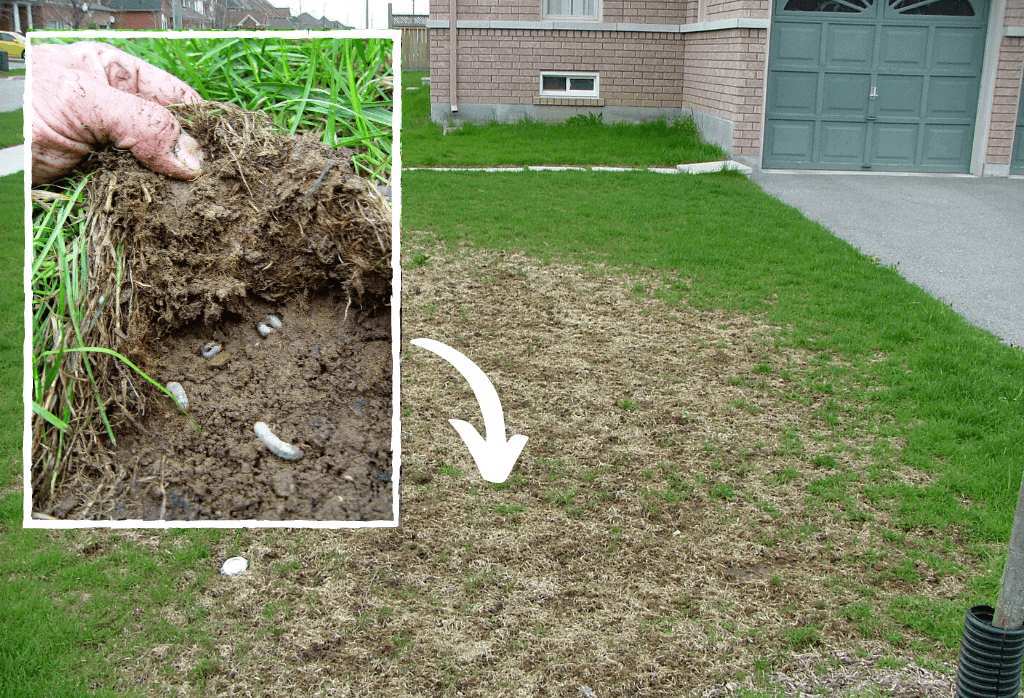
Image source: Bing (Web (fair-use with source credit))
How many samples to take:
One test square isn't enough to judge your whole lawn. Take at least three to five samples from different areas, especially if your lawn is larger than a few thousand square feet. Grub egg distribution is often patchy, so a single sample might miss hotspots entirely.
If you find eggs in multiple samples, you're dealing with a broader infestation. If you find them in just one or two spots, targeted treatment of those areas may be sufficient.
What Happens After the Eggs Hatch (And Why Timing Is Everything)
Once grub eggs hatch, the larvae immediately begin feeding on grass roots. This is the stage that causes visible damage to your lawn, and it's also the stage where treatment options start to narrow.
The first instar stage:
Newly hatched grubs are tiny, usually less than 5 millimeters long. They're white to cream-colored with a distinct brown head capsule and three pairs of legs near the head. At this stage, they're feeding on fine root hairs and organic matter near the soil surface.
Damage is minimal and usually not visible yet.
The second and third instar stages:
Within a few weeks, the grubs grow rapidly. By late summer and early fall, third instar grubs can reach 20 to 25 millimeters in length. This is when root feeding becomes severe enough to cause brown patches that don't respond to watering.
The turf feels spongy underfoot and can be pulled up like a loose carpet, because the roots have been chewed through.
Why egg detection matters for treatment timing:
Preventive insecticides, such as those containing chlorantraniliprole, work best when applied just before or during egg hatch. The product creates a zone in the soil that kills grubs as they emerge and begin feeding. If you apply too early, the residual activity may fade before the eggs hatch.
Too late, and the grubs are already large enough to survive the treatment.
Curative insecticides, such as those containing trichlorfon, target larger grubs and work faster but have a shorter window of effectiveness. These are applied in late summer or early fall when grubs are actively feeding and damage is becoming visible.
The overwintering phase:
As soil temperatures drop in late fall, grubs burrow deeper into the soil, often 6 to 12 inches down, to survive freezing temperatures. They become inactive and stop feeding. In spring, they move back toward the root zone for a brief feeding period before pupating and emerging as adult beetles.
Spring feeding usually causes less damage than fall feeding, because the grubs are preparing to pupate rather than actively growing.
Common Mistakes People Make When Identifying Grub Eggs
Even experienced gardeners misidentify things they find in soil. Here are the most common errors when it comes to grub eggs.
Mistaking fertilizer granules for eggs. This happens constantly, especially in spring and early summer when people are actively fertilizing. Fertilizer pellets are harder, more uniform, and usually found near the surface. If you recently applied fertilizer, give the soil a few weeks before assuming those white specks are eggs.
Looking too late in the season. By September in most regions, grub eggs have already hatched. If you're inspecting in fall and finding C-shaped larvae instead of eggs, you've missed the egg stage entirely. Adjust your expectations and switch to a curative approach.
Inspecting dry soil. Grub eggs desiccate and collapse when soil moisture drops below about 10 percent. If you dig in bone-dry soil, you might find shriveled, collapsed eggs that are hard to recognize. Always inspect when the soil is moist.
Only checking one spot. Grub egg distribution is rarely uniform across a lawn. A single inspection might come up empty while a nearby area has dozens of eggs. Take multiple samples from different zones.
Confusing grub eggs with earthworm cocoons. Earthworm cocoons are smaller, lemon-shaped, and amber-colored. They're a sign of healthy soil, not a pest problem. If you're finding these, leave them alone.
Assuming all white grubs are the same. Different scarab species have different egg-laying timelines, preferred soil conditions, and susceptibility to treatments. Japanese beetle grubs, European chafer grubs, and May beetle grubs may all be present in the same lawn, and they don't all respond to the same control methods.
When to Treat vs. When to Wait: Using What You Find
Finding grub eggs in your lawn doesn't automatically mean you need to treat. The decision depends on how many eggs you found, what species they belong to, and the overall health of your turf.
When treatment makes sense:
- You found eggs in multiple inspection sites across the lawn
- You've had grub damage in the same area in previous years
- Your lawn is a high-value turf area, such as a golf course or carefully maintained landscape
- The eggs are from a species known to cause significant damage in your region
When you might wait:
- You found only one or two eggs in a single sample
- Your lawn is healthy and can tolerate some root feeding
- You're planning to use biological controls, such as beneficial nematodes, which require specific timing
- You're within a week or two of natural hatch, and a preventive application window has passed
Treatment options based on timing:
| Timing | Product Type | Target Stage | Notes |
|---|---|---|---|
| Early summer (June–July) | Chlorantraniliprole | Eggs and newly hatched grubs | Preventive, long residual |
| Mid-summer (July–August) | Imidacloprid | Eggs and young grubs | Preventive, apply before hatch |
| Late summer (August–September) | Trichlorfon | Actively feeding grubs | Curative, fast-acting |
| Early fall (September–October) | Beneficial nematodes | Young to medium grubs | Biological, needs moist soil |
Biological alternatives:
Beneficial nematodes, specifically Heterorhabditis bacteriophora, are microscopic worms that seek out and kill grubs in the soil. They're applied as a soil drench and work best when soil temperatures are above 60 degrees Fahrenheit. They won't eliminate a severe infestation on their own, but they can significantly reduce grub populations when used as part of an integrated approach.
Milky spore disease, caused by the bacterium Paenibacillus popilliae, targets Japanese beetle grubs specifically. It takes several years to establish in the soil but can provide long-term control once active. It's not effective against other grub species.
Quick Reference: Grub Egg Identification Cheat Sheet
Here's a summary you can keep handy when you're out in the lawn inspecting soil.
Grub eggs:
- Pearly white when fresh, turning cream or yellow with age
- Oval, slightly elongated, 1.5 to 2 millimeters
- Smooth, glossy surface
- Soft and pliable shell
- Found buried 2 to 4 inches in moist soil
- Scattered loosely, not in clusters
- Present from mid-June through early August in most regions
Not grub eggs:
- Fertilizer granules: hard, uniform, near surface
- Perlite: lightweight, rigid, irregular shape
- Slug eggs: translucent, gelatinous, clustered
- Earthworm cocoons: lemon-shaped, amber, smaller
- Ant eggs: found in nests, not scattered in open soil
When to inspect:
- Late June through early August
- After light rain or irrigation
- In moist, well-drained areas of the lawn
- Near trees and shrubs that attract adult beetles
What to do if you find them:
- Note the number and condition of eggs
- Identify the species if possible
- Time preventive treatment to coincide with expected hatch
- Re-inspect in a week to track development
Frequently Asked Questions
How big are grub eggs?
Grub eggs are about 1.5 to 2 millimeters across, roughly the size of a pinhead or small sesame seed. They're easy to miss without close inspection or a magnifying glass. Size varies slightly by species, but most common turf grub eggs fall within this range.
What color are grub eggs when first laid?
Fresh grub eggs are pearly white with a slight gloss. They're smooth and slightly translucent. As they age over the following days, the color shifts to cream or pale yellow.
Right before hatching, they may look slightly darker or more opaque.
How deep in the soil are grub eggs?
Most species lay eggs 2 to 4 inches below the soil surface. This depth keeps the eggs in the moist root zone where larvae will find food after hatching. Some species, like the black turfgrass ataenius, may lay eggs slightly shallower.
Can you see grub eggs without a magnifying glass?
You can see grub eggs with the naked eye if you're looking carefully in good light, but they're easy to miss. A hand lens or 10x magnifying glass makes identification much easier and more reliable. Without magnification, they're easy to confuse with fertilizer granules or small bits of perlite.
When do grub eggs hatch?
Grub eggs typically hatch in 10 to 14 days under warm, moist soil conditions. In most temperate regions, this means hatching occurs in July or August. Soil temperature and moisture both influence the exact timing.
Do all grub species lay eggs at the same time?
No. Different scarab species have slightly different egg-laying schedules. European chafers tend to lay earlier in June, while Japanese beetles peak in July.
May beetles follow a similar timeline. In southern climates, all of these timelines shift earlier by several weeks.
The Visual Differences Between Common Grub Species' Eggs
While most grub eggs share the same basic pearly white, oval appearance, there are subtle differences between species that can help you narrow down what you're dealing with.
Japanese beetle eggs are on the smaller side, around 1.5 to 1.8 millimeters. They're a clean, bright white when fresh with a noticeable gloss. Japanese beetles tend to lay in irrigated lawns and golf courses, so if you're finding eggs in a well-maintained turf area, this species is a strong candidate.
European chafer eggs are slightly larger, typically 1.8 to 2.0 millimeters. They start white but tend to yellow faster than Japanese beetle eggs. European chafers are particularly common in the Northeast and Upper Midwest, and they're known for producing severe grub damage in home lawns.
May beetle eggs are the largest of the common turf grubs, reaching 2.0 to 2.2 millimeters. They're white when laid and take on a cream tone as they age. May beetles have longer life cycles than Japanese beetles or chafers, sometimes taking two to three years to complete development, which means you might find eggs and grubs of different sizes in the same lawn simultaneously.
Masked chafer eggs are smaller, around 1.4 to 1.6 millimeters. They're harder to spot because of their size, but they have the same pearly appearance. Masked chafers are common in the Midwest and can overlap with European chafer populations.
Black turfgrass ataenius eggs are the smallest, often just 1.0 to 1.3 millimeters. They're easy to overlook entirely without magnification. This species tends to show up on golf course fairways and closely mown lawns rather than typical home yards.
If you're trying to identify which species you're dealing with, the eggs alone usually aren't enough. You'll get a better answer by noting the adult beetles present on nearby plants, the timing of egg-laying in your area, and the pattern of any turf damage from previous years. University extension services in your state can often help with identification if you collect samples and send them in.
How to Inspect Your Lawn for Grub Eggs Step by Step
We covered the basic inspection process earlier, but there are a few additional details that can make your search more effective.
Use a sieve for better results. If you're finding eggs hard to spot in crumbled soil, try passing dry soil through a standard kitchen sieve or a dedicated soil sieve. The eggs will remain on top of the screen along with small debris, making them easier to pick out against a white background.
Check at the right time of day. Early morning or late evening inspections work best, because the lower light angle casts small shadows that make eggs and other objects more visible against the soil. Midday sun tends to wash out subtle details.
Look for adult beetle activity as a clue. If you're seeing Japanese beetles feeding on roses or linden trees nearby, the odds of finding eggs in your adjacent lawn go up significantly. Adult feeding and egg-laying happen in the same general timeframe, so heavy beetle activity on plants is a good signal to start digging.
Mark your inspection spots. If you find eggs in a particular area, mark it with a small flag or stake. Return to the same spot in 7 to 10 days to check whether the eggs have hatched. This gives you concrete data on hatch timing in your specific lawn, which is more useful than general regional guidelines.
Keep records from year to year. Note where you found eggs, how many, and what species you identified. Over two or three seasons, patterns emerge that help you predict where problems will show up next. Some areas of a lawn are consistently more attractive to egg-laying beetles, and knowing those hotspots lets you focus your efforts.
What Happens After the Eggs Hatch (And Why Timing Is Everything)
The transition from egg to feeding larva is the critical window for control. Once grubs hatch, they're vulnerable for a short period before they grow large enough to cause significant damage.
Days 1 to 7 after hatch: Newly emerged grubs are tiny and feeding on fine root hairs. They're susceptible to preventive insecticides and beneficial nematodes at this stage. Damage is not yet visible on the surface.
Weeks 2 to 4 after hatch: Grubs enter the second instar stage and begin feeding more aggressively on larger roots. You might notice the turf feeling slightly spongy in heavily infested areas, but brown patches are still unlikely.
Weeks 4 to 8 after hatch: This is when third instar grubs cause the most visible damage. Root systems are severely compromised, and brown patches appear and expand. The turf can be rolled back like carpet because the roots have been chewed through.
Curative treatments are most effective when applied early in this window.
Late fall through winter: Grubs move deeper into the soil to overwinter. They stop feeding and become dormant. Spring feeding is usually lighter, because the grubs are preparing to pupate rather than actively growing.
The key takeaway is that egg detection gives you a head start. If you know eggs are present and you know roughly when they'll hatch, you can time preventive treatments to hit that vulnerable early larval stage. Waiting until you see brown patches means the grubs are already well established, and you're playing catch-up.
Common Mistakes People Make When Identifying Grub Eggs
We touched on identification errors earlier, but a few more deserve mention because they lead to real consequences for your lawn.
Treating based on last year's damage. Grub populations fluctuate from year to year. Just because you had damage in one area last summer doesn't mean eggs are there this summer. Inspect current soil conditions rather than relying on memory.
Applying preventive insecticides too early. Products like chlorantraniliprole need to be in the soil when eggs hatch. If you apply in early June but eggs aren't laid until mid-July, the residual activity may have degraded by the time grubs emerge. Timing matters more than the product itself.
Ignoring soil moisture requirements. Both egg survival and treatment effectiveness depend on adequate soil moisture. Eggs desiccate in dry soil. Beneficial nematodes can't move through dry soil to find grubs.
If conditions are dry, water before and after any treatment application.
Assuming one treatment solves everything. Grub management works best as an ongoing strategy, not a one-time fix. Monitoring egg populations year to year, maintaining healthy turf, and using targeted treatments when needed will outperform any single application.
When to Treat vs. When to Wait: Using What You Find
The decision to treat comes down to egg density, lawn value, and your tolerance for damage.
Low egg count, healthy lawn: If you found only a few eggs across multiple samples and your lawn is thick and well-maintained, you might be able to skip treatment entirely. Healthy turf can tolerate a surprising amount of root feeding without showing visible damage.
Moderate egg count, mixed lawn condition: This is the gray area where judgment matters. If you're seeing eggs in several spots and your lawn has thin or stressed areas, a targeted preventive treatment makes sense. Focus on the areas where you found eggs rather than treating the entire lawn.
High egg count or history of damage: When eggs are abundant or you've had severe grub damage in the same area before, treat preventively. The cost of treatment is almost always less than the cost of lawn renovation after a bad grub year.
Organic and biological options: If you prefer to avoid synthetic insecticides, beneficial nematodes applied in late summer can reduce grub populations significantly. Milky spore takes longer to establish but provides multi-year control for Japanese beetle grubs specifically. Both options require proper soil moisture and temperature conditions to work.
The most important thing is to base your decision on what you actually find in the soil, not on guesswork or calendar dates alone. A few minutes of inspection in July can save you from a damaged lawn in September.