You walk outside and find irregular brown patches spreading across your lawn. The turf lifts up almost like loose carpet, and underneath you spot pale, C-shaped curled larvae nestled in the soil. When people ask what are grubs in the lawn, they're talking about the larval stage of scarab beetles, and those grubs are eating the root system that keeps your grass alive and anchored.
Getting the identification and timing right is what separates a quick recovery from replacing whole sections of sod.
In our research, aggregate extension guidance and turfgrass science departments consistently identify eight to ten grubs per square foot as the point where most cool-season turf types sustain real damage. Below that, healthy grass can typically outgrow the feeding pressure. Understanding what grubs actually are, which species you're dealing with, and when they're most vulnerable will save you from throwing money at the wrong solution at the wrong time.

Image source: Wikimedia Commons / Сарапулов (CC BY)
Quick Answer: What Are Grubs in the Lawn?
White grubs are the C-shaped larval stage of scarab beetles. They live underground and feed on turfgrass roots. The most common species are Japanese beetle, European chafer, and June bug grubs.
They are creamy white with brown heads and six small legs near the head. A few grubs are normal. More than eight to ten per square foot causes visible lawn damage.
Image source: Wikimedia Commons / Сарапулов (CC BY)
What White Grubs Are and How to Confirm You Have Them
White grubs are the immature form of beetles belonging to the family Scarabaeidae. They spend the most destructive portion of their life cycle underground, wrapped in a characteristic C-shape, feeding on the roots of turfgrass plants. The body is creamy white to grayish with a distinct brown head capsule and three pairs of small legs clustered right behind the head.
Depending on the species, mature larvae range from about a quarter inch to over an inch and a half long.

Image source: Wikimedia Commons / Tim Gage (CC BY-SA)
You confirm a grub problem with a simple physical test. Cut a one-foot square of turf at the edge of a damaged area and fold it back like a flap of carpet. Count the grubs you see in the top two to three inches of soil.
Cut three or four squares in different areas of the lawn and average the count. That number tells you whether you actually have a problem that needs intervention or just a background population your grass can handle.
The grub life cycle and why it dictates everything you do
Adult beetles lay eggs in the soil during mid to late summer. Those eggs hatch into small larvae by late July or early August, and the young grubs feed aggressively on roots through fall. As soil temperatures drop, they burrow deeper and become dormant over winter.
They return to the root zone in spring to feed briefly before pupating into adults by late spring or early summer. That cycle means the timing of any control effort has to match the stage the grubs are in. A preventive product applied in spring when grubs are nearly mature will have almost no effect.
A curative product applied in midsummer before eggs have even hatched is equally wasted.
The critical windows are narrow. Preventive treatments work best when applied in late June through early August, right around peak egg-laying. Curative treatments work best from late August into October, when the larvae are still small and actively feeding near the surface.
Miss those windows and you're relying on products that were never designed for the job.
How grubs actually kill grass (it's not what most people think)
Grubs don't chew the visible green blades you see above ground. They sever the roots underground, which means the grass can no longer take up water or nutrients. The first symptom is usually a wilted or thinning appearance that mimics drought stress, even when you've been watering.
The real tell is that damaged sections roll back easily from the soil because the root system has been destroyed. You can pull up a chunk of turf with almost no resistance.
Secondary damage compounds the problem fast. Skunks, raccoons, birds, and in some regions armadillos rip up the lawn overnight to feed on the grubs. A lawn that started with moderate root damage can look completely destroyed after a few nights of animal foraging.
That distinction matters because sometimes the animal digging is the first thing that alerts a homeowner to the grub problem underneath.
The Common Grub Species and How to Tell Them Apart
Not all grubs are the same species, and the species matters because their life cycles, peak activity windows, and even their response to biological controls can differ. Japanese beetle grubs tend to be the most destructive in cool-season lawns across the Northeast and Midwest. European chafer grubs are a major problem in the Northeast and Great Lakes regions, often peaking a few weeks earlier in the fall.
June bug grubs, from the genus Phyllophaga, are more common in the Southeast and have a longer life cycle that can extend two to three years in some climates.
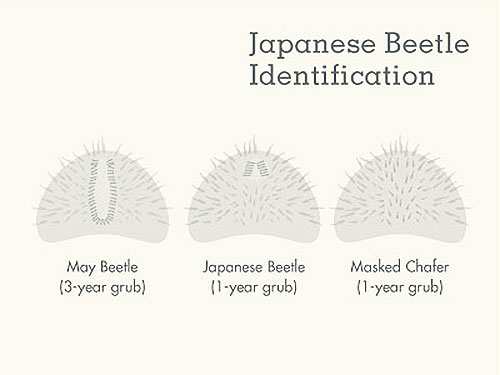
Image source: Bing (Web (fair-use with source credit))
The most reliable way to separate species is examining the raster pattern. That's the arrangement of hairs, spines, and bare spots on the underside of the abdomen near the rear end. University extension services publish identification guides with photographs of these光栅 patterns for each major species.
If you're sending a sample to your local extension office for identification, make sure the grubs are alive and stored in a container with moist soil. Dead or dried-out specimens lose the hair pattern and become nearly impossible to classify.
Japanese beetle grubs
Japanese beetle (Popillia japonica) grubs are among the most widely recognized. The raster pattern forms a distinctive V-shaped arrangement of spines on the underside of the last abdominal segment. Adults are metallic green and copper-brown, roughly half an inch long, and emerge in midsummer to feed on garden plants before laying eggs.
Their grub stage causes significant turf damage from August through October and again briefly in spring. They respond well to preventive treatments timed to adult beetle activity in July.
European chafer grubs
European chafer (Amphimallon majale) grubs look superficially similar to Japanese beetle grubs but their raster pattern has two parallel rows of spines that run lengthwise rather than forming a V. The adults are tan-colored beetles that swarm around trees in June. European chafer grubs tend to start feeding earlier in the fall and sometimes continue later into cold weather than other species.
They're also the species most often implicated in severe skunk and raccoon damage because of their relatively large size and high populations.
June bug / May beetle grubs
June bugs, from the genus Phyllophaga, belong to a massive group of closely related species that are difficult to tell apart as larvae. They tend to be the largest grubs you'll find, sometimes exceeding an inch and a half at maturity. Their raster pattern varies between species, so professional identification is often necessary in regions with multiple Phyllophaga species present.
Their multi-year life cycle means you can see grubs of vastly different sizes in the same lawn simultaneously.
Billbug damage that gets mistaken for grubs
Billbugs (Sphenophorus species) are another turf pest whose damage gets misidentified as grub injury. The adult is a weevil, not a scarab beetle, and the larva is a small, legless, cream-colored grub. Billbug larvae bore inside grass stems and crown tissue rather than feeding on roots in the soil.
Tug on the affected stems and if the inner crown pulls out as a hollow, sawdust-filled tube, you're dealing with billbugs, not scarab grubs. No amount of soil-applied grub insecticide will control billbugs because where they feed is different.
Grub Damage vs. Everything Else: The Accurate Diagnosis
Brown patches in a lawn have dozens of possible causes. Drought stress, fungal diseases like brown patch or dollar spot, compacted soil, dog urine damage, fertilizer burn, and irrigation failure can all produce symptoms that look like grub damage at a quick glance. The key difference is that grub damage shows up together with a compromised root system and visible larvae in the soil.
Every other cause leaves the root structure intact when you pull back the sod.
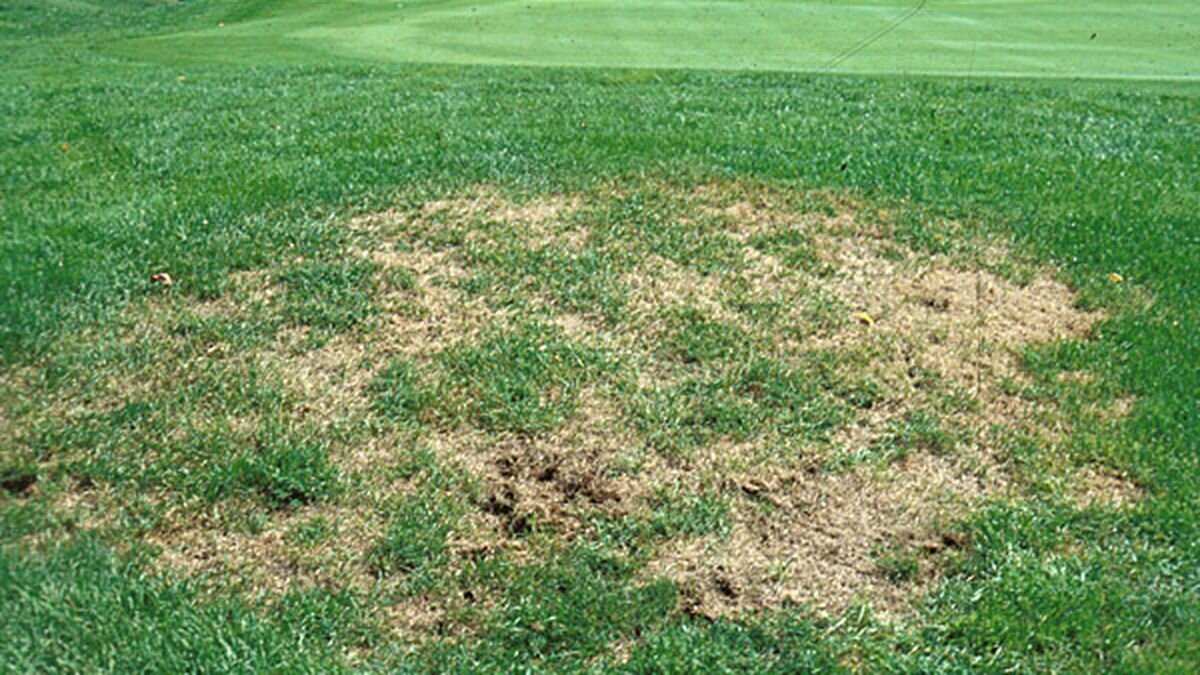
Image source: Bing (Web (fair-use with source credit))
Before you spend money on any treatment, verify the problem first. Remove a one-foot square section from the edge where damaged turf meets healthy turf. Count the grubs in the soil portion.
If you're finding five or fewer grubs per square foot across multiple test spots, the brown patches almost certainly have a different cause. Fixing grub damage with a product when the real issue is a fungal disease wastes time and money and lets the actual problem spread further.
The cut-and-peel test explained step by step
Do the cut-and-peel test when the turf is actively growing, typically spring or early fall. Use a sharp shovel or hand spade to cut three sides of a one-foot square about three inches deep. Lift the flap and examine the thatch layer and top inch of soil.
Count every grub you see. Press the flap back into place and water it to help it re-root. Test at least three spots in the lawn, choosing areas near the boundary zones rather than the dead centers of patches.
The guidelines for interpreting grub counts are fairly consistent across cool-season turf species:
- Less than 5 grubs per square foot. Healthy turf usually tolerates this level. Treatment typically isn't warranted unless livestock or high-traffic stress is also present.
- 5 to 10 grubs per square foot. Treatment is worth considering in irrigated high-value turf or when secondary stress like heat or drought is likely. Monitor and possibly treat.
- More than 10 grubs per square foot. Active treatment is generally recommended. Damage is likely already occurring or will appear shortly.
Threshold counts: how many grubs actually justify treatment
Those threshold numbers aren't arbitrary. They stem from turfgrass science field trials that measured root reduction, plant mortality, and recovery speed at different grub densities. Cool-season grasses like Kentucky bluegrass, perennial ryegrass, and tall fescue can tolerate low to moderate feeding because their growth rate allows them to replace severed roots.
Warm-season species recover even faster in peak heat.
The threshold gets tighter if your lawn is already under stress. Newly seeded areas, lawns with heavy shade, drought-stressed turf, and newly sodded installations can sustain significant damage at lower grub counts. Account for the overall health of the grass, not just the number of grubs in isolation.
Why brown patches in August aren't always grubs
Late summer is peak season for several fungal diseases that produce brown or thinning patches resembling grub damage. Brown patch (Rhizoctonia solani) is particularly tricky because it shows up in hot, humid weather on well-maintained, highly fertilized turf, conditions where homeowners often assume their lawn is otherwise healthy. Look for the telltale pattern of individual grass blades showing irregular tan lesions with dark brown borders, which indicates a fungal infection.
Grubs destroy roots underground without damaging the leaf blades in the same characteristic way.
If you're unsure, dig. If there are no grubs present and the roots are still attached and white when you pull back the sod, chances are good that disease, drought, or another environmental factor is the culprit. Get the diagnosis right and you'll apply the correct solution the first time instead of repeating the wrong one month after month.
Prevention vs. Curative Treatment: Choosing the Right Timeline
The single most important decision in grub control isn't which product you pick. It's when you apply it. Grubs are only vulnerable to most treatments during specific windows in their life cycle, and applying outside those windows wastes your money and leaves the lawn unprotected.
Understanding the difference between preventive and curative approaches will keep you from making the most common timing mistake homeowners make.
Preventive control window (late June through early August)
Preventive products target eggs and newly hatched larvae before they grow large enough to cause serious root damage. The application window runs from late June through early August in most regions, timed to coincide with adult beetle egg-laying activity. Soil temperatures reaching about 50 to 55 degrees Fahrenheit at a four-inch depth typically signal the start of egg hatch.
Applying a preventive product just before that hatch gives you the best chance of killing larvae while they're still small and near the surface.
This approach works well for lawns with a documented history of grub problems. If you've dealt with grubs in the past two or three years, preventive treatment is usually the smarter play. You're essentially getting ahead of the problem before damage starts, rather than reacting after the roots are already compromised.
Curative control window (late August through October)
Curative products target grubs that are already present and actively feeding. The sweet spot is late August through October, when the larvae are still relatively small, typically under half an inch, and feeding close to the root zone. At this stage, they're vulnerable to shorter-residual insecticides that wouldn't survive long enough to work as a preventive application earlier in summer.
Curative treatment makes sense when you discover an active infestation during fall lawn renovation or when you missed the preventive window and are finding damage. It also works as a rescue treatment if you applied a preventive product but suspect it didn't perform as expected due to heavy rainfall or improper watering-in after application.
Why spring grub treatments almost always fail
Spring applications of grub control products consistently underperform, and the reason comes down to grub size and behavior. By spring, the larvae from the previous summer have grown large and moved deeper in the soil profile. They're harder to reach with surface-applied products and their thicker cuticle makes them more tolerant of chemical exposure.
Most preventive products also have a limited soil residual that breaks down before spring grubs return to the root zone.
The exception is a curative product with a short residual window applied in early spring while grubs are still feeding near the surface before pupation. Even then, the window is narrow and the results are less reliable than a properly timed fall curative application. If you're seeing damage in spring, focus on helping the lawn recover through watering and fertilization rather than reaching for a grub product.
Then plan your preventive application for the following summer.
Chemical and Biological Control Options That Actually Work
The product landscape for grub control has shifted significantly over the past decade. Several older active ingredients have been restricted or banned in various states, and biological options have improved enough to be viable for many homeowners. Matching the product to your timing, grub species, and lawn management philosophy is what determines whether the treatment succeeds.
Preventive products: chlorantraniliprole-based options
Chlorantraniliprole is the active ingredient in several widely available preventive grub products. It works by affecting muscle function in larvae and has a favorable environmental profile compared to older chemistries. It's less toxic to bees and other non-target organisms, which matters if your lawn borders flowering gardens or pollinator habitat.
The product needs to be watered in after application to move it into the root zone where eggs are hatching. Apply it in early to midsummer and it provides season-long control for most scarab species.
Curative products: fast-acting options for active infestations
For curative control, trichlorfon and carbaryl are the two active ingredients with the fastest knockdown of existing grubs. Trichlorfon in particular works quickly and has a short soil residual, which makes it ideal for fall applications when you need to stop active feeding fast. These products need to be applied when grubs are small and actively feeding near the surface.
Water them in lightly after application and avoid mowing for a day or two to let the product settle into the thatch layer.
Carbaryl is a broad-spectrum insecticide that controls grubs but also kills beneficial soil organisms. Use it only when grub counts are well above threshold and biological options aren't practical. Trichlorfon is generally the better choice for targeted curative grub control with less collateral impact on non-target species.
Beneficial nematodes: species selection and application realities
Beneficial nematodes are microscopic roundworms that seek out and kill grubs from the inside. Heterorhabditis bacteriophora is the species most effective against Japanese beetle and European chafer grubs. Steinernema species tend to target different soil insects and are less reliable for scarab larvae.
Nematodes are living organisms, which means they need to be applied in cool, moist conditions and watered in immediately. Hot, dry soil kills them before they can find a host.
Apply nematodes in late afternoon or on overcast days to avoid UV exposure. Keep the soil moist for at least a week after application so the nematodes can move through the soil profile. They work best as a curative treatment in early fall when grubs are small and soil temperatures are still warm enough for nematode activity but not so hot that they desiccate.
Milky spore: what it does and who it helps (and doesn't)
Milky spore disease, caused by the bacterium Paenibacillus popilliae, specifically targets Japanese beetle grubs. It doesn't work on European chafer, June bug, or other scarab species. The bacteria multiply inside infected grubs and release spores into the soil that can persist for years.
In our research, aggregate extension data suggests milky spore takes two to four years to establish fully in a lawn, so it's a long-term strategy rather than a quick fix.
Milky spore makes sense if you've confirmed Japanese beetle grubs as your primary problem and you're committed to a multi-year management plan. It's less useful in regions where multiple grub species are present, because it won't touch anything other than Japanese beetle larvae. Pair it with proper lawn care practices and you can build a self-sustaining suppression system over time.
Common Grub Control Mistakes That Waste Money and Damage Lawns
The most expensive mistake is treating for grubs when you don't actually have a grub problem. Brown patches from fungal disease, drought, or irrigation issues won't respond to any grub product. Always confirm grub presence and count before spending money on treatment.
Applying preventive products in spring is the second most common error. By the time spring arrives, the grubs from the previous year are large, deep in the soil, and nearly finished feeding. A preventive product applied now will break down before the next generation of eggs hatches in summer.
You've spent the money and gotten almost nothing in return.
Overwatering after application can be just as bad as not watering at all. Most granular products need about a quarter inch of water to move the active ingredient into the root zone. A heavy irrigation event or a big rainstorm right after application can wash the product off the lawn entirely or push it below the zone where grubs are feeding.
Check the product label for specific watering recommendations and follow them precisely.
Using the wrong biological control species is another frequent misstep. Not all nematodes kill all grubs. Applying Steinernema species when you have Japanese beetle grubs, for example, will give you poor results because that nematode species isn't well adapted to parasitizing scarab larvae.
Match the biological control to the specific grub species you've identified.
Finally, ignoring the label restrictions on banned or restricted active ingredients can create legal liability and environmental harm. Imidacloprid, a neonicotinoid, is restricted or banned for lawn use in several states including Maryland, Connecticut, Vermont, and Massachusetts. Check your state department of agriculture's current regulations before purchasing any grub control product.
The label is a legal document, and applying a product in a way that contradicts the label is a violation of federal pesticide law.
Expert Tips for Long-Term Grub Management
Long-term grub management is about building a lawn that can tolerate moderate feeding pressure without visible damage. Start with proper mowing height. Taller grass, typically three to four inches for cool-season species, develops deeper roots that can withstand some root feeding without showing stress.
Short-mowed lawns have shallow root systems and show damage at much lower grub counts.
Water deeply and infrequently rather than light daily sprinkles. Deep watering encourages roots to grow further into the soil profile, which makes the turf more resilient. Light, frequent watering keeps roots near the surface where grub feeding is concentrated and damage appears fastest.
Overseed thin areas in early fall to maintain dense turf cover. Grubs cause the most visible damage in sparse, weak lawns where there's less root mass to begin with. A thick, healthy stand of grass can lose a significant portion of its roots and still recover without bare patches showing.
Monitor annually even in years you don't treat. Grub populations fluctuate based on weather, natural predators, and disease pressure. A lawn that needed treatment one year might have negligible grub counts the next.
Doing the cut-and-peel test each fall gives you the data to make informed decisions rather than applying products on a fixed schedule regardless of actual need.
Keep records of what you applied, when you applied it, and what the grub counts were before and after. Over a few years, that history reveals patterns in your specific lawn that no generic calendar recommendation can match. You'll start to see which product and timing combination works best for your soil type, grass species, and local grub population.
Safety, Legal, and Environmental Considerations
Always check your state department of agriculture regulations before purchasing any grub product. Neonicotinoids like imidacloprid are restricted in multiple states. The product label is a legal document, and applying off-label is a federal violation.
Keep children and pets off treated lawns for the full re-entry interval listed on the label. Store all products in original containers away from water sources. Never apply near storm drains or bodies of water unless the label specifically permits it.
Real Scenarios: How Grub Problems Typically Play Out
A homeowner finds brown patches in late August, peels back the sod, and counts fifteen grubs per square foot. A fall curative application stops the active feeding, but the lawn needs overseeding in September to fill in bare areas before winter.
Another homeowner sees raccoons tearing up the lawn in October. The grub count is only four per square foot. The animals, not the grubs, caused the visible damage.
The solution is deterring the wildlife, not treating the lawn.
A third scenario involves a lawn with annual Japanese beetle problems. After three years of preventive applications combined with milky spore establishment, grub counts drop below threshold and treatments are no longer needed annually.
Frequently Asked Questions
How do I know if grubs are causing my lawn damage?
Cut a one-foot square at the edge of a damaged area and count grubs in the top two inches of soil. Five or more per square feet across multiple test spots confirms a problem worth treating. No grubs means the cause is something else.
When is the best time to treat for grubs?
Preventive treatments work best from late June through early August. Curative treatments are most effective from late August through October when grubs are small and actively feeding near the surface.
Can I treat grubs in the spring?
Spring treatments are generally ineffective. The grubs are too large and most preventive products have broken down by then. If you missed fall treatment, focus on lawn recovery and plan for proper summer timing next year.
Are grub control products safe for pets?
Follow the label's re-entry interval and keep pets off until the product has been watered in and the lawn has dried. Once dried, most labeled products present minimal risk during normal use.
What if animals are digging up my lawn?
Animals dig because grubs are present. Treat the grub population first. The animal activity typically subsides within a week or two once the food source is eliminated.
Do I need to treat every year?
Not necessarily. Monitor grub counts annually. Many lawns have low populations that don't justify treatment every season.
Consistent monitoring prevents unnecessary applications.
Final Decision Guide: What to Do About Your Grub Problem
Confirm grubs are present with the cut-and-peel test. Count them across multiple spots. If you're finding fewer than five per square foot, skip treatment and address other lawn health issues first.
If counts fall between five and ten per square foot, evaluate the lawn's overall health and stress level. Stressed lawns benefit from treatment. Healthy lawns can often wait and be monitored.
Counts above ten per square foot warrant active treatment. Choose a preventive product for next summer's application window if it's currently early season. Choose a curative nematode or short-residual insecticide if it's late summer or fall and grubs are already active.
Reassess each year. Grub populations change. Lawn health improves with better practices.
What worked one season may not be needed the next.