If you've noticed brown patches in your lawn that pull up like loose carpet, grub worms are probably high on your suspect list. "What are grub worms" is one of the most common lawn questions every summer, and the answer matters more than most homeowners realize.
White grubs are the larval stage of scarab beetles, including Japanese beetles, European chafers, June beetles, and masked chafers. They live underground feeding on turfgrass roots, and when their populations cross a certain threshold, the damage becomes visible and progressive. The generally accepted treatment threshold for cool-season grasses in the US is 5 to 10 grubs per square foot, though this varies by grass type and region.
Getting this identification right determines whether you spend money on treatment or let nature handle it.
Quick Answer
Grub worms are the larval stage of scarab beetles. These larvae live underground, feeding on the roots of turfgrass and ornamental plants. They have cream-colored, C-shaped bodies with brown heads and six legs.
The most common species include Japanese beetle larvae, European chafer larvae, and June beetle larvae. Identification matters because not all grubs cause damage at the same population levels.
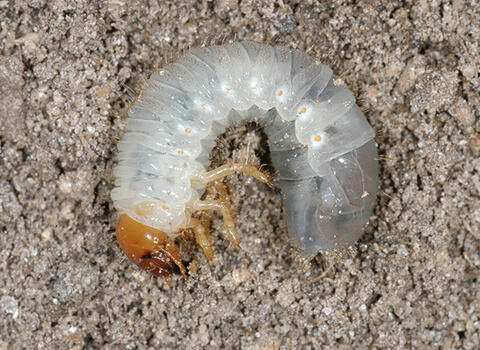
Image source: Bing (Web (fair-use with source credit))
Why Getting Grub Worm Identification Right Actually Matters
Treating for grubs when you do not have a real problem wastes money, harms beneficial soil organisms, and can carry real regulatory and ecological consequences. Misidentification is the single biggest mistake we see in lawn care advice.
Grub damage looks a lot like other lawn problems. Drought stress, fungal diseases like brown patch and dollar spot, chinch bug feeding, and even dog urine spots can all create irregular brown areas. The difference is that grub-damaged turf lifts away from the soil easily because the root system has been severed.
If you cannot roll back a brown patch like a loose rug, grubs are probably not the culprit.
Beyond property damage, there is the pesticide issue. Neonicotinoids like imidacloprid face increasing restrictions in several US states, including Maryland, Connecticut, and Vermont. Certain municipalities restrict their use on ornamental turf.
Applying these products unnecessarily does not just risk fines or neighbor complaints. It can harm pollinators, especially when flowering weeds like clover are present in the lawn at the time of application. Mowing before application is considered best practice by EPA guidelines.
Over-treating also damages the soil food web. Ground beetles, rove beetles, and parasitoid wasps naturally suppress grub populations. Broad-spectrum applications can set natural enemies back by multiple seasons, making future outbreaks more likely.
What Grub Worms Are (And What They're Not)
White grubs are the form of beetles in the family Scarabaeidae. The life cycle follows a predictable pattern: adults lay eggs in moist soil during summer, eggs hatch into larvae within 2 to 3 weeks, and those larvae feed on roots through fall and again in spring before pupating into adults.
Here is what a white grub actually looks like:
- Body shape. C-shaped when at rest, curled into an arc.
- Color. Cream or whitish body with a distinct brown or tan head capsule.
- Size. Ranges from roughly ¼ inch for newly hatched larvae to over 1 inch for mature third-instar grubs depending on species.
- Legs. Six true legs clustered near the head. This distinguishes them from look-alikes like crane fly larvae, which lack visible legs.
- Raster pattern. The arrangement of small hairs and spines on the underside of the last abdominal segment. This is the definitive characteristic entomologists use for species identification, and it requires a hand lens or microscope to see reliably.
What grubs are not just as important. Crane fly larvae (leatherjackets) are legless and often darker. Ground beetle larvae are predatory, mostly beneficial, and have prominent mandibles.
Billbug larvae are also legless and tend to be found inside grass stems rather than free in the soil. If you are seeing something in your soil and calling it a grub, confirm it is actually a scarab larva before taking action.
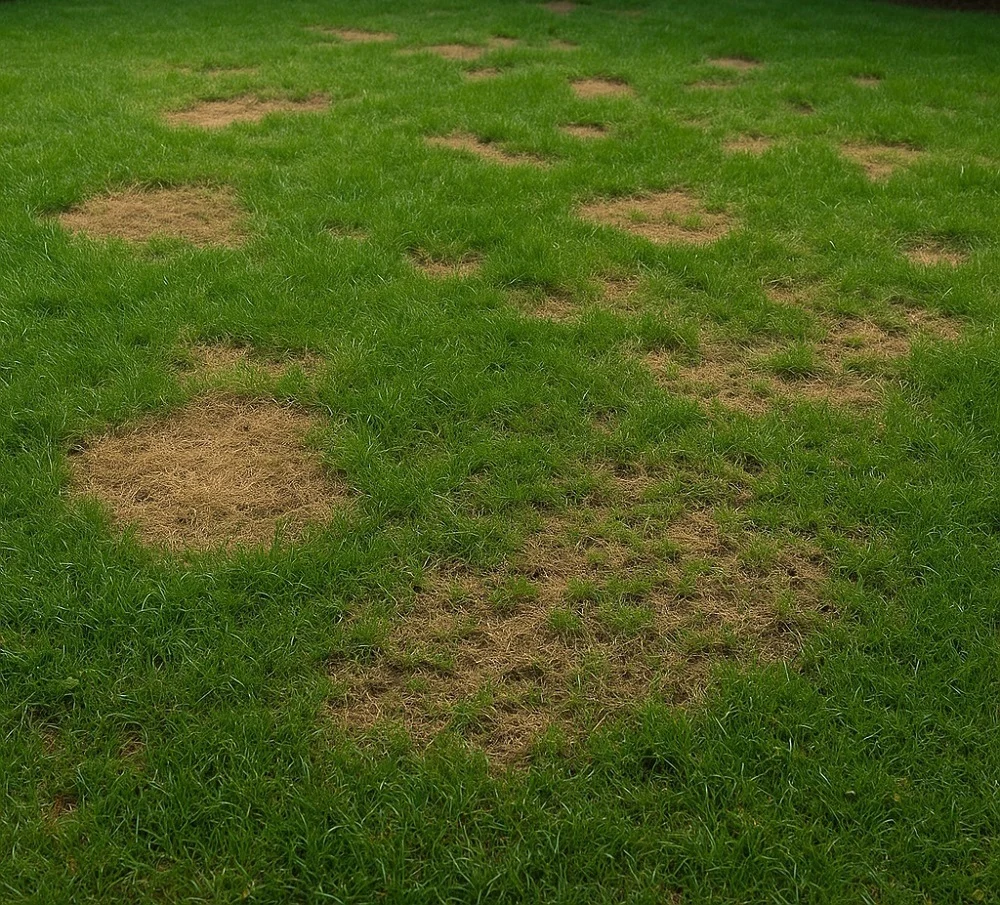
Image source: Bing (Web (fair-use with source credit))
How to Confirm You've Got Grub Damage
Visual symptoms are the first clue. Irregular brown patches that do not respond to watering are suspicious. The key diagnostic test is the tug test: grab a handful of turf at the edge of a damaged area and pull.
If the grass lifts easily with no root resistance, you likely have significant grub feeding underneath.
For confirmation, dig a square-foot section at the boundary between dead and healthy turf, going about 2 to 3 inches deep. Flip it over and count the grubs visible in the soil and among the thatch. Repeat this in 3 to 4 spots across the damaged area for a reliable average.
Species
Typical Threshold (grubs/sq ft)
Japanese beetle
5-8
European chafer
8-12
June beetle (Phyllophaga)
5-10
Asiatic garden beetle
10-15
Black turfgrass ataenius
20+
Warm-season grasses like Bermuda and zoysia generally tolerate higher counts because their aggressive root systems regenerate faster. Cool-season stands of Kentucky bluegrass, fescue, and perennial ryegrass are more vulnerable at lower counts.
The Species You're Actually Dealing With
Not all grubs are created equal. Treatment timing, product choice, and even whether treatment is necessary depend on which species you are dealing with. The raster pattern, visible on the underside of the grub's tail end, is the standard identification method used by university extension services across the US.
Adult flight timing gives a general indication of what you might expect below ground. Japanese beetles fly in early summer (June to July in most of the eastern US), so their eggs hatch into small grubs by late July through August. European chafers fly earlier, often in June.
June beetles (Phyllophaga species) tend to fly in May and June in a three-year life cycle.
Here is the practical problem. By most homeowners notice damage in late summer or early fall, the grubs are often already in their second or third instar stage. Larger grubs are significantly harder to kill with curative products, which is one of the biggest reasons treatment timing gets missed.
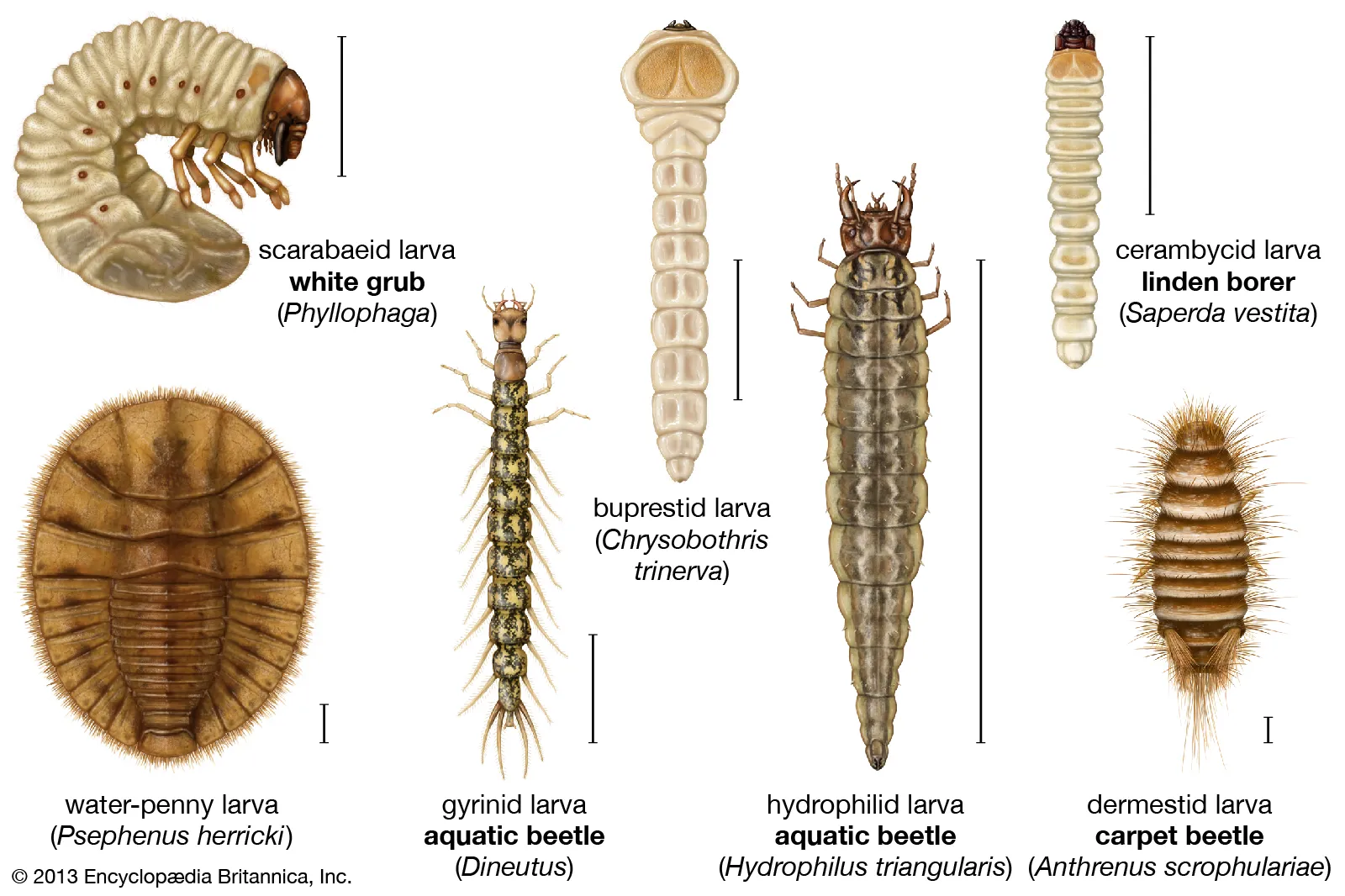
Image source: Bing (Web (fair-use with source credit))
If you cannot reliably distinguish species by the raster pattern, many university extension offices offer identification services for a small fee or sometimes free. Sending a samplecup of soil with several intact larvaeto a county extension agent removes the guesswork entirely.
When Grubs Become a Real Problem: Threshold Counts That Matter
Threshold is the most important concept in grub management. It is the population level at which the cost and risk of treatment is justified by the damage prevented. Going below threshold, you leave grubs alone.
Going above it, you consider intervention. This is the core of integrated pest management (IPM) as outlined by university extension programs nationwide.
For most cool-season residential lawns in the Northeast and Midwest, the threshold sits between 5 and 10 grubs per square foot. Vigorous, well-irrigated warm-season turf in the South can handle up to 15 to 20 grubs per visible square foot before showing visible symptoms.
Secondary damage is a real signpost. If skunks, raccoons, or cored birds are actively digging in your lawn overnight, grub counts are almost certainly above threshold. Wildlife can destroy more turf in a single night than weeks of grub feeding.
Animal digging is often the event that finally triggers a treatment decision, even though the grub population has been building for months.
Another variable is drought. A lawn under water stress will show symptoms at much lower grub counts because the grass lacks the root reserves to compensate for feeding damage. During dry spells, the effective threshold drops.
This is the irrigation question matters in your decision.
Treatment Options Compared: Chemical, Biological, and Doing Nothing
Three approaches cover virtually every grub situation. Each has a specific window, a specific cost, and a specific set of tradeoffs. Choosing the wrong one is the most common reason treatments fail.
Curative chemical treatment. Products containing trichlorfon (sold as Dylox) kill existing grubs on contact and through ingestion. They work within 1 to 3 days and are the go-to option when you have already confirmed grub counts above threshold in late summer or early fall. The downside is a relatively short application window and higher toxicity to non-target organisms compared to newer options.
Preventive chemical treatment. Chlorantraniliprole (the active ingredient in GrubEx) and imidacloprid (Merit and its generics) are applied before egg hatch, typically in late spring to early summer. These do not kill large, mature grubs well. They work by targeting newly hatched larvae before they grow.
Applied correctly, a single application provides season-long control. Chlorantraniliprole has a significantly lower toxicity profile for mammals and birds than neonicotinoids, which is why it has become the more recommended preventive option in recent extension guidance.
Biological control. Milky spore (Paenibacillus popilliae) is a soil bacterium that infects Japanese beetle grubs specifically. It takes 2 to 3 years to establish in the soil but then persists for a decade or more. Beneficial nematodes, particularly Heterorhabditis bacteriophora, can be applied as a curative treatment and are effective against multiple species when soil temperatures are above 55°F and the soil is kept moist after application.
Bacillus thuringiensis galleriae (Btg) is a newer option showing promise against Japanese beetles and some other species.
Doing nothing. When grub counts are below threshold, this is the correct management decision. Natural predators, parasitoids, and disease pressure often keep populations stable without any intervention.
Approach
Best Timing
Effective Against Multiple Species?
Residual Duration
July through September
Yes (trichlorfon)
1 to 2 weeks
Late spring to early summer
Yes (chlorantraniliprole)
Entire growing season
Late summer, warm soil
Yes (nematode species vary by product)
1 season, requires reapplication
Late summer
No (milky spore is Japanese beetle specific)
10+ years once established
Doing nothing
N/A
N/A
N/A
Why Most People Treat Grubs Too Late
The annual pattern repeats across neighborhoods every year. Homeowners see brown patches in September, buy a curative product, apply it, and wonder why lawn damage continues the following fall.
The problem is developmental. By early fall, many Japanese beetle and European chafer grubs have already progressed to their third instar. These larger larvae have tougher cuticles, feed less actively as temperatures cool, and are harder for curative products to kill.
Trichlorfon is the only widely available curative that performs reliably on larger grubs, and even its efficacy drops as soil temperatures decline below 60°F.
The practical prevention for last year's damage is a preventive application applied the following late spring to early summer, timed just before adult beetles begin laying eggs. Japanese beetle adults typically start emerging in June across the mid-Atlantic and Midwest. Late May to mid-June preventive applications lay down the chemical barrier before egg hatch.
Homeowners who skip preventive treatment and rely solely on curative applications are essentially managing last year's problem. This reactive cycle leads to more product use, more lawn repair, and more frustration over time. Breaking the cycle means shifting the calendar mindset.
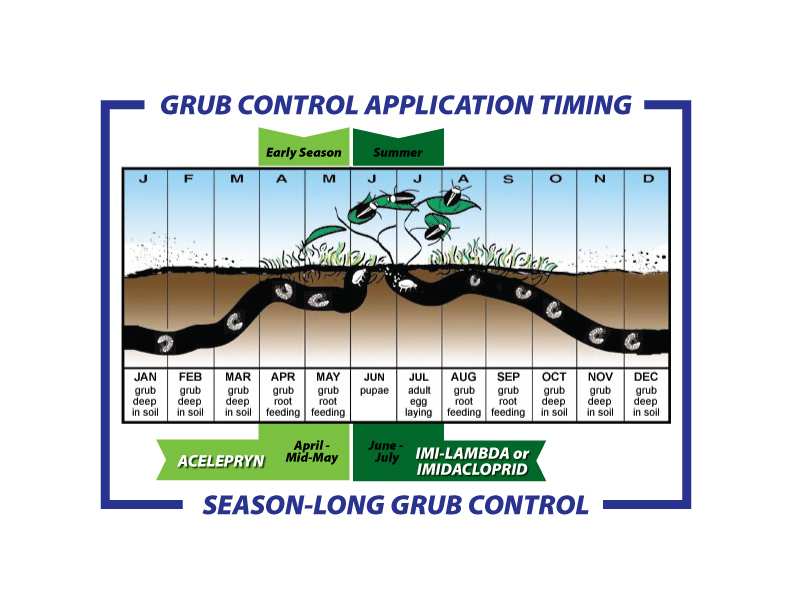
Image source: Bing (Web (fair-use with source credit))
Step-by-Step: Evaluating Your Lawn and Making a Treatment Decision
Step 1: Scout Your Lawn in Late July or Early August
This is the earliest point at which you can reliably detect newly hatched grubs from that summer's egg-laying cycle. Cut a 1-foot by 1-foot square at the edge of any suspicious area, peel it back, and count the grubs you find in the top 3 inches of soil and thatch.
Step 2: Take Multiple Samples
One square foot tells you almost nothing about the whole lawn. Sample at least 4 to 6 spots across damaged and adjacent healthy areas. Calculate your average grubs per square foot.
Step 3: Compare Against Threshold
If your average is below 5 grubs per square foot on cool-season turf, skip treatment. If it is between 5 and 15, consider the secondary factors: is the lawn drought-stressed, is wildlife actively tearing it up, and is the turf otherwise vigorous? High-stress lawns justify treatment at lower counts.
Step 4: Choose Your Product Class Based on Grub Size and Season
Small grubs in late summer (first and second instar) are vulnerable to most products. If you are scouting in August and see mostly small grubs, a curative application of trichlorfon or beneficial nematodes can be effective. If you are making the decision in spring, use a preventive product like chlorantraniliprole for protection going forward.
Step 5: Follow Label Directions Exactly
This is legally required, not a suggestion. The product label specifies application rate per square footage, irrigation requirements after application (typically ¼ inch of water to move granules into the soil), and safety intervals for children and pets. Off-label application is a federal violation under FIFRA for restricted-use products.
Step 6: Reinspect 7 to 14 Days After Treatment
This confirms product efficacy. You should find dead or dying grubs in treated areas. If live grubs are present at similar counts two weeks later, either the application timing was off or the product did not reach the feeding zone.
Common Mistakes That Wasted Money or Made Things Worse
Applying preventive products in fall. This is the single costliest timing error. Preventive products like chlorantraniliprole are designed to target tiny, newly hatched larvae.
By fall, grubs are larger and feeding deeper. Applying a preventive then wastes your money and does not solve the existing problem.
Overwatering before treatment. Saturated soil pushes granules deeper than the feeding zone, where grubs in the thatch and root layer never contact the active ingredient. Soak-dry cycles perform better than flooding.
Treating the whole lawn when damage is spot-confined. If grub counts only exceed threshold in isolated areas, spot-treating those zones cuts your product cost by 70 to 90 percent and reduces chemical load across the property.
Ignoring the mowing-height connection. Short-mowed lawns have shallower root systems and show grub damage sooner. Maintaining a mowing height of 3 to 3.5 inches for cool-season grasses gives the turf more root mass to sustain some feeding without visible decline.
Skipping species identification and defaulting to the most aggressive product. Not every grub population needs not application, and not every species responds equally. A few minutes with a hand lens on the raster pattern prevents unnecessary treatment more often than not.
When to Call a Professional Instead of Going DIY
Commercial applicators have access to products not available to homeowners, including restricted-use formulations like certain chlorpyrifos-alternative soil insecticides. If your grub counts exceed 30 per square feet across more than 1500 square feet of lawn, professional application makes sense both for product selection and for calibrated equipment that ensures even coverage.
Professionals are also the right call if you cannot reliably identify the scarab species. Misidentification leads to wrong-product choices. A licensed applicator can send samples to state diagnostic labs and build a treatment plan around confirmed species, local flight data, and soil conditions on your specific property.
If you are dealing with recurring grub damage year after year despite DIY treatments, that pattern suggests either a timing mismatch or an underlying soil condition (compaction, poor drainage, excessive thatch) that is creating ideal egg-laying habitat. A turf professional can address the root cause, not just the symptoms.
Long-Term Strategy: Keeping Grubs Under Control With Minimal Chemical Input
The most sustainable approach to grub management is not a single product application per year. It is a combination of cultural practices and targeted intervention only when monitoring tells you it is necessary.
Overseeding with resistant grass varieties is one of the least-discussed tools. Endophyte-enhanced perennial ryegrasses and tall fescues produce compounds that reduce feeding by various turf pests, including some beetle larvae. Extension research at Rutgers and Penn State has documented measurable reductions in grub feeding damage in endophyte-enhanced stands compared to older susceptible cultivars.
Managing thatch matters more than most homeowners realize. A thatch layer exceeding ½ inch harbors eggs and protects larvae from both predators and surface-applied products. Core aeration in fall reduces thatch and improves product penetration the following season.
Vertical mowing (dethatching) perpendicular to the original pattern removes accumulated organic matter in one pass if the layer is thick enough to warrant aggressive action.
Soil health drives everything. Compacted, poorly drained lawns are preferred egg-laying sites for European chafers and Japanese beetles. Improving drainage through top-dressing with compost, core aeration, and adjusting grade near foundations reduces the moist, loose soil conditions scarab beetles seek for oviposition.
If you commit to preventive treatment with chlorantraniliprole, reapply annually for 2 to 3 consecutive years. Do not skip a season and assume the problem is solved. Beetle pressure fluctuates year based on winter survival rates and spring moisture.
Annual scouting keeps you informed without relying on guesswork.
Frequently Asked Questions
What are grub worms exactly?
Grub worms are the larval stage of scarab beetles. They are cream-colored, C-shaped larvae with brown heads that live underground feeding on grass roots. The species most commonly found in US lawns include Japanese beetle larvae, European chafer larvae, and June beetle larvae.
How do I know if my lawn has a grub problem?
The tug test is the fastest diagnostic. Brown patches that pull up easily with no root resistance indicate grub feeding below. For confirmation, dig a 1-foot square at the edge of damaged turf and count grubs in the top 3 inches of soil.
When should I treat grubs for best results?
Curative treatment works best in late July through September when grubs are small and actively feeding near the surface. Preventive products like chlorantraniliprole should be applied in late spring to early summer, before adult beetles lay eggs. Treating during the wrong window is the main reason homeowners see poor results.
Can I use beneficial nematodes instead of chemicals?
Yes. Heterorhabditis bacteriophora nematodes are an effective biological curative option against multiple white grub species. They require soil temperatures above 55°F, moist soil during application, and proper storage (refrigeration until use).
Peak performance occurs when grub populations are small and conditions stay humid for several days after application.
Will grub damage go away on its own?
Minor grub feeding below threshold levels will not kill a healthy, well-irrigated lawn. Natural predators and disease typically keep low populations in check. If counts exceed 5 to 10 per square feet on cool-season turf, however, damage will worsen without intervention, and secondary wildlife digging accelerates the destruction.
Are grub treatments safe for pets and children?
Most modern lawn grub products require the treated area to dry before allowing foot traffic, typically 2 to 4 hours. Withholding pets and children from the lawn until granules are watered in and the area is dry prevents ingestion of undissolved product. Always follow the specific safety intervals printed on the product label, as these vary by active ingredient.