What animal feeds on grubs? is the first question that pops into your head when you step outside to find cone-shaped holes, rolled-back sod strips, or torn-up lawn grass overnight. Grubs are a high-protein food source for dozens of North American wildlife species, and their foraging can wreck a healthy turf lawn in just a few nights. If you’ve ever stared at destroyed grass and wondered what’s raiding your yard, you’re in the right place.
Per USDA Agricultural Research Service data, white grub larvae (the juvenile stage of scarab beetles) damage more than 40 million acres of U.S. residential turf annually as of 2026. The visible lawn destruction is almost always from an animal digging for these nutrient-rich larvae, not the grubs feeding on grass roots directly. We’ll start with the direct answer to your core question, then walk through how to confirm the culprit fast.

Image source: Web (Bing) / absolutelawnpros.com (Web image (fair-use with source credit))
Quick Answer
Raccoons, skunks, armadillos, moles, opossums, coyotes, foxes, and many bird species all feed on lawn grubs. The animal damaging your yard depends on your region, digging pattern, and time of year. Skunks and raccoons are the most common culprits in suburban North America.
Moles eat grubs but also earthworms, so their damage looks distinct. You can ID the exact animal by matching its digging style to your lawn damage.
First, Confirm You Actually Have a Grub Problem
Before you start targeting wildlife, you need to confirm grubs are actually the food source attracting animals to your lawn. Not all lawn damage comes from grub-foraging, and treating for the wrong pest wastes time and money. Per University of Illinois Extension guidelines, the standard treatment threshold is 10 to 15 white grubs per square foot of turf.
If your count is lower, the animal may be feeding on earthworms or other soil organisms instead.
White grubs are the larval stage of scarab beetles, including Japanese beetles, European chafers, and June beetles. Females lay eggs in moist soil in mid-summer, and eggs hatch into small, C-shaped larvae that feed on grassroots through fall. Grub populations peak in late August and early September, which is also when animal foraging damage is most severe.
Uncontrolled grub feeding severs grassroots, leading to irregular brown patches of turf that pull up easily like loose carpet.
To test for grubs:
- Cut a 1-square-foot section of sod in a damaged area, peeling it back like a rug
- Dig 2 to 4 inches into the soil under the sod, where grubs feed on grassroots
- Count all C-shaped, white larvae with brown head capsules you find
- If you hit 10 or more, you have a grub problem that will keep drawing animals back until you treat it
If your count is low, skip ahead to the digging pattern ID section to figure out what else the animal is eating.
Identify the Culprit By Its Digging Pattern (Decision Tree)
Each grub-feeding animal leaves a unique digging signature in your lawn, so matching the damage to the pattern is the fastest way to ID the culprit. Start by checking your lawn at dawn, before animals cover up their work overnight. This decision flow works for most of North America, with regional variations noted where relevant.
Use this simple decision flow:
- If you see small, cone-shaped holes 2 to 3 inches deep scattered across the lawn, it’s almost certainly skunks. They use their long claws to dig straight down for grubs, leaving neat, conical pits. Skunk damage is most common in the eastern and central U.S., where their populations are dense in suburban areas.
- If you see large, rolled-back strips of sod 6 to 12 inches wide, pulled up like a loose rug, that’s raccoon damage. Raccoons root around with their dexterous front paws, tearing up large sections of turf to get to grubs underneath. Raccoon damage often appears overnight, and the torn sod is still moist and rolled tight in the morning.
- If you see shallow, winding tunnels just under the sod surface, that’s moles. Moles eat grubs but prefer earthworms, so their tunnels are often found even when grub counts are low. Moles are active year-round, so you may see tunnel ridges even in winter when grubs are dormant deep in the soil.
- If you see shallow, broad rooting patches 3 to 6 inches deep, often near fence lines or wooded edges, that’s armadillos. Nine-banded armadillos root in the soil with their snouts and claws, leaving messy, disturbed patches. Armadillo damage is almost exclusively found in the southeastern and south-central U.S., though their range is expanding northward as winters warm.
- If you see small, shallow peck marks and scattered holes with no torn sod, that’s birds like crows, starlings, or robins. They peck at the soil surface to grab exposed grubs, usually after rain softens the top layer. Starling flocks can cause widespread damage in open lawn areas, especially in urban and suburban parks.
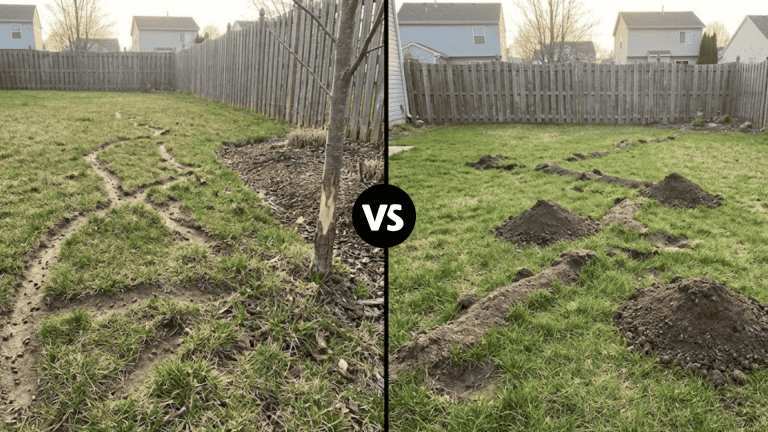
Image source: Bing (Web (fair-use with source credit))
For a quick side-by-side reference, use the table below to match damage to the animal:
| Animal | Damage Pattern | Depth | Most Common Region |
|---|---|---|---|
| Skunk | Small, cone-shaped holes | 2-3 inches | Eastern and central U.S. |
| Raccoon | Large, rolled-back sod strips | 1-2 inches | All of North America, suburban areas |
| Mole | Shallow, winding subsurface tunnels | 1-4 inches | All of North America |
| Armadillo | Messy, broad rooting patches | 3-6 inches | Southeastern and south-central U.S. |
| Bird | Small, shallow peck marks, no torn sod | <1 inch | All regions, especially after rain |
Note: Voles create above-ground runways through tall grass and eat grass roots and blades, not grubs, so their damage looks very different from the patterns listed above. If you see above-ground paths through vegetation, you’re dealing with voles, not grub-foraging animals.
What To Do Once You’ve ID’d the Animal
Your next steps depend entirely on which animal you’re dealing with, as some are easy to deter and others require more involved, regulated solutions. For all animals, the first priority is eliminating the grub food source so they stop returning. Once grubs are under control, use targeted deterrents for your specific culprit.
First, treat active grub infestations before addressing wildlife. Natural grub control options include beneficial nematodes (Steinernema and Heterorhabditis species), which are safe for pets, children, and beneficial insects. Chemical options containing chlorantraniliprole or imidacloprid are highly effective, but follow all EPA label instructions to avoid harming pollinators like bees.
For common grub feeders:
- Skunks and raccoons: Use motion-activated flood lights and remove attractants like pet food, fallen fruit, and unsecured garbage cans. If damage is severe, live trapping may be an option, but check local regulations first. Skunks are rabies vector species, so never handle a trapped skunk without protective gear.
- Moles: If grubs are eliminated, moles will usually move on on their own within a few weeks. You can add castor oil repellents or physical barriers like underground mesh to protect high-value garden beds.
- Armadillos: Install partial fencing buried 6 to 12 inches deep along fence lines to block their rooting. Remove dense brush and leaf litter near your lawn to reduce hiding spots. Armadillos can carry leprosy, so avoid handling them directly if you trap one.
- Birds: Use lightweight netting over damaged lawn areas temporarily, or place visual deterrents like reflective tape or predator decoys to scare them off. Remove bird feeders temporarily if flocks are causing persistent damage.
If the animal is a protected species (like badgers in some U.S. states) or a rabies vector (raccoons, skunks, foxes), do not attempt to trap or handle it yourself. Contact a licensed wildlife removal professional instead. As of 2026, many states have updated rabies vector handling laws to require professional intervention for these species.
Common Mistakes That Make Grub and Wildlife Damage Worse
Most homeowners make a few avoidable errors when dealing with grub-foraging wildlife, which can make the problem far worse over time.
- Treating only the animal, not the grubs: If you trap or deter the animal but leave the grub population intact, new animals will move in within weeks to take advantage of the free food. Always treat grubs first, then address wildlife.
- Applying grub control at the wrong time: Preventive grub treatments work best in early summer, before eggs hatch. Curative treatments work in late summer or fall, when grubs are small and actively feeding. Applying chemicals in spring, when grubs are large and less susceptible, wastes money and does little to reduce populations.
- Using homemade repellents that don’t work: Common DIY fixes like mothballs, garlic sprays, or ultrasonic devices have no proven efficacy against skunks, raccoons, or armadillos, and can even harm non-target wildlife or violate local pesticide laws. Mothballs, for example, are registered as pesticides and are illegal to use as repellents in many areas.
- Ignoring local trapping regulations: Trapping and relocating wildlife without a permit is illegal in most U.S. states and Canadian provinces, and can spread disease to new areas. Many states also prohibit relocating rabies vector species across county lines entirely.
- Overwatering your lawn: Grub larvae survive best in consistently moist soil, so watering only 1 to 1.5 inches per week (including rainfall) reduces grub survival rates without encouraging more animal foraging. Overwatering also increases the risk of fungal lawn diseases, which create additional stress for your turf.
- Using broad-spectrum pesticides unnecessarily: Broad-spectrum insecticides kill beneficial soil organisms like earthworms and predatory beetles that naturally control grub populations. This can lead to worse grub outbreaks in subsequent years.
- Waiting too long to act: Grub populations can double in size in as little as 2 weeks in peak summer, so waiting to treat damage leads to far more extensive lawn destruction and higher animal foraging activity.
If you’re unsure about your grub count or the animal damaging your lawn, contact your local cooperative extension office for free, region-specific advice.
Regional Variations: Which Animals and Grubs Are Common Near You
Your local wildlife mix and climate determine which animals are most likely feeding on grubs in your yard. Here’s a breakdown by region:
| Region | Most Common Animal | Most Common Grub Type |
|---|---|---|
| Northeast U.S. | Raccoons, skunks, moles | European chafer, Japanese beetle |
| Southeast U.S. | Armadillos, raccoons, opossums | Green June beetle, southern masked chafer |
| Midwest U.S. | Skunks, raccoons, badgers | Japanese beetle, May/June beetle |
| Pacific Northwest | Moles, birds (starlings, robins) | European chafer, cranefly larvae (often confused with grubs) |
| Southwest U.S. | Coyotes, foxes, birds | Scarab beetle larvae (less common) |
| Canada (southern) | Raccoons, skunks, starlings | European chafer, Japanese beetle |
As of 2026, armadillo populations have expanded into southern Illinois, Indiana, and Missouri, so homeowners in these new areas may see armadillo damage for the first time. Similarly, European chafer grubs have moved into parts of the Pacific Northwest where they weren’t found a decade ago.
If you live in a new development or suburban area that was recently farmland, expect higher raccoon and skunk activity. These animals thrive in edge habitats where forest meets lawn, and grubs are an easy, high-calorie food source they’ve learned to exploit.
Safety and Legal Rules For Handling Grub-Feeding Wildlife
Wildlife laws vary significantly by state and province, and getting it wrong can result in fines or disease exposure. Always check your local regulations before taking action beyond basic deterrents.
The Centers for Disease Control and Prevention (CDC) classifies raccoons, skunks, and foxes as primary rabies vector species. In most states, trapping or handling these animals requires a permit from your state wildlife agency. Some states also ban relocation entirely, as moving infected animals spreads rabies to new populations.
Key legal points to know as of 2026:
- Trapping permits required: Most states require a permit for trapping raccoons, skunks, foxes, and badgers. Armadillos may be classified as nuisance species in some states and not require a permit.
- Relocation bans: Many states and Canadian provinces prohibit moving trapped wildlife more than 1 mile from the capture site, or across county lines.
- Poison is illegal: Using poisons to kill grub-feeding wildlife is illegal in all 50 states and can result in felony charges if it harms non-target species.
- Professional removal: Licensed wildlife control operators are regulated by state wildlife agencies and carry the necessary permits and liability insurance.
Without getting into the finer points of local trapping laws, the safest approach for most homeowners is to focus on grub control and exclusion. Physical barriers, motion-activated lights, and removing food sources keep animals out without legal risk.
Long-Term Lawn Care To Keep Grubs and Wildlife Away
Preventing grub infestations in the first place is far easier than dealing with skunks tearing up your lawn every August.
Focus on these long-term strategies:
- Water deeply and less often. Grub eggs and newly hatched larvae need consistently moist soil to survive. Allow the top 2 inches of soil to dry between waterings to reduce egg survival rates.
- Maintain healthy soil with organic matter. Regular compost top dressing improves soil structure, drainage, and biodiversity. Healthy turf with deep roots withstands grub damage better.
- Mow at 3 to 4 inches. Taller grass shades the soil, keeping it cooler and less attractive to beetles laying eggs. Taller grass also develops deeper root systems.
- Use predatory nematodes preventively. Apply beneficial nematodes (Heterorhabditis bacteriophora) every 2 weeks during August and September, when grubs are small and vulnerable. Nematodes are safe for pets, children, and pollinators.
- Avoid over-fertilizing with nitrogen. Grubs thrive in lush, nitrogen-rich grass. Use slow-release or organic fertilizers instead of quick-release synthetic nitrogen.
- Overseed damaged areas in early fall. Thin turf from grub damage is more vulnerable to weed invasion and further damage. A fall overseeding with a mix of tall fescue or perennial ryegrass fills bare spots before winter.
If you maintain a healthy lawn with these practices, grub populations rarely reach the 10 grubs per square foot threshold that attracts foraging animals. The key is consistency: a single season of overwatering or under-maintenance can set you back.
For homeowners who want the correct fluid level for their lawn equipment, keeping your mower running smoothly with a properly serviced engine makes a real difference in how cleanly your grass cuts and recovers from grub damage.
Common Real-World Scenarios and What To Do In Each
Scenario 1: You wake up to 6 cone-shaped holes in a 10-foot section near your driveway. A neighbor saw a skunk last week.
This is classic skunk damage. Count grubs in the area using the peel-back test. If you find 12 per square foot, treat with nematodes immediately and apply a follow-up treatment in 2 weeks.
Install motion-activated lights that face the affected area. The skunk will move on once grub numbers drop, typically within 10 to 14 days.
Scenario 2: Large strips of sod are pulled back like carpet across a 50-foot stretch, and you hear noises at night.
Raccoons are your culprit. Secure all garbage cans with bungee cords, bring pet food indoors at night, and pick up any fallen fruit from trees. If you have a compost pile, switch to a sealed bin.
Raccoons are smart and persistent: removing attractants is essential.
Scenario 3: You see shallow winding tunnels raised just under the grass surface, but no torn sod or holes.
Moles. Test for grubs anyway. If grub count is below 10 per square foot and you see earthworms in the tunnels, the mole is feeding on worms, not grubs.
In that case, focus on reducing soil moisture in that area and consider castor oil repellants. Moles usually don’t kill turf roots directly, so their tunnels heal quickly if you roll them flat.
Scenario 4: A wide strip of rooting damage along your fence line, with small, shallow holes scattered in the lawn.
Armadillos, if you live in the Southeast or south-central U.S. Dig a 12-inch deep trench along the fence line and install 1/4-inch hardware cloth buried to that depth. Remove brush piles and leaf litter to reduce cover.
Armadillo damage typically appears after rain softens the soil.
Scenario 5: Small peck marks and shallow holes across your open lawn after a rain shower.
Birds, most likely European starlings, robins, or crows. These are typically not a serious problem and resolve on their own after the soil dries out. If birds are flocking daily and causing widespread damage, use reflective scare tape or a temporary lightweight net over the affected areas.
Remove bird feeders until the flock moves on.
For each scenario, treat the underlying grub problem before you address the animal. Animals return to a consistent food source, eliminate the food and they stop coming.
Frequently Asked Questions About Animals That Feed On Lawn Grubs
Do grubs attract snakes to my yard?
Not directly. Snakes eat small rodents, frogs, and insects, not grubs. But animals that dig for grubs, like skunks and moles, can leave holes that attract snakes looking for cool, dark hiding spots during hot weather.
If you see snakes near grub damage, the snake is probably hunting the animal that dug the hole.
Will grubs kill my lawn completely?
Grubs can kill sections of your lawn if populations exceed 15 per square foot and animals dig them up. But most grub damage is reversible with watering, overseeding, and proper care after the grubs are controlled.
The grass roots that survive will regrow once soil conditions improve.
Can I prevent grubs without chemicals?
Yes. Beneficial nematodes, milky spore disease (for Japanese beetle grubs), and proper watering to keep soil dry during egg-laying months are all effective non-chemical strategies.
Nematodes are widely available online and at garden centers. They require careful application, store them in the fridge, apply in cool weather, and water thoroughly after spreading.
How long do grubs live in the soil?
White grubs live for one year. Eggs hatch in July and August, larvae feed through late fall, then burrow deeper into soil for winter dormancy. In spring, they move back up to feed on roots again, pupate in May or June, and emerge as adult beetles.
The entire lifecycle means even if you treat one year, grubs can return if adult beetles lay eggs in your soil the following season.
Should I let skunks dig for grubs naturally?
Natural grub control from skunks and birds can reduce grub populations without chemicals, but it comes with a cost.
Skunks tear up sod extensively, and their digging creates open soil where weeds germinate quickly. If the damage is limited to a small area and you can live with the mess, let them work. For larger lawns or high-visibility areas, artificial control methods give you more predictable results.
Does crabgrass prevent grubs?
No. Crabgrass is a warm-season grass with thick stems and roots that grubs can still feed on. However, crabgrass often fills thin areas where grubs have already damaged the turf, so the two problems can appear together.
Managing crabgrass is best done by maintaining a thick, healthy lawn through proper mowing, watering, and fertilization, not by relying on it as a grub deterrent.
If you’re still unsure which animal is feeding on grubs in your lawn after trying the decision tree, your local cooperative extension office can provide free identification help. Take clear photos of the damage from multiple angles, note the time of day the damage appears, and bring a grub count sample with you. Armed with that information, you can stop guessing and start the right treatment for your yard.