You're Not Doing Anything Wrong, Here's What's Going On
You've been checking your cucumber vines every morning and you've spotted the issue: no male flowers on cucumber plant blooms anywhere. Every flower you see has that tiny cucumber-shaped swelling at the base, which means they're all female. Before you panic, know that this is one of the most common things gardeners run into, and it usually has a straightforward explanation.
Modern cucumber breeding has changed the game. Many of the varieties sold as of 2026 are gynoecious (meaning they produce almost exclusively female flowers) or parthenocarpic (meaning they set fruit without pollination at all). In our research, we've found that most home gardeners don't realize what they've planted until the flowers show up.
Let's walk through exactly what's happening and what you can do about it.
Quick Answer
No male flowers on a cucumber plant is often completely normal. Many modern varieties are bred to produce only female flowers. If you're growing a gynoecious or parthenocarpic type, you won't see male flowers at all.
Check your seed packet to confirm which variety you planted.
The Three Reasons You're Not Seeing Male Flowers
There are really only three scenarios that explain what you're seeing. Figuring out which one applies to you is the first step.
Scenario A: You planted a gynoecious or parthenocarpic variety. This is by far the most common reason. These varieties are specifically bred to produce female flowers almost exclusively.
It's not a problem. It's the whole point of the variety.
Scenario B: You planted a monoecious variety and the male flowers just haven't shown up yet. Monoecious types usually produce male flowers first, then female flowers a week or two later. If your plant is still young, patience might be all you need.
Scenario C: Something in your growing conditions is suppressing male flower development. Temperature, nitrogen levels, and daylength all influence how cucumber plants express sex in their flowers. This one takes a bit more detective work.
The key is figuring out which bucket you're in before you take any action. Let's start with the easiest check.
How to figure Out Which Type You're Growing
This is where most of the confusion starts. You need to know what you planted, and the answer is usually right on the seed packet or in the variety description.
Check the seed packet or variety name
Look for these keywords on your seed packet or in the catalog description:
- Gynoecious: Produces 90, 100% female flowers. No male flowers needed for fruit set in many cases, though some gynoecious varieties still benefit from a pollinator plant nearby.
- Parthenocarpic: Sets fruit without any pollination whatsoever. These are common in greenhouse and indoor varieties. You'll rarely, if ever, see male flowers.
- Monoecious: Produces separate male and female flowers on the same plant. You should see both types. Male flowers typically appear first.
- Perfect-flowered or bisexual: Produces flowers that contain both male and female parts. No separate male or female flowers at all.
If you still have the packet, flip it over. Most seed companies clearly label gynoecious and parthenocarpic varieties. If you bought transplants from a nursery, ask them what variety you have, or look up the plant tag.
Understanding what "monoecious" actually means in practice
Monoecious doesn't mean male and female flowers show up in equal numbers at the same time. Most monoecious cucumber varieties produce a burst of male flowers first, sometimes 10 to 20 male flowers before the first female flower appears. This is the plant's natural strategy to ensure pollen is ready when female flowers open.
As the plant matures, the ratio shifts. Later in the season, you'll typically see more of a balance between male and female flowers. If you're only a few weeks into flowering and you planted a monoecious type, the male flowers may still be on their way.
Here's a quick comparison to help you sort it out:
| Trait | Gynoecious | Parthenocarpic | Monoecious |
|---|---|---|---|
| Female flowers | Nearly 100% | Nearly 100% | Roughly 50% (varies by stage) |
| Male flowers | Very few to none | Very few to none | Present, often early |
| Pollination needed? | Sometimes (check variety) | No | Yes |
| Best for | High yield, home gardens | Greenhouse, indoor, enclosed spaces | Open gardens with pollinators |
| Example varieties | 'Diva', 'Socrates', 'Tyria', 'Genuine' | 'Socrates', 'Tyria', 'Excelsior', 'Picolino' | 'Marketmore 76', 'Straight Eight', 'Lemon', 'Boston Pickling' |
If you're still not sure what you're growing, take a photo of the flowers and your local extension service can usually help you identify the type. You can also check out Bermuda Grass In Pennsylvania for more on how regional growing conditions affect plant development, though that's a different crop entirely.
Scenario 1: You're Growing a Gynoecious or Parthenocarpic Variety — This Is Normal
If your seed packet says "gynoecious" or "parthenocarpic," congratulations. Your plant is doing exactly what it's supposed to do. You're not missing anything.
Gynoecious varieties have been bred over decades to maximize yield by producing more female flowers. More female flowers means more cucumbers per plant. That's the whole appeal.
Most gynoecious seed packets also include a small percentage of a pollinator variety (often marked with a different colored seed) to provide some pollen when needed. If your packet had a few seeds of a different color, that's your pollinator plant.
Parthenocarpic varieties go a step further. They set fruit without pollination, which means the fruit comes out seedless or nearly seedless. These are the standard for commercial greenhouse production and they work beautifully in home gardens too, especially in enclosed spaces or on balconies where pollinators might not reach.
What this means for your harvest
You don't need to do anything. Your plant will set fruit on its own (in the case of parthenocarpic types) or with minimal pollination (in the case of gynoecious types). If you're growing a gynoecious variety outdoors where bees are active, the bees will handle pollination naturally.
If you're growing in a greenhouse or enclosed space, you might need to introduce a pollinator variety or hand-pollinate occasionally.
The one thing to watch for: if you're growing a gynoecious variety and you see female flowers but no fruit developing, you might have a pollination gap. In that case, see Scenario 3 below.
Scenario 2: You're Growing a Monoecious Variety and Male Flowers Haven't Shown Up Yet
If you've confirmed you're growing a monoecious variety and you're not seeing any male flowers, there are a few things that could be going on. Let's walk through them.
Temperature: the hidden factor nobody talks about
Cucumber flower sex expression is strongly influenced by temperature. Nighttime temperatures above 65°F (18°C) suppress male flower production. If you're in the middle of a heat wave or your nights have been unusually warm, your plant may be producing almost exclusively female flowers.
This is well-documented in crop science research. Cooler nights, in the 55, 65°F (13, 18°C) range, tend to promote a more balanced male-to-female flower ratio. If your nights have been running warm, the male flowers may show up once temperatures cool down.
Nitrogen overload: too much leaf growth, too few flowers
If you've been fertilizing with a high-nitrogen fertilizer, your plant may be putting all its energy into producing leaves at the expense of flowers. Cucumbers are heavy feeders, but too much nitrogen delays flowering and can skew the ratio of male to female flowers.
Switch to a balanced fertilizer or one with higher phosphorus and potassium once you see flowers starting. Something like a 5-10-10 or a tomato-type fertilizer works well for fruiting cucumbers.
Daylength and its subtle effect on sex expression
Cucumbers are sensitive to daylength, though the effect varies by variety. Long days (14+ hours of light) tend to promote female flower production in many modern varieties. Short days can encourage more male flowers.
This is more of a factor for growers in northern latitudes with very long summer days, but it's worth knowing about.
Plant age and why patience sometimes really is the answer
If your plant is less than 45 days old from transplant, you may simply be too early. Most cucumber varieties don't start flowering until 35 to 50 days after transplanting, and male flowers in monoecious types often appear in the first week of flowering. If you're only seeing female flowers in that first week, give it another 7 to 10 days.
The first female flowers on a monoecious plant sometimes appear at node 5 through 8. If your plant hasn't reached that node count yet, keep waiting. You can also read up on How To Get Bermuda Grass To Spread 2 if you're dealing with other growing challenges in your garden this season.
Scenario 3: You Need Fruit but Have No Male Flowers — What to Do Right Now
This is the scenario that actually requires action. You have female flowers, you need fruit, and there's no pollen source in sight. Here's what you can do.
Hand pollination as a last resort
If you have access to a male flower from another cucumber plant (a neighbor's garden, a different variety you planted, or even a wild cucumber relative), you can hand-pollinate. Pick a fresh male flower in the morning, peel back the petals to expose the stamen, and gently dab it against the center of each female flower. One male flower can pollinate 3 to 5 female flowers.
If you don't have access to any male flowers at all, your options narrow. You can try purchasing a parthenocarpic variety next time, or you can try using a pollinator variety planted alongside your existing plants.
Adding a pollinator variety to your row
For future plantings, if you want to grow gynoecious varieties, plant one monoecious (pollinator) variety for every 6 to 8 gynoecious plants. This gives you a reliable pollen source. Many seed companies sell gynoecious blends that already include a pollinator variety in the mix.
If you're mid-season and already have a pollination problem, you can still plant a fast-maturing monoecious variety now. Some varieties like 'Early Fortune' or 'Suyo Long' can start flowering within 35 days. It won't help this week, but it can cover you for the rest of the season.
When to just wait it out
If you're growing outdoors and bees are active in your garden, pollination is probably happening whether you see male flowers or not. A single bee visit can pollinate multiple female flowers. If you're seeing small cucumbers forming at the base of your female flowers, pollination is working.
You don't need to do anything else.
The real concern is if female flowers are blooming, withering, and falling off without any fruit developing. That's a clear sign of a pollination problem, and you'll need to take action.
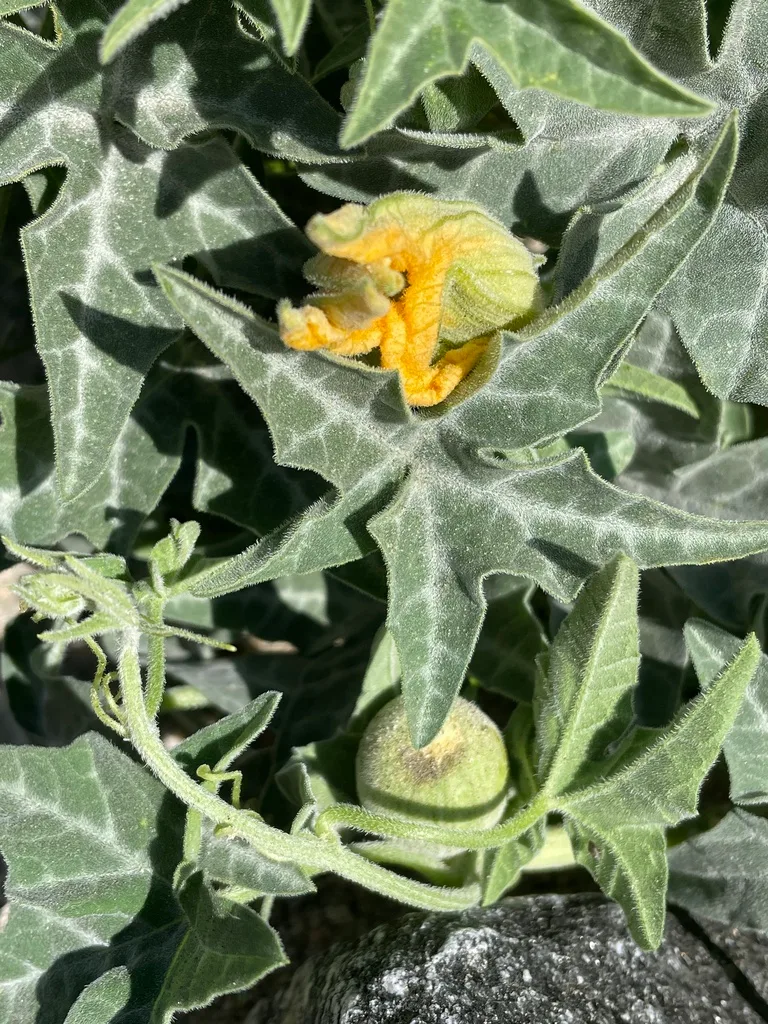
Image source: iNaturalist / Irene
Quick Visual Guide: Male vs. Female Cucumber Flowers
Being able to tell male from female flowers apart is essential for troubleshooting. Here's what to look for.
Female flowers have a tiny, immature cucumber (called an ovary) right at the base of the flower, between the flower and the stem. It looks like a miniature cucumber, sometimes no bigger than a grain of rice. Once you learn to spot it, you can never miss it.
Male flowers sit on a thin, plain stem with no swelling at all. The flower just connects directly to the stem. Inside the flower, you'll see a central stamen covered in yellow pollen.
The easiest way to remember: female flowers have the baby fruit. Male flowers don't.
If every flower on your plant has that tiny swelling at the base, you're looking at an all-female-flower situation. That's normal for gynoecious and parthenocarpic varieties. If you're growing a monoecious variety and you see both types, everything is working as expected.
What Stress Does to Cucumber Flower Sex Expression
Cucumber plants are surprisingly responsive to their environment when it comes to flower production. Here's a breakdown of the most common stress factors and what they do.
| Condition | Effect on Male Flowers | Effect on Female Flowers |
|---|---|---|
| Night temps above 65°F (18°C) | Suppressed or delayed | Usually unaffected |
| Excessive nitrogen | Delayed flower production overall | Reduced fruit set |
| Long daylight hours (14+ hrs) | Some suppression | Favored in gynoecious types |
| Drought stress | Flowers abort early | Fruit misshapen or drops |
| Overcrowding | Reduced overall flowering | Reduced overall fruit set |
Temperature is the biggest lever. If you're in a warm climate and you want more male flowers on a monoecious variety, there's not much you can do about the weather. But you can avoid making it worse by keeping nitrogen in check and providing consistent water.
Drought stress is another common culprit. Cucumbers are about 95% water, and inconsistent watering causes flowers to abort, fruit to develop poorly, and the plant to drop female flowers before they open. Keep soil consistently moist, not soggy, especially during flowering and fruiting.
Choosing Seeds Next Time: What to Look For
If you want to avoid this confusion in the future, pay close attention when you're buying seeds. Here's a quick guide based on how you're growing.
For outdoor gardens with pollinators: Monoecious varieties are the simplest choice. You'll get both male and female flowers, bees will do the work, and you won't have to think about it. Good options include 'Marketmore 76', 'Straight Eight', 'Lemon', and 'Boston Pickling'.
For maximum yield in any setting: Gynoecious varieties give you more fruit per plant. Look for 'Diva', 'Socrates', 'Tyria', or 'Genuine'. Just make sure you have a pollinator variety mixed in or rely on bees.
For greenhouses, indoor growing, or enclosed spaces: Parthenocarpic varieties are your best bet. They set fruit without any pollination at all. 'Socrates', 'Tyria', 'Excelsior', and 'Picolino' are all solid choices for controlled environments.
For short growing seasons: Look for early-maturing varieties that start flowering quickly. 'Early Fortune', 'Suyo Long', and 'Spartan Dawn' can start producing within 35 to 40 days from transplant.
Seed cost is worth mentioning too. Gynoecious and parthenocarpic hybrids typically run $3 to $6 per packet, while open-pollinated monoecious varieties are usually $2 to $4 per packet. The hybrids cost more, but the yield advantage often makes up for it.
Common Mistakes That Make This Worse
A few things gardeners do accidentally can make the no-male-flowers situation more frustrating than it needs to be.
Planting too early in cold soil. Cucumbers are warm-season crops. If you direct-seed into soil below 60°F (15°C), the plant can get stressed in ways that affect flower development later. Wait until soil temperatures are consistently above 65°F.
Over-fertilizing with nitrogen. We covered this above, but it bears repeating. A lush, dark green, leafy cucumber plant with no flowers is almost always a nitrogen problem. Ease off the fertilizer and switch to a bloom-boosting formula.
Removing the first female flowers. Some gardeners pinch off the first few female flowers to encourage the plant to grow bigger before fruiting. With gynoecious varieties, this can backfire because you're removing the only flowers the plant produces. Let them grow.
Not checking the seed packet. This is the root cause of most confusion. If you don't know what variety you planted, you can't diagnose the problem. Always keep your seed packets for at least one full season.
Assuming all varieties behave the same. If you've grown cucumbers before and always saw male flowers, don't assume this year's plants should behave identically. Different varieties have completely different flowering patterns.
Quick Troubleshooting Guide: No Male Flowers on Your Cucumber Plant
Here's a decision-tree-style guide to help you figure out exactly what to do based on your situation.
Step 1: Check your seed packet or variety name.
- If it says gynoecious or parthenocarpic, stop worrying. This is normal.
- If it says monoecious, move to Step 2.
Step 2: How old is your plant?
- Less than 45 days from transplant: Wait another 1 to 2 weeks. Male flowers may still appear.
- More than 45 days: Move to Step 3.
Step 3: What are your nighttime temperatures?
- Below 65°F (18°C): Temperature isn't the issue. Move to Step 4.
- Above 65°F (18°C): Heat is likely suppressing male flowers. This should correct itself when temperatures cool.
Step 4: Are you seeing fruit develop on the female flowers?
- Yes, small cucumbers are forming: Pollination is happening somehow. You're fine.
- No, flowers are dropping without fruit: You have a pollination problem. Move to Step 5.
Step 5: What's your growing environment?
- Outdoors with bee activity: Hand-pollinate with a brush as a backup, or plant a pollinator variety.
- Indoors or enclosed: You need a parthenocarpic variety next time. For now, try hand-pollinating if you can source a male flower.
This same kind of step-by-step troubleshooting applies to other garden problems too. For example, if you're dealing with Fungus In Bermuda Grass, the diagnostic approach is similar: identify the type, check conditions, then act.
When to Worry and When to Relax
Here's the bottom line. In most cases, no male flowers on your cucumber plant is not a crisis. It's either a feature of the variety you planted or a temporary condition that will resolve on its own.
Relax if:
- You're growing a gynoecious or parthenocarpic variety
- Your plant is young and still in its first week of flowering
- You're seeing fruit develop on female flowers
- Bees are active in your garden
Take action if:
- You're growing a monoecious variety and flowers are dropping without fruit
- You're in an enclosed space with no pollinator access
- Female flowers are yellowing and falling off before they open
- You've confirmed the variety and something genuinely seems wrong
The cucumber plant is remarkably resilient. Even when conditions aren't ideal, it usually finds a way to produce. Your job is just to give it the right variety for your setup and keep the growing conditions reasonable.
Frequently Asked Questions
Should I remove female flowers from my cucumber plant?
No, don't remove them unless you're intentionally thinning fruit. Female flowers are what become cucumbers. Removing them just wastes potential harvest, especially on gynoecious varieties that produce almost nothing but female flowers.
Can a cucumber plant have only female flowers?
Yes, absolutely. Gynoecious and parthenocarpic varieties are specifically bred to produce only or almost only female flowers. This is completely normal and nothing to worry about.
How long does it take for male flowers to appear on cucumbers?
On monoecious varieties, male flowers typically appear within the first week of flowering, often 35 to 50 days after transplanting. If you're past that window and still seeing no male flowers, check your variety type and growing conditions.
Why are my cucumber flowers falling off without making fruit?
This is almost always a pollination problem. Female flowers need to be pollinated within 1 to 2 days of opening, or they yellow and drop. If you're not seeing fruit set, you likely need to hand-pollinate or introduce a pollinator variety.
Do I need two cucumber plants to get fruit?
Not necessarily. Parthenocarpic varieties set fruit with just one plant. Monoecious and gynoecious varieties need a pollen source, but that can come from a single plant (monoecious) or from bees visiting other gardens nearby.
Can heat cause a cucumber plant to stop making male flowers?
Yes. Nighttime temperatures consistently above 65°F (18°C) suppress male flower production in many varieties. This is one of the most common reasons for a temporary absence of male flowers during summer heat waves.