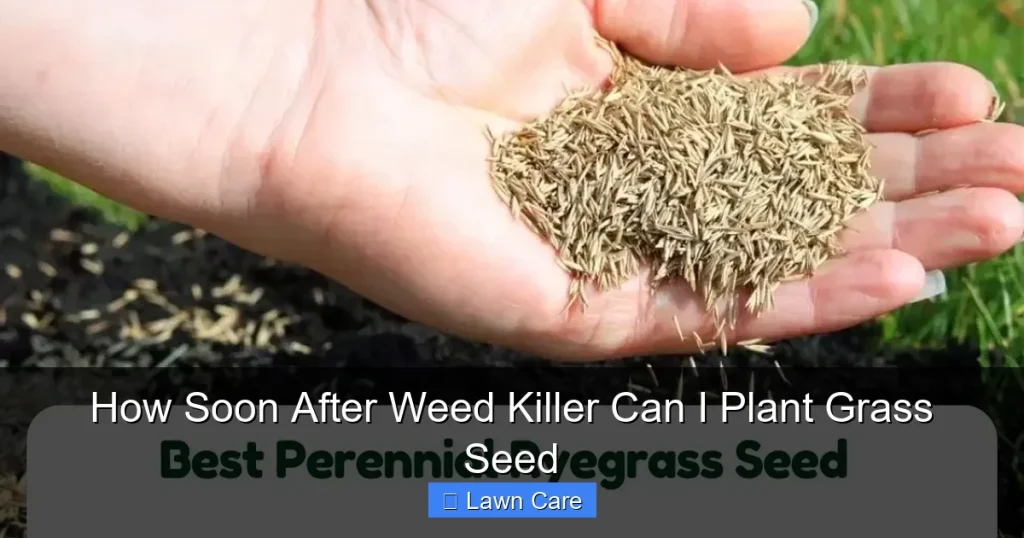
Deciding when to plant grass seed after applying weed killer is crucial for a healthy lawn. Timing is everything, as different weed killers have varying residual effects. This guide will walk you through the essential steps to ensure your new grass has the best chance to thrive, from understanding product labels to preparing your soil. Follow these tips for a weed-free, lush lawn.
# How Soon After Weed Killer Can I Plant Grass Seed?
Tired of dandelions, clover, and other unwelcome guests taking over your lawn? Using weed killer is a common solution for many homeowners. But once the weeds are gone, a new challenge arises: when can you safely plant grass seed to fill in those bare patches and create a lush, green carpet? This is a question many lawn enthusiasts grapple with, and the answer isn’t always straightforward.
Applying weed killer might seem like the end of the process, but it’s often just the beginning if your goal is a beautiful, new lawn. If you jump the gun and plant grass seed too soon, the residual chemicals from the weed killer can prevent your new seeds from germinating or even kill the seedlings. This guide will equip you with the knowledge to navigate this common lawn care dilemma. We’ll break down the factors involved, explain the different types of weed killers, and provide clear steps to help you achieve a successful seeding project after weed treatment.
## The Crucial Factor: Understanding Your Weed Killer
The most critical piece of information you need is the type of weed killer you used. Not all weed killers are created equal, and their impact on future grass seed germination varies significantly. The active ingredients and formulation of the product dictate how long it will remain active in the soil and potentially harm new grass seedlings.
### Pre-Emergent Herbicides: The Long Wait
Pre-emergent herbicides are designed to prevent weed seeds from germinating in the first place. They work by creating a chemical barrier in the soil that kills developing weed roots before they can emerge. Because they target the germination process, these types of weed killers pose the biggest threat to your new grass seed.
If you used a pre-emergent herbicide, you will generally need to wait a considerable amount of time before planting grass seed. This waiting period can range from a few weeks to several months, depending on the specific product. Common pre-emergent herbicides include those containing ingredients like trifluralin, pendimethalin, and prodiamine. These are often applied in early spring to prevent crabgrass and other summer annual weeds, and again in the fall to prevent winter annuals.
### Post-Emergent Herbicides: A Shorter Waiting Period
Post-emergent herbicides are designed to kill weeds that have already sprouted and are actively growing. They work by being absorbed by the weed’s foliage and then translocated throughout the plant, eventually killing it. Many common broadleaf weed killers fall into this category.
The good news is that most post-emergent herbicides break down in the soil much faster than pre-emergents. This means you can typically plant grass seed sooner after applying a post-emergent product. However, “sooner” is still a relative term, and the exact waiting time will still depend on the specific ingredients and formulation. Examples of post-emergent herbicides include those with active ingredients like 2,4-D, dicamba, and MCPP (mecoprop).
### “Weed and Feed” Products: A Double Whammy
Products that combine weed killer with fertilizer, often called “weed and feed” products, require special attention. These often contain both a fertilizer to boost grass growth and a herbicide to kill weeds. The herbicide component is typically a post-emergent, but some formulations might include a pre-emergent as well, especially those designed for season-long weed prevention.
If your “weed and feed” product contains a pre-emergent, the waiting period for planting grass seed will be significantly extended, just as if you had applied a standalone pre-emergent. Always check the label to determine if a pre-emergent is included.
## Reading the Label is Non-Negotiable
This cannot be stressed enough: always read and follow the instructions on the weed killer’s product label. The manufacturer has conducted extensive testing to determine the safe re-seeding intervals for their specific product. This information is usually found in a section titled “When to Re-seed,” “Reseeding Restrictions,” or something similar.
### What to Look For on the Label:
*
Active Ingredients: Identify the active ingredients in your weed killer. Knowing these can help you research further if the label is unclear, though the label itself is the primary source of truth.
*
Re-seeding Interval: This is the most crucial piece of information. It will explicitly state how many days, weeks, or months you must wait after application before you can safely plant grass seed.
*
Type of Herbicide: The label may indicate if the product is pre-emergent, post-emergent, or a combination.
*
Application Instructions: Proper application is key. Some products may require watering in, while others should not be watered for a certain period. This can influence how quickly the herbicide breaks down.
### Common Waiting Periods: A General Guide
While the label is your ultimate guide, here are some general waiting periods to give you an idea:
* Most Post-Emergent Herbicides: Typically require a waiting period of 7 to 30 days.
* Herbicides Containing Dicamba: Can sometimes require a longer waiting period, up to 30 days or more, due to its persistence in the soil.
* Products with Pre-Emergent Components: Can range from 60 days to 6 months or even longer. Some pre-emergents, like those used for crabgrass control, can inhibit germination for an entire growing season.
* “Weed and Feed” Products (with Pre-Emergent): Follow the longest waiting period specified, usually dictated by the pre-emergent component.
Example: If you used a broadleaf weed killer and the label says “Do not seed for 14 days,” you must wait at least two weeks. If you applied a crabgrass preventer in the spring, you might not be able to seed until fall, as many of these products remain active for 90-120 days.
## Steps to Planting Grass Seed After Weed Killer
Once you’ve determined the appropriate waiting period and it has passed, you’re ready to prepare for seeding. Following these steps will maximize your chances of a successful lawn renovation.
### Step 1: Verify the Waiting Period Has Passed
This is a simple but essential check. Double-check your calendar against the product label’s recommended waiting time. It’s better to wait an extra day or two than to risk your investment in new grass seed.
### Step 2: Test Your Soil (Optional but Recommended)
Before embarking on any major lawn project, it’s a good idea to test your soil. A soil test can tell you about the pH level and nutrient content of your soil. Most grass seed thrives in a slightly acidic to neutral pH (6.0-7.0). If your soil is too acidic or alkaline, weed killers might also interact with it differently. You can get a soil test kit from your local garden center or extension office.
### Step 3: Prepare the Soil Bed
This is a critical phase for successful grass seed germination. The goal is to create a fine, crumbly seedbed that allows for good seed-to-soil contact.
#### Removing Debris and Dead Weeds
After the waiting period, your lawn might still have dead weeds or other debris. Rake the area thoroughly to remove any thatch, dead plant material, and rocks. This ensures that the soil surface is clean and open for the new seed.
#### Loosening the Soil
Use a rake, hoe, or tiller to loosen the top 2-3 inches of soil. This breaks up compacted soil, allowing for better root penetration and improved drainage. If you have significant bare spots, you might need to add a thin layer of compost or topsoil to level the area and provide nutrients.
#### Leveling the Seedbed
After loosening, rake the area smooth. Aim for a relatively level surface to prevent water from pooling in some areas and drying out too quickly in others. This also makes mowing easier once the grass grows.
### Step 4: Select the Right Grass Seed
Choosing the right type of grass seed for your climate, soil type, and desired lawn appearance is vital. Consider factors like sun exposure, foot traffic, and your region’s climate. For example, if you’re in a warm-weather region, you might be looking at types of Bermuda grass seed. If you’re in a cooler climate, fescue or bluegrass might be more appropriate. Remember, timing is also key for planting specific grass types. You’ll want to plant your grass seed within the optimal window for that species. For instance, knowing when to plant grass seed is essential for success.
### Step 5: Apply the Grass Seed
There are several ways to apply grass seed, depending on the size of the area you’re seeding.
#### Broadcasting by Hand
For smaller areas, you can simply scatter the seed by hand. Work in overlapping passes to ensure even coverage. A good rule of thumb is to scatter about half the seed in one direction (e.g., north-south) and the other half in the perpendicular direction (e.g., east-west) to avoid thin spots.
#### Using a Spreader
For larger lawns, a broadcast spreader or drop spreader is more efficient and ensures more even distribution. Calibrate your spreader according to the grass seed bag’s recommendations.
Always follow the recommended seeding rate on the grass seed bag. Over-seeding can lead to weak competition between grass plants, while under-seeding will result in thin patches.
### Step 6: Ensure Good Seed-to-Soil Contact
This is often overlooked but is critical for germination. Grass seeds need to be in direct contact with the soil to absorb moisture and nutrients.
#### Raking Lightly
After spreading the seed, lightly rake the area. This helps to push the seed slightly into the loosened soil. You don’t want to bury the seed too deeply, as most grass seeds need light to germinate. A light raking should cover the seeds with about 1/8 to 1/4 inch of soil.
#### Light Rolling (Optional)
For larger areas, you can use a lawn roller to gently press the seed into the soil. This improves seed-to-soil contact, especially on looser soil types. Be careful not to compact the soil too much.
### Step 7: Water Consistently
Proper watering is paramount for germinating grass seed. The seedbed must be kept consistently moist, but not waterlogged.
#### Gentle Watering
Use a gentle spray from your hose or a sprinkler system that provides a fine mist. Avoid strong streams of water, which can wash away the seed.
#### Frequency
Water lightly several times a day, especially in the first few weeks. The goal is to keep the top layer of soil moist where the seeds are located. As the seedlings grow taller, you can gradually reduce the frequency and increase the duration of watering.
### Step 8: Protect the Seeded Area
Keep foot traffic and pets off the newly seeded area until the grass is well established. This can take several weeks. If you have steep slopes, you might consider using a straw mulch or a seed-starting mat to prevent erosion.
## Troubleshooting Common Issues
Even with careful planning, you might encounter a few bumps along the road.
### Problem: Grass Seed Isn’t Germinating
*
Possible Cause 1: You planted too soon after weed killer application. The herbicide is still active.
*
Possible Cause 2: Seed-to-soil contact is poor. Seeds are sitting on top of the soil and drying out.
*
Possible Cause 3: The soil is not staying consistently moist. The seeds have dried out.
*
Possible Cause 4: The seed is old or not viable.
*
Solution: Wait longer, re-prepare the soil for better contact, water more consistently, or purchase fresh seed.
### Problem: Grass Seed Germinates, But Seedlings Die
*
Possible Cause 1: Residual herbicide damage. The seedlings are too young and sensitive to the remaining chemicals.
*
Possible Cause 2: Over-watering or under-watering. Constantly waterlogged soil can lead to root rot, while too little water will dry out delicate seedlings.
*
Possible Cause 3: Extreme temperatures. Seedlings are sensitive to heat and cold.
*
Solution: In cases of herbicide damage, there’s little you can do but wait for the chemicals to break down and re-seed. Ensure proper watering practices. Plant during the appropriate season for your grass type.
### Problem: Weeds are Still Growing in the New Lawn
*
Possible Cause 1: The weed killer didn’t affect all weed types. Some weeds are resistant.
*
Possible Cause 2: New weed seeds have blown into the area.
*
Solution: Once the grass is established enough for mowing (typically after 2-3 mowings), you can use a selective post-emergent herbicide that is safe for your newly seeded grass. Proper lawn maintenance, like regular mowing and proper watering, will also help your grass outcompete weeds.
## Conclusion: Patience and Precision Lead to a Lush Lawn
Successfully seeding your lawn after using weed killer requires a blend of patience and precision. The most crucial takeaway is to understand your product and adhere strictly to its label instructions. Rushing the process is a common mistake that can undo all your hard work and lead to wasted time and money.
By carefully observing the recommended waiting periods, preparing your soil diligently, selecting the right grass seed, and providing consistent care, you lay the foundation for a beautiful, resilient lawn. Remember that the goal is not just to eliminate weeds but to cultivate a healthy, thriving turf that you can enjoy for years to come. So, take your time, follow the steps, and be rewarded with a lush, green landscape. Happy seeding!
- Understand Your Weed Killer: The type of weed killer used is the primary factor determining how long you must wait before planting grass seed.
- Read the Product Label Carefully: Always consult the weed killer’s packaging for specific instructions regarding re-seeding intervals.
- Pre-Emergent vs. Post-Emergent: Pre-emergent herbicides prevent seeds from germinating, meaning you must wait longer after their application to plant new grass seed. Post-emergent herbicides kill existing weeds and generally have shorter waiting periods.
- Soil Testing and Preparation: After the recommended waiting period, thoroughly prepare the soil by removing debris and loosening it for optimal seed germination.
- Consider Environmental Factors: Weather conditions, such as rainfall and temperature, can influence how quickly weed killer breaks down in the soil.
- “Weed and Feed” Products Require Extra Caution: These combination products often contain pre-emergent herbicides that can inhibit grass seed germination for an extended period.
- Be Patient for Best Results: Rushing the process can lead to stunted growth or the death of your new grass, so patience is key.