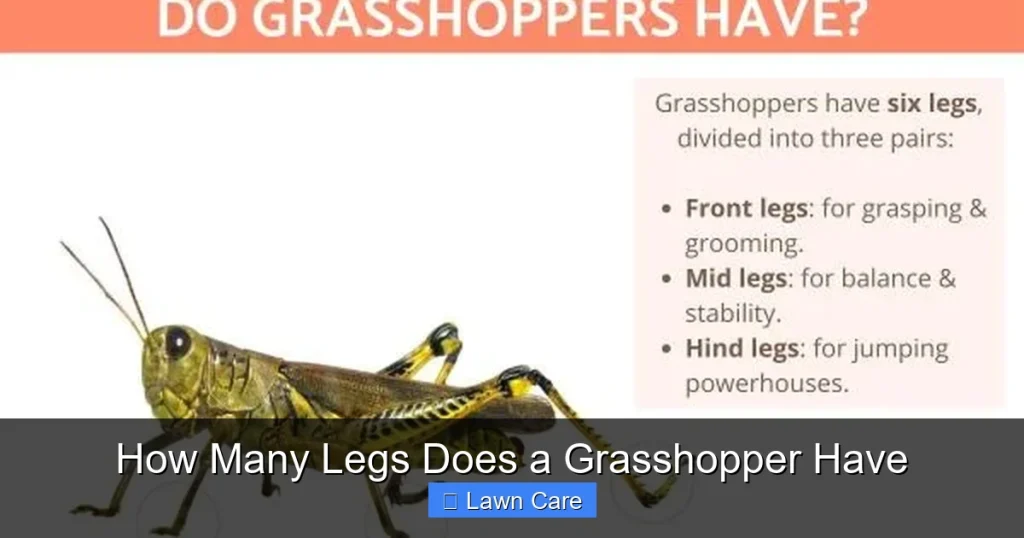
Grasshoppers are fascinating insects known for their powerful leaps. You might be wondering, “How many legs does a grasshopper have?” The answer is simple: six legs. This guide will break down the anatomy of a grasshopper’s legs, explaining the function of each pair. We’ll explore how these legs contribute to their incredible agility and survival in your lawn and garden.
## How Many Legs Does a Grasshopper Have? A Deep Dive into Their Anatomy
If you’ve ever watched a grasshopper leap across your lawn or garden, you’ve likely marveled at its incredible agility. These common insects are a familiar sight, especially during warmer months, and their distinctive hopping ability is their most famous trait. But have you ever stopped to think about the mechanics behind their impressive jumps? A crucial part of this mechanism is their leg structure. So, let’s settle the question: how many legs does a grasshopper have? The answer, like many things in the insect world, is straightforward once you know where to look.
This guide will take you on a journey into the fascinating world of grasshopper anatomy, focusing specifically on their legs. We’ll break down the number of legs, explore the unique adaptations of each pair, and explain how these legs contribute to their survival, from feeding and walking to their signature leaps. Whether you’re a gardener trying to understand your lawn’s inhabitants or just curious about the natural world, you’ll gain a new appreciation for these six-legged wonders.
## The Simple Answer: Six Legs
Let’s get straight to the point. A grasshopper, like all insects, has **six legs**. These legs are attached to the thorax, the middle section of its body, which is a key characteristic of the insect class. You won’t find any more or any less on a healthy, adult grasshopper. This fundamental body plan is shared across the vast majority of insect species.
### Understanding Insect Anatomy Basics
Before we delve deeper into the grasshopper’s legs, it’s helpful to remember the basic body segments of an insect:
* **Head:** This is where the eyes, antennae, and mouthparts are located.
* **Thorax:** This is the central section of the body, and it’s where the legs and wings (if present) are attached. Insects have three pairs of legs, meaning one pair attached to each segment of the thorax.
* **Abdomen:** This is the posterior section of the body, containing most of the digestive and reproductive organs.
So, when you look at a grasshopper, you’ll see its head, followed by its thorax where the six legs emerge, and then its abdomen.
## A Closer Look at the Six Legs: Three Pairs, Three Purposes
While there are six legs in total, they aren’t all built the same. Nature has equipped grasshoppers with specialized legs for different functions. These legs are incredibly complex and finely tuned for their specific roles. Let’s examine each pair:
### 1. The Front Legs: Grasping and Walking
The first pair of legs, located at the very front of the thorax, are generally smaller than the hind legs. These legs are primarily used for **walking, sensing the ground, and grasping food**.
#### Walking and Exploration
When a grasshopper isn’t jumping, it uses its front and middle legs to walk along surfaces. These legs have segments that allow for flexible movement, much like our own legs. They help the grasshopper navigate its environment, whether it’s a blade of grass or the soil.
#### Feeding and Grasping
A fascinating feature of the front legs is their ability to act like little arms. Grasshoppers often hold their food, like leaves or seeds, with their front legs while they eat. The leg segments are adapted for holding and manipulating food items, making mealtime efficient. This is part of their herbivorous nature, which can sometimes make them a nuisance in gardens if populations become too large.
### 2. The Middle Legs: Balance and Maneuvering
The second pair of legs, positioned behind the front legs on the thorax, are often similar in structure to the front legs. Their main role is to provide **balance and assist in maneuvering**.
#### Supporting the Body
These legs act as supports when the grasshopper is standing or walking. They help distribute its weight evenly and maintain stability.
#### Aid in Locomotion
While not as specialized as the front or hind legs, the middle legs are still essential for smooth movement. They work in coordination with the other legs to allow the grasshopper to move with surprising grace.
### 3. The Hind Legs: The Powerhouse of Jumping
This is where things get truly impressive. The third pair of legs, located at the rear of the thorax, are significantly larger and more robust than the other two pairs. These are the **jumping legs**, and they are the key to a grasshopper’s survival and its iconic ability to escape predators.
#### Anatomy of a Jumping Leg
Each hind leg consists of several segments, but the most prominent is the **femur**. The femur in the hind leg is greatly enlarged and filled with powerful muscles. These muscles are used to store and release energy, enabling the grasshopper to propel itself forward and upward with incredible force.
#### The Jumping Mechanism
When a grasshopper prepares to jump, it bends its hind legs at the knee-like joint. This action stores elastic energy in the muscles and tendons, much like coiling a spring. When it’s ready, it rapidly extends these powerful hind legs, releasing the stored energy in a burst that can launch it many times its own body length. This jump is its primary defense mechanism, allowing it to evade hungry predators like birds, lizards, and even some mammals.
## Why So Many Legs? The Evolutionary Advantage
The six-legged design is a hallmark of insects and has proven incredibly successful over millions of years of evolution. For grasshoppers, this specific arrangement of legs provides several crucial advantages:
* **Versatility:** Having different types of legs allows for a variety of movements and actions. They can walk, climb, grasp, and, of course, jump.
* **Stability:** Three pairs of legs provide a stable base for their bodies, especially when navigating uneven terrain or when holding food.
* **Defense:** The highly specialized hind legs are a remarkable adaptation for escaping danger. This allows them to survive encounters with predators that might otherwise decimate their population.
## Grasshoppers in Your Lawn and Garden: An Ecological Perspective
While we’re focusing on how many legs a grasshopper has, it’s worth noting their place in your outdoor spaces. Grasshoppers are herbivores and can sometimes cause damage to lawns and gardens by feeding on plants. Understanding their anatomy, including their legs and their feeding habits, can help you appreciate their role in the broader ecosystem. They are a food source for many animals and play a part in the food web.
If you’re concerned about grasshoppers in your lawn, understanding their behavior can be helpful. For instance, knowing how they move can inform strategies for managing them. For those who prefer a meticulously manicured yard, considering the right mowing practices is important. Did you know that the frequency of mowing can impact the environment for insects? While grasshoppers themselves don’t directly interact with mowing schedules, understanding your lawn’s needs, like [how often do you have to mow a clover lawn], can contribute to a healthier overall ecosystem. Similarly, knowing [how much water does a lawn need per week] supports a robust environment that can sustain various forms of life, including grasshoppers.
## Grasshopper Life Stages and Legs
It’s important to note that the leg structure and function we’ve described apply to adult grasshoppers. However, young grasshoppers, called nymphs, also have six legs from the time they hatch. As they grow, they molt their exoskeletons several times. While their legs will develop and strengthen with each molt, the fundamental six-legged structure remains consistent throughout their nymphal stages and into adulthood.
## Common Misconceptions and Interesting Facts
* **”Are they spiders?”** No! Spiders are arachnids and have eight legs. Grasshoppers are insects and always have six legs.
* **”Do all grasshoppers jump the same way?”** While the basic mechanism is the same, the power and distance of jumps can vary significantly between different species. Some grasshoppers are more adept jumpers than others.
* **”Can grasshoppers fly?”** Many adult grasshoppers have wings and can fly short distances. However, their primary mode of rapid escape is still jumping. The wings are often used for aerial maneuvering or to cover longer distances between feeding grounds.
## Conclusion: Six Legs, Endless Capabilities
So, to reiterate, the answer to “how many legs does a grasshopper have” is a definitive six. This seemingly simple fact unlocks a deeper understanding of these remarkable creatures. Their six legs are not just appendages for movement; they are highly specialized tools that enable them to walk, grasp, balance, and, most famously, leap to incredible distances. Each pair plays a vital role in their survival, from finding food to escaping predators.
The next time you see a grasshopper in your yard, take a moment to appreciate the intricate design of its six legs. They are a testament to the power of evolution and the amazing adaptations found in the insect world. Understanding these fundamental aspects of grasshopper biology can even offer insights into managing your lawn and garden, fostering a more balanced and interesting ecosystem right outside your door.
Key Takeaways
- Grasshoppers possess a total of six legs, arranged in three distinct pairs.
- The front two legs are primarily used for walking and grasping food.
- The middle pair of legs assist in balance and maneuvering.
- The hind legs are dramatically enlarged and specialized for powerful jumping.
- Understanding grasshopper leg anatomy helps in appreciating their unique biology and their role in the ecosystem.
- While they have six legs, their most striking feature is the powerful propulsion their hind legs provide.