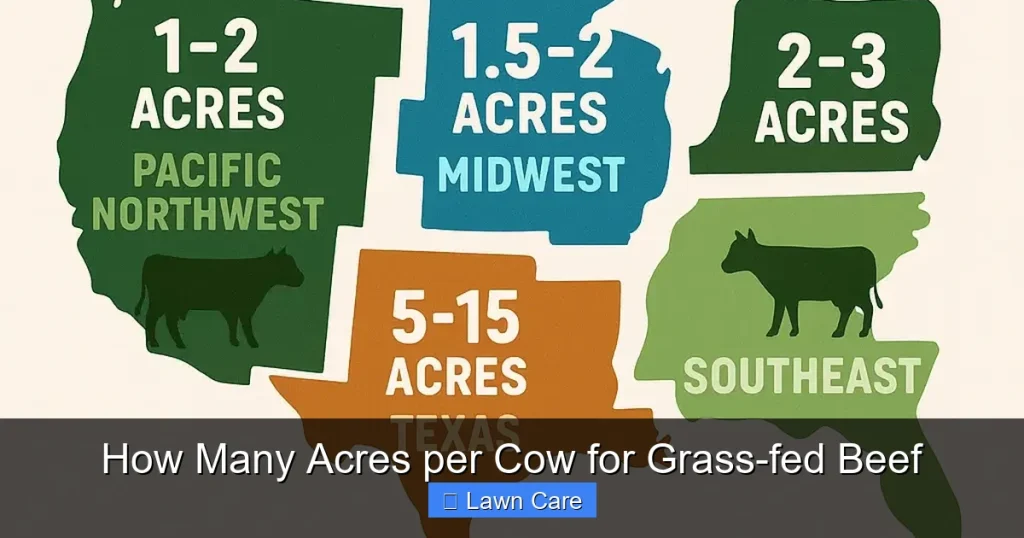
Determining the right stocking rate is crucial for successful grass-fed beef operations. This guide explains how many acres per cow are needed, considering factors like forage quality, rainfall, and herd management. Achieving optimal acreage ensures pasture health and sustainable beef production. Learn how to balance your herd size with your land’s capacity for a thriving, eco-friendly farm.
# How Many Acres per Cow for Grass-fed Beef
So, you’re interested in raising grass-fed beef? That’s fantastic! It’s a rewarding venture that not only provides delicious, healthy meat but can also be a sustainable way to manage your land. One of the most fundamental questions you’ll face is: “How many acres per cow do I need?” It’s a question without a simple, one-size-fits-all answer, but understanding the factors involved will help you make informed decisions for your specific situation.
This guide will walk you through everything you need to know. We’ll explore the concept of stocking rates, the environmental and management factors that influence them, and how to calculate what works best for your farm. By the end, you’ll have a clear roadmap for determining the right acreage to ensure your grass-fed beef operation thrives while keeping your pastures healthy and productive.
## Understanding Stocking Rate: The Core Concept
At its heart, determining how many acres per cow you need is all about the **stocking rate**. Stocking rate refers to the amount of land required to support a certain number of livestock over a specific period. It’s typically measured in Animal Units (AU) per acre or acres per Animal Unit. An Animal Unit is a standard measure, often defined as one mature cow with a calf.
### Why is Stocking Rate So Important?
Getting your stocking rate right is crucial for several reasons:
* **Pasture Health:** Overstocking can lead to overgrazing, where animals eat the grass faster than it can regrow. This damages the root systems, reduces plant diversity, can lead to soil erosion, and ultimately degrades your pasture.
* **Animal Health and Productivity:** Underfed animals due to insufficient forage won’t grow well, reproduce effectively, or produce high-quality meat. Conversely, well-fed animals on well-managed pastures will be healthier and more productive.
* **Economic Viability:** Too few cows on too much land means you’re not utilizing your resources efficiently, impacting your profitability. Too many cows on too little land can lead to a breakdown of the pasture, requiring expensive interventions like supplemental feeding or reseeding.
* **Environmental Sustainability:** Proper stocking rates contribute to healthy ecosystems, support biodiversity, and can even improve soil carbon sequestration.
## Factors Influencing Acres per Cow
Now, let’s dive into the variables that dictate how much land your cows will need.
### 1. Forage Type and Quality
This is arguably the most significant factor. Different grasses and legumes have varying nutritional content and growth rates.
* **High-Quality Forages:** Lush, nutrient-dense grasses like alfalfa, clover, or well-managed cool-season grasses can support more animals per acre. These plants have good protein and energy content.
* **Lower-Quality Forages:** Coarser, less nutritious grasses or those in less ideal growing conditions will require more land to provide the same amount of nutrition.
* **Pasture Composition:** A diverse pasture with a mix of grasses, legumes, and forbs (non-grassy flowering plants) is generally more resilient and nutritious than a monoculture.
### 2. Rainfall and Climate
Water is essential for plant growth. Your region’s rainfall patterns and typical climate will heavily influence forage production.
* **High Rainfall Areas:** Regions with consistent, adequate rainfall throughout the growing season can produce more grass, supporting higher stocking rates.
* **Arid or Drought-Prone Areas:** In dry climates, pastures produce less forage, and there might be extended periods of slow or no growth. This necessitates lower stocking rates and often requires supplemental feed during dry spells.
* **Growing Season Length:** A longer growing season means more days of pasture growth, allowing for higher carrying capacity.
### 3. Soil Health and Fertility
Healthy soil is the foundation of healthy pastures. Factors like soil type, pH, organic matter content, and nutrient levels directly impact how well grasses grow.
* **Fertile Soils:** Soils rich in organic matter and balanced nutrients will support more vigorous grass growth.
* **Poor Soils:** Compacted, nutrient-deficient, or highly acidic/alkaline soils will struggle to produce enough forage for even a moderate number of animals. You might need to improve your soil, for instance, by learning how to balance soil pH for better grass growth or addressing compaction.
* **Manure as Fertilizer:** Livestock manure is a natural fertilizer. Properly managed grazing can help distribute this fertility, but it doesn’t eliminate the need for good soil conditions. In fact, cow manure is good for grass, but its effectiveness depends on the underlying soil’s ability to utilize it.
### 4. Management Practices
How you manage your pastures can dramatically increase or decrease the number of acres needed per cow.
* **Rotational Grazing:** This is perhaps the most impactful management technique. Instead of allowing cows to graze one large pasture continuously, rotational grazing involves dividing pastures into smaller paddocks and moving animals frequently. This allows grasses to recover between grazings, leading to more consistent forage production and better pasture health.
* **Strip Grazing:** A more intensive form of rotational grazing where animals are given access to a narrow strip of pasture at a time.
* **Time-Controlled Grazing:** Moving animals based on predetermined grazing durations.
* **Rest Periods:** Allowing pastures to rest (not be grazed) for sufficient periods is vital for regrowth and root development.
* **Stocking Density:** This refers to the number of animals on a given area at a specific time. While stocking rate is over a season, stocking density refers to a shorter period. High-density, short-duration grazing can be very effective when combined with rest.
* **Supplemental Feeding:** If you must supplement with hay or grain, you are essentially reducing the carrying capacity of your land. Minimizing this is key to true grass-fed operations.
* **Pasture Improvement:** Overseeding with more nutritious grasses, managing weeds, and ensuring adequate water access can boost productivity. For example, understanding how many pounds of grass seed per square foot are needed for reseeding can be a critical part of pasture improvement.
### 5. Animal Type and Requirements
Not all cattle have the same needs.
* **Cow-Calf Pairs:** A mature cow with a nursing calf has higher nutritional demands than a dry cow or a steer. Calves are growing rapidly.
* **Bulls:** Mature bulls also have significant nutritional requirements, especially during the breeding season.
* **Stage of Production:** Pregnant cows, lactating cows, and growing calves all have different energy and protein needs.
### 6. Seasonality and Year-Round Grazing
Can you graze year-round? Or do you have a defined grazing season?
* **Year-Round Grazing:** Requires a robust pasture system that can provide adequate forage throughout the year, often relying on stockpiled (ungrazed) forage or winter-hardy grasses. This generally allows for higher average stocking rates.
* **Seasonal Grazing:** If you have a shorter grazing season and need to feed hay for several months, the “per cow” acreage calculation needs to account for the reduced forage availability during non-grazing periods. The total acreage will be higher to sustain the herd through the entire year.
## Calculating Your Needs: A Practical Approach
Instead of relying on a single number, it’s best to estimate based on your specific conditions.
### Step 1: Assess Your Forage Production
* **Understand Your Grass:** What kind of grasses do you have? Are they high-energy or more fibrous? How dense is the sward?
* **Estimate Dry Matter Production:** This is the total amount of grass (minus water content) your pasture can produce per acre per year. This is hard to do precisely without professional assessment, but you can get a rough idea by observing growth rates and visually estimating biomass. Local agricultural extension offices can often provide data on average forage production for your region.
* **Consider Seasonality:** When does your grass grow best? When does it go dormant?
### Step 2: Determine Forage Needs per Animal
* **Animal Unit Month (AUM):** A common unit for measuring forage consumption. One AU typically consumes about 750-800 pounds of dry matter per month. A cow-calf pair may consume 1.0 to 1.5 AU equivalents.
* **Grazing Days:** How many days will the animal be on pasture?
* **Rough Estimate:** A mature cow-calf pair might eat 25-30 pounds of dry matter per day.
### Step 3: Apply the Stocking Rate Formula
A common way to think about it is:
Total Available Forage (lbs/acre/year) / Forage Needed per AU (lbs/AU/year) = AUs per Acre
Then, you invert this to find acres per AU:
1 / (AUs per Acre) = Acres per AU
**Example:**
Let’s say your pasture produces 4,000 lbs of dry matter per acre per year.
A cow-calf pair needs approximately 1.2 AUs, and each AU needs about 9,600 lbs of dry matter per year (800 lbs/month * 12 months).
* Forage needed per cow-calf pair per year = 1.2 AU * 9,600 lbs/AU = 11,520 lbs.
* AUs per Acre = 4,000 lbs/acre / 9,600 lbs/AU = 0.417 AU per acre.
* Acres per AU = 1 / 0.417 AU/acre = 2.4 acres per AU.
* So, you’d need roughly 2.4 acres per cow-calf pair in this scenario.
**Important Caveat:** This is a simplified example. Real-world calculations must account for grazing efficiency (animals don’t eat 100% of the grass, and some is wasted or trampled), pasture recovery time, and variations in forage quality throughout the year. Many experienced graziers use a rule of thumb like 1-2 acres per cow in highly productive, well-managed pastures, and 5-10+ acres per cow in less productive or arid regions.
### Step 4: Consider Management and Make Adjustments
* **Rotational Grazing:** If you implement good rotational grazing, you can often increase carrying capacity by 20-50% or more. This means you might need fewer acres per cow than initially calculated for continuous grazing.
* **Drought Contingency:** Always plan for dry years. You might need slightly more land or a plan for supplemental feed to avoid depleting your pastures.
* **Herd Composition:** Adjust calculations based on the actual animals you plan to run.
## Typical Acreage Ranges for Grass-Fed Beef
While it’s highly variable, here are some general guidelines:
* **Highly Productive, Well-Managed Pastures (e.g., lush humid regions with good soil):** 0.5 to 2 acres per cow-calf pair.
* **Moderately Productive Pastures (e.g., mixed climates, good but not exceptional forage):** 2 to 5 acres per cow-calf pair.
* **Less Productive or Arid Regions (e.g., dry plains, mountainous terrain):** 5 to 10 acres or even more per cow-calf pair.
* **Backgrounding/Steer Operations:** Steers might require slightly less acreage than cow-calf pairs, but this depends on their growth stage and rate.
Remember, these are starting points. Your specific farm’s conditions will dictate the precise number.
## Tips for Success
* **Start Conservatively:** It’s better to have slightly too much land than not enough, especially when you’re starting. You can always increase herd size later if your pastures prove more productive than anticipated.
* **Observe Your Pastures:** Regularly walk your pastures. Look at how much grass is available, how quickly it’s being eaten, and how well it’s recovering. This is your best indicator of whether your stocking rate is appropriate.
* **Invest in Pasture Management:** Learn about rotational grazing. Consider improving your pasture through overseeding or soil amendments. Healthy pastures are the bedrock of your operation. If you’re considering planting new grass species, look into guides on how to choose the best grass seed for your lawn or specifically for forage.
* **Monitor Animal Condition:** Keep a close eye on your cattle. Are they in good condition? Are they gaining weight as expected? Their health is a direct reflection of your forage availability.
* **Record Keeping:** Track your stocking rates, forage production (even if estimated), rainfall, and animal performance. This data is invaluable for refining your management over time.
* **Consider Your Goals:** Are you aiming for maximum herd size, or are you prioritizing long-term pasture health and biodiversity? Your goals will influence your stocking rate decisions.
## Troubleshooting Common Issues
* **Pasture Being Eaten Too Quickly:** This is a clear sign of overstocking or insufficient pasture growth.
* **Solution:** Reduce herd size, move animals to a different pasture sooner, or implement more intensive rotational grazing with longer rest periods. You might also need to consider improving your forage quality or quantity through reseeding or fertilization.
* **Pasture Not Being Eaten Enough (Becoming Mature and Woody):** This can happen with understocking or if animals are being moved too infrequently. While it might seem like you have “extra” grass, mature grass is often less nutritious.
* **Solution:** Consider increasing herd size if your pastures can handle it sustainably. You might also adjust grazing timing or intensity. Sometimes, a controlled burn or mowing can help rejuvenate older pastures.
* **Muddy Paddock in Wet Weather:** This indicates too many animals concentrated in one area, leading to soil compaction and trampling, especially when combined with wet conditions.
* **Solution:** Reduce the number of animals in the paddock or limit their access time. Implement rotational grazing to move animals before they damage the soil excessively. Ensure adequate drainage or consider using sacrifice areas with more durable surfaces during wet periods. Soil compaction is a serious issue that reduces water infiltration and grass growth.
* **Nutritional Deficiencies:** Even with plenty of grass, certain nutrients might be lacking.
* **Solution:** Soil testing can identify nutrient deficiencies. Consult with a veterinarian or livestock nutritionist about mineral supplements or forage analysis. Ensure you’re providing access to clean water.
## Conclusion
Determining the correct number of acres per cow for grass-fed beef is a dynamic process, not a static calculation. It’s a balancing act between the needs of your animals and the capacity of your land, heavily influenced by your local climate, soil type, and, most importantly, your management practices.
By understanding the factors at play – from forage quality to rainfall to the effectiveness of your grazing system – you can make informed decisions that lead to a healthy, productive, and sustainable grass-fed beef operation. Start with conservative estimates, observe your pastures closely, invest in good grazing management, and continuously learn and adapt. Doing so will pave the way for success in your grass-fed beef journey.
- Stocking Rate Varies Widely: There’s no single answer; the number of acres per cow can range from 0.5 to 10 acres or more, depending on numerous environmental and management factors.
- Forage Quality is King: The type, density, and nutritional value of the grasses are the biggest drivers of how much land a cow needs. Richer pastures support more animals.
- Climate and Rainfall Matter: Areas with consistent rainfall and longer growing seasons can support higher stocking rates than arid or drought-prone regions.
- Management Practices are Key: Rotational grazing, pasture resting, and soil health improvement can significantly increase carrying capacity, meaning fewer acres per cow.
- Animal Needs Fluctuate: A growing calf has different nutritional demands than a mature cow or a bull, impacting the required acreage.
- Soil Health is Foundational: Healthy soil leads to healthy grass, which in turn supports a larger, healthier herd.
- Long-Term Sustainability: Overstocking pastures damages the land, leading to reduced productivity and environmental degradation, while understocking wastes potential.