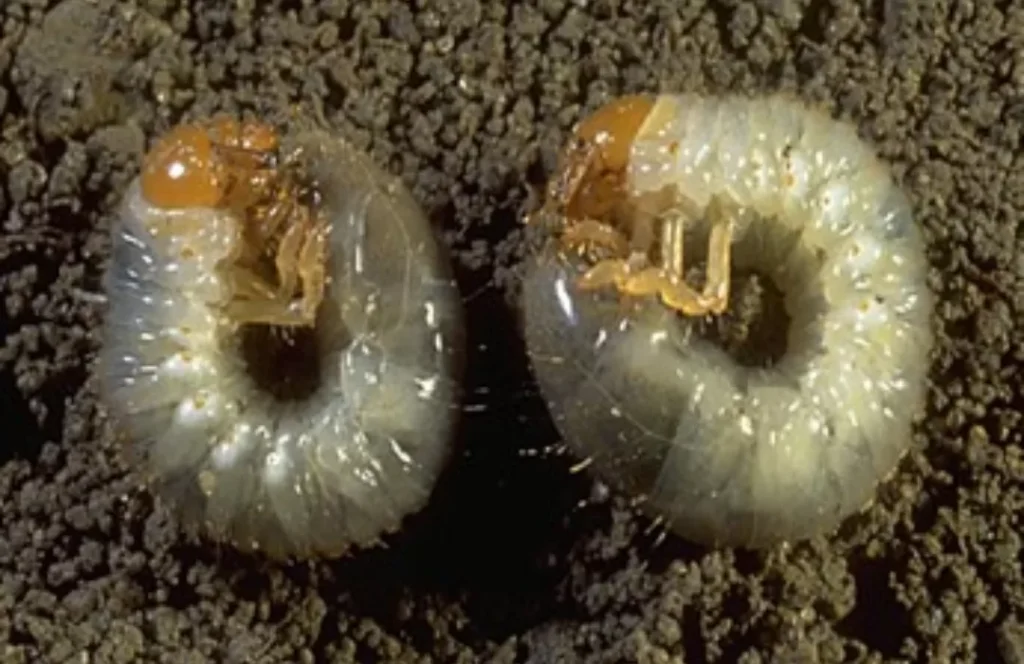

Image source: Wikimedia Commons / Сарапулов (CC BY)
Does Spectracide Kill Grubs? The Answer Depends on Which Product You Buy
Does Spectracide kill grubs? It's one of the most common lawn care questions we see, and the honest answer is more nuanced than a simple yes or no. Spectracide makes multiple lawn insect products, and some of them absolutely will kill grubs while others won't touch them.
The trick is knowing which product does what, and that's where most homeowners get tripped up.
Here's the key detail: the active ingredient matters more than the brand name on the bag. Spectracide products containing trichlorfon are formulated to kill grubs in the soil. Products built around lambda-cyhalothrin or gamma-cyhalothrin target surface-feeding insects like ants and chinch bugs, not the larvae living below the turf.
We'll walk you through exactly how to tell them apart, when to treat, and what to expect.
The Quick Answer: Yes, But Only the Right Spectracide Product
Spectracide does make products that kill grubs. The active ingredient you need is trichlorfon. It's a curative insecticide that targets grubs already feeding in your lawn.
You'll find it in Spectracide's dedicated Grub Killer granular formula. Products like Triazicide won't solve a grub problem. Always check the active ingredient on the label before you buy.
How to Tell If You Actually Have a Grub Problem
Before you spend money on any treatment, make sure grubs are actually the culprit. Brown patches in a lawn can come from drought stress, fungal disease, dog urine, or poor soil conditions. Grub damage has a few telltale signs that set it apart.
The easiest test is the tug test. Grab a handful of brown turf and pull. If the sod lifts up easily like a loose carpet, grubs have likely chewed through the roots underneath.
That spongy, disconnected feel is a strong indicator.
For confirmation, dig a small test hole about one square foot and two to three inches deep in the damaged area. Flip that section of sod over and count what you find. Here's the general threshold most extension services use:
| Grubs per sq ft | Action needed |
|---|---|
| 0 to 4 | Usually none. Natural predators often keep this level in check. |
| 5 to 9 | Borderline. Monitor the area. Treat if damage is visible and spreading. |
| 10 or more | Treatment recommended. Damage will likely worsen without intervention. |
You might also notice increased animal activity on your lawn. Skunks, raccoons, and birds digging up turf at night or early morning are often after grubs. That kind of secondary damage can be just as destructive as the grubs themselves.
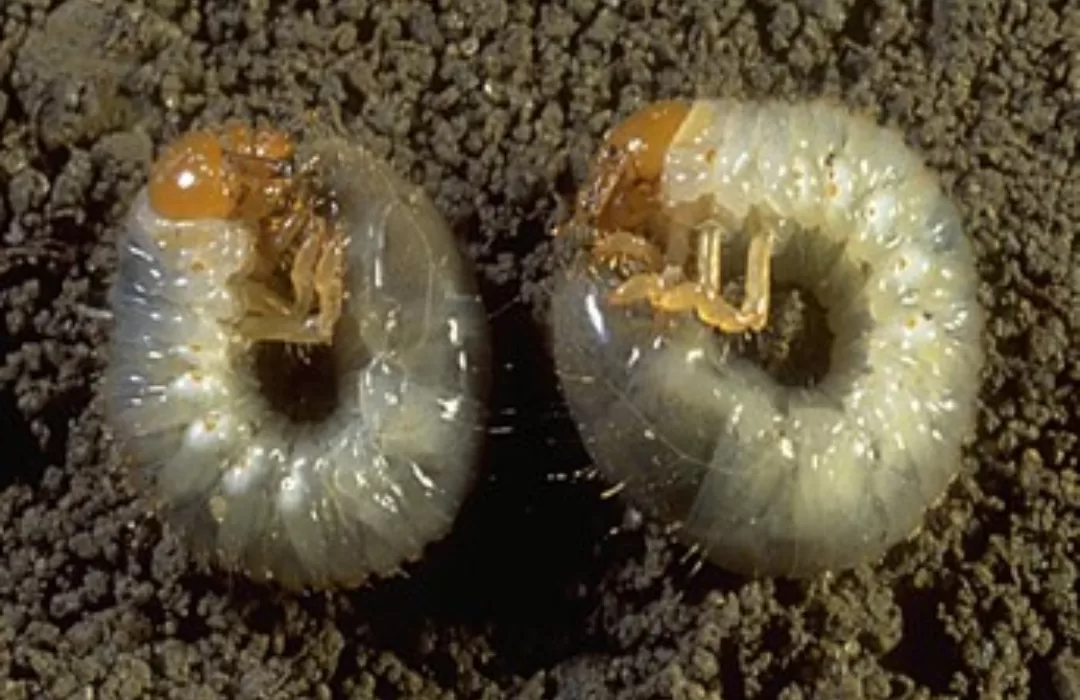
White grubs from Japanese beetles are among the most common species homeowners encounter. They're C-shaped, creamy white with a brown head, and typically about one inch long when fully grown.
Which Spectracide Products Kill Grubs (and Which Ones Don't)
This is where the confusion happens. The Spectracide brand covers a wide range of insect control products, and they are not interchangeable. Let's break down the main ones you'll find on store shelves.
Products that DO kill grubs:
- Spectracide Grub Killer Granules, This is the one you want. It contains trichlorfon (sometimes listed as Dylox) as the active ingredient. It's a curative treatment, meaning it kills grubs that are already present and actively feeding. You apply it with a standard broadcast spreader and water it in.
Products that do NOT kill grubs effectively:
- Spectracide Triazicide Insect Killer for Lawns & Landscapes, Contains lambda-cyhalothrin. This is a pyrethroid insecticide designed for surface-feeding and above-ground insects like ants, fleas, ticks, and chinch bugs. It does not move into the soil profile where grubs live.
- Spectracide Bug Stop, Another pyrethroid-based product aimed at perimeter pests and surface insects. Not a grub solution.
- Spectracide Weed & Feed combinations, These focus on broadleaf weeds and lawn nutrition. No grub control.
The pattern is straightforward. If the active ingredient is a pyrethroid (lambda-cyhalothrin, gamma-cyhalothrin, bifenthrin, permethrin), it won't reach grubs. If it's trichlorfon, it will.
Always read the active ingredient panel on the front of the bag or bottle, not just the product name.
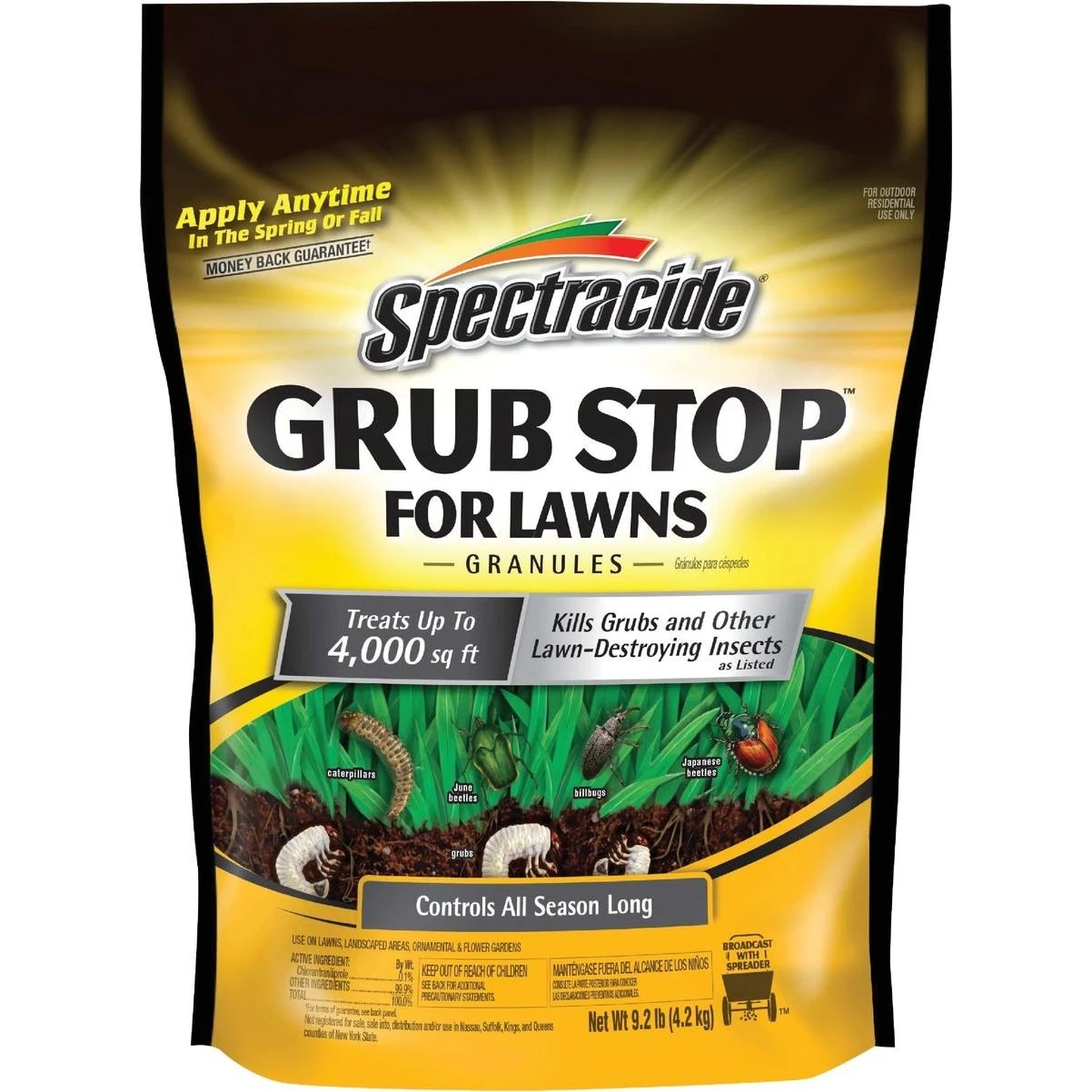
The Spectracide Grub Killer granular product is the one to reach for when you've confirmed a grub problem. Check the label for trichlorfon as the active ingredient.
When to Treat for Grubs: Timing Makes or Breaks Your Results
Timing is arguably the most important factor in whether your treatment works. Apply too early or too late and you'll waste your effort.
Trichlorfon-based products like Spectracide Grub Killer are curative treatments. That means they work best when grubs are small, actively feeding, and close to the soil surface. That window typically falls between late July and September in most of the United States.
Here's why. Adult beetles lay eggs in mid to late summer. Those eggs hatch into tiny larvae that start feeding on grass roots almost immediately.
Young grubs are much more vulnerable to insecticides than mature ones. By spring, grubs have grown larger, moved deeper into the soil, and are harder to reach. Spring applications of curative products are significantly less effective.
Best timing by region:
| Region | Ideal treatment window |
|---|---|
| Northern states (Zones 3 to 5) | Late July through August |
| Mid-Atlantic / Midwest (Zones 5 to 6) | Late July through mid-September |
| Southern states (Zones 7 to 9) | August through early October |
If you're reading this in spring and seeing damage, the grubs you're dealing with are nearly mature. A curative treatment will still work but expect lower efficacy. Your better move is to treat the following summer when the next generation of young grubs is vulnerable.
One more timing note. Water your lawn lightly the day before application if the soil is very dry. Grubs in dry soil tend to move deeper, away from the treatment zone.
Moist soil keeps them closer to the surface where the product can reach them.
How to Apply Spectracide Grub Killer Correctly
Getting the application right is just as important as choosing the right product and timing. Here's the step-by-step process that gives you the best chance of success.
Step 1: Mow your lawn first. Cut the grass to your normal height before spreading granules. This helps the product reach the soil surface instead of getting trapped in tall grass blades.
Step 2: Calibrate your spreader. Check the product label for the application rate, which is typically given per 1,000 square feet. Set your broadcast spreader to the recommended setting listed on the bag. If your spreader isn't listed, do a test run on a measured area to confirm even coverage.
Step 3: Apply the granules evenly. Walk at a steady pace across the lawn in overlapping passes. Avoid piling product in one spot. Uneven application leads to patchy results and potential turf burn in concentrated areas.
Step 4: Water immediately after application. This is the step people skip, and it's the one that matters most. Trichlorfon needs to be watered into the soil to reach the grubs. Apply at least one-quarter inch of water using a sprinkler or hose-end sprinkler.
Don't rely on rainfall unless it's a guaranteed soaking rain within 24 hours.
Step 5: Keep foot traffic light for a few days. Let the product settle into the soil profile without disturbance.
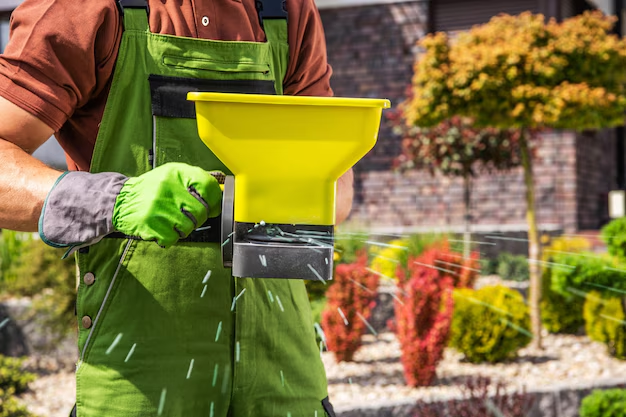
A standard broadcast spreader is the right tool for applying Spectracide Grub Killer granules. Calibrate it to the rate on the product label for even coverage.
A few things to keep in mind during application:
- Don't apply before a heavy rain event. You'll get runoff instead of soil penetration.
- Wear gloves and long sleeves as a basic precaution.
- Sweep any granules off hard surfaces like driveways and sidewalks. They can stain concrete.
- Don't apply to waterlogged or saturated soil. The product won't distribute properly.
What to Expect After Treatment: Timeline and Results
Once you've applied Spectracide Grub Killer correctly, here's the general timeline of what happens.
Days 1 to 3: Trichlorfon works relatively fast compared to preventive products. Grubs that come into contact with the treated soil or ingest treated root tissue will begin dying within this window. You won't see them surface.
They decompose in the soil.
Week 1 to 2: This is when you should notice a reduction in secondary damage. If skunks or birds were digging in your lawn, that activity should taper off as the grub population drops.
Weeks 2 to 4: The damaged turf won't recover overnight. Grass that lost its roots to grub feeding needs time to regrow. If the damage occurred in late summer or early fall, you may need to overseed thin or bare patches once the grubs are under control.
One application is usually enough for a single season of curative control. Trichlorfon doesn't have the long residual activity of preventive products like chlorantraniliprole. It does its job and breaks down.
If you have a recurring grub problem year after year, consider switching to a preventive product applied in late spring or early summer the following season.
When to reseed: Wait at least two weeks after grub treatment before overseeding damaged areas. This gives the product time to do its work and avoids disturbing the treated soil profile. Fall is the ideal time for reseeding cool-season grasses, which lines up well with a late summer grub treatment.
Common Mistakes That Make Spectracide Fail Against Grubs
Even the right product can underperform if the application goes wrong. These are the mistakes we see most often.
Buying the wrong Spectracide product. This is number one by a wide margin. People grab Triazicide because it's on the end cap at the home center and the label mentions "lawns." It won't kill grubs. Check for trichlorfon on the active ingredient panel every single time.
Applying too late in the season. By October in northern states, grubs have often moved deep enough into the soil that surface-applied granules can't reach them effectively. The product works, but the grubs are out of range. Stick to that late July through September window.
Skipping the watering step. Trichlorfon needs to move into the root zone where grubs are feeding. Granules sitting on top of dry soil do almost nothing. Water within 24 hours of application, no exceptions.
Treating in spring instead of summer. Spring grubs are large, mature, and deep. Curative products are far less effective against them. If you're seeing damage in April or May, note it and plan to treat the following summer when the new generation hatches.
Over-applying. More product does not mean better control. It means wasted money and potential turf stress. Follow the rate on the label.
Calibrate your spreader. Even coverage beats heavy concentration every time.
Not confirming grubs are the problem. We've seen people treat for grubs when the real issue was compacted soil, a fungal patch disease, or irrigation problems. Do the dig test first. Five minutes with a shovel saves you the cost of a product you didn't need.
Spectracide vs. Other Grub Control Options
Spectracide Grub Killer isn't the only game in town. Here's how it stacks up against the main alternatives you'll encounter.
| Product type | Active ingredient | Curative or preventive | Best for |
|---|---|---|---|
| Spectracide Grub Killer | Trichlorfon | Curative | Active infestations, late summer treatment |
| GrubEx | Chlorantraniliprole | Preventive | Stopping grubs before they hatch, spring application |
| Dylox 6.2 | Trichlorfon (higher concentration) | Curative | Severe infestations, professional-grade option |
| Milky spore | Paenibacillus popilliae | Biological, long-term | Japanese beetle specific, multi-year approach |
| Beneficial nematodes | Heterorhabditis bacteriophora | Biological curative | Organic approach, needs precise soil conditions |
When Spectracide Grub Killer is the right choice: You've confirmed an active grub problem in late summer, you want a fast-acting curative treatment, and you're comfortable with a conventional insecticide. It's affordable, widely available, and works quickly when timed right.
When to consider an alternative instead: If you want season-long prevention, go with a chlorantraniliprole-based product like GrubEx applied in late spring. If you prefer an organic route, beneficial nematodes can work but they require moist soil, warm temperatures, and careful handling. If you've had grubs three years running, a preventive strategy makes more sense than chasing them curatively every fall.
Milky spore deserves a mention for long-term Japanese beetle management. It's a bacterium that specifically targets Japanese beetle grubs and can persist in the soil for years. The downside is it takes two to three years to build up effective populations and it doesn't touch other grub species like European chafers or billbugs.
When to Call a Pro Instead of DIY
Most grub problems are manageable on your own. There are situations where a licensed lawn care professional is worth the cost.
Consider calling a pro when:
- You've treated twice in one season and grub counts remain high. That suggests either a misidentification issue or an unusually heavy infestation that needs stronger products.
- The damage is widespread across your entire lawn, not just isolated patches. Full-lawn recovery often benefits from a combined treatment and overseeding plan.
- You're dealing with a mixed pest problem. Grubs plus fungal disease plus compaction requires a broader strategy than a single product can address.
- You have concerns about applying insecticides near a well, pond, or waterway. Professionals have access to application techniques and products that reduce runoff risk.
Professional treatments often use the same active ingredients you can buy retail, sometimes at higher concentrations. The main advantage is diagnosis accuracy and application precision. A good lawn care company will confirm the pest, identify the species, and time the treatment correctly.
Safety, Pets, and Environmental Considerations
Trichlorfon is a broad-spectrum organophosphate insecticide. It's effective, but it deserves respect in how you handle and apply it.
For pets and children: Keep them off the treated lawn until the granules have been watered in and the surface is dry. This is typically a matter of hours, but check the specific product label for the exact re-entry interval. Once the product has moved into the soil and dried, the risk drops significantly.
For water sources: Don't apply near storm drains, wells, ponds, or streams. Trichlorfon is toxic to aquatic organisms. Maintain a buffer zone of at least several feet from any water feature.
Never apply before a heavy rain that could cause runoff.
For beneficial insects: Trichlorfon is not selective. It will kill earthworms, ground beetles, and other soil organisms in the treated area. This is a trade-off.
The impact is localized and temporary, but it's worth knowing before you treat.
Storage and disposal: Keep the product in its original container in a cool, dry place out of reach of children and pets. Don't pour leftover product down any drain. Check your local household hazardous waste guidelines for proper disposal of unused portions.
State restrictions: Some states have additional regulations on trichlorfon use. Always verify that the product is registered for use in your state before purchasing. The EPA registration is federal, but state-level rules can vary.
Frequently Asked Questions
How long does Spectracide Grub Killer take to work?
Most grubs die within one to three days of exposure. You won't see dead grubs on the surface. They decompose in the soil.
Secondary signs like animal digging should slow within a week.
Can I apply Spectracide Grub Killer in the spring?
You can, but it's not ideal. Spring grubs are large and deep, making them harder to reach. Curative products work best on young, small grubs in late summer.
If spring is your only option, water thoroughly and manage your expectations on efficacy.
Will Spectracide Grub Killer kill earthworms?
Yes, trichlorfon is not selective and will affect earthworms in the treated area. The impact is localized. Earthworm populations typically recover over time as surrounding populations move back into the treated zone.
How many grubs per square foot is too many?
Most extension services recommend treatment when you find five to ten grubs per square foot. Below that threshold, healthy turf can usually tolerate the feeding damage. Above ten, visible damage is likely and treatment is warranted.
Can I overseed right after treating for grubs?
Wait at least two weeks after application before overseeding. This gives the product time to work and avoids disturbing the treated soil. Early fall is the best window for overseeding cool-season grasses after a summer grub treatment.
Is Spectracide Grub Killer safe for pets once applied?
Keep pets off the lawn until the granules are watered in and the surface is dry. After that, the product has moved into the soil and the risk to pets is minimal. Always follow the specific re-entry guidance on the product label.
The Bottom Line: Your Decision Guide
Here's a simple framework to walk through.
If you have brown patches and confirmed five or more grubs per square foot in late summer: Grab Spectracide Grub Killer with trichlorfon. Apply it correctly, water it in, and you should see results within days.
If you have brown patches but no grubs: Stop. Your problem is something else. Check for drought stress, fungal disease, or irrigation issues before spending money on insecticide.
If it's spring and you're seeing damage: Note the problem and plan to treat the following summer. Spring curative treatments are a tough sell on efficacy.
If you've had grubs multiple years in a row: Switch to a preventive strategy. Apply a chlorantraniliprole-based product in late spring to stop the next generation before it starts feeding.
If you prefer organic methods: Look into beneficial nematodes or milky spore. They require more patience and precise conditions, but they avoid conventional insecticides entirely.
The brand name on the bag matters less than the active ingredient inside it. Trichlorfon kills grubs. Pyrethroids don't.
That single distinction will save you time, money, and frustration the next time you're standing in the lawn care aisle trying to figure out what actually works.